1
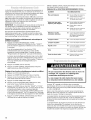
Cleanupsugary
spillsandsoilsassoonashotsurface
indicator
lightgoesoff.Ifnotwipedupwhilewarm,surface
pittingcanoccur.
Donotslidecookware
orbakeware
across
thecooktop.
Aluminum
orcopperbottoms
androughfinishes
on
cookware
orbakeware
couldleavescratches
ormarksonthe
cooktop.
Donotcookpopcorn
inprepackaged
aluminum
containers
onthecooktop.
Itcouldleavealuminum
marks
thatcannot
beremoved
completely.
Donotallowobjects
thatcouldmelt,likeplasticoraluminum
foil,totouchanypartoftheentire
cooktop.
Donotusethecooktop
asacuttingboard.
Usecookware
aboutthesamesizeasthesurface
cooking
area.Cookware
shouldnotextend
morethan1in.(2.5cm)
outside
thearea.
When canning for long periods, alternate the use of surface
cooking areas, elements or surface burners between batches.
This allows time for the most recently used areas to cool.
•
Center the canner on the grate or largest surface cooking
area or element. Canners should not extend more than 1 in.
(2.5 cm) outside the cooking area.
•
Do not place canner on two surface cooking areas, elements
or surface burners at the same time.
•
On ceramic glass models, only use flat-bottomed
For more information, contact your local U.S. Government
Agricultural Department Extension Office. In Canada, contact
Agriculture Canada. Companies that manufacture home
canning products can also offer assistance.
IMPORTANT:
cooking area,
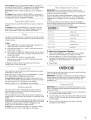
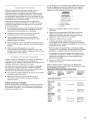
1. Surface Cooking Area
2. Cookware/Canner
3. 1 in. (2.5 cm) Maximum Overhang
Use flat-bottomed cookware for best heat conduction and
energy efficiency. Cookware with rounded, warped, ribbed or
dented bottoms could cause uneven heating and poor
cooking results.
Determine flatness by placing the straight edge of a ruler
across the bottom of the cookware. While rotating the ruler,
no space or light should be visible between it and the
cookware.
Cookware designed with slightly indented bottoms or small
expansion channels can be used.
Never leave empty
element or surface
Do not cook foods directly on the cooktop.
Hot Surface Indicator Light (under ceramic glass)
The hot surface indicator light will glow as long as any surface
cooking area is too hot to touch, even after the surface cooking
area(s) is turned off.
cookware
burner.
on a hot surface
Ideal cookware
should have a flat bottom, straight sides,
fitting lid and the material should be of medium-to-heavy
thickness.
a well-
Rough finishes may scratch the cooktop.
Aluminum
and copper
may be used as a core or base in cookware.
However, when used
as a base it can leave permanent
marks on the cooktop or grates.
Cookware
material is a factor in how quickly and evenly heat is
transferred,
which affects cooking results. A non-stick
finish has
the same characteristics
as its base material. For example,
aluminum
cookware
with a non-stick
finish will take on the
properties
of aluminum.
Use the following
characteristics.
chart
as a guide
for cookware
material
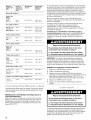
COOKWARE
CHARACTERISTICS
Aluminum
•
Heats quickly and evenly.
•
Suitable for all types of cooking.
•
Medium or heavy thickness is best for
most cooking tasks.
•
Heats slowly and evenly.
•
Good for browning and frying.
•
Maintains
Make sure the bottoms of pots and pans are clean and dry
before using them. Residue and water can leave deposits
when heated.
•
canners.
Cast iron
heat for slow cooking.
Ceramic
or
•
Follow manufacturer's
Ceramic
glass
•
Heats slowly, but unevenly.
•
Ideal results on low to medium
settings.
Copper
•
Heats very quickly and evenly.
Earthenware
•
Follow manufacturer's
•
Use on low heat settings.
Porcelain enamelon-steel or cast
iron
•
See stainless steel or cast iron.
Stainless
•
Heats quickly, but unevenly.
•
A core or base of aluminum or copper on
stainless steel provides even heating.
steel
instructions.
heat
instructions.