1
back to contents
8.
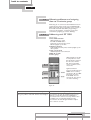
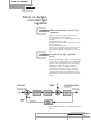
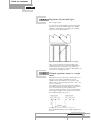
In order to measure correctly the total illuminance, the
light sensor must be placed directly above the user level
(cf. Section 6.3). Any other positioning of the sensor
would result in erroneous feedback to the system and
consequently in unsatisfactory functioning.
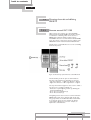
Section 6.8.1 explains how the required illuminance level
can be set with the TRIOS DALI system.
Correct operation of the regulating circuit can only be
ensured if all the components in the circuit, i.e. regulator
(e.g.TRIOS), ballast, lamp and sensor, are tuned to each
other. Ideally they should be supplied by the same
manufacturer, since, despite the extensive standardisation
of the technology used, tolerances and differences in
detail can occur between different manufacturers, and
this in turn can result in functional problems.
8.3.
Daylight-dependent switching or
dimming?
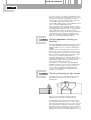
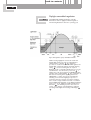
Automatic daylight-linked regulating systems save energy
and costs by gradually dimming and extinguishing the
lighting installation as soon as adequate natural light is
available.
Medical research and practical experience prove that a
sudden drop of 10% in the illuminance level in a room
has a disruptive effect on people present. If the artificial
light in an office is suddenly switched off everyone will
look up and concentration will be disturbed.
Progressive dimming prior to extinction, balanced by
increasing natural light, makes the switching-off operation
virtually imperceptible as this occurs at a level much
lower than the critical 10% threshold.
The importance of the quality of an artificial lighting
installation should be seen as being proportional to the
acuteness of the visual tasks to be carried out in the
room. In offices an installation with high-frequency
operation and a daylight-linked dimming function is
therefore recommended.
8.4.
Tips for positioning the light sensor
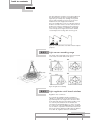
The light sensor must be directed towards a working
plane which offers good and consistent reflection
characteristics.
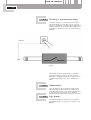
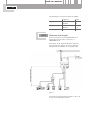
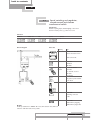
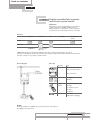
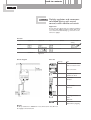
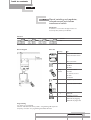
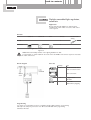
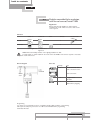
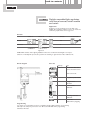
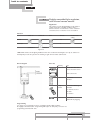
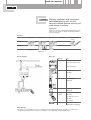
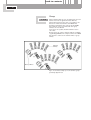
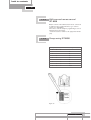
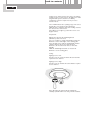
Figure 21: Sensor fitted above the working plane; the
illustration shows a room with a window at the side.
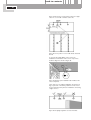
As explained in Section 6.2, the sensor must be fitted
above the illuminated working plane, so that it receives
light reflected form that plane. Since the sensor measures
the total illuminance resulting from natural and artificial
light, influences such as obstructions in front of windows,
shadows caused by window blinds and ageing of the
lighting system itself are automatically taken into account.