1
g
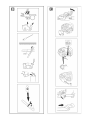
Fuel and fuel vapour are highly inflammable. Take
care when handling fuel and chain oil. Keep away
from naked flames and do not breathe in fuel vapour.
• Never try to refuel the saw while it is running.
• Make sure there is plenty of ventilation when
refuelling or mixing fuel (2-stroke mixture).
• Move the saw at least 3 m from the refuelling
point before starting it.
• Never start the chainsaw:
a) If you have spilt fuel or chain oil on the saw.
Wipe off the spill and allow remaining fuel to
evaporate.
b) If you spill fuel or chain oil on yourself or your
clothes, change your clothes.
c) If there is a fuel leak. Check regularly for
leaks from the FUEL CAP and FUEL LINES.
• Always store the chain saw and fuel away from
any sources of sparks or naked flames, e.g.
machines, electric motors, relays, switches,
boilers, etc.
• Always store fuel in an approved container
designed for that purpose.
• For longer periods of storage or for transport of
the saw, the fuel and chain oil tanks should be
emptied. Ask where you can dispose of waste
fuel and chain oil at your local petrol station.
8 Never use any accessories other than those recommended in this manual. See the sections on
”Technical data”.
!
The risk of accident is increased if you use
the wrong cutting equipment or a chain that
is not sharpened correctly. Using the wrong
combination of bar and chain can increase
the risk of accidents!
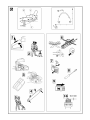
WHAT IS KICKBACK?
The word kickback is used to describe the sudden
reaction that happens when the upper quadrant of
the tip of the bar (known as the “kickback zone”)
touches an object and the saw is kicked backwards.
Kickback always occurs in the cutting plane of the
saw. Normally the saw and bar are thrown backwards and upwards towards the user. However the
saw may move in a different direction depending on
the way it was being used when the kickback zone of
the bar touched the object.
Kickback only occurs if the kickback zone of the bar
touches an object.
SHARPENING YOUR CHAIN AND ADJUSTING
RAKER CLEARANCE
The risk of kickback is increased with a badly
2
sharpened chain!
A General information on sharpening cutting teeth
• Never use a blunt chain. When the chain is blunt
you have to exert more pressure to force the bar
through the wood and the cuttings will be very
small. If the chain is very blunt it will not produce
any cuttings at all, just wood powder.
• A sharp chain eats its way through the wood and
produces long, thick cuttings.
• The cutting part of the chain is called the CUTTING
LINK and this consists of a CUTTING TOOTH (A) and
the RAKER LIP (B). The cutting depth is determined
by the difference in height between the two.
B Sharpening cutting teeth
To sharpen cutting teeth you will need a ROUND FILE
and a FILE GAUGE. See the ”Technical data” section
for information on the size of file and gauge that are
recommended for your saw chain.
1 Check that the chain is correctly tensioned. A slack
chain is difficult to sharpen correctly.
2 Always file cutting teeth from the inside face,
reducing the pressure on the return stroke.
File all the teeth on one side first, then turn the saw
over and file the teeth on the other side.
3 File all the teeth to the same length. When the length
of the cutting teeth is reduced to 4 mm (0,16”) the
chain is worn out and should be replaced.
Lubricating cutting equipment
Poor lubrication of cutting equipment may cause
the chain to snap and lead to serious, even fatal
injuries. Prolonged inhalation of exhaust gases
from the engine, chain lubrication oil mist and/or
saw dust can be unhealthy.
A Chain oil
• Chainsaw chain oil must demonstrate good adhesion to the chain and also maintain its flow caracteristics regardless of whether it is warm summer
or cold winter weather.
• As a chainsaw manufacturer we have developed
an optimal chain oil which, with its vegetable oil
base, is also biodegradable. We recommend the
use of our own oil for both maximum chain life and
to minimise environmental damage.
• If our own chain oil is not available, standard chain
oil is recommended.
• In areas where oil specifically for lubrication of
saw chains is unavailable, ordinary EP 90 transmission oil may be used.
• Never use waste oil!
This is dangerous for yourself, the saw and the
environment.