1
What makes the IOT feasible is the world’s advancement in
data capture and wireless technologies. Adoption of data
capture technologies have seen a stable growth in the market
during the past few years. Wireless technologies on the other
hand, which is the cornerstone of turning captured information
into business intelligence, has undergone many innovative
developments. Amongst these, Wi-Fi and mobile broadband
technologies are the most popular for mobile applications.
Wi-Fi
Application Layer
Networking Layer
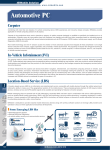
By definition, “The Internet of Things” is literally having every
“thing” connected in a vast, gigantic network, consisting of
three layers: sensor layer, network layer, application layer.
Sensor Layer
The Internet of Things
Home
Automation
Intelligent
Community
Telehealth
2G
Industrial
Automation
Public Safety
3G
Fleet
Management
4G
Cellular Network
Broadcasting Network
M2M
M2M
Sensors, barcode readers, RFID readers, IP camera, GPS
Commonly known by its trademark name “Wi-Fi”, the range of products using the IEEE 802.11 family of standards
allows electronic devices to exchange data wirelessly over a computer network. A device with Wi-Fi functions,
such as a laptop, smartphone, or tablet pc, can connect to a network resource such as the Internet through a
wireless network access point.
Although Wi-Fi has become a popular option for connecting industrial devices, the issues that face mobile
industrial applications are quite different from the issues encountered in a typical commercialized application.
Industrial application requires greater energy efficiency and undisrupted Wi-Fi connection to ensure optimal
business operation. To meet these requirements, IEIMobile’s Wi-Fi enabled devices provides the following:
Power saving mode while the device is on suspend and Wi-Fi communication is in idle.
Auto connection to exiting wireless LAN.
Seamless wireless roaming and auto-switching.
Mobile Broadband
Data Rate
3G
3G
4G
High Mobility Communication
(moving vehicle)
384 kbit/s
100 Mbit/s
Low Mobility Communication
(walking / stationary)
2Mbit/s
1 Gbit/s
IEIMobile
Introduction
Mobile broadband refers to high-speed wireless Internet access through a
portable modem. Traditional broadband services utilize cable modem, DSL, which
are wired to buildings, greatly limits the mobility of internet access. By contrast,
mobile broadband that utilizes cellular networks for wireless access. 3G and 4G
are the most common in use today.
Since 2003, cellular providers have been rolling out 3G networks with improved
data download and upload speeds. With the rapid evolution of wireless technology,
the 4th Generation (4G) wireless network was first introduced in 2010 and is
expected to be the successor of previous 2G and 3G networks. Currently,the Long
Term Evolution (LTE) is the 4G network being deployed worldwide.
Industrial PDA
(EDA)
Tablet PC
180 operators in 70 countries investing in LTE
Automotive PC
Countries with commercial LTE service
Countries with LTE commercial network
deployments on-going or planned
Countries with LTE trial systems
(pre-commitment)
* Published by GSA (2011)
Spectra GmbH & Co. KG
www.spectra.de [email protected]
Niederlassung Österreich
www.spectra-austria.at [email protected]
Spectra (Schweiz) AG
www.spectra.ch [email protected]
2