1
BURNER
CELL
PANEL
NOTE: If thermostat terminals are jumpered before blower access door switch is closed, blower will run for 90 sec before
beginning a heating or cooling cycle.
17. If furnace is operating properly, release blower access door
switch, replace blower access door.
III.
11 32"
13 32"
WARNING: Blower access door switch opens 115-v
power to control center. No component operation can
occur. Caution must be taken when manually closing this
switch for service purposes. Failure to follow this warning could result in electrical shock, personal injury, or
death.
HOT
SURFACE
IGNITOR
ASSEMBLY
CLEANING HEAT EXCHANGER
The following steps should be performed by a qualified service
technician:
NOTE: If the heat exchangers get a heavy accumulation of soot
and carbon, they should be replaced rather than trying to clean
them thoroughly due to their intricate design. A build-up of soot
and carbon indicates that a problem exists which needs to be
corrected, such as improper adjustment of manifold pressure,
insufficient or poor quality combustion air, incorrect size, or
damaged manifold orifice(s), improper gas, or a restricted heat
exchanger. Action must be taken to correct the problem.
If it becomes necessary to clean heat exchanger because of light
dust or corrosion proceed as follows:
1. Turn gas and power to furnace to OFF.
2. Remove control and blower access doors.
3. Disconnect vent connector from furnace flue collar.
4. Disconnect internal vent pipe and enclosure.
a. Remove
vent
pipe
enclosure
cover
on
downflow/horizontal furnaces only.
C
L
7 8"
IGNITOR
C
L
BURNER
IGNITOR
ASSEMBLY
A93347
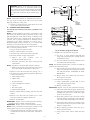
Fig. 8—Position of Ignitor to Burner
a. Assemble wire brush and steel spring cable.
(1.) Use 48 in. of 1/4-in. diameter high-grade steel
spring cable (commonly known as drain clean-out
or Roto-Rooter cable).
(2.) Use 1/4-in. diameter wire brush (commonly known
as 25-caliber rifle cleaning brush).
NOTE: The materials needed in items (1.) and (2.) can usually be
purchased at local hardware stores.
b. Disconnect and remove short piece of vent pipe from
within furnace.
NOTE: Vent pipe is screwed and RTV sealed to relief box.
c. Remove vent pipe enclosure by removing screw in upper
back. Push bottom side backward to release tabs.
(3.) Insert twisted wire end of brush into end of spring
cable, and crimp tight with crimping tool or strike
with ball-peen hammer. TIGHTNESS IS VERY
IMPORTANT.
5. Remove 2 screws that secure relief box. (See Fig. 6 or 7.)
6. Disconnect wires to the following components. Mark wires
to aid in reconnection of:
a. Draft safeguard switch.
(4.) Remove metal screw fitting from wire brush to
allow insertion into cable.
b. Clean each heat exchanger cell.
b. Inducer motor.
c. Pressure switch(es).
(1.) Attach variable-speed, reversible drill to end of
spring cable (end opposite brush).
d. Limit overtemperature switch(es).
e. Gas valve.
(2.) Remove cell outlet plates.
IMPORTANT: Replace screws in center panel before cleaning.
f. Hot surface ignitor.
g. Flame-sensing electrode
(3.) Insert brush end of cable into upper opening of cell
and slowly rotate with drill. DO NOT force cable.
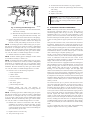
Gradually insert at least 36 in. of cable into 2 upper
passes of cell. (See Fig. 9.)
7. Remove complete inducer assembly and relief box from
furnace.
8. Remove screws that secure flue collector box to center
panel. Be careful not to damage collector box.
9. Remove cell outlet plates.
IMPORTANT: Replace screws in center panel before cleaning.
10. Remove burner assembly and cell inlet plates.
IMPORTANT: Replace screws in center panel before cleaning.
NOTE: Be very careful when removing burner assembly to avoid
breaking ignitor. See Fig. 8 for correct ignitor location.
11. Using field-provided small wire brush, steel spring cable,
reversible electric drill, and vacuum cleaner, clean cells as
follows:
(4.) Work cable in and out of cell 3 or 4 times to obtain
sufficient cleaning. DO NOT pull cable with great
force. Reverse drill and gradually work cable out.
(5.) Insert brush end of cable in lower opening of cell,
and proceed to clean 2 lower passes of cell in same
manner as 2 upper passes.
(6.) Repeat foregoing procedures until each cell in
furnace has been cleaned.
(7.) Using vacuum cleaner, remove residue from each
cell.
—5—