1
Heat Exchanger Cleaning Procedure
WARNING
Soot deposits in the flue passages are a sign that the boiler may be operating at high carbon monoxide (co) levels. After
cleaning the boiler of soot deposits, check the CO level in the flue gas to insure that the boiler is operating properly.
If it is necessary to check CO, use a combustion analyzer, or other instrument which is designed to measure CO in
flue gas. A CO “sniffer” designed for testing CO levels in ambient air cannot be used to check boiler combustion. Take
a flue gas sample by inserting a sample probe through the vent terminal. Do not take a sample until the boiler has
been firing for at least five minutes.
A normal CO reading for an CWD series boiler is less than 50ppm (0.005%). A reading of more than 100ppm
(0.01%) is indicative of a combustion problem.
Some causes of excessive CO include:
•
•
•
•
•
•
•
•
•
•
•
•
Incorrectly sized or drilled burner orifice
Partially plugged flue passages
Improper manifold pressure
Partial blockage of vent or intake system
Foreign material in burner venturis or burner ports
Missing regulator cover or disconnected regulator reference tube
Damaged fan impeller or housing
Damaged or missing fan gasket
Leak in seal between flue collector and heat exchanger
Distorted or missing combustion chamber floor
Damaged base
Flue gas leak in the concentric section of the coaxial terminal
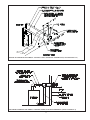
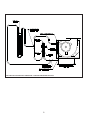
1) Turn off electrical power and gas supply to the boiler.
2) Remove the burner tray. To do this:
a) Remove the intake cover.
b) Remove the four Allen head screws holding the elbow flange onto the gas valve.
c) Remove the three 10-32 screws holding the manifold gasket plate to the intake box.
d) Remove the four 5-16 nuts holding the burner tray in the boiler.
e) Carefully remove the burner assembly being careful not to damage the firedoor insulation or the manifold gasket.
3) Disconnect the vent system from the boiler by removing the four 10-32 screws holding the vent collar in place.
4) Remove the top jacket panel. If possible, remove the rear and left side jacket panels.
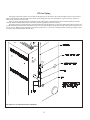
5) Unplug the fan and remove the fan cover plate.
6) Disconnect the pressure switch hoses.
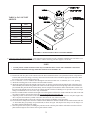
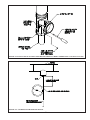
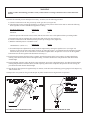
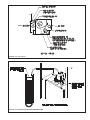
7) Loosen the two ¼-20 nuts and washers in the flue collector lugs. Slide the flue collector lugs off of each flue collector flange.
8) Score the silicone seal around the flue collector with a utility knife or similar tool.
9) Pry the flue collector off of the heat exchanger, being careful not to damage the flue collector or fan.
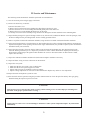
10 Remove the stainless steel flue baffle from each flue passage.
11) Clean the flue passageways using a stiff bristle brush. Be certain that all foreign material is removed from the gaps between
the pins.
12) Clean the bottom surfaces of the heat exchanger.
13) Put a light in the combustion chamber and look through the flue passages from the top to verify that they have been
thoroughly cleaned.
14) Replace the flue baffles.
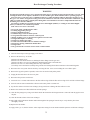
15) Apply a heavy (1/4”) bead of silicone with a temperature rating of at least 400F around the perimeter of the heat exchanger.
53
53