1
NETWORK TECHNOLOGIES - CHAPTER 9 69
Network technologies
Different network technologies are used to support and provide the many benefits of
a network video system. This chapter begins with a discussion about the local area
network, in particular, Ethernet networks and the components that support it. The use
of Power over Ethernet is also covered.
Internet communication is then addressed with discussions on IP (Internet Protocol)
addressing—what they are and how they work, including how network video products
can be accessed over the Internet. An overview of the data transport protocols used in
network video is also provided.
Other areas covered in the chapter include virtual local area networks and Quality of
Service, and the different ways of securing communication over IP networks. For more
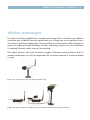
on wireless technologies, see Chapter 10.
9.1
Local area network and Ethernet
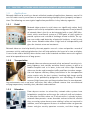
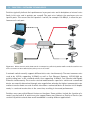
A local area network (LAN) is a group of computers that are connected together in a localized
area to communicate with one another and share resources such as printers. Data is sent in the
form of packets and to regulate the transmission of the packets, different technologies can be
used. The most widely used LAN technology is the Ethernet and it is specified in a standard
called IEEE 802.3. (Other types of LAN networking technologies include token ring and FDDI.)
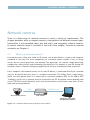
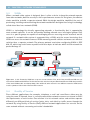
Ethernet uses a star topology in which the individual nodes (devices) are networked with one
another via active networking equipment such as switches. The number of networked devices in
a LAN can range from two to several thousand.
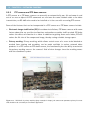
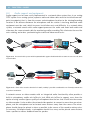
The physical transmission medium for a wired LAN involves cables, mainly twisted pair or fiber
optics. A twisted pair cable consists of eight wires, forming four pairs of twisted copper wires
and is used with RJ-45 plugs and sockets. The maximum cable length of a twisted pair is 100 m
(328 ft.) while for fiber, the maximum length ranges from 10 km to 70 km, depending on the