1
Gas Pressure Regulators
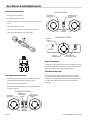
Purpose Of A Gas Pressure Regulator
Hydrostatic Relief Device
Gas pressure regulators have two main purposes, to
reduce supply main pressure to safe operating pressures of
connected appliances and to maintain constant downstream
pressure, regardless of changes in the gas flow or upstream
pressure variations.
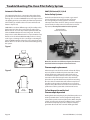
A hydrostatic relief device is used in propane systems. They
are to be installed between two valves in a propane system.
If liquid propane is trapped between two closed valves in
piping or hose, it will begin to expand as its temperature
increases. The hydrostatic relief device relieves this pressure
and prevents the pipe from bursting.
Supply gas pressure is usually higher than the safe operating
pressures of connected appliances.
If an appliance receives too much fuel, it will over fire. If it
receives too little fuel, it will under fire. It will produce too
much or too little heat. Combustion characteristics could
change resulting in carbon monoxide generation. The
appliance may not work properly or efficiently.
Main Categories Of Regulators
Service Regulator is used in natural gas systems to
reduce service line pressure to building line pressure at
the gas meter. In propane, they are used to reduce the
service line pressure to building line pressure and placed
between the storage container and the building.
System Regulator is used to reduce building line
pressure when pressure required by a system of
appliances or equipment is less than the pressure in the
pipe where it enters the building.
Appliance Regulator is used to reduce building line
pressure to the pressure required by the appliance. It is
often built into a combination control.
Downstream refers to the flow of gas after it has passed the
regulator. Upstream refers to the flow of gas before it passes
through the regulator.
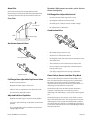
A manual shut-off valve must be installed upstream of the
regulator so that the regulator may be isolated for servicing.
System regulators may require an internal relief device or a
line relief device to allow excess gas to be vented outdoors.
Some vents contain a leak-limiting device to restrict flow
so that gas accumulation does not reach dangerous levels.
These are not required to vent outdoors.
The pressure setting on a line relief device should not be
higher than the lowest rated item downstream of the relief
device. Most natural and all propane relief devices must be
vented outdoors.
Page 50
Venting Of Regulators
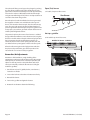
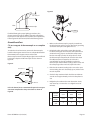
Vent lines must be protected from damage including water
entry and inset damage. Vent line size must be at least the
nominal pipe size of the vent outlet of the pressure regulator
but not less than 0.25”.
Individual vent lines may be connected to a single vent line
provided this single vent line is twice the area of the total
area of the connected bleed vent lines. Vent lines must be
increased by one pipe size diameter for every 50 ft. The
increase must be made at the regulator vent outlet.
In natural gas, when using a diaphragm or combination
control valve, relieved gas may be vented to the low-inlet
pressure appliance combustion chamber. It must have a
continuous pilot.
Terminology
Set Point is the desired outlet pressure of the regulator. As
flow rate increases, the downstream pressure decreases.
Lock up is the pressure above the set point that is used to
shut the regulator off tight. To make a tight seal, the regulator
must increase the downstream pressure to force the disk into
the knife-edge. This is called lock up pressure.
Droop and offset describe the downstream pressure drop
set point. At this point, the valve is opened and there is an
increase flow of gas. Droop is a percentage of the set point
pressure. The accuracy of a regulator is determined by the
amount of flow it can pass for a given amount of droop. The
closer a regulator is to the set point, the more accurate it is.
The Loading Element is used to counterbalance the
downstream pressure. It is usually a spring.
The Measuring Element is usually a diaphragm. It is used
to measure the changes in the downstream pressure. It is
attached by a stem to the restricting element so that they
both move together.
Part # GCTRM Rev 3 (12/10/09)