1
C. DIP Switch Programming
VIKING ©
AUX. AUDIO
VOLUME
VIKING
ELECTRONICS
HUDSON, WI 54016
6.5 sec
Please continue to hold. Your call is very important to us.
We’ll be back with you in just a moment.
4
6.5 sec
2
3
4
5
REMOTE TRIGGER
1
2
3
4
SPEAKER
OUTPUT
PRESS AND HOLD
AUTO REPEAT
MIC ATTENUATION
DEFAULT MSG.
PWR
3
1
5
6
7
6
C
LED2
Thank you for holding, we look forward to talking with
you. Please continue to hold and we’ll be back with you
in a moment.
AUX. AUDIO
INPUT/ MOH
7.5 sec
STATUS
2
HANDSET
REC/ MONITOR
Please continue to hold. We’ll be back with you as soon
as possible.
RECORD AUDIO
INPUT (MIC/ TAPE)
Message
4.5 sec
START/ STOP
Length
1
1ON2 3 4S35 6 7
MAX
MIN
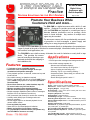
DIGITAL ANNOUNCER
WITH 2 WATT AMPLIFIER
600 OHM AUDIO
OUTPUT
MAX
MESSAGE REPEAT
DELAY TIMES
MIN
OFF = Unit will only playback the user-recorded message(s) (total number of messages limited to 250 or the maximum record time of 7.5 minutes).
Message #
MODEL DVA-2WA
MASTER
VOLUME
LED1
ON = Unit will only playback the professionally pre-recorded on-hold pacifier messages (4 messages, approximately 30 seconds of total playback time). See the table
below. Note: The 4 pre-recorded messages are stored in non-volatile memory and
cannot be re-recorded or erased.
POWER 12V DC
1. DIP Switch 1 - Pre-Recorded or User-Recorded Messages
ON
1
2
3
4
5
6
7
OFF
Thank you for holding, we appreciate your patience.
Please hold the line and we’ll be right back with you.
Sw 2
Sw 3
Sw 4
Delay Time
OFF
OFF
OFF
2 seconds
OFF
OFF
ON
15 seconds
OFF
ON
OFF
30 seconds
OFF
ON
ON
60 seconds
ON
OFF
OFF
5 minutes
ON
OFF
ON
7.5 minutes
4. DIP Switch 6 - Continuous/Normal Play Mode
ON
ON
OFF
15 minutes
ON = Continuous loop. OFF = Normal play.
ON
ON
ON
30 minutes
2. DIP Switches 2, 3 and 4 - Delay Time Between Message Playback
These DIP switches are used to select the delay time for background music between
message playback. Use the table at the right to select your desired delay time.
3. DIP Switch 5 - Remote Trigger Operation
ON = Message will only play while a contact is maintained across terminals 1 and 2.
OFF = Message will continue to play after contact is removed.
5. DIP Switch 7 - Input Gain Adjustment
ON = Reduce gain for line level devices. OFF = High gain for electret mics.
Operation
A. Recording
The DVA-2WA is designed to be recorded from any line level source (tape/CD player, PC soundcard, etc.) or live from
an Electret microphone or carbon handset. Single or multiple messages may be recorded. You may record up to 250
messages, but the total length of all messages may not exceed the maximum record time. With the PLAY/RECORD
switch in the RECORD (right) position follow the steps in Programming and Recording.
B. Information On-Demand
With the PLAY/RECORD switch in the PLAY position, the DVA-2WA is ready to play. Momentarily press the start
switch on the front panel or a remote switch connected to the remote trigger terminals (or “REMOTE SW” pads 1 & 2)
to initiate a single message playback. Each message will playback one at a time in the order in which they were
recorded. After a message has been played, the button must be pressed again for the next message. The START/
STOP switch on the front panel (or the switch connected to “REMOTE SW” pads 1 & 2) can also be used to start and
stop message playback. Momentarily pressing the switch during an announcement will stop playback and will also
reset the unit to begin playback from the first message recorded on the next switch activation or remote trigger.
C. Continuous Loop (DIP Switch 6 ON)
In the continuous loop mode (see Installation section C), the DVA-2WA will play all recorded messages one at a time
in the order in which they were recorded with programmed delay times between each message. Delays between message playback are selectable from 2 seconds to 30 minute increments (see Programming section C). If a background
music source is connected, music will be faded in and out during the delay times.
Note: If the Auxiliary Audio is not loud enough, and the AUX AUDIO is at maximum, increase the volume of your music
source (licensed radio, etc.)