1
102
D -V H S P L AYE R S & R E CO R D E R S
JVC
HM-DH5 • HM-DT100
D-VHS Player/Recorders
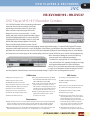
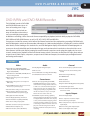
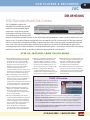
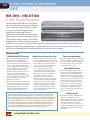
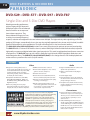
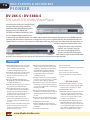
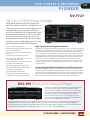
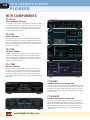
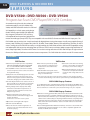
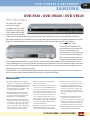
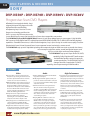
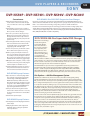
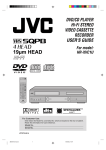
The HM-DH5 and HM-DT100 are D-VHS machines
that record, play back and archive high-definition
content, and play D-Theater HD movies. They are
also the first D-VHS Hi-Def digital recorders
equipped with a digital High-Definition
Multimedia Interface (HDMI), which provides the
highest quality, uncompressed digital pictures and
sound through a single connection. Since HDMI is
all-digital, there is virtually no signal deterioration,
resulting in pristine, “lossless” images just like the original. For maximum convenience and full access to high-definition
programs, the HM-DT100 is equipped with an integrated digital HDTV receiver. This allows you to receive, record, and
view all forms of digital programs, including HD broadcasts, without an extra set-top box.
F E AT U R E S
HDMI With HDCP Protection
Motion Active Progressive Scan
Three Recording Modes
◆ HDMI’s integrated High-bandwidth Digital
◆ Today, demand for large-screen displays has
◆ HS mode (28.2 Mbps) for up to 4 hours HDTV
Content Protection (HDCP) copyright
protection technology supports secure
one-way transfer of digital content between
a source, such as D-VHS and projectors,
monitors and digital TVs (DTVs). HDMI plays
back high definition D-Theater software,
prerecorded high definition material
available from five Hollywood studios and
other providers, and even standard
definition analog tapes. It transfers analog
and S-VHS signals after conversion to 480p
(progressive) digital video for greatly
improved image quality.
◆ Moreover, since a single HDMI cable carries
all video and audio signals, it is easier to set
up and enjoy today’s most advanced home
theater performance than it is to set up a
conventional system. HDMI makes ugly
tangles of cables a thing of the past.
never been higher. Unfortunately, there is an
inverse relationship between screen size and
picture quality; a poor quality signal looks
even worse on a large screen. This is especially true for lower resolution analog
sources. To offset this problem, JVC’s
advanced Motion Active Progressive Scan
circuit upconverts 480i interlace signals to
480p (progressive). It uses sophisticated
motion detection circuitry for pixel
compensation. This eliminates jitter and
flicker to produce smoother, cleaner images
that come close to matching the quality of
true progressive scan sources. Since this
minimizes the perceived picture degradation that normally appears as the display
screen gets larger, you’ll experience better
picture quality than before when playing
back S-VHS and VHS tapes.
What sets D-VHS apart from other digital systems is that it is the only format that can record
HDTV in full quality and without further compression or decoding and re-encoding stages.
Because D-VHS’s 28.2 Mbps HS mode far exceeds the 19Mbps specification of ATSC MPEG-2 HD
broadcasting formats, and because a single DF-480 D-VHS cassette stores up to 50 GB of data,
D-VHS records high-definition sources such as 1080i or 720p digital broadcasts complete with
5.1-channel surround sound. Of course, D-VHS also records standard definition (SD) sources
such as 480p and 480i digital broadcasts thanks to its 14.1 Mbps STD and other LS modes.
There’s even a built-in MPEG-2 encoder to easily make high-quality digital recordings from
analog NTSC sources in the high quality HS, STD, or extended-time LS3 modes.
PHOTO - VIDEO - PRO AUDIO
www.bhphotovideo.com
recording; STD Mode (14.1 Mbps) for up to 7
hours SD recording; LS3 Mode (4.7 Mbps or
400 TV lines) for up to 24 hours long-time
recording per DF-420 cassette
Super MPEG Encoder
◆ To enable high-quality digital recording of
analog sources, the HM-DH5 and HM-DT100
use JVC’s exclusive Super MPEG Encode
Pre-Processor to prepare analog signals for
digital conversion so that digital recordings
appear to surpass the quality of the original
analog sources. Incorporates a Time Base
Corrector (TBC) to eliminate jitter, a Frame
Synchronizer to correct frame crossover
jitter and process any deviant frames, and a
3-Dimension Noise Reduction circuit to
remove noise from both still and moving
parts of video pictures.
i.LINK Terminals
◆ They offer front and rear i.LINK (IEEE-1394)
terminals to conveniently connect to
i.LINK-compatible DV or HD camcorders for
editing. The IEEE 1394 compliant connection
converts DV to MPEG-2 for editing of
camcorder footage. It can also receive and
transfer 720p MPEG-2 Transport Stream data
signals from an HD camcorder for editing
and dubbing.