1
PVI 1800/PVI 2500(Rev A)
Installation and Operation Manual
The string PV concept
The use of string PV concept significantly reduces the cabling costs on a photovoltaic system. The use of
just one, two (or in some cases 3) parallel strings of PV modules in series has proven advantageous by
delivering a high operating voltage to the solar inverter. This advantage is primarily reflected in a higher
efficiency of the inverter. Careful optimization of the overall inverter system’s cost and efficiency lead to
the choice of a 400V DC maximum system voltage for the PVI 1800 and 2500 for use with 1kW to 3kW
PV arrays per inverter.
Data acquisition, display and communication
The integrated data acquisition, display and communication capability of the PVI 1800/PVI 2500 allows
comprehensive tracking of data for understanding of system performance. All error messages and
operating conditions of the PVI 1800/PVI 2500 as well as the PV system can be shown on the display.
Downloading data from the PVI 1800/PVI 2500 for analysis on a PC is also possible over the data
interfaces (RS232 or 485).
These functions allow complete and continuous monitoring of the photovoltaic system. Read-out of data
over the integrated interface and its display is only possible when the solar system is in operation.
An optional full-featured, “inverter-direct” data acquisition and logging gateway and web-based service is
available from Fat Spaniel. You can purchase this from Solectria Renewables or Fat Spaniel. It plugs
into the inverter and to the facility’s internet service.
Technical structure of the PVI 1800/PVI 2500
A high frequency switching bridge circuit operating in connection with a high frequency transformer
provides galvanic isolation of the photovoltaic system from the building’s AC power (and electrical
utility grid). The PV voltage and current are optimized in such a way that fluctuations which are caused
by differing sunlight strengths and PV module temperatures can still end up producing the maximum
possible power.
Internal regulation of the PVI 1800/PVI 2500 is achieved using microcontrollers, which control the
function of MPP (Maximum Power Point) tracking.
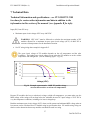
The input PV voltage window is designed to cover a range of 125 to 400 VDC from the PV array. This
means that many combinations of modules and strings from different manufacturers can be used.
The inverter has nearly no standby power consumption and night–time losses (0.2 W). Even when
running, the control circuit power use of the inverter is reduced to a minimum, which helps give the
inverter high operational efficiency.
The housing and heat sink for the PVI 1800/PVI 2500 is manufactured using a heavy aluminium extrusion
with an anti-corrosion finish. The housing is designed to NEMA4 and IP65 to be dust-proof and resistant to
water spray. The heat sink (and fan on the PVI 2500) are designed in such a way that operation of the
inverter is possible at ambient temperatures of -4° F (–20° C) to +131° F (+55° C) at full rated power (at
240VAC or 208VAC).
6
DOCR-070570-A