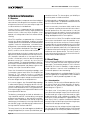
1
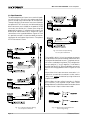
Models:
Micro-Tech 600, 1200 & 2400
Micro-Tech 601, 1201 & 2401
Some models may be exported under the name Amcron.®
©
2001 by Crown Audio, Inc., P.O. Box 1000, Elkhart, IN 46515-1000 U.S.A. Telephone: 219-294-8000. Fax: 219-294-8329. Trademark
Notice: Grounded Bridge™ is a trademark and Amcron®, Crown ®, Micro-Tech and ODEP are registered trademarks of Crown
International, Inc. Other trademarks are the property of their respective owners.
Obtaining Other Language Versions:
To obtain information in another language about the use of this product, please contact your local Crown Distributor. If you need
assistance locating your local distributor, please contact Crown at 219-294-8200.
Note: The information provided in this manual was deemed accurate as of the publication date. However, updates
to this information may have occurred. To obtain the latest version of this manual, please visit the Crown website at
www.crownaudio.com.
Approved for
THX Theatre
Systems.
102990-5
2/01
3
YEAR
THREE YEAR
FULL WARRANTY
3
YEAR
WORLDWIDE
NORTH AMERICA
SUMMARY OF WARRANTY
The Crown Audio Division of Crown International, Inc., 1718 West
Mishawaka Road, Elkhart, Indiana 46517-4095 U.S.A. warrants to you, the
ORIGINAL PURCHASER and ANY SUBSEQUENT OWNER of each
NEW Crown1 product, for a period of three (3) years from the date of
purchase by the original purchaser (the “warranty period”) that the new
Crown product is free of defects in materials and workmanship, and we
further warrant the new Crown product regardless of the reason for failure,
except as excluded in this Crown Warranty.
SUMMARY OF WARRANTY
The Crown Audio Division of Crown International, Inc., 1718 West Mishawaka
Road, Elkhart, Indiana 46517-4095 U.S.A. warrants to you, the ORIGINAL
PURCHASER and ANY SUBSEQUENT OWNER of each NEW Crown product,
for a period of three (3) years from the date of purchase by the original purchaser
(the “warranty period”) that the new Crown product is free of defects in materials
and workmanship. We further warrant the new Crown product regardless of the
reason for failure, except as excluded in this Warranty.
1
Note: If your unit bears the name “Amcron,” please substitute it for the
name “Crown” in this warranty.
ITEMS EXCLUDED FROM THIS CROWN WARRANTY
This Crown Warranty is in effect only for failure of a new Crown product
which occurred within the Warranty Period. It does not cover any product
which has been damaged because of any intentional misuse, accident,
negligence, or loss which is covered under any of your insurance contracts.
This Crown Warranty also does not extend to the new Crown product if the
serial number has been defaced, altered, or removed.
ITEMS EXCLUDED FROM THIS CROWN WARRANTY
This Crown Warranty is in effect only for failure of a new Crown product which
occurred within the Warranty Period. It does not cover any product which has
been damaged because of any intentional misuse, accident, negligence, or loss
which is covered under any of your insurance contracts. This Crown Warranty
also does not extend to the new Crown product if the serial number has been
defaced, altered, or removed.
WHAT THE WARRANTOR WILL DO
We will remedy any defect, regardless of the reason for failure (except as
excluded), by repair, replacement, or refund. We may not elect refund
unless you agree, or unless we are unable to provide replacement, and
repair is not practical or cannot be timely made. If a refund is elected, then
you must make the defective or malfunctioning product available to us free
and clear of all liens or other encumbrances. The refund will be equal to the
actual purchase price, not including interest, insurance, closing costs, and
other finance charges less a reasonable depreciation on the product from
the date of original purchase. Warranty work can only be performed at our
authorized service centers. We will remedy the defect and ship the product
from the service center within a reasonable time after receipt of the
defective product at our authorized service center.
WHAT THE WARRANTOR WILL DO
We will remedy any defect, regardless of the reason for failure (except as
excluded), by repair, replacement, or refund. We may not elect refund unless you
agree, or unless we are unable to provide replacement, and repair is not practical
or cannot be timely made. If a refund is elected, then you must make the defective
or malfunctioning product available to us free and clear of all liens or other
encumbrances. The refund will be equal to the actual purchase price, not
including interest, insurance, closing costs, and other finance charges less a
reasonable depreciation on the product from the date of original purchase.
Warranty work can only be performed at our authorized service centers or at the
factory. We will remedy the defect and ship the product from the service center
or our factory within a reasonable time after receipt of the defective product at our
authorized service center or our factory. All expenses in remedying the defect,
including surface shipping costs in the United States, will be borne by us. (You
must bear the expense of shipping the product between any foreign country and
the port of entry in the United States and all taxes, duties, and other customs fees
for such foreign shipments.)
HOW TO OBTAIN WARRANTY SERVICE
You must notify us of your need for warranty service not later than ninety
(90) days after expiration of the warranty period. All components must be
shipped in a factory pack. Corrective action will be taken within a
reasonable time of the date of receipt of the defective product by our
authorized service center. If the repairs made by our authorized service
center are not satisfactory, notify our authorized service center
immediately.
HOW TO OBTAIN WARRANTY SERVICE
You must notify us of your need for warranty service not later than ninety (90)
days after expiration of the warranty period. All components must be shipped in
a factory pack, which, if needed, may be obtained from us free of charge.
Corrective action will be taken within a reasonable time of the date of receipt of
the defective product by us or our authorized service center. If the repairs made
by us or our authorized service center are not satisfactory, notify us or our
authorized service center immediately.
DISCLAIMER OF CONSEQUENTIAL AND INCIDENTAL DAMAGES
YOU ARE NOT ENTITLED TO RECOVER FROM US ANY INCIDENTAL
DAMAGES RESULTING FROM ANY DEFECT IN THE NEW CROWN
PRODUCT. THIS INCLUDES ANY DAMAGE TO ANOTHER PRODUCT
OR PRODUCTS RESULTING FROM SUCH A DEFECT.
DISCLAIMER OF CONSEQUENTIAL AND INCIDENTAL DAMAGES
YOU ARE NOT ENTITLED TO RECOVER FROM US ANY INCIDENTAL
DAMAGES RESULTING FROM ANY DEFECT IN THE NEW CROWN
PRODUCT. THIS INCLUDES ANY DAMAGE TO ANOTHER PRODUCT OR
PRODUCTS RESULTING FROM SUCH A DEFECT. SOME STATES DO NOT
ALLOW THE EXCLUSION OR LIMITATIONS OF INCIDENTAL OR
CONSEQUENTIAL DAMAGES, SO THE ABOVE LIMITATION OR
EXCLUSION MAY NOT APPLY TO YOU.
WARRANTY ALTERATIONS
No person has the authority to enlarge, amend, or modify this Crown
Warranty. This Crown Warranty is not extended by the length of time which
you are deprived of the use of the new Crown product. Repairs and
replacement parts provided under the terms of this Crown Warranty shall
carry only the unexpired portion of this Crown Warranty.
DESIGN CHANGES
We reserve the right to change the design of any product from time to time
without notice and with no obligation to make corresponding changes in
products previously manufactured.
LEGAL REMEDIES OF PURCHASER
No action to enforce this Crown Warranty shall be commenced later than
ninety (90) days after expiration of the warranty period.
THIS STATEMENT OF WARRANTY SUPERSEDES ANY OTHERS
CONTAINED IN THIS MANUAL FOR CROWN PRODUCTS.
9/90
WARRANTY ALTERATIONS
No person has the authority to enlarge, amend, or modify this Crown Warranty.
This Crown Warranty is not extended by the length of time which you are
deprived of the use of the new Crown product. Repairs and replacement parts
provided under the terms of this Crown Warranty shall carry only the unexpired
portion of this Crown Warranty.
DESIGN CHANGES
We reserve the right to change the design of any product from time to time without
notice and with no obligation to make corresponding changes in products
previously manufactured.
LEGAL REMEDIES OF PURCHASER
THIS CROWN WARRANTY GIVES YOU SPECIFIC LEGAL RIGHTS, YOU
MAY ALSO HAVE OTHER RIGHTS WHICH VARY FROM STATE TO STATE.
No action to enforce this Crown Warranty shall be commenced later than ninety
(90) days after expiration of the warranty period.
THIS STATEMENT OF WARRANTY SUPERSEDES ANY OTHERS
CONTAINED IN THIS MANUAL FOR CROWN PRODUCTS.
Telephone: 219-294-8200. Facsimile: 219-294-8301
Telephone: 219-294-8200. Facsimile: 219-294-8301
9/90
The information furnished in this manual does not include all of the details of design, production, or variations of the
equipment. Nor does it cover every possible situation which may arise during installation, operation or maintenance.
If your unit bears the name “Amcron,” please substitute it for the name “Crown” in this manual. If you need special
assistance beyond the scope of this manual, please contact our Technical Support Group.
Crown Technical Support Group
Plant 2 SW, 1718 W. Mishawaka Rd., Elkhart, Indiana 46517 U.S.A.
Phone: 800-342-6939 (North America, Puerto Rico and Virgin Islands) or 219-294-8200
Fax: 219-294-8301 Internet: http://www.crownaudio.com
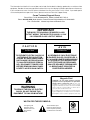
IMPORTANT
THE MICRO-TECH 2400/2401 REQUIRES CLASS 1
OUTPUT WIRING. THE MICRO-TECH 600/601 & 1200/
1201 REQUIRE CLASS 2 OUTPUT WIRING.
CAUTION
AVIS
RISK OF ELECTRIC SHOCK
DO NOT OPEN
RISQUE DE CHOC ÉLECTRIQUE
N’OUVREZ PAS
TO PREVENT ELECTRIC SHOCK DO
NOT REMOVE TOP OR BOTTOM
COVERS. NO USER SERVICEABLE
PARTS INSIDE. REFER SERVICING
TO QUALIFIED SERVICE PERSONNEL. DISCONNECT POWER CORD
BEFORE REMOVING BACK PANEL
COVER TO ACCESS GAIN SWITCH.
À PRÉVENIR LE CHOC ÉLECTRIQUE
N’ENLEVEZ PAS LES COUVERCLES. IL
N’Y A PAS DES PARTIES SERVICEABLE
À L’INTÉRIEUR. TOUS REPARATIONS
DOIT ETRE FAIRE PAR PERSONNEL
QUALIFIÉ SEULMENT. DÉBRANCHER
LA BORNE AVANT D’ENLEVER LA
COVERTURE EN ARRIÈRE.
Magnetic Field
CAUTION! Do not locate sensitive high-gain
equipment such as preamplifiers or tape decks
directly above or below the unit. Because this
amplifier has a high power density, it has a strong
magnetic field which can induce hum into unshielded
devices that are located nearby. The field is strongest just above and below the unit.
WARNING
TO REDUCE THE RISK OF ELECTRIC
SHOCK, DO NOT EXPOSE THIS
EQUIPMENT TO RAIN OR MOISTURE!
If an equipment rack is used, we recommend locating the amplifier(s) in the bottom of the rack and the
preamplifier or other sensitive equipment at the top.
WATCH FOR THESE SYMBOLS:
The lightning bolt
triangle is used to
alert the user to the
risk of electric
shock.
The exclamation point
triangle is used to alert the
user to important operating
or maintenance instructions.
Printed on
recycled paper.
Micro-Tech 600/1200/2400 Power Amplifiers
Important Safety Instructions
1) Read these instructions.
2) Keep these instructions.
3) Heed all warnings.
4) Follow all instructions.
5) Do not use this apparatus near water.
6) Clean only with a dry cloth.
7) Do not block any ventilation openings. Install in accordance with the manufacturer’s instructions.
8) Do not install near any heat sources such as radiators, heat registers, stoves, or other apparatus that
produce heat.
9) Do not defeat the safety purpose of the polarized or
grounding-type plug. A polarized plug has two
blades with one wider than the other. A groundingtype plug has two blades and a third grounding
prong. The wide blade or the third prong is provided
for your safety. If the provided plug does not fit into
your outlet, consult an electrician for replacement of
the obsolete outlet.
10) Protect the power cord from being walked on or
pinched, particularly at plugs, convenience receptacles, and the point where they exit from the apparatus.
11) Only use attachments/accessories specified by the
manufacturer.
12) Use only with a cart, stand, bracket, or table specified by the manufacturer, or sold with the apparatus.
When a cart is used, use caution when moving the
cart/apparatus combination to avoid injury from tipover.
13) Unplug this apparatus during lightning storms or
when unused for long periods of time.
14) Refer all servicing to qualified service personnel. Servicing is required when the apparatus has been
damaged in any way, such as power-supply cord or
plug is damaged, liquid has been spilled or objects
have fallen into the apparatus, the apparatus has
been exposed to rain or moisture, does not operate
normally, or has been dropped.
15) To reduce the risk of fire or electric shock, do not expose this apparatus to rain or moisture.
Page 4
Reference Manual
Micro-Tech 600/1200/2400 Power Amplifiers
CONTENTS
1 Welcome ........................................................................... 7
1.1 Unpacking ................................................................. 7
1.2 Features ..................................................................... 7
2 Facilities ........................................................................... 8
3 Installation .....................................................................
3.1 Mounting ..................................................................
3.2 Cooling ....................................................................
3.3 Wiring ......................................................................
3.3.1 Stereo (Two-Channel) Operation ....................
3.3.2 Bridge-Mono Operation .................................
3.3.3 Parallel-Mono Operation ................................
3.3.4 Input Connection ...........................................
3.3.5 Output Connection .........................................
3.3.6 Additional Load Protection .............................
3.4 AC Mains Power Requirements ................................
10
10
10
11
11
12
13
14
16
18
18
4 Operation .......................................................................
4.1 Precautions ..............................................................
4.2 Indicators .................................................................
4.3 Protection Systems ...................................................
4.3.1 ODEP ............................................................
4.3.2 Ultrasonic and Radio Frequency Protection ....
4.3.3 Drive Protection .............................................
4.3.4 Transformer Thermal Protection ......................
4.3.5 Fuses and Circuit Breakers ............................
4.4 Controls ...................................................................
4.5 Filter Cleaning ..........................................................
19
19
19
19
19
20
20
20
20
21
21
5 Technical Information ...................................................
5.1 Overview ..................................................................
5.2 Circuit Theory ...........................................................
5.2.1 Stereo Operation ...........................................
5.2.2 Bridge-Mono Operation .................................
5.2.3 Parallel-Mono Operation ................................
22
22
22
22
24
24
6 Specifications ................................................................ 25
7 AC Power Draw and Thermal Dissipation .................... 34
Reference Manual
8 Accessories ...................................................................
8.1 Cooling Fan Options .................................................
8.2 Input Connectors .....................................................
8.2.1 MT-XLR ..........................................................
8.2.2 MT-BB ............................................................
36
36
36
36
36
9 Service ...........................................................................
9.1 Worldwide Service ...................................................
9.2 North American Service ...........................................
9.2.1 Service at a North American Service Center ...
9.2.2 Factory Service ..............................................
37
37
37
37
37
Page 5
Micro-Tech 600/1200/2400 Power Amplifiers
ILLUSTRATIONS
1.1
2.1
2.2
3.1
3.2
3.3
3.4
3.5
3.6
3.7
3.8
3.9
3.10
3.11
3.12
3.13
3.14
3.15
3.16
4.1
4.2
5.1
6.1
6.2
6.3
6.4
6.5
6.6
6.7
6.8
6.9
6.10
6.11
6.12
6.13
7.1
7.2
7.3
8.1
8.2
Page 6
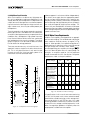
Micro-Tech Amplifier ................................................................... 7
Front Facilities ............................................................................ 8
Rear Facilities ............................................................................. 9
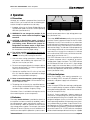
Mounting Dimensions ............................................................... 10
Top View of a Rack-Mounted Unit ............................................. 10
Proper Air Flow with a Rack-Mounted Blower ............................ 10
Stereo Wiring ............................................................................ 11
Bridge-Mono Wiring ................................................................. 12
Parallel-Mono Wiring ................................................................. 13
Unbalanced Input Wiring for the Optional MT-XLR ..................... 14
Balanced Input Wiring for the Optional MT-XLR ......................... 14
Balanced and Unbalanced Phone Plug Wiring .......................... 14
Subsonic Filter Capacitors ........................................................ 15
Unbalanced RF Filters .............................................................. 15
Balanced RF Filters .................................................................. 15
Wire Size Nomograph ............................................................... 16
Low-Frequency Protection Circuit for Inductive Loads ............... 17
Loudspeaker Fuse Nomograph ................................................ 18
AC Mains Cords and Plugs ....................................................... 18
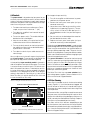
Indicators ................................................................................. 19
Input Sensitivity and Ground Lift Switches ................................. 21
Circuit Block Diagram ............................................................... 23
Micro-Tech 600 Minimum Power Matrix ..................................... 27
Micro-Tech 1200 Minimum Power Matrix ................................... 28
Micro-Tech 2400 Minimum Power Matrix ................................... 28
Micro-Tech 600 Maximum Power Matrix .................................... 29
Micro-Tech 1200 Maximum Power Matrix .................................. 30
Micro-Tech 2400 Maximum Power Matrix .................................. 30
Typical Frequency Response .................................................... 31
Typical Damping Factor ............................................................ 31
Typical Output Impedance ........................................................ 31
Typical Phase Response ........................................................... 32
Typical Crosstalk for the Micro-Tech 600 ................................... 32
Typical Crosstalk for the Micro-Tech 1200 ................................. 33
Typical Crosstalk for the Micro-Tech 2400 ................................. 33
Micro-Tech 600 Power Draw, Current Draw and Thermal
Dissipation at Various Duty Cycles ............................................ 34
Micro-Tech 1200 Power Draw, Current Draw and Thermal
Dissipation at Various Duty Cycles ............................................ 35
Micro-Tech 2400 Power Draw, Current Draw and Thermal
Dissipation at Various Duty Cycles ............................................ 35
MT-XLR .................................................................................... 36
MT-BB ...................................................................................... 36
Reference Manual
Micro-Tech 600/1200/2400 Power Amplifiers
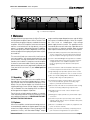
Fig. 1.1 Micro-Tech Amplifier
1 Welcome
Congratulations on your purchase of a Micro-Tech® professional power amplifier. Crown’s Micro-Tech 600, 1200
and 2400 are the original industry standards for touring
amplifiers. Micro-Tech amplifiers are known around the
world as a the benchmark for high-density, ultra-pure
power in a compact, lightweight package. In addition,
each model gives you Crown’s legendary ODEP® protection to keep the show going long after other amplifiers would fail.
This manual will help you successfully install and use
your new amplifier—we strongly recommend you read
all instructions, warnings and cautions. Be sure to read
Sections 3.3.2 and 3.3.3 if you plan to use the amplifier
in one of its two mono modes. Also for your protection,
please send in your warranty registration card today and
save your bill of sale since it is your official proof of
purchase.
stages combine to provide performance and reli-ability
that surpass all traditional designs. Micro-Tech amplifiers also have an independent high-voltage
power supply for each channel. This approach results
in extremely low crosstalk and makes it possible to use
each channel as a separate amplifier. Here are some
more impressive features of your Micro-Tech amplifier:
❏ Patented ODEP (Output Device Emulation Protection)
circuitry compensates for overheating and overload to
keep the amplifier working long after others would fail.
❏ Crown’s Grounded BridgeTM design delivers incredible
voltage swings without using stressful output transistor
configurations like more traditional amplifiers. This
results in significantly lower distortion and superior
reliability.
❏ Very low harmonic and intermodulation distortion result
in the best dynamic transfer function in the industry.
❏ High damping factor provides superior motion control
over low-frequency drivers for clean, accurate low end.
1.1 Unpacking
Please unpack and inspect your new amplifier for any
damage that may have occurred during transit. If damage is found, notify the transportation company immediately. Only you, the consignee, may initiate a claim for
shipping damage. Crown will be happy to cooperate
fully as needed. Save the shipping carton as evidence
of damage for the shipper’s inspection.
Even if the unit arrived in perfect condition, as most do,
save all packing materials so you will have them if you
ever need to transport the unit. NEVER SHIP THE UNIT
WITHOUT THE FACTORY PACK.
1.2 Features
Micro-Tech amplifiers use the latest technology and miniaturized design to deliver the highest power and value
for their size, weight and price. Crown’s patented ODEP
protection circuitry and Grounded Bridge™ output
Reference Manual
❏ Two mono modes (Bridge-Mono and Parallel-Mono) for
driving a wide range of load impedances.
❏ Full protection against shorted outputs, open circuits,
DC, mismatched loads, general overheating, highfrequency overloads and internal faults.
❏ Efficient heat sinks and self-contained forced air cooling
prevent overheating and prolong component life.
❏ Ground lift switch to isolate chassis and phone jack
audio grounds.
❏ Binding post outputs provide easy and versatile output
connection.
❏ Internal three-position input sensitivity switch provides
settings of 0.775 and 1.4 volts for standard 1-kHz power,
and 26-dB voltage gain.
❏ Mounts in a standard 19-inch (48.3-cm) equipment rack
(units can also be stacked).
❏ Three year “No-Fault” full warranty completely protects
your investment and guarantees its specifications.
Page 7
Micro-Tech 600/1200/2400 Power Amplifiers
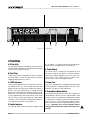
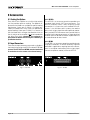
Fig. 2.1 Front Facilities
2 Facilities
A. Filter Grille
This metal grille supports and protects the dust filter (B).
To clean the dust filter, detach the grille by removing the
three screws that hold it in place.
on, AC power is available and the low-voltage power
supply and fan are operational (see Section 4.2).
E. Power Switch
The dust filter removes large particles from the air drawn
by the cooling fan. Check the filter regularly to prevent
clogging (see Sections 3.2 and 4.5).
This rocker switch is used to turn the amplifier on and
off. When turned on, the output is muted for approximately four seconds to protect your system from startup transients. (To change the start-up delay time,
contact Crown’s Technical Support Group.)
C. ODEP Indicators
F. Power Cord
During normal operation of the Output Device Emulation Protection circuitry, these amber indicators glow
brightly to show that reserve thermodynamic energy is
present. They dim proportionally as energy reserves
decrease. In the rare event that energy reserves are depleted, the ODEP indicators turn off and the protection
circuitry proportionally limits output drive so the amplifier can safely continue operating even under severe
conditions. These indicators also help identify more unusual operating conditions (see Section 4.2).
All units are shipped with an appropriate plug and cord
for the required AC voltage (see Figure 3.16). Also, refer
to Section 7 for power usage information.
B. Dust Filter
D. Enable Indicator
This indicator lights when the amplifier has been turned
Page 8
G. Stereo/Mono Modes Switch
The three operating modes of a Micro-Tech amplifier are
controlled by this three-way switch. Stereo mode is used
for normal two-channel operation, Bridge-Mono mode
is used to drive a single channel with a load impedance
of at least 4 ohms, and Parallel-Mono mode is used to
drive a single channel with a load impedance less than
4 ohms. Important: Turn off the amplifier before
changing the stereo/mono modes switch (see Section 3.3).
Reference Manual
Micro-Tech 600/1200/2400 Power Amplifiers
BRIDGE-MONO WIRING
–
PUSH TO RESET
CH-2
5
F
RED TERMINALS
ONLY. (CH-1
IS POSITIVE.)
CH-1
BRIDGE
MONO
CAUTION: TURN OFF AMPLIFIER
BEFORE CHANGING THIS SWITCH!
G
H
–
GND
10
1
12
INPUT
GAIN
RING
SLEEVE
I
J
8
LIFT
9
2
INPUT GROUND LIFT
11
0
+ TIP
7
3
9
2
BALANCED
INPUT WIRING
5
6
4
8
3
WARNING: TO REDUCE THE RISK OF FIRE OR
ELECTRIC SHOCK DO NOT EXPOSE THIS EQUIPMENT
TO RAIN OR MOISTURE.
CH-1
7
4
STEREO
PARALLEL
MONO
6
10
1
INPUT
11
0
(AFFECTS PHONE INPUTS ONLY.)
(MONO)
GAIN
L
K
J
K
® INTERNATIONAL, INC.
ELECTRONIC EQUIPMENT
UNBALANCED
INPUT WIRING
12
+ TIP
ELKHART, IN 46517
MADE IN U.S.A.
SERIAL NUMBER
GND
SWITCH TO
BRIDGE-MONO.
3 OUTPUT ACROSS
CLASS 1
OUTPUT
WIRING
REQUIRED.
THIS AMPLIFIER IS EQUIPPED WITH SELECTABLE INPUT SENSITIVITY. REMOVE COVER PLATE (ABOVE) TO ACCESS SENSITIVITY SWITCH.
MAXIMUM OUTPUT: 900 WATTS
PER CHANNEL INTO 2 OHMS AT 1 KHz
WITH NO MORE THAN 0.1% THD.
REG. U.S. PAT. OFF.
4,330,809
4,611,180
+
OUTPUTS
CH-2
MODEL: MICRO-TECH 2400 SERIES
AC VOLTS: 120 AMPS: 17 60 Hz
1 TURN AMPLIFIER OFF.
2 SET STEREO/MONO
CAUTION:
THIS COVER IS NECESSARY FOR
EFFICIENT COOLING OF THE AMPLIFIER.
REMOVE ONLY TO ACCESS GAIN SWITCH.
0000
PARALLEL-MONO WIRING
+
1 TURN AMPLIFIER OFF.
2 SET STEREO/MONO
–
SWITCH TO
PARALLEL-MONO.
3 ADD JUMPER (14
GAGE OR LARGER)
ACROSS RED
TERMINALS.
4 OUTPUT ACROSS CH-1
TERMINALS ONLY.
000000
SLEEVE
M
M
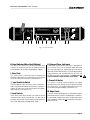
Fig. 2.2 Rear Facilities
H. Reset Switches (Micro-Tech 2400 only)
K. Balanced Phone Jack Inputs
The Micro-Tech 2400 has two push-button reset
switches on the back panel that are used to reset the
circuit breakers for the high-voltage power supplies.
A balanced ¼-inch phone jack input is provided for
each channel. They may be wired for either balanced
(tip, ring and sleeve) or unbalanced (tip and sleeve)
operation (refer to Section 3.3.4). XLR and barrier block
input connectors are available with the MT-XLR and
MT-BB accessories (see Section 8.2). Caution: Do not
use the channel 2 input in either mono mode.
I. Cover Plate
This cover plate is removed when changing the
amplifier’s input sensitivity (see Section 4.4) or installing
an MT-XLR or MT-BB accessory (see Section 8.2).
L. Ground Lift Switch
❑ Input Sensitivity Switch
The three-position input sensitivity switch is located inside the amplifier behind the cover plate (I). Settings include 0.775 volts and 1.4 volts for standard 1 kHz power,
and 26 dB gain (see Section 4.4).
This switch is used to isolate the phone jack signal
grounds from the AC power (chassis) ground. Moving
the switch to the “lift” position helps prevent the hum
associated with ground loops (see Section 4.4).
M. Output Jacks
J. Level Controls
These back panel level controls are used to set the
amplifier’s output levels (see Section 4.4). Be sure to
turn down the channel 2 level control (fully counterclockwise) when operating in Bridge-Mono mode.
Reference Manual
A pair of versatile binding posts is provided for output
connection to each channel. Loudspeakers can be easily connected using banana plugs, spade lugs or bare
wire (European models do not accept banana plugs).
See Section 3.3.
Page 9
Micro-Tech 600/1200/2400 Power Amplifiers
3 Installation
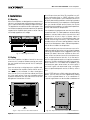
3.1 Mounting
Micro-Tech amplifiers are designed for standard 19-inch
(48.3-cm) rack mounting or stacking without a cabinet. In a
rack, it is best to mount units directly on top of each other.
This provides the most efficient air flow and support. If the
rack will be transported, we recommend that you provide
support for the amplifier’s back panel or secure it to the
rack to help support the unit’s weight.
Fig. 3.1 Mounting Dimensions
3.2 Cooling
Micro-Tech amplifiers include an internal fan that runs
when the unit is turned on. Before mounting your amplifier, you should familiarize yourself with its cooling requirements.
Here are some tips to help keep your amplifier cool.
First, never block the amplifier’s front or side air vents. If
the amplifier is rack-mounted, its sides should be at
least 2 inches (5 cm) away from the cabinet (see Figure
3.2). Also, open spaces in the rack should be covered
to prevent heated air from the side exhaust vents from
being drawn into the front air intake.
You will know when your Micro-Tech amplifier has sufficient cooling because its ODEP indicators will be
brightly lit. If the amplifier’s ODEP indicators dim or turn
off, overly demanding conditions are forcing it to protect
itself from overheating. If you experience a cooling problem, you should consider several factors that may be
contributing to the problem, including load impedance,
air flow and ambient air temperature.
Low-impedance loads generate more heat than higher
impedance loads. To avoid impedance-related cooling
problems, connect loads to each channel with a total
impedance of at least 2 ohms in Stereo, 4 ohms in
Bridge-Mono, and 1 ohm in Parallel-Mono mode (see
Section 3.3 for wiring instructions). If your loads are reasonable and you still have a cooling problem, check for
shorts in the loudspeaker cables, and look for problems
with air flow or ambient air temperature.
Air flow restrictions are the most common cause of inadequate cooling. Restrictions may result from improper
mounting, piles of power cords, clogged dust filters and
closed rack doors. Mount the amplifier to allow sufficient air flow into the front intake, out the side exhaust
vents, and out the back of the rack. An air flow restriction like a pile of power cords can simply be moved out
of the way. Air filters should be cleaned using the procedure in Section 4.5. If rack doors are the problem, you
can leave them open, remove them, or install a grille. If
you install a grille, we recommend using a wire grille
because perforated panels restrict air flow by at least
40%.
If your ODEP indicators still dim under demanding conditions, you may want to install supplemental cooling
like a rack-mounted blower or an air conditioner. A
“squirrel cage” blower can be installed at the bottom of
17 in
IMPORTANT: Be sure the back of
the amplifier is supported.
AIR
FLOW
AIR
FLOW
AMPLIFIER
(TOP VIEW)
16 in
2 in
MIN.
RACK
CABINET
AIR FLOW
Fig. 3.2 Top View of a Rack-Mounted Unit
Page 10
Fig. 3.3 Proper Air Flow with a Rack-Mounted Blower
Reference Manual
Micro-Tech 600/1200/2400 Power Amplifiers
the rack so it blows outside air into the space between
the door and the front of the amplifiers. This will pressurize the “chimney” behind the door (Figure 3.3, Option
1). The blower should not blow air into or take air out of
the space behind the amplifiers. For racks without a front
door, you can evacuate the rack by mounting the blower
at the top of the rack so air blows out the back (Figure
3.3, Option 2). You can estimate a rack’s required air
flow by adding each unit’s maximum air flow rating.
Each Micro-Tech 600 and 1200 can move 35 cubic feet
(1 cubic meter) of air per minute, and each Micro-Tech
2400 can move 45 cubic feet (1.3 cubic meters) of air
per minute. So if you put one of each in a rack, you
would need 115 cubic feet (3.2 cubic meters) of air flow
through the rack per minute under worst-case conditions (35 cubic feet + 35 cubic feet + 45 cubic feet =
115 cubic feet).
Another cooling problem to consider is high ambient air
temperature. If the ambient air temperature is extremely
high, ODEP may reduce the output to protect the amplifier even when it is receiving the maximum recommended air flow. Under these unusual conditions, it may
be necessary to use air conditioning for supplemental
cooling. Air conditioning is rarely a necessity because
internal fans and rack-mounted blowers almost always
provide enough air flow for the most extreme conditions.
Still, air conditioning helps reduce the ambient temperature of the air flowing through the rack. If you plan to use
air conditioning, refer to Section 7 for information on calculating the hourly thermal dissipation of your system.
3.3 Wiring
The following section describes common ways to install
your amplifier in a sound system. The input and output
terminals are located on the back panel. Please use
care when making connections, selecting signal
sources and controlling the output level. The load you
save may be your own! Crown assumes no liability for
damaged loads resulting from careless amplifier use or
deliberate overpowering.
CAUTION: When making or changing connections,
always disconnect the AC power and turn the level
controls off (fully counterclockwise). This is very important because it reduces the chance of loud blasts
that can cause loudspeaker damage.
Micro-Tech amplifiers may be operated in one of three
modes (Stereo, Bridge-Mono and Parallel-Mono) by
switching the stereo/mono switch on the back panel.
There are VERY IMPORTANT wiring differences among
these three modes which are discussed next.
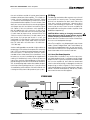
3.3.1 Stereo (Two-Channel) Operation
In Stereo mode, installation is very intuitive: input channel 1 feeds output channel 1, and input channel 2 feeds
output channel 2. To put the amplifier into Stereo mode,
first turn the amplifier off, then slide the stereo/mono
switch to the center position, and properly connect the
output wiring as shown in Figure 3.4. Each channel has
a pair of binding posts for easy loudspeaker cable connection. Observe correct polarity, and be very careful
not to short the two channels together.
STEREO MODE
Fig. 3.4 Stereo Wiring
Reference Manual
Page 11
Micro-Tech 600/1200/2400 Power Amplifiers
CAUTION: In Stereo mode, never tie the amplifier’s
outputs directly together, and never parallel them
with the output of another amplifier. Such connections do not increase the output power and may activate the protection circuitry to prevent overheating.
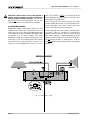
3.3.2 Bridge-Mono Operation
Bridge-Mono mode is used to drive loads with a total
impedance of at least 4 ohms (see Section 3.3.3 if the
load is less than 4 ohms). Wiring for Bridge-Mono mode
is very different from the other modes and requires special attention. First, turn off the amplifier. Then select
Bridge-Mono mode by sliding the stereo/mono switch
to the right (as you face the back panel). Both outputs
receive the channel 1 input signal, but channel 2 is inverted so it can be bridged with channel 1. DO NOT
USE THE CHANNEL 2 INPUT or signal quality will be
greatly degraded. Also, turn down the channel 2 level
control (fully counterclockwise).
Note: The channel 2 input and level control are not defeated in Bridge-Mono mode. Any signal feeding channel 2 will work against the channel 1 signal, and usually
results in distortion and inefficient operation.
Connect the load across the two red (+) binding posts
as shown in Figure 3.5. The positive (+) lead from the
loudspeaker connects to the red (+) channel 1 binding
post, and the negative (–) or ground lead from the loudspeaker connects to the red (+) channel 2 binding post.
Do not connect the black (–) binding posts. Also, the
load must be balanced so neither lead is connected to
ground.
BRIDGE-MONO MODE
Fig. 3.5 Bridge-Mono Wiring
Page 12
Reference Manual
Micro-Tech 600/1200/2400 Power Amplifiers
CAUTION: Only connect balanced equipment
(meters, switches, etc.) to the Bridge-Mono output.
Both sides of the line must be isolated from the input grounds or oscillations may occur.
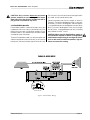
3.3.3 Parallel-Mono Operation
Parallel-Mono mode is used to drive loads with a total
impedance of less than 4 ohms (see Section 3.3.2 if the
load is 4 ohms or more). Installing the amplifier in Parallel-Mono mode is very different from the other modes
and requires special attention.
To select Parallel-Mono mode, turn off the amplifier and
slide the stereo/mono switch to the left (as you face the
back panel). Connect the input signal to channel 1 only.
The channel 2 input and level control are bypassed in
this mode, so they should not be used.
Connect the load to the channel 1 output as shown in
Figure 3.6. The positive loudspeaker lead (+) connects
to the red (+) channel 1 binding post and the negative
(–) or ground lead from the loudspeaker connects to the
black (–) channel 1 binding post. Finally, install a jumper
wire of at least 14 gauge between the red (+) binding
posts of both channels 1 and 2.
CAUTION: When wired for Parallel-Mono mode, do
not operate the amplifier in Stereo or Bridge-Mono
mode until the output wiring is reconfigured. Failure
to do so will result in inefficient operation, high distortion and excessive heating.
PARALLEL-MONO MODE
Fig. 3.6 Parallel-Mono Wiring
Reference Manual
Page 13
Micro-Tech 600/1200/2400 Power Amplifiers
3.3.4 Input Connection
The balanced phone jack inputs have a nominal impedance of 20 K ohms (10 K ohms with unbalanced wiring)
and will accept the line-level output of most devices.
Three-pin female XLR connectors are also available on
the optional MT-XLR accessory and balanced barrier
block connectors are available on the optional MT-BB
accessory (see Section 8.2). Correct input wiring will
depend on two factors: (1) whether the input signals are
balanced or unbalanced, and (2) whether the signal
source floats or has a ground reference. Figures 3.7 and
3.8 provide examples of recommended connection
techniques for each type of signal source. The optional
MT-XLR connector is shown.
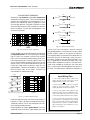
Fig. 3.8 Balanced Input Wiring
for the Optional MT-XLR
The amplifier’s built-in ¼-inch input phone connectors
can be wired similarly for balanced or unbalanced, floating or ground-referenced sources. The phone connectors have a standard tip-ring-sleeve (TRS) configuration:
the tip is positive (+), ring is negative (–) and sleeve is
ground (see Figure 3.9). Wiring for different sources follows the XLR wiring guidelines shown in Figures 3.7 and
3.8.
When either of the input connector accessories is installed, the unused input connectors can be used as
“daisy chain” outputs to feed the input signal from one
amplifier to another.
Please follow the input wiring instructions in Section
3.3.2 and 3.3.3 if the amplifier will be used in either
Bridge-Mono or Parallel-Mono mode. Remember, do not
use the channel 2 input in either mono mode.
Fig. 3.7 Unbalanced Input Wiring
for the Optional MT-XLR
Page 14
Fig. 3.9 Balanced and Unbalanced
Phone Plug Wiring
Reference Manual
Micro-Tech 600/1200/2400 Power Amplifiers
SOLVING INPUT PROBLEMS
Sometimes large subsonic (subaudible) frequencies
are present in the input signal. These can damage loudspeakers by overloading or overheating them. To attenuate such frequencies, place a capacitor in series
with the input signal line. The graph in Figure 3.10 shows
some possible capacitor values and how they affect frequency response. Use only low-leakage paper, mylar
or tantalum capacitors.
910 Ω
+
A
+
.003
µF
Balanced In
–
Balanced Out
–
910 Ω
1.8 mH
+
B
Balanced In
+
.015
µF
–
Balanced Out
–
1.8 mH
2.5 mH
+
C
Balanced In
+
.018
µF
–
Balanced Out
–
2.5 mH
0.47 Film 1.8 mH
+
D
Balanced In
+
.015
µF
–
Balanced Out
–
0.47 Film 1.8 mH
Fig. 3.12 Balanced RF Filters
Fig. 3.10 Subsonic Filter Capacitors
Another problem to avoid is the presence of large levels
of radio frequencies or RF in the input signal. Although
high RF levels may not pose a threat to the amplifier,
they can burn out tweeters or other loads that are sensitive to high frequencies. Extremely high RF levels may
also cause the amplifier to prematurely activate its protection circuitry. RF can be introduced into an input signal by local radio stations or the bias signal of many
tape recorders. To prevent RF problems, install appropriate low-pass filters on the inputs. Examples are
shown below for unbalanced wiring:
1.8 K ohm
Source
.003
µF
To
Amp
dB
0
GND
6 dB/octave
A
3.9 mH
R 600 ohm
Source
.015
µF
To
Amp
A
12 dB/octave
–10
B
GND
C
B
5 mH
R 600 ohm
Source
.018
µF
–20
To
Amp
GND
C
4 kHz
Note: A low source impedance (R) can be
increased to 600 ohms with an appropriate resistor.
10 kHz
40 kHz
100 kHz
Frequency
Fig. 3.11 Unbalanced RF Filters
For balanced input wiring, use one of the examples in
Figure 3.12. Filters A, B and C correspond to the unbalanced filters above. Filter D also incorporates the subsonic filter described previously.
usually cause hum in the output. A common source of
ground loop problems is the placement of input cables
parallel to power cables or near power transformers.
The magnetic field that surrounds these conductors can
induce the 50 or 60 Hz alternating current into your input cables. To prevent this type of ground loop, it is always a good idea to locate input cables away from
power cables and power transformers. We also recommend using shielded or twisted pair wire. With loose
wires, use tie-wraps to bundle together each pair of input wires. This helps reduce magnetically-induced cur-
Input Wiring Tips
1. Use only shielded cable. Cables with
higher density shields are better. Spiral
wrapped shield is not recommended.
2. When using unbalanced lines, keep the
cables as short as possible. Avoid cable
lengths greater than 10 feet (3 meters).
3. Do not run signal cables together with
high-level wiring such as loudspeaker wires
or AC cords. This reduces the chance of hum
or noise being induced into the input cables.
4. Turn off the entire system before changing connections. Turn down the level controls
(fully counterclockwise) before powering the
system back up. Crown is not liable for damage incurred when any transducer or component is overdriven.
Another problem to avoid is ground loops. These are
undesired currents that flow in a grounded system and
Reference Manual
Page 15
Micro-Tech 600/1200/2400 Power Amplifiers
rent by minimizing the cross-sectional area between
conductors that could bisect the magnetic field.
excellent damping factor can easily be negated by using insufficient loudspeaker cables.
Ground loops will also occur when the input and output
grounds are tied together. DO NOT CONNECT THE INPUT AND OUTPUT GROUNDS TOGETHER. Tying the
input and output grounds together can also cause feedback oscillation from the load current flowing in the
loop. To avoid this problem use proper grounding, isolate the inputs, and isolate other common AC devices. If
necessary, the input phone jack grounds can be isolated from the AC mains (chassis) ground with the
ground lift switch located on the back panel of the amplifier (see Figure 2.2 and Section 4.4).
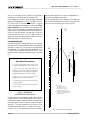
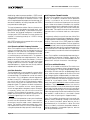
Use the nomograph and the procedure that follow to
find the recommended American Wire Gauge (AWG) or
resistance per 1000 feet of wire for your system.
3.3.5 Output Connection
Consider the power-handling capacity of your load before connecting it to the amplifier. Crown is not liable for
damage incurred at any time due to any load being
overpowered. The use of loudspeaker protection fuses
is highly recommended (see Section 3.3.6). Also,
please pay close attention to the precautions in Section
4.1.
.0002
.0002
RS
Source
Resistance
(Ohms)
.0004
.0006
.001
RL
RS
Damping
Factor
.002
20,000
.004
10,000
.006
.01
5,000
RL
Load
Resistance
(Ohms)
40
.02
Copper
Wire
2,000
1,000
8000
.04
5000
500
30
.06
Ohms/1000 Feet
(305 Meters)
.1
200
100
.2
Two
Conductor
Cable
20
50
Use Good Connectors
1. To prevent possible short circuits, insulate exposed loudspeaker cable connectors.
2. Do not use connectors that might accidentally tie conductors together when making or breaking connections (for example, a
standard three-wire stereo phone plug).
20
1
10
5
2
10
0.3
2
0.6
5
1.5
10
3.1
20
50
100
6.1
15.3
30.5
200
61.0
.4
.6
15
1
500
152.5
1000
305.0
2000
610.0
500
100
50
2
4
#20
10
5
4. Avoid using connectors with low currentcarrying capacity.
#16
#14
#10
5000
Feet
1
#8
#6
.5
#4
1525
Meters
#2
1
10
.1
6
3. Never use connectors that can be
plugged into AC power receptacles.
#18
#12
6
7
#28
#26
#24
#22
9
8
AWG (American
Wire Gauge)
1000
#0
#00
#0000
.05
5
20
4
40
.01
3
5. Do not use connectors that have any tendency to short.
2
HOW TO DETERMINE
APPROPRIATE WIRE GAUGE
It is important to use loudspeaker cables with sufficient
gauge (thickness) for the length being used. The resistance introduced by inadequate cables will reduce both
the output power and the motion control of the loudspeakers. The latter problem occurs because the
damping factor decreases as cable resistance increases. This is very important because the amplifier’s
Page 16
1.5
Example Shown:
Load Resistance = 8 ohms
Desired Damping Factor = 500
Source Resistance = 0.016 ohms
Cable Length = 10 feet (3.1 meters)
Recommended Wire: #8 AWG or equivalent
wire with 1.75 ohms or less resistance per
1000 feet (305 meters).
1
0.9
0.8
0.7
0.6
0.5
Fig. 3.13 Wire Size Nomograph
Reference Manual
Micro-Tech 600/1200/2400 Power Amplifiers
1. Note the load resistance of the loudspeakers connected
to each channel of the amplifier. Mark this value on the
“Load Resistance” line of the nomograph.
2. Select an acceptable damping factor and mark it on the
“Damping Factor” line. Your amplifier can provide an excellent damping factor of 1,000 from 10 to 400 Hz in Stereo
mode with an 8 ohm load. In contrast, typical damping factors are 50 or lower at these frequencies. Higher damping
factors yield lower distortion and greater motion control over
the loudspeakers. A common damping factor for commercial applications is between 50 and 100. Higher damping
factors may be desirable for live sound, but long cable
lengths often limit the highest damping factor that can be
achieved practically. In recording studios and home hi-fi, a
damping factor of 500 or more is very desirable.
3. Draw a line through the two points with a pencil, and continue until it intersects the “Source Resistance” line.
4. On the “Two Conductor Cable” line, mark the length of
the cable run.
5. Draw a pencil line from the mark on the “Source Resistance” line through the mark on the “Two Conductor Cable”
line and intersect the “Copper Wire” line.
6. The required wire gauge for the selected wire length and
damping factor is the value on the right-hand scale of the
“Copper Wire” line. For metric wire sizes, find the recommended resistance in ohms per 305 meters (1000 feet) and
use this information to reference the correct wire size. Note:
Wire size increases as the AWG gets smaller.
7. If the size of the cable exceeds what you want to use,
(1) find a way to use shorter cables, (2) settle for a lower
damping factor, or (3) use more than one cable for each line.
Options 1 and 2 will require the substitution of new values for
cable length or damping factor in the nomograph. For option 3, doubling the number of conductors of equal thickness will reduce the resistance in ohms per 1000 feet (305
meters) by half. When using AWG standards, you can estimate the effective wire gauge by subtracting 3 from the
given wire gauge every time the number of conductors of
equal gauge is doubled. So, if #10 wire is too large, two #13
wires can be substituted, or four #16 wires can be used for
the same effect.
gether. Do not bundle wires from different amplifiers. This reduces the chance of conductors acting like antennas that transmit or receive the high
frequencies that can cause oscillations.
2. Avoid using shielded loudspeaker cable.
3. Never tie together input and output grounds.
4. Never tie together different amplifier outputs.
5. Keep output cables separated from input
cables.
6. Install an RF filter in series with each input (see
Section 3.3.4).
7. Install input wiring according to the instructions
in Section 3.3.4.
Another problem to avoid is the presence of large subsonic currents when primarily inductive loads are
used. Examples of inductive loads are 70-volt step-up
transformers and electrostatic loudspeakers.
Inductive loads can act like a short circuit at low frequencies. This can cause the amplifier to produce large
low-frequency currents and activate its protection circuitry. Always take the precaution of installing a subsonic filter in series with each of the amplifier’s inputs
when inductive loads are used. A three-pole, 18 dB per
octave filter with a –3 dB frequency of 50 Hz is recommended (some applications may benefit from an even
higher –3 dB frequency). Such a filter is described with
the subsonic frequency problems in Section 3.3.4.
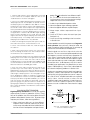
Another way to protect inductive loads from large lowfrequency currents and to prevent the amplifier from
prematurely activating its protective systems is to parallel a 590 to 708 µF nonpolarized motor start capacitor
and a 4-ohm, 20-watt resistor in series with the
amplifier’s output and the positive (+) lead of the transformer. This circuit is shown in Figure 3.14. It uses components that are available from most electrical supply
stores.
SOLVING OUTPUT PROBLEMS
High-frequency oscillations can cause your amplifier
to prematurely activate its protection circuitry. The effects of this problem are similar to the effects of the RF
problems described in Section 3.3.4. To prevent highfrequency oscillations, follow these guidelines:
1. When using long cable runs, or when different
amplifiers share a common cable tray or jacket,
use tie-wraps to bundle individual conductors so
the wires for each loudspeaker are kept close to-
Reference Manual
Fig. 3.14 Low-Frequency Protection
Circuit for Inductive Loads
Page 17
Micro-Tech 600/1200/2400 Power Amplifiers
3.3.6 Additional Load Protection
Micro-Tech amplifiers can deliver very high power levels, so it’s a good idea to add some protection if its not
already built into your loudspeakers. Loudpseakers are
subject to thermal damage from sustained overpowering and mechanical damage from large transient voltages. In both cases, fuses may be used to protect your
loudspeakers.
Thermal protection and voltage protection require different types of fuses. Slow-blow fuses are used to prevent thermal damage because they respond to thermal
conditions like a loudspeaker. High-speed instrument
fuses like the Littlefuse 361000 series are used to protect loudspeakers from transient voltages. The nomograph in Figure 3.15 can be used to select the correct
fuse for thermal or voltage protection.
There are two common ways to install the fuses. One
approach is to put a single fuse in series with each output. This is easy because there is only one fuse per
channel to install. But if the fuse blows, power is removed from all of the connected loads.
A better approach is to fuse each driver independently.
This allows you to apply the most appropriate protection for the type of driver being used. In general, lowfrequency drivers (woofers) are the most susceptible to
thermal damage and high-frequency drivers (tweeters)
are usually damaged by large transient voltages. This
means that your loudspeakers will tend to have better
protection when the woofers are protected by slow-blow
fuses and high-frequency drivers are protected by highspeed instrument fuses.
3.4 AC Mains Power Requirements
All Micro-Tech amplifiers are shipped with an appropriate line cord and plug. The standard cord and plug for
each model are listed by country (or region) in Figure 3.16. When possible, use a power receptacle on a
dedicated circuit, and always make sure it will provide
the right voltage with sufficient current. We do not recommend operating your amplifier with voltages greater
than 10% above or below the unit’s rated voltage. For
example, an amplifier rated for 120 VAC operaton
should not exceed 132 VAC. See Section 7 for power
requirements under a variety of conditions.
Country or Region
Micro-Tech
600
Cord
Australia, New Zealand
Plug
Micro-Tech
1200
Cord
Plug
Micro-Tech
2400
Cord
Plug
1.5 mm2 AS 3112 1.5 mm2 AS 3112 1.5 mm2 AS 3112
10 A
10 A
15 A
Argentina, Austria, China, 1.5 mm2 CEE 7/7 1.5 mm2 CEE 7/7 1.5 mm2 CEE 7/7
Denmark, Finland, France,
Germany, Greece, Holland,
Indonesia, Italy, Korea,
Malaysia, Portugal, Spain,
Sweden, Switzerland,
Turkey
Brazil, Guam, Hong Kong, 14/3 SJT NEMA 14/3 SJT NEMA
5-15P
5-15P
Jamaica, Japan, Peru,
Phillipines, Singapore,
Tahiti, Taiwan, Thailand,
Venezuela
12/3 SO
NEMA
5-15P
Central America,
North America
12/3 SO
NEMA
5-20P
14/3 SJT NEMA 14/3 SJT NEMA
5-15P
5-15P
India, South Africa
1.5 mm2
Ireland, Norway,
United Kingdom,
United Arab Emirates
1.5 mm2 BS 1363 1.5 mm2 BS 1363 1.5 mm2 BS 1363
BS 546 1.5 mm2 BS 546 1.5 mm2 BS 546
Fig. 3.16 AC Mains Cords and Plugs
Fig. 3.15 Loudspeaker Fuse Nomograph
Page 18
All specifications in this manual were measured using
120 VAC, 60 Hz power mains unless otherwise noted.
Specifications are derived using a mains voltage that is
accurate to within 0.5% with THD less than 1.0% under
all testing conditions. Performance variations can occur
at other AC mains voltages and line frequencies. In addition, line regulation problems will directly affect the
output power available from the amplifier.
Reference Manual
Micro-Tech 600/1200/2400 Power Amplifiers
4 Operation
4.1 Precautions
Although your amplifier is protected from internal and
external faults, you should still take the following precautions for optimum perfromance and safety:
1. Improper wiring for the Stereo, Bridge-Mono and
Parallel-Mono modes can result in serious operating
difficulties (see Section 3.3).
2. WARNING: Do not change the position of the
stereo/mono switch unless the amplifier is first
turned off.
3. CAUTION: In Parallel-Mono mode, a jumper is
used between the red (+) channel 1 and 2 red output binding posts. Remove this jumper for
Bridge-Mono and Stereo modes, or high distortion and excessive heating will occur. Also, check
the stereo/mono switch for proper setting.
4. Turn off the amplifier and unplug it from the AC
mains before removing the back panel cover plate
or before removing and cleaning the dust filter.
5. Use care when making connections, selecting signal sources and controlling the output level. The
load you save may be your own!
6. Do not short the ground lead of an output cable to
the input signal ground. This will form a ground loop
and may cause oscillations.
7. Operate the amplifier from AC mains of not more
than 10% above or below the selected line voltage
and only at the specified line frequency.
8. Never connect the output to a power supply output, battery or power main. Such connections may
result in electrical shock.
9. Tampering with the circuitry by unqualified personnel or making unauthorized circuit changes may be
hazardous and invalidates all agency listings.
Remember: Crown is not liable for damage that results
from overdriving other system components.
4.2 Indicators
The amber enable indicator is provided to show that
the amplifier has been turned on (or enabled), and its
low-voltage power supply and forced-air cooling system are working. It does not indicate the status of the
high-voltage power supplies. For example, the enable
indicator will remain lit during unusual conditions that
would cause the amplifier’s protection systems to temReference Manual
Fig. 4.1 Indicators
porarily remove power from a high-voltage power supply (see Section 4.3).
The amber ODEP indicators confirm the normal operation of Crown’s patented Output Device Emulation
Protection circuitry. Each channel has an amber front
panel indicator that shows thermal-dynamic energy reserve. Normally, each ODEP indicator is lit to show available reserve energy. The indicator will dim proportionally
as the energy reserve for its channel decreases. In the
rare event that a channel has no reserve, its indicator
will turn off and the ODEP circuitry will limit the channel’s
output drive (see Section 4.3.1.)
The ODEP indicators also turn off if the amplifier loses
AC power, the power switch is turned off, or the lowvoltage power supply fuse blows. The ODEP indicator
for the affected channel will turn off if a high-voltage
power supply fuse or breaker blows, or if the channel
activates transformer thermal protection. Conditions that
activate “drive protection” do not affect the ODEP indicators (see Section 4.3.3).
4.3 Protection Systems
Micro-Tech amplifiers have extensive protection systems including ODEP, ultrasonic/RF protection, drive
protection, and power supply fuses or breakers.
4.3.1 ODEP
Crown invented ODEP to solve two long-standing problems in amplifier design: to prevent amplifier shutdown
during demanding operation, and to increase the efficiency of the output circuitry.
To do this, Crown established a rigorous program to
measure the safe operating area (SOA) of each output
transistor before installing it in an amplifier. Next, Crown
designed intelligent circuitry to simulate the instantaneous operating conditions of those output transistors.
Its name describes what it does: Output Device Emulation Protection or ODEP. In addition to simulating output
transistor operating conditions, it compares their operation to their known SOA. If ODEP sees that more power
will be asked of the output devices than they are capable
Page 19
Micro-Tech 600/1200/2400 Power Amplifiers
of delivering under the present conditions, ODEP immediately limits the drive level until it falls within the SOA. Limiting
is proportional and kept to an absolute minimum—only
what is required to prevent output transistor damage. Under normal conditions, no limiting is required and ODEP is
transparent to the audio signal.
This level of protection enables Crown to increase output efficiency to never-before-achieved levels while
greatly increasing reliability. As described in the previous section, the on-board intelligence is monitored by
the front panel ODEP indicators that show whether the
amplifier is functioning correctly or if ODEP is limiting
the drive level.
With ODEP you get maximum power with maximum protection so the show goes on.
4.3.2 Ultrasonic and Radio Frequency Protection
Micro-Tech amplifiers have a controlled slew rate. This
means that their design limits the frequencies they can
reproduce. At the same time, the amplifier’s controlled
slew rate has no effect on its audio performance because limiting occurs well above 20 kHz. This approach
protects the amplifier from radio frequencies, and also
protects some sensitive loads (like tweeters). In the real
world, an amplifier’s slew rate only needs to be large
enough to deliver the maximum voltage at the highest
required frequency—higher slew rates actually allow the
reproduction of undesirable frequencies.
4.3.3 Drive Protection
The drive protection system temporarily removes drive
from the output stages to protect the amplifier and its
connected loads. Drive protection can be activated in
two situations. First, if dangerous subsonic frequencies
or direct current (DC) is detected in the amplifier’s output, the unit will activate its DC/low-frequency protection circuitry which puts the affected channel in drive
protection mode. This protects the loads and prevents
oscillation. The amplifier resumes normal operation
when it no longer detects dangerous output. Although it
is extremely unlikely that you will ever activate the
amplifier’s DC/low-frequency protection system, improper source materials like subsonic square waves or
a severely clipped signal can activate this system.
The amplifier’s fault protection system puts the affected
channel into drive protection mode in rare situations
where heavy common-mode current is detected in its
output. The amplifier should never output heavy common-mode current unless its circuitry is damaged. Activating drive protection helps prevent further damage.
Page 20
4.3.4 Transformer Thermal Protection
All Micro-Tech amplifiers have transformer thermal protection. The amplifier’s transformer thermal protection
circuitry is activated in very unusual circumstances
where the unit’s transformer temperature rises to unsafe
levels. Under these abnormal conditions, the amplifier
will remove power from the affected channel’s high-voltage power supply which puts the channel in drive protection mode. The amplifier channel will return to normal
operation after its transformer cools to a safe temperature.
It is extremely unlikely that you will ever see a Micro-Tech
amplifier activate transformer thermal protection as long as
it is operated within rated conditions (see Section 6, Specifications). One reason is that ODEP keeps the amplifier
working under very severe conditions. Even so, higher than
rated output levels, excessively low-impedance loads and
unreasonably high input signals can generate more heat in
the transformer than in the output devices. These conditions can overheat a transformer and activate its protection
system.
Micro-Tech amplifiers are designed to keep working under conditions where other amplifiers would fail. But
even when a Micro-Tech’s limits are exceeded, it will still
protect itself—and your investment—from damage.
4.3.5 Fuses and Circuit Breakers
120 VAC, 60 Hz models and all Micro-Tech 2400s have
an internal fuse that protects the low-voltage power supply and cooling fan. The high-voltage power supplies
for the Micro-Tech 600 and 1200 are protected by internal
fuses, while the power supplies for the Micro-Tech 2400
high-voltage supplies are protected by circuit breakers.
With rated loads and output levels, the fuses (or circuit
breakers) should only shut down the amplifier in the rare
instance of a catastrophic failure. ODEP protection
keeps the amplifier operational under most other severe
conditions. The fuses (or circuit breakers) can also shut
down the amplifier in cases where extremely low-impedance loads and high output levels result in current draw
that exceeds their rating. Again, this should only be possible when operating outside rated conditions like when
the amplifier is used to drive a 1 ohm load in Stereo
mode, or when an input signal is clipped severely.
Micro-Tech amplifiers do not blow their fuses or trip their
breakers unless something is wrong. In the rare event
that an internal fuse blows, please refer the unit to a
qualified technician. If a breaker in a Micro-Tech 2400
trips, try to identify and correct the problem before resetting the breakers. If the problem persists, refer the
unit to a qualified technician.
Reference Manual
Micro-Tech 600/1200/2400 Power Amplifiers
4.4 Controls
To change the input sensitivity:
The power switch is located on the front panel so you
can easily turn the amplifier on or off. If you ever need to
make any wiring or installation changes, don’t forget to
disconnect the power cord. Please follow these steps
when first turning on your amplifier:
1. Turn off the amplifier and disconnect its power
cord from the AC power source.
2. Remove the back panel cover plate (or input
connector accessory).
2. Turn down the amplifier’s level controls located
on the back panel.
3. Locate the access hole for the sensitivity switch
inside the chassis opening (Figure 4.2). The sensitivity switch will not be visible because it is
mounted below the hole. Use your little finger to
reach it.
3. Turn on the power switch. The enable indicator
beside the switch should glow.
4. Set the switch to the desired position noted on
the label beside the access hole.
4. After the turn-on delay, turn up the level of your
audio source to the maximum desired level.
5. Replace the back panel cover plate (or input
connector accessory) and restore power.
5. Turn up the level controls on the back panel of
the amplifier until the maximum desired loudness
or power level is achieved.
The back panel stereo/mono switch is used to select
Stereo, Bridge-Mono or Parallel-Mono operating mode.
Power must be removed from the amplifier before selecting a different operating mode. There are also important wiring differences among the different modes,
so be sure to read Section 3.3 before changing the position of the stereo/mono switch.
1. Turn down the level of your audio source. For example, set your mixer’s volume to “∞” (off).
6. Turn down the level of your audio source to its
normal range.
You can adjust each channel’s output using the back
panel level controls. These controls are located on the
back panel to help prevent unwanted tampering.
A three-position input sensitivity switch is located inside the amplifier’s back panel cover plate. The switch
is set at the factory to a sensitivity of 0.775 volts for standard 1 kHz power into 8 ohms.* If desired, the sensitivity can be switched to 1.4 volts for standard 1 kHz power
into 8 ohms, or a voltage gain of 26 dB. The 26 dB gain
setting is equivalent to a sensitivity of 2.1 volts for the
Micro-Tech 600, 2.5 volts for the Micro-Tech 1200 and
3.2 volts for the Micro-Tech 2400.
*Factory setting for International versions is 1.4 V.
A dust filter is provided on the air intake to the cooling
system (Figure 2.1). If this filter becomes clogged, the
unit will not cool as efficiently as it should and may produce lower-than-normal output levels due to high heat
sink temperature.
1.4 V
26 dB
0.77 V
THIS AMPLIFIER IS EQUIPPED WITH SELECTABLE INPUT SENSITIVITY. REMOVE COVER PLATE (ABOVE) TO ACCESS SENSITIVITY SWITCH.
CH-2
5
6
BALANCED
INPUT WIRING
+
–
GND
TIP
RING
SLEEVE
CH-1
7
5
9
3
2
10
2
INPUT GROUND LIFT
11
0
12
GAIN
6
7
4
8
3
1
INPUT
LIFT
(AFFECTS PHONE INPUTS ONLY.)
8
9
10
1
INPUT
(MONO)
11
0
UNBALANCED
INPUT WIRING
12
GAIN
+
GND
GROUND LIFT SWITCH
Fig. 4.2 Input Sensitivity and Ground Lift Switches
Reference Manual
The Micro-Tech 2400 has two reset switches for its
high-voltage power supplies. Refer to Section 4.3.5 in
the unusual event of a tripped breaker.
4.5 Filter Cleaning
SENSITIVITY SWITCH INSIDE ACCESS HOLE
4
The ground lift switch is located on the back panel
and can isolate the input signal grounds from the AC
(chassis) ground. It affects only the phone jack inputs
and has no affect on accessory input connectors. Sliding the switch to the left isolates or “lifts” the grounds by
placing an impedance between the sleeve of each
phone jack and the AC ground.
TIP
SLEEVE
To remove the filter, use a phillips screwdriver to remove
the three screws that hold the front grille in place. Wash
the filter with mild dishwashing detergent and warm water. Be sure to dry the filter before reinstalling it. Replacement filters may be ordered from the factory.
Dust filters are not 100% efficient—depending on the
local environment, the internal heat sinks of the amplifier
will benefit from periodic cleaning by a qualified technician. Internal cleaning information is available from our
Technical Support Group.
Page 21
Micro-Tech 600/1200/2400 Power Amplifiers
5 Technical Information
5.1 Overview
Micro-Tech amplifiers incorporate several technological
advancements including real-time computer simulation
of output transistor stress, low-stress output stages and
an advanced heat sink embodiment.
Custom circuitry is incorporated to limit temperature
and current to safe levels making it highly reliable and
tolerant of faults. Unlike many lesser amplifiers, it can
operate at its voltage and current limits without self-destructing.
Micro-Tech amplifiers are protected from all common
hazards that plague high-power amplifiers including
shorted, open or mismatched loads; overloaded power
supplies; excessive temperature, chain-destruction
phenomenon, input overload and high-frequency blowups. The unit protects loudspeakers from input and output DC, as well as turn-on and turn-off transients.
Real-time computer simulation is used to create an analogue of the junction temperature of the output transistors (hereafter referred to as the output devices).
Current is limited only when the device temperature
becomes excessive—and only by the minimum
amount required). This patented approach called Output Device Emulation Protection (or ODEP) maximizes
the available output power and protects against overheating—the major cause of device failure.
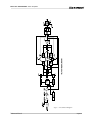
Crown also invented the four-quadrant topology used
in the output stages of each Micro-Tech amplifier (see
Figure 5.1). This special circuitry is called the
Grounded Bridge. It makes full use of the power supply
by delivering peak-to-peak voltages to the load that are
twice the voltage seen by the output devices.
As its name suggests, the Grounded Bridge topology
is referenced to ground. Composite devices are constructed as gigantic NPN and PNP devices to handle
currents which exceed the limits of available devices.
Each output stage has two composite NPN devices and
two composite PNP devices.
The devices connected to the load are referred to as
“high-side NPN and PNP” and the devices connected
to ground are referred to as “low-side NPN and PNP.”
Positive current is delivered to the load by increasing
conductance simultaneously in the high-side NPN and
low-side PNP stage, while decreasing conductance of
the high-side PNP and low-side NPN.
The two channels may be used together to double the
voltage (Bridge-Mono) or current (Parallel-Mono) prePage 22
sented to the load. This feature gives you flexibility to
maximize power available to the load.
A wide bandwidth, multiloop design is used for state-ofthe-art compensation. This produces ideal behavior and
results in ultra-low distortion values.
Aluminum extrusions have been widely used for heat
sinks in power amplifiers due to their low cost and reasonable performance. But measured on a watts per
pound or watts per volume basis, the extrusion technology doesn’t perform nearly as well as the heat sink technology developed for Micro-Tech amplifiers.
The heat sinks in a Micro-Tech amplifier are fabricated
from custom convoluted fin stock that provides an extremely high ratio of area to volume, or area to weight.
All power devices are mounted directly to massive heat
spreaders that are electrically at the Vcc potential. Making the heat spreaders electrically alive improves thermal performance by eliminating the insulating interface
underneath each power device. The chassis itself is
also used as part of the thermal circuit to maximize utilization of the available resources.
5.2 Circuit Theory
Each channel is powered by its own power transformer
T100 or T200. Both channels share a common low-voltage supply. The secondary output of T100 is full-wave
rectified by D109 and is filtered by a large computer
grade capacitor. A thermal switch embedded in the
transformer protects it from overheating.
The low-voltage fanformer is rectified by diodes D1, D2, D3
and D4 to generate an unregulated 24 volts. Monolithic
regulators U1 and U2 provide a regulated ±15 volts.
5.2.1 Stereo Operation
For simplicity, the discussion of Stereo operation will refer to one channel only. Mono operation will be discussed later. For specific circuit references, see the
block diagram in Figure 5.1.
The signal at the ¼-inch phone jack input passes directly to the balanced gain stage (U104-A and U104-B).
The balanced gain stage causes balanced to singleended conversion using a difference amplifier. From
there, gain can be controlled with a potentiometer. The
error amp (U104-C) amplifies the difference between
the output signal and the input signal from the gain pot,
and drives the voltage translator stage.
From the error amp, the voltage translator stage routes
the signal to the Last Voltage Amplifiers (LVAs) based
on signal polarity. The +LVA (Q105) and the –LVA (Q110),
Reference Manual
Micro-Tech 600/1200/2400 Power Amplifiers
Fig. 5.1 Circuit Block Diagram
Reference Manual
Page 23
Micro-Tech 600/1200/2400 Power Amplifiers
with their push-pull effect through the bias servo Q318,
drive the fully complementary output stage.
The bias servo Q318 is thermally coupled to the heat
sink and sets the quiescent bias current in the output
stage to lower the distortion in the crossover region of
the output signal. D301, D302, D303, and D304 remove
the charge on the unused portion of the output stage
based on the polarity of the output signal.
With the voltage swing provided by the LVAs, the signal
then gains current amplification through the Darlington
emitter-follower output stage.
The bridge-balanced circuit (U104-D) receives a signal
from the output of the amplifier and compares it to the
signal at the Vcc supply. The bridge-balanced circuit
then develops a voltage to drive the bridge-balanced
output stage. This results in the Vcc supply
having exactly one half of the output voltage added to
their quiescent voltage. D309, D310, D311 and a trimmer resistor set the quiescent current point for the
bridge-balanced output stage.
The protection mechanisms that affect the signal path
are implemented to protect the amplifier under real-world
conditions. These conditions are high instantaneous current, excessive temperature, and output device operation outside safe conditions.
Q107 and Q108 sense output current and act as a common current limiter. When instantaneous current exceeds
the design criteria, the limiters remove the drive from
the LVAs to limit output current to safe levels.
To further protect the output stages, the patented ODEP
circuitry is used. It produces an analog output proportional to the always changing die temperature of the output transistor. This output controls the translator stage
previously mentioned, removing any further drive that
may exceed the safe operating area of the output stage.
Thermal sensors S100 and S200 give the ODEP circuits
vital information on the operating temperature of the heat
sink on which the output devices are mounted.
Page 24
Should the amplifier fail in a way that would cause DC
across the output lead, the DC protection circuit senses
this on the negative feedback loop and shuts down the
output stage drive until the DC is removed.
5.2.2 Bridge-Mono Operation
By setting the back panel stereo/mono switch to BridgeMono, you can convert a Micro-Tech amplifier for
bridged-mono operation. With a signal applied to the
channel 1 input and the load connected between the
positive (+) output terminals, twice the voltage can be
delivered to the load.
The channel 1 output feeds the channel 2 error amp
U204-A. The signal feeding channel 2 is inverted so the
channel 2 output will have the opposite polarity of channel 1. This makes it possible to deliver twice as much
voltage to the load while the protection mechanisms for
each channel continue to work independently.
5.2.3 Parallel-Mono Operation
With the stereo/mono switch set to Parallel-Mono, the
output of channel 2 is paralleled with that of channel 1.
A suitable jumper capable of handling high current must
be connected across the positive (+) output terminals
to gain the benefits of this operating mode.
The signal path for channel 1 is the same as previously
discussed, except that channel 1 also drives the output
stage of channel 2. The balanced input, error amp, translators, and LVAs of channel 2 are disconnected and no
longer control the channel 2 output stage. The channel
2 output stage and protection mechanisms are also
coupled through S1 and function as one.
In Parallel-Mono mode, the amplifier can deliver twice
the current of a single channel. Because the channel 2
ODEP circuit is coupled through S1, the amplifier gains
additional protection if a fault occurs in the channel 2
output stage. The channel 2 ODEP circuit will limit the
output of both output stages by removing the drive from
the channel 1 voltage translator.
Reference Manual
Micro-Tech 600/1200/2400 Power Amplifiers
6 Specifications
The following applies to units in Stereo mode with with both channels driven into 8 ohm loads and an input sensitivity of 26 dB unless
otherwise specified.
Standard 1 kHz Power: refers to maximum average power in watts
at 1 kHz with 0.1% THD.
Full Bandwidth Power: refers to maximum average power in watts
from 20 Hz to 20 kHz with 0.1% THD.
120 VAC, 60 Hz Units: refers to amplifiers with dedicated transformers for 120 VAC, 60 Hz power mains.
International Units: refers to amplifiers with special multi-tap transformers that can be configured for several AC mains voltages (some
may be labeled 601, 1201 or 2401).
Performance
Frequency Response: ±0.1 dB from 20 Hz to 20 kHz at
1 watt (see Figure 6.7).
Phase Response: ±10 degrees from 10 Hz to 20 kHz at
1 watt (see Figure 6.10).
Signal-to-Noise: A-weighted, better than 105 dB below
full bandwidth power. From 20 Hz to 20 kHz, better than
100 dB below full bandwidth power.
Total Harmonic Distortion (THD): Less than 0.05% at full
bandwidth power from 20 Hz to 1 kHz increasing linearly to
0.1% at 20 kHz.
Intermodulation Distortion (IMD): (60 Hz and 7 kHz 4:1)
Less than 0.05% from 163 milliwatts to full bandwidth
power.
Damping Factor: Greater than 1,000 from 10 Hz to 400 Hz
(see Figure 6.8).
Crosstalk: See Figures 6.11, 6.12 and 6.13.
Controlled Slew Rate: Greater than 13 volts / µs.
Common Mode Rejection (CMR): At rated full bandwidth
power, better than 70 dB from 20 Hz to 1 kHz falling linearly
to better than 50 dB at 20 kHz.
Voltage Gain: 20:1 ±6% or 26 dB ±0.5 dB at the maximum
level setting (also see Section 4.4).
Micro-Tech 600 : 55:1 ±+6% or 35 dB ±0.5 dB at 0.775-volt
sensitivity; 31:1 ±6% or 30 dB ±0.5 dB at 1.4-volt sensitivity.
Micro-Tech 1200 : 64:1 ±6% or 36 dB ±0.5 dB at 0.775-volt
sensitivity; 34:1 ±6% or 31 dB ±0.5 dB at 1.4-volt sensitivity.
Micro-Tech 600
Stereo mode (both channels driven):
400 watts into 2 ohms.
325 watts into 4 ohms.
220 watts into 8 ohms.
Bridge-Mono mode:
750 watts into 4 ohms.
655 watts into 8 ohms.
450 watts into 16 ohms.
Parallel-Mono mode:
700 watts into 1 ohm.
665 watts into 2 ohms.
450 watts into 4 ohms.
Micro-Tech 1200
Stereo mode (both channels driven):
675 watts into 2 ohms.
480 watts into 4 ohms.
310 watts into 8 ohms.
Bridge-Mono mode:
1,300 watts into 4 ohms.
970 watts into 8 ohms.
620 watts into 16 ohms.
Parallel-Mono mode:
1,300 watts into 1 ohm.
965 watts into 2 ohms.
620 watts into 4 ohms.
Micro-Tech 2400
Stereo mode (both channels driven):
1,050 watts into 2 ohms.
800 watts into 4 ohms.
520 watts into 8 ohms.
Bridge-Mono mode:
2,070 watts into 4 ohms.
1,585 watts into 8 ohms.
1,035 watts into 16 ohms.
Parallel-Mono mode:
2,080 watts into 1 ohm.
1,605 watts into 2 ohms.
1,035 watts into 4 ohms.
Load Impedance: Safe with all types of loads. Rated for 2
to 16 ohms in Stereo, 4 to 16 ohms in Bridge-Mono and 1
to 4 ohms in Parallel-Mono mode.
Power
Required AC Mains: 100, 120, 220 and 240 VAC (±10%),
50 and 60 Hz units are available. All units draw 90 watts or
less when idle. AC mains current, frequency and voltage
requirements are provided on the unit’s back panel (also
see Section 7).
Output Power: The following are guaranteed minimums
for standard 1-kHz power from 120 VAC, 60 Hz North American units. For more information or specifications on international units, see the power matrices that follow.
Important: Your amplifier must have sufficient AC power.
Amplifiers cannot create energy—they require proper voltage and current to deliver the power you expect.
Micro-Tech 2400 : 83:1 ±6% or 38 dB ±0.5 dB at 0.775-volt
sensitivity; 46:1 ±6% or 33 dB ±0.5 dB at 1.4-volt sensitivity.
Reference Manual
Page 25
Micro-Tech 600/1200/2400 Power Amplifiers
Controls
Power: A front panel rocker switch used to turn the amplifier on and off.
Level: A back panel rotary potentiometer for each channel used to control the output level.
Stereo/Mono: A three-position back panel switch used to
select Stereo, Bridge-Mono or Parallel-Mono mode.
Sensitivity: A three-position switch inside the back cover
plate used to select the input sensitivity for both channels:
0.775 volts or 1.4 volts for standard 1 kHz power into
8 ohms, or 26 dB gain (see Section 4.4).
Ground Lift: A two-position back panel switch used to
isolate the phone jack input grounds from the AC ground.
Reset (Micro-Tech 2400 only): A back panel push button
for each channel used to reset the circuit breaker for each
channel.
Indicators
Enable: This amber indicator shows the on/off status of
the low-voltage power supply and cooling fan.
ODEP: Each channel has an amber front panel indicator
that shows thermal-dynamic energy reserve. Normally,
each ODEP indicator is lit to show available reserve energy. The indicator will dim proportionally as the energy
reserve for its channel decreases. In the rare event that a
channel has no reserve, its indicator will turn off and the
ODEP circuitry will limit the channel’s output drive. They
remain off if the power is turned off, disconnected, or if the
low-voltage power supply fuse blows. A channel’s ODEP
indicator will also remain off if its high-voltage supply fuse
blows (or breaker opens) or if transformer thermal protection is activated.
Input/Output
Input Connector: Two balanced ¼-inch phone jacks. See
Section 8.2 for XLR and barrier block accessories.
Input Impedance: Nominally 20 K ohms, balanced. Nominally 10 K ohms, unbalanced.
Input Sensitivity: Settings include 0.775 volts and 1.4 volts
for standard 1 kHz power, or 26 dB gain (see Section 4.4).
Output Connectors: Two sets of color-coded binding
posts for banana plugs, spade lugs or bare wire (European models do not accept banana plugs).
Output Impedance: Less than 10 milliohms in series with
less than 2 microhenries (see Figure 6.9).
DC Output Offset: (Shorted input) ±10 millivolts.
Output Signal
Stereo: Unbalanced, two-channel.
Bridge-Mono: Balanced, single-channel. Channel 1 conPage 26
trols are active; channel 2 should be turned down.
Parallel-Mono: Unbalanced, single-channel. Channel 1
controls are active; channel 2 is bypassed.
Protection
Micro-Tech amplifiers are protected against shorted, open
or mismatched loads; overloaded power supplies; excessive temperature, chain destruction phenomena, input
overload damage and high-frequency blowups. They also
protect loudspeakers from input/output DC and turn-on/
turn-off transients.
If unreasonable operating conditions occur, the patented
ODEP circuitry will proportionally limit the drive level to protect the output stages, particularly in the case of elevated
temperature. Transformer overheating will result in a temporary shutdown of the affected channel; when it has
cooled to a safe temperature, the transformer will automatically reset itself. Controlled slew rate voltage amplifiers prevent RF burnouts, and input overload protection is
provided by the input current limit. Refer to Section 4.3.
Turn On: The four-second turn-on delay prevents dangerous turn-on transients. Turn-on occurs at zero crossing of
the AC waveform, so power sequencers are rarely needed
with multiple units. Note: To change the turn-on delay time,
contact Crown’s Technical Support Group.
Construction
Steel chassis with durable black finish, front panel Lexan
overlay and specially designed “flow-through” ventilation
from front to side panels.
Cooling: Internal heat sinks with forced-air cooling for
rapid, uniform heat dissipation.
Dimensions: Standard 19-inch (48.3-cm) rack mount width
(EIA RS-310-B), 3.5-inch (8.9-cm) height and 16-inch (40.6cm) depth behind the mounting surface.
Approximate Weight: Center of gravity is 6 inches
(15.2 cm) behind the front mounting surface.
120 VAC, 60 Hz Units:
Micro-Tech 600 : 36 pounds, 4 ounces (16.5 kg) net;
41 pounds, 2 ounces (18.7 kg) shipping weight.
Micro-Tech 1200 : 41 pounds, 1 ounce (18.6 kg) net;
45 pounds, 3 ounces (20.5 kg) shipping weight.
Micro-Tech 2400 : 46 pounds, 14 ounces (21.3 kg) net;
55 pounds, 12 ounces (25.3 kg) shipping weight.
International Units:
Micro-Tech 600 : 39 pounds, 7 ounces (17.9 kg) net;
44 pounds, 2 ounces (20.0 kg) shipping weight.
Micro-Tech 1200 : 41 pounds, 0 ounces (18.6 kg) net;
45 pounds, 4 ounces (20.5 kg) shipping weight.
Micro-Tech 2400 : 47 pounds, 9 ounces (21.6 kg) net;
56 pounds, 6 ounces (25.6 kg) shipping weight.
Reference Manual
Micro-Tech 600/1200/2400 Power Amplifiers
Crown specifications are guaranteed for three years.
In an effort to provide you with as much information as possible about the high power-producing capabilities of your amplifier, we have
created the following power matrices.
Minimum Power Specifications
Crown’s minimum power specifications represent the absolute smallest amount of output power you can expect from your amplifier when it
is driven to full output under the given conditions. Some spaces in each matrix may be left blank because the same guarantee is not
provided for those conditions—however, your amplifier will perform well under all conditions listed in each matrix.
When measuring power, 0.1% THD appears to be the industry standard for distortion. Two of the maximum average power specifications
shown in each minimum power matrix are measured at 0.1% THD so you can easily compare Crown specifications to those of other
manufacturers. But this high level of distortion actually allows for some clipping which is undesirable. Because of this, a maximum average
power specification at 0.05% THD is included in each minimum power matrix which represents non-clipped conditions. Although most
manufacturers do not give you power specifications at 0.05% THD, we encourage them to provide these specifications so you will have a
more realistic representation of the way amplifiers should be used in the real world—without a clipped output signal.
Many manufacturers publish power specs with a tolerance of ±1 dB or worse. This means their amplifier can deviate more than 20% in
output! A 100-watt amplifier would meet their specification if it only produced 79.4 watts. Other manufacturers qualify their specifications by
saying they are “typical,” “subject to manufacturing tolerances,” “single channel driven” or that they are specified with “fuses bypassed.”
Each of these statements effectively removes any performance guarantee. In fact, some manufacturers use these tactics to generate large
power numbers, and they don’t even print a disclaimer. We take a different approach at Crown—our amplifiers are guaranteed to meet or
exceed their specifications for three years. Further, because our published specs are set below our “in-house” measurements, you can
expect every Crown amplifier to exceed its published minimum power specs. We believe you should get what you pay for.
Stereo/Mono
Mode
120 VAC, 60 Hz Units
Stereo
(both channels
driven)
Bridge-Mono
(balanced output)
Parallel-Mono
Stereo
International Units
(both channels
driven)
Bridge-Mono
(balanced output)
Parallel-Mono
Maximum Average
FTC Continuous Average
Load (Ohms)
AC Mains
Micro-Tech 600 – Minimum Guaranteed Power (Watts)
0.1% THD
(See note 1)
1 kHz
20Hz-20kHz
1 kHz
2
400
335
395
4
325
300
8
225
210
0.1% THD
(See note 2)
0.05% THD
(See note 3)
0.1% THD
(See note 4)
1 kHz
20Hz-20kHz
325
320
285
220
220
210
4
750
650
745
8
655
605
650
645
570
16
450
425
445
450
420
1
700
695
2
665
660
635
4
450
450
450
2
380
375
4
335
305
330
320
285
8
230
220
230
230
215
4
730
725
8
680
625
670
645
565
16
465
440
465
465
430
1
680
675
2
665
665
645
4
460
455
455
Minimum Power Notes:
All minimum power specifications are based on 0.5%
regulated AC mains with THD of less than 1.0% and
an ambient room temperature of 70° F (21° C). International units with multi-tap transformers are specified for the worst-case transformer tap (normally 100
VAC, 50 Hz). The standard EIA power measurement
(RS-490) is not identified here because it is identical
to the FTC Continuous Average Power specification.
1. A 1 kHz sine wave is presented to the amplifier
and the output monitored for nonlinear distortion.
The level is increased until THD reaches 0.1%. At
this level the average power per channel is reported.
2. A sine wave is presented to the amplifier over the
range from 20 Hz to 20 kHz and the output monitored for nonlinear distortion. The level at each frequency is increased until THD reaches 0.1%. At
this level the average power per channel is reported.
3. A 1 kHz sine wave is presented to the amplifier
and the output monitored for nonlinear distortion.
The level is increased until THD reaches 0.05%.
At this level the average power per channel is reported.
4. Continuous power in the context of Federal Trade
Commission testing is understood to be a minimum of five minutes of operation. Harmonic distortion is measured as the RMS sum total and given
as a percentage of the fundamental output voltage. This applies for all wattages greater than 0.25
watts.
Fig. 6.1 Micro-Tech 600 Minimum Power Matrix
Reference Manual
Page 27
Micro-Tech 600/1200/2400 Power Amplifiers
Stereo/Mono
Mode
120 VAC, 60 Hz Units
Stereo
(both channels
driven)
Bridge-Mono
(balanced output)
Parallel-Mono
Stereo
International Units
(both channels
driven)
Bridge-Mono
(balanced output)
Parallel-Mono
Maximum Average
FTC Continuous Average
Load (Ohms)
AC Mains
Micro-Tech 1200 – Minimum Guaranteed Power (Watts)
0.1% THD
(See note 1)
1 kHz
20Hz-20kHz
1 kHz
2
675
585
660
4
480
450
8
310
295
0.1% THD
(See note 2)
0.05% THD
(See note 3)
0.1% THD
(See note 4)
1 kHz
20Hz-20kHz
480
475
425
305
305
295
4
1,300
1,130
1,285
8
970
895
960
960
850
16
620
590
615
620
585
1
1,300
1,290
2
965
960
950
4
620
615
610
2
520
455
515
4
420
385
415
410
365
8
285
275
285
280
265
4
1,045
920
1,030
8
845
780
840
830
730
16
570
540
565
570
535
1
1,040
1,040
2
845
845
820
4
570
570
565
Fig. 6.2 Micro-Tech 1200 Minimum Power Matrix
Stereo/Mono
Mode
120 VAC, 60 Hz Units
Stereo
(both channels
driven)
Bridge-Mono
(balanced output)
Parallel-Mono
Stereo
International Units
(both channels
driven)
Bridge-Mono
(balanced output)
Parallel-Mono
Maximum Average
FTC Continuous Average
Load (Ohms)
AC Mains
Micro-Tech 2400 – Minimum Guaranteed Power (Watts)
0.1% THD
(See note 1)
1 kHz
20Hz-20kHz
1 kHz
2
1,050
850
1,025
4
800
750
8
520
505
4
2,070
1,670
2,030
0.1% THD
(See note 2)
0.05% THD
(See note 3)
0.1% THD
(See note 4)
1 kHz
20Hz-20kHz
785
770
685
510
505
495
8
1,585
1,485
1,565
1,530
1,355
16
1,035
1,000
1,020
1,005
955
1
2,080
2,050
2
1,605
1,590
1,470
4
1,035
1,025
1,005
2
895
4
745
715
735
690
660
8
510
500
510
505
500
4
1,775
875
1,735
8
1,485
1,420
1,475
1,395
1,320
16
1,030
1,000
1,020
1,010
980
1
1,765
1,750
2
1,470
1,460
1,400
4
1,020
1,010
1,000
Fig. 6.3 Micro-Tech 2400 Minimum Power Matrix
Page 28
Reference Manual
Micro-Tech 600/1200/2400 Power Amplifiers
Maximum Power Specifications
Crown’s maximum power specifications represent the largest amount of output power you can expect from your amplifier when it is driven to
full output under the given conditions. These specifications can be used to prevent loudspeaker and hearing damage.
The maximum power matrices include specifications for single cycle and 40 millisecond burst sine waves. Burst signals act like large
transient peaks that are present in common source signals. Loudspeakers can respond to a single cycle burst, so the single cycle burst
specifications should be used to help you protect your loudspeakers. In contrast, a 40 millisecond burst represents the typical response
time of the human ear. Your ear will not respond to the entire dynamic change of a burst that lasts less than 40 milliseconds.
The burst power specifications are provided at 0.05% THD which is a practical low distortion condition. Operating the amplifier at levels
higher than 0.05% THD can result in output power levels that are higher than those listed in the maximum power matrices.
Maximum Power Notes:
All maximum power specifications are based on 0.5% regulated AC mains with THD of less than 1.0% and an ambient room temperature of 70° F (21° C).
International units with multi-tap transformers are specified for the best-case transformer tap (normally 240 VAC, 60 Hz). Although it is an unusual condition, your
amplifier can function well with AC mains voltages up to 10% over the specified line voltage. With overvoltage conditions, your amplifier may be capable of
delivering instantaneous power levels up to 20% greater than the specifications in the matrix.
1. A single cycle sine wave is presented to the amplifier and monitored for nonlinear distortion. The average power during the burst is reported. Loudspeakers
must be able to withstand this level if they are to be safely used with this amplifier.
2. A 40 millisecond sine wave burst (10 percent duty cycle) is presented to the amplifier and monitored for nonlinear distortion. The average power during the burst
is reported. This power level is a measurement of the amplifier’s maximum transient power that can be perceived by the human ear.
Stereo/Mono
Mode
120 VAC, 60 Hz Units
Stereo
(both channels
driven)
Bridge-Mono
(balanced output)
Parallel-Mono
Stereo
International Units
(both channels
driven)
Bridge-Mono
(balanced output)
Parallel-Mono
Load (Ohms)
AC Mains
Micro-Tech 600 – Maximum Power (Watts)
Single Cycle Tone Burst
40 Millisecond Tone Burst
0.05% Distortion
(See note 1)
0.05% Distortion
(See note 2)
20 Hz
50 Hz
1 kHz
7 kHz
50 Hz
1 kHz
7 kHz
2
460
460
475
495
460
430
455
4
350
430
575
560
375
340
355
8
255
280
325
320
245
235
245
4
820
910
930
940
910
855
895
8
700
860
1,165
1,130
750
685
710
16
510
565
655
640
510
465
485
1
905
920
940
970
920
860
890
2
765
865
1,155
1,120
750
690
710
4
520
560
650
635
510
465
485
2
450
495
505
515
490
460
490
4
375
475
615
605
415
370
385
8
260
310
350
345
270
250
260
4
945
970
985
990
970
915
960
8
745
950
1,240
1,210
825
730
770
16
520
620
700
680
545
500
525
1
880
915
930
970
915
895
940
2
740
960
1,230
1,225
845
735
765
4
525
610
700
675
540
505
530
Fig. 6.4 Micro-Tech 600 Maximum Power Matrix
Reference Manual
Page 29
Micro-Tech 600/1200/2400 Power Amplifiers
Stereo/Mono
Mode
120 VAC, 60 Hz Units
Stereo
(both channels
driven)
Bridge-Mono
(balanced output)
Parallel-Mono
Stereo
International Units
(both channels
driven)
Bridge-Mono
(balanced output)
Parallel-Mono
Load (Ohms)
AC Mains
Micro-Tech 1200 – Maximum Power (Watts)
Single Cycle Tone Burst
40 Millisecond Tone Burst
0.05% Distortion
(See note 1)
0.05% Distortion
(See note 2)
20 Hz
50 Hz
1 kHz
7 kHz
50 Hz
1 kHz
7 kHz
2
685
885
1,050
1,060
755
685
725
4
515
620
770
750
535
500
525
8
350
375
420
410
345
320
335
4
1,475
1,730
2,025
1,945
1,475
1,395
1,395
8
1,030
1,240
1,585
1,640
1,120
1,040
1,120
16
675
745
870
890
695
665
695
1
1,325
1,735
1,980
2,010
1,495
1,340
1,405
2
1,010
1,230
1,515
1,465
1,060
980
1,030
4
690
750
830
810
675
630
660
2
635
850
1,075
1,090
755
640
680
4
490
620
810
785
550
485
505
8
330
385
440
425
350
320
335
4
1,255
1,650
2,090
2,120
1,495
1,265
1,330
1,020
8
990
1,255
1,615
1,565
1,105
980
16
655
765
880
850
695
640
670
1
1,240
1,635
1,980
1,995
1,485
1,250
1,315
2
975
1,250
1,605
1,555
1,075
965
1,005
4
655
765
890
855
685
645
665
Fig. 6.5 Micro-Tech 1200 Maximum Power Matrix
Stereo/Mono
Mode
120 VAC, 60 Hz Units
Stereo
(both channels
driven)
Bridge-Mono
(balanced output)
Parallel-Mono
Stereo
International Units
(both channels
driven)
Bridge-Mono
(balanced output)
Parallel-Mono
Load (Ohms)
AC Mains
Micro-Tech 2400 – Maximum Power (Watts)
Single Cycle Tone Burst
40 Millisecond Tone Burst
0.05% Distortion
(See note 1)
0.05% Distortion
(See note 2)
20 Hz
50 Hz
1 kHz
7 kHz
50 Hz
1 kHz
7 kHz
2
1,015
1,405
1,715
1,675
1,250
1,090
1,145
4
780
965
1,310
1,270
860
795
830
8
565
600
710
690
545
510
535
4
2,010
2,745
3,380
3,380
2,465
2,175
2,265
8
1,590
1,915
2,610
2,550
1,775
1,590
1,660
16
1,120
1,185
1,420
1,375
1,085
1,025
1,065
1
1,960
2,780
3,145
3,045
2,510
2,145
2,225
2
1,565
1,955
2,605
2,505
1,695
1,580
1,630
4
1,125
1,185
1,410
1,365
1,125
1,020
1,060
2
1,025
1,485
1,655
1,680
1,340
1,080
1,135
4
835
1,085
1,515
1,480
975
835
875
8
570
690
825
800
625
565
585
4
2,055
3,000
3,390
3,335
2,660
2,140
2,250
8
1,670
2,165
3,055
2,935
1,950
1,670
1,740
16
1,165
1,395
1,675
1,610
1,245
1,145
1,190
1
2,035
2,965
3,065
3,085
2,645
2,155
2,235
2
1,665
2,160
3,040
2,945
1,940
1,685
1,735
4
1,135
1,375
1,655
1,600
1,235
1,125
1,170
Fig. 6.6 Micro-Tech 2400 Maximum Power Matrix
Page 30
Reference Manual
Micro-Tech 600/1200/2400 Power Amplifiers
+2
+1
0
–1
–2
8 ohm
4 ohm
–3
2 ohm
1 watt
dB
–4
–5
–6
–7
10
100
1K
10 K
100 K
FREQUENCY (Hz)
Fig. 6.7 Typical Frequency Response
1400
1200
1000
800
600
400
8 ohm
200
100
0
100
20
1K
10 K
20 K
FREQUENCY (Hz)
Fig. 6.8 Typical Damping Factor
504.0
126.8
MILLIOHMS
6 dB
31.8
8.0
2.0
10
100
1K
10 K
100 K
FREQUENCY (Hz)
Fig. 6.9 Typical Output Impedance
Reference Manual
Page 31
Micro-Tech 600/1200/2400 Power Amplifiers
TEF ®
Measurement
+45˚
0˚
–45˚
100
1K
10 K
20 K
FREQUENCY (Hz)
Fig. 6.10 Typical Phase Response
TEF ®
Measurement
–45
–51
–57
–63
dB
–69
–75
–81
100
1K
10 K
20 K
FREQUENCY (Hz)
Fig. 6.11 Typical Crosstalk for the Micro-Tech 600
Page 32
Reference Manual
Micro-Tech 600/1200/2400 Power Amplifiers
TEF ®
Measurement
–66
–72
–78
–84
dB
–90
–96
–102
100
1K
10 K
20 K
FREQUENCY (Hz)
Fig. 6.12 Typical Crosstalk for the Micro-Tech 1200
TEF ®
Measurement
–60
–66
–72
–78
dB
–84
–90
–96
100
1K
10 K
20 K
FREQUENCY (Hz)
Fig. 6.13 Typical Crosstalk for Micro-Tech 2400
Reference Manual
Page 33
Micro-Tech 600/1200/2400 Power Amplifiers
7 AC Power Draw and
Thermal Dissipation
This section provides detailed information about the
amount of power and current drawn from the AC mains
by Micro-Tech amplifiers and the amount of heat produced under various conditions. The calculations presented here are intended to provide a realistic and
reliable depiction of the amplifiers. The following assumptions or approximations were made:
• The amplifier’s available channels are loaded, and full
power is being delivered.
Here are the equations used to calculate the data presented in Figures 7.1, 7.2 and 7.3:
AC Mains Power
Draw (watts)
• Quiescent thermal dissipation equals 222 btu/hr at
65 watts and 273 btu/hr at 80 watts.
• The estimated duty cycles take into account the typical crest factor for each type of source material.
• Duty cycle of pink noise is 50%.
• Duty cycle of highly compressed rock ‘n’ roll midrange
is 40%.
• Duty cycle of rock ‘n’ roll is 30%.
• Duty cycle of background music is 20%.
+ Quiescent Power
Draw (watts)
Amplifier Efficiency (.65)
The quiescent power draw figures provided in the opposite column are typical and include power drawn by
the fan. The following equation converts power draw in
watts to current draw in amperes:
AC Mains Power
Draw (watts)
Current Draw =
(amperes)
AC Mains x
Power
Voltage
Factor (.83)
• Amplifier efficiency at standard 1 kHz power is estimated to be 65%.
• Typical quiescent power draw for the Micro-Tech 600
is 65 watts; typical quiescent power draw for the Micro-Tech 1200 and 2400 is 80 watts.
Total output power with all x Duty
channels driven (watts)
Cycle
=
The power factor of 0.83 is needed to compensate for
the difference in phase between the AC mains voltage
and current. The following equation is used to calculate
thermal dissipation:
Thermal
Dissipation =
(btu/hr)
(
Total output power with all x Duty x .35
channels driven (watts)
Cycle
Amplifier Efficiency (.65)
+
)
Quiescent Power
Draw (watts)
x 3.415
The constant 0.35 is inefficiency (1.00–0.65) and the factor 3.415 converts watts to btu/hr. Thermal dissipation in
btu is divided by the constant 3.968 to get kcal. If you
plan to measure output power under real-world conditions, the following equation may also be helpful:
• Duty cycle of continuous speech is 10%.
Thermal
Dissipation =
(btu/hr)
• Duty cycle of infrequent paging is 1%.
(
Total measured output power x .35
from all channels (watts)
Amplifier Efficiency (.65)
+
)
Quiescent Power
Draw (watts)
x 3.415
Micro-Tech 600
L O A D
8 Ohm Stereo / 16 Ohm Bridge-Mono / 4 Ohm Parallel-Mono
4 Ohm Stereo / 8 Ohm Bridge-Mono / 2 Ohm Parallel-Mono
2 Ohm Stereo / 4 Ohm Bridge-Mono / 1 Ohm Parallel-Mono
Duty
Cycle
AC Mains
Power
Draw
(Watts)
50%
415
5.0
2.3
40%
345
4.1
30%
275
20%
10%
Current Draw (Amps)
Thermal Dissipation
100-120 V 220-240 V
btu/hr
kcal/hr
AC Mains
Power
Draw
(Watts)
640
160
580
6.9
3.2
1.9
555
140
475
5.7
3.3
1.5
470
120
375
205
2.5
1.1
390
100
135
1.6
0.7
305
80
Current Draw (Amps)
Thermal Dissipation
100-120 V 220-240 V
btu/hr
kcal/hr
AC Mains
Power
Draw
(Watts)
835
210
680
8.2
3.7
2.6
715
180
560
6.7
4.5
2.0
590
150
435
270
3.2
1.5
470
120
170
2.0
0.9
345
90
Current Draw (Amps)
Thermal Dissipation
100-120 V 220-240 V
btu/hr
kcal/hr
960
245
3.1
810
205
5.2
2.4
665
170
315
3.7
1.7
520
130
190
2.3
1.0
370
95
Fig. 7.1 Micro-Tech 600 Power Draw, Current Draw and
Thermal Dissipation at Various Duty Cycles
Page 34
Reference Manual
Micro-Tech 600/1200/2400 Power Amplifiers
Micro-Tech 1200
L O A D
8 Ohm Stereo / 16 Ohm Bridge-Mono / 4 Ohm Parallel-Mono
4 Ohm Stereo / 8 Ohm Bridge-Mono / 2 Ohm Parallel-Mono
2 Ohm Stereo / 4 Ohm Bridge-Mono / 1 Ohm Parallel-Mono
Duty
Cycle
AC Mains
Power
Draw
(Watts)
50%
560
6.7
40%
465
5.6
30%
370
20%
10%
Current Draw (Amps)
Thermal Dissipation
100-120 V 220-240 V
btu/hr
kcal/hr
AC Mains
Power
Draw
(Watts)
3.0
845
215
830
10.0
2.5
730
185
680
8.2
4.4
2.0
615
155
530
275
3.3
1.5
505
130
175
2.1
1.0
390
100
Current Draw (Amps)
Thermal Dissipation
100-120 V 220-240 V
btu/hr
kcal/hr
AC Mains
Power
Draw
(Watts)
4.5
1165
295
1120
13.5
3.7
990
250
915
11.0
6.4
2.9
810
205
705
380
4.6
2.1
630
160
230
2.8
1.3
455
115
Current Draw (Amps)
Thermal Dissipation
100-120 V 220-240 V
btu/hr
kcal/hr
6.1
1515
385
5.0
1270
320
8.5
3.9
1020
260
495
6.0
2.7
770
195
290
3.5
1.6
525
135
Fig. 7.2 Micro-Tech 1200 Power Draw, Current Draw and
Thermal Dissipation at Various Duty Cycles
Micro-Tech 2400
L O A D
8 Ohm Stereo / 16 Ohm Bridge-Mono / 4 Ohm Parallel-Mono
4 Ohm Stereo / 8 Ohm Bridge-Mono / 2 Ohm Parallel-Mono
2 Ohm Stereo / 4 Ohm Bridge-Mono / 1 Ohm Parallel-Mono
Duty
Cycle
AC Mains
Power
Draw
(Watts)
50%
880
10.6
4.8
40%
720
8.7
30%
560
20%
10%
Current Draw (Amps)
Thermal Dissipation
100-120 V 220-240 V
btu/hr
kcal/hr
AC Mains
Power
Draw
(Watts)
1230
310
1315
15.8
7.2
3.9
1040
265
1070
12.9
6.7
3.1
850
215
825
400
4.8
2.2
660
165
240
2.9
1.3
465
120
Current Draw (Amps)
Thermal Dissipation
100-120 V 220-240 V
btu/hr
kcal/hr
AC Mains
Power
Draw
(Watts)
1750
445
1695
20.4
9.3
5.8
1455
370
1375
16.5
9.9
4.5
1160
295
1050
575
6.9
3.1
865
220
330
3.9
1.8
570
145
Current Draw (Amps)
Thermal Dissipation
100-120 V 220-240 V
btu/hr
kcal/hr
2205
555
7.5
1820
460
12.6
5.7
1435
365
730
8.7
4.0
1050
265
405
4.9
2.2
660
170
Fig. 7.3 Micro-Tech 2400 Power Draw, Current Draw and
Thermal Dissipation at Various Duty Cycles
Reference Manual
Page 35
Micro-Tech 600/1200/2400 Power Amplifiers
8 Accessories
8.1 Cooling Fan Options
Every Micro-Tech amplifier has a built-in high-velocity
fan that provides optimum cooling. Two optional replacement fan blades are available for special cooling
requirements. Crown part C 6594-3 is a quieter, lowvelocity fan blade that in many cases can provide adequate cooling. Crown part C 6593-5 is a reverse air
flow fan blade which changes the direction of the air
flow in and out of the amplifier (not recommended for
the Micro-Tech 2400). Important: The optional replacement fan blades should only be installed by a
qualified technician.
8.2 Input Connectors
There are two input connector accessories available at
the time of this printing: the MT-XLR and the MT-BB. Important: The MT-XLR and MT-BB must be installed at
an authorized service center or the Crown factory.
Fig. 8.1 MT-XLR
Page 36
8.2.1 MT-XLR
The MT-XLR is an accessory panel that provides two
standard 3-pin female XLR input connectors. The
MT-XLR accessory makes it easy to quickly change
connections in a system that uses standard XLR connectors. It can also be used in systems that need to
daisy chain an input signal from one amplifier to another.
Because the MT-XLR connectors are in parallel with the
amplifier’s built in phone connectors, an input signal fed
to either input can be fed to another amplifier from the
unused connector for that channel.
8.2.2 MT-BB
The MT-BB is an accessory panel that provides barrier
strip input connectors. An MT-BB accessory might be
desirable in applications requiring bare wire connections. It can also be used to daisy chain an input signal
from one amplifier to another just like the MT-XLR.
Fig. 8.2 MT-BB
Reference Manual
Micro-Tech 600/1200/2400 Power Amplifiers
9 Service
This unit has very sophisticated circuitry which should
only be serviced by a fully trained technician. This is
one reason why each unit bears the following label:
CAUTION: To prevent electric shock, do not remove
covers. No user serviceable parts inside. Refer servicing to a qualified technician.
Factory Service Shipping Instructions:
1. When sending a Crown product to the factory for
service, be sure to fill out the service information
form that follows and enclose it inside your unit’s
shipping pack. Do not send the service information form separately.
6.1 Worldwide Service
Service may be obtained from an authorized service
center. (Contact your local Crown/Amcron representative or our office for a list of authorized service centers.)
To obtain service, simply present the bill of sale as proof
of purchase along with the defective unit to an authorized service center. They will handle the necessary paperwork and repair.
Remember to transport your unit in the original factory
pack.
6.2 North American Service
Service may be obtained in one of two ways: from an
authorized service center or from the factory. You may
choose either. It is important that you have your copy of
the bill of sale as your proof of purchase.
6.2.1 Service at a North American Service Center
This method usually saves the most time and effort. Simply present your bill of sale along with the defective unit
to an authorized service center to obtain service. They
will handle the necessary paperwork and repair. Remember to transport the unit in the original factory pack.
A list of authorized service centers in your area can be
obtained from our Technical Support Group.
6.2.2 Factory Service
To obtain factory service, fill out the service information page found in the back of this manual and send it
along with your proof of purchase and the defective unit
to the Crown factory.
For warranty service, we will pay for ground shipping
both ways in the United States. Contact Crown Factory
Service or Technical Support to obtain prepaid shipping
labels prior to sending the unit. Or, if you prefer, you
may prepay the cost of shipping, and Crown will reimburse you. Send copies of the shipping receipts to
Crown to receive reimbursement.
Always use the
original factory pack
to transport the unit.
2. To ensure the safe transportation of your unit to
the factory, ship it in an original factory packing
container. If you don’t have one, call or write
Crown’s Parts Department. With the exception of
polyurethane or wooden crates, any other packing material will not be sufficient to withstand the
stress of shipping. Do not use loose, small size
packing materials.
3. Do not ship the unit in any kind of cabinet (wood
or metal). Ignoring this warning may result in extensive damage to the unit and the cabinet. Accessories are not needed—do not send the
product documentation, cables and other hardware.
If you have any questions, please call or write the Crown
Technical Support Group.
Crown Customer Service
Technical Support / Factory Service
Plant 2 SW, 1718 W. Mishawaka Rd., Elkhart,
Indiana 46517 U.S.A.
Telephone: 219-294-8200
800-342-6939 (North America,
Puerto Rico, and Virgin Islands only)
Facsimile:
219-294-8301 (Technical Support)
219-294-8124 (Factory Service)
Internet:
Email:
http://www.crownaudio.com
[email protected]
Your repaired unit will be returned via UPS ground.
Please contact us if other arrangements are required.
Reference Manual
Page 37
Crown Factory Service Information
Shipping Address: Crown Audio, Inc., Factory Service, Plant 2 SW, 1718 W. Mishawaka Rd., Elkhart, IN 46517
Phone: 1-800-342-6939 or 1-219-294-8200 Fax: 1-219-294-8124
Owner’s Name: _________________________________________________________________________
Shipping Address: ______________________________________________________________________
Phone Number: _____________________________
Fax Number: _____________________________
Model: ________________________ Serial Number: ______________ Purchase Date: ___________
NATURE OF PROBLEM
(Be sure to describe the conditions that existed when the problem occurred and what attempts were made to correct it.)
______________________________________________________________________________
______________________________________________________________________________
______________________________________________________________________________
______________________________________________________________________________
______________________________________________________________________________
Detach and send with unit.
______________________________________________________________________________
______________________________________________________________________________
______________________________________________________________________________
______________________________________________________________________________
______________________________________________________________________________
______________________________________________________________________________
______________________________________________________________________________
______________________________________________________________________________
______________________________________________________________________________
______________________________________________________________________________
Other equipment in your system: _________________________________________________________
______________________________________________________________________________
______________________________________________________________________________
______________________________________________________________________________
______________________________________________________________________________
______________________________________________________________________________
______________________________________________________________________________
If warranty has expired, payment will be: ❏ Cash/Check
Card Number:___________________________
❏ VISA
❏ MasterCard
❏ C.O.D.
Exp. Date:_______ Signature:____________________________
ENCLOSE THIS PORTION WITH THE UNIT. DO NOT MAIL SEPARATELY.