1
AT-8000 Series Fast Ethernet Switches Installation Guide
Store and
Forward
Backpressure
and Flow
Control
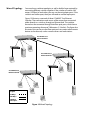
These Fast Ethernet Switches use store and forward as the method for
receiving and transmitting frames. When an Ethernet frame is received
on a switch port, the switch does not retransmit the frame out the
destination port until it has received the entire frame and stored the
frame in a port buffer. It then examines the frame to determine if it is a
valid frame. Invalid frames, such as fragments or runts, are discarded by
the switch. This insures that only valid frames are transmitted out the
switch ports and that damaged frames are not propagated on your
network.
In order to maintain the orderly movement of data between the endnodes, an Ethernet switch may periodically need to signal an end-node
to stop sending data. This can occur under several circumstances. For
example, if two end-nodes are operating at different speeds, the switch,
while transferring data between the end-nodes, might need to instruct
the faster end-node to stop transmitting data to allow the slower endnode to catch up. An example of this would be when a server operating
at 100 Mbps is sending data to a workstation operating at only 10 Mbps.
How a switch signals an end-node to stop transmitting data differs
depending on the speed and duplex mode of the end-node and switch
port. A twisted pair port operating at 100 Mbps port and half-duplex
mode stops an end-node from transmitting data by forcing a collision. A
collision on an Ethernet network occurs when two end-nodes attempt to
transmit data using the same data link at the same time. A collision
causes end-nodes to stop sending data. When the switch needs to stop a
100 Mbps, half-duplex end-node from transmitting data, it forces a
collision on the data link, which stops the end-node. Once the switch is
ready to receive data again, the switch stops forcing collisions. This is
referred to as backpressure.
A port operating at 100 Mbps and full-duplex mode uses PAUSE frames,
as specified in the IEEE 802.3x standard, to stop the transmission of data
from an end-node. Whenever the switch wants an end-node to stop
transmitting data, it issues this frame. The frame instructs the end-node
to cease transmission. The switch continues to issue PAUSE frames until
it is ready again to receive data from the end-node. This is referred to as
flow control.
41