1
Setup and Flying
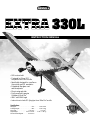
Our new Extra 330L will blow away almost any pilot wanting to
fly aerobatics. When designing this model, I incorporated design
features and enhancements that have been learned from several
years of Tournament of Champions and IMAC competition.
Does this mean the Extra is only for the serious competitor?
Absolutely not! What this does mean is that the Extra is finetuned and tweaked to excel in both precision aerobatics and wild
freestyle type 3D, so doing any aerobatics will be easier than it
has ever been.
Preflight
Before getting to the really fun stuff—flying— I’d like to reiterate
some very important steps that were covered in the assembly
instructions. For those of you who are veterans of large models,
this is old news. But to you new comers to the world of large
models, this is very important info.
While many smaller models are very tolerant of improper control
linkage setups and flying techniques, large models are not. Don’t
let that scare you away from large models; they are truly one of
the best flying experiences in RC that money can buy. However,
please pay particular attention to the following areas:
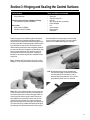
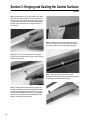
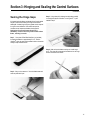
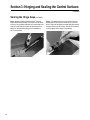
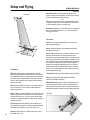
Seal the aileron and elevator hinge gaps.
This should be considered part of finishing the model, and is as
important as installing the fuel tank or battery pack. On large
aerobatic models, this is absolutely necessary. Failure to do this
may very well cause control surface flutter, and on a large model,
this will most likely cause a crash. Putting safety and model
preservation to the side, there are several other reasons to do
this on an aerobatic model. It will increase the effectiveness of
the control surfaces, and the model will track more true and
precise. Hinge gaps sealed? CHECK!
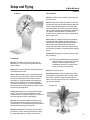
Maintain the proper mechanical advantage on all
control surface linkages.
Same as unsealed hinge gaps, this is often the cause of flutter.
Please follow the control horn and servo arm lengths
recommended in this manual. Shorter arms on the servo or
longer control horns on the elevator and ailerons are fine, but do
not try to go the other way to increase throw. It will cause flutter
on the Extra. The recommended linkage setups are more than
adequate to achieve full 3D throws. That’s straight off of the
prototypes. Linkages are set? CHECK!
Never attempt to make full throttle dives!
Large models perform much more like full-size aircraft than
small models. If the airframe goes too fast, such as in a high
throttle dive, it may fail. The Extra should be flown like a fullscale Extra. Throttle management is absolutely necessary. If the
nose is down, the throttle comes back. CHECK!
by Mike McConville
The Prototype Model Setup
All of the recommended settings in this manual are a result of the
flight testing on the prototype Extras. There are no secrets. If you
follow the instructions and these tips, your Extra will be set up
just like mine.
Although a computer radio is not mandatory, it is preferable in
this model. I use Exponential on all controls to soften the feel
around neutral. This makes it easier to fly smooth in precision
maneuvers and also makes it less likely to over-control in 3D
mode. I use the following expo values: Elevator +38% Low Rate,
+70% 3D Rate. Aileron +40% Low Rate, +55% 3D Rate. Rudder
+25% Low Rate, +50% 3D Rate. Note that + expo values soften
the neutral with JR radios. Other brand systems may require
“-” (negative) expo values to soften the neutral.
I have flown Extras equipped with both JR 8101 servos and JR
8411 digital servos. While both are excellent choices for the
Extra, I personally prefer the feel with the digital 8411 servos; the
model feels slightly more responsive with these servos. I use a
6V NiCad battery pack equipped with a 5.7 V regulator for
maximum speed and torque from the servos.
The prototype Extras were tested on both the Zenoah G-62 as
well as the Zenoah GT-80. With the G-62 for power, the
performance was very good sport power. Vertical performance
was good but not unlimited. I used a Pro-Zinger 22 x 10 prop for
all testing. Even some 3D maneuvers such as Harriers, Blenders,
and Harrier landings were possible; anything that did not require
unlimited vertical.
My personal favorite powerplant is the Zenoah GT-80. I use a
Bolly 24 x 10 propeller, which the GT-80 turns at approximately
7000 rpm, and a preshaped and balanced Bolly 24 x 10 at
7700 rpm. Both work well, but I feel the preshaped prop has the
edge in hovering maneuvers. This combination has proven to be
totally unlimited and allows anything imaginable from torque
rolls just a few inches off the ground to multiple vertical snaps.
I found that adequate engine cooling is very important with the
GT-80 and strongly recommend adding the cowl baffles and
cutting the cowl bottom hole to the size recommended in the
instructions. When this was done, the performance difference
was dramatic. If you aren’t getting this kind of performance, take
a look at the cowl and how well the GT-80 is being cooled.
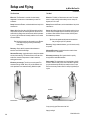
Performance tip: Drill eight 5/16" diameter holes through
the internal baffle plate in the GT-80
mufflers. I drilled seven through the
intake opening and one up through the
exhaust stack. Just be sure to flush out
all of the metal shavings from the
mufflers. This little 10-minute trick will
add 300 rpm to the top end.
33