1
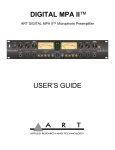
ART Digital MPA™ Microphone Preamplifier
control. The DMPA takes about 10-30 seconds to smoothly transition from one mode to the other.
There is a slight increase in gain in the “High” plate voltage mode.
In the “normal” (OUT) position, the tube distortion gradually rises until it smoothly clips. The tube is
run almost completely open-loop in this mode, providing a musical tube “crunch” when overdriven
with a natural recovery from clipping. The tube section can be more easily overdriven when the
gain switch is in. This mode brings out the harmonics in the input sources, particularly stringed
instruments.
The tube circuit runs extremely clean in the “high” (IN) position of the plate voltage switch. As
signal levels rise distortion remains very low until within 6dB of clipping, where the overload characteristics smoothly limit the signal swing. There is increased bandwidth (>100KHz), and headroom in this mode as well.
Meter Switch
The analog meters can monitor either the output signal at the output jacks (“output” position) or the
tube output level (“tube” position).
VU on the meter measures +4dBu at the output jacks in “output” mode.
When in “tube” mode there is 10 to 15dB of headroom above 0VU before the tube saturates (for
“normal” and “high” plate voltage settings respectively).
Digital Section Front Panel Controls
Digital Level Control
The levels driving the A/D converter are adjusted with this control. The topology of the DMPA
lends itself to simultaneous use of the analog and digital outputs, as each has its’ own level control. Common to both is the output signal of the tube circuit.
The Digital level control is variable from +10dB to -∞ (fully muted).
Located before the Digital level control is the insert jack, allowing processing to be added before
digital conversion.
As the Digital Level control is used refer to the Digital level LED meter which indicates both peak
and average level present at the A/D converter input. This meter helps you get the perfect level
adjustment and avoid clipping the A/D. Refer to the section titled “Obtaining the perfect digital level
setting” for more detail on the operation and use of these features.
Dither Switch
The DMPA possesses a 24-bit A/D converter. When the output of the unit goes off to a system
that can handle only 16 bit data, the 8 least significant bits of data are ignored (truncated). This
leaves the sound with gritty “digital” sounding signals at very low levels. Depressing the Dither
switch adds a dither component that when truncated replaces this with a more musical sound as
the levels trail off into the noise floor.
6