1
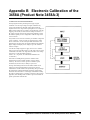
The 3458A Multimeter produces the required step input voltage.
Then, its analog-to-digital converter samples the attenuator output.
These measurement results determine constants used to control the
output of the flatness adjusting DAC. Control of the DAC output
effectively changes the resistance in one leg of the attenuator to
produce the desired maximally flat response. Calibration constants
are separately determined for each
AC range.
AC converters normally have turnover errors. A standard metrology
practice is to use ± signals to correct these errors. A shorter time
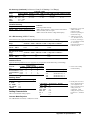
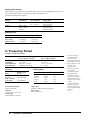
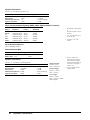
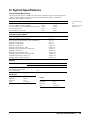
between samples of these ± signals reduces 1/f noise. Thus the 3458A
Multimeter samples at a higher rate to give 1/f rejection, as indicated
in Figure 6.
These signals are applied to the RMS converter and track-and- hold
amplifier paths. Attenuated or amplified levels produce inputs
appropriate for each of six AC voltage ranges. The 3458A Multimeter
measures the correct values of these DC levels with the DC input path
that has already been calibrated. These known values are compared
with the measured gains of the RMS converter and track-and-hold
amplifier paths. Gain constants are the result of transferring accuracy
between ranges, as discussed under DC gain adjustments.
Gain of the RMS converter is non-linear at one-tenth full scale. This
non-linearity is effectively an offset corrected by applying the
chopped DC levels at one-tenth the full-scale voltage.
One-time Adjustments
The following electronic adjustments are only performed once at the
factory or following repair of the circuitry involved.
1. Determine the actual frequency value of the crystal used for
frequency and period measurements.
2. Adjust time base interpolator accuracy.
3. Adjust high frequency response of the AC attenuator and
amplifier by transfer of accuracy at 100 kHz to 2 MHz and
8 MHz.
Traceability
The above methods result in all functions and ranges being traceable
to one or both of the internal reference standards. These internal
standards are, in turn, traceable to the external standards. The problem
is knowing the uncertainty to which they are traceable. The answer
lies in knowing the maximum uncertainty of each transfer
measurement made. The dominant sources of transfer uncertainty are
the linearity errors of the internal circuits and the noise of each
measurement. Each transfer measurement contributes some error.
With multiple transfers between ranges, the error is cumulative.
However, the excellent short-term stability of the internal references
and the superior linearity of the analog-to-digital converter minimizes
these errors. For example, the cumulative transfer error for the 3458A
Multimeter is less than 1 part per million on the lower three DC volt
ranges.
All calibration transfer errors and noise errors are included in the
published accuracy specifications of the 3458A Multimeter.
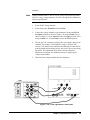
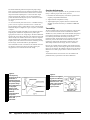
Figure 5.
The frequency
response of the AC
attenuator is
adjusted based on
two readings taken
at specific delays
after application of
a step input.
Shown in this
drawing are two
different
uncompensated
responses
representing under
shoot and
overshoot.
104
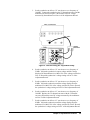
Figure 6.
Positive and negative
signals are internally
provided to eliminate
turnover errors. This
input is also sampled
at a higher rate to
reject 1/f noise.
Appendix B Electronic Calibration of the 3458A (Product Note 3458A-3)