1
IMPORTANT SAFEGUARDS AND WARNINGS
Prior to installation and use of this product, the following WARNINGS should be observed.
1.
Installation and servicing should only be done by qualified service personnel and
conform to all local codes.
2.
Unless the unit is specifically marked as a NEMA Type 3, 3R, 3S, 4, 4X, 6, or 6P
enclosure, it is designed for indoor use only and it must not be installed where
exposed to rain and moisture.
3.
Only use replacement parts recommended by Pelco.
4.
After replacement/repair of this unit’s electrical components, conduct a resistance
measurement between line and exposed parts to verify the exposed parts have not
been connected to line circuitry.
5.
Unit shall not be exposed to dripping or splashing. No objects filled with liquids, such
as vases, should be placed on the unit.
6.
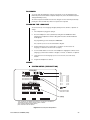
Product ID label is located on the bottom of this unit. Please refer to product ID label
for important operating information.
Please thoroughly familiarize yourself with the information in this manual prior to installation
and operation.
DESCRIPTION
WHAT IS A VIDEO MULTIPLEXER?
A multiplexer lets you record pictures from up to 16 cameras on a single time-lapse VCR.
You can also watch up to 16 cameras simultaneously on one screen, either live or in
playback. For closer detail, you can choose full-screen viewing without losing detail (as
occurs with “quad” devices that compress four pictures into one for recording).
The multiplexer acts as an interface between the CCTV cameras and the time-lapse VCR.
It switches between cameras much like a sequential switcher, except a multiplexer must
switch at exactly the same rate as the VCR is recording so just one video picture (field) is
recorded from each camera before it switches to the next camera. The reason is that, with
several cameras, you need to switch as quickly as possible to minimize the time gap
between successive pictures from a particular camera.
Time-lapse VCRs are similar to home VHS recorders except time-lapse VCRs can record
as many as 960 hours of video on a single T-120 (two-hour) VHS cassette. Even the lowest
cost models have longer recording times than a normal consumer VCR.
If you connect one camera to a multiplexer and record at two-hour speed on a time-lapse
recorder, motion appears normal when you play the tape. But as you add more cameras to
the multiplexer, it must switch between cameras, allowing a gap in the pictures recorded for
any one camera. The more cameras, the longer the gap. Motion on playback becomes
jerky because of missing video.
Not only does the number of cameras affect the time gap, so does recording speed. The
slower the speed, the longer the gap. Normal recording speed for full motion is two-hour
mode. Recording 12, 48, or 960 hours of video on a two-hour tape means a lot of video is
left out.
Thus, the more cameras and the slower the recording speed, the longer the time gap
between recorded pictures for each camera. Also, having both black and white and color
cameras together in a system—rather than just one kind—slows switching. Important video
could be lost.
4
Pelco Manual C1920M-D (4/03)