1
In order to understand how voice communications would be treated in a data network, let’s first take a
look at the typical topologies of voice and data networks running separately.
Understanding Voice Networks
Public Switched Telephone Network
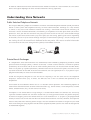
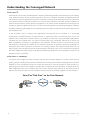
For the past 100 years, people have relied on the Public Switched Telephone Network (PSTN), otherwise
known as POTs (Plain Old Telephone Service), for voice communication. Although it is very reliable,
it utilizes a very basic and inefficient method for making a connection called circuit-switching. To
illustrate a circuit-switched connection, the following is the process that takes place when you make a
phone call. First, you dial the number of the party you wish to talk to. The call is then routed through
the switch at your local central office (CO) to the party you are calling, opening the circuit. Depending
on location, the call may be routed through multiple CO connections opening a circuit through each
one. During the call, the routed line is dedicated to the two parties. This means no other information
can travel over the line, even though there is plenty of bandwidth available.
Private Branch Exchanges
In a corporation, voice communication has traditionally been handled by proprietary platforms called
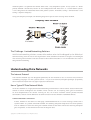
private branch exchanges (PBXs). A PBX is essentially a switch used to connect a number of phones
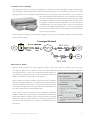
(extensions) to each other and to one or more outside phone lines. To illustrate how the PBX works,
when a user picks up a phone (extension) a PBX dial tone will be heard. At this point, the user can dial
any other extension on the PBX. To reach an outside line, the user typically dials a “9” (or presses a preprogrammed button) to access the PSTN network.
A PBX was originally designed to save the cost of requiring a line for each user to the telephone
company’s central office (CO). In effect, the PBX acts like a mini-CO, owned and operated by the
corporation.
A limitation to the traditional PBX is that it is a location-centric platform. The networking options to
extend voice communications to other remote locations (e.g. branch offices, sister companies, satellite
offices, telecommuters, etc.) are few and can be costly.
One option, if the remote office is large enough, is to add another PBX at the remote site, and set up
a private network between the two with leased lines (tie lines) purchased from the phone company.
To make an outgoing call to the remote office, the user would dial an “8” (or press a pre-programmed
button) to access the tie line and then dial the remote office extension. Tie lines, however, are expensive
because they add extra monthly phone charges. And, the telecommunications manager may be faced
with the challenge of tying together two dissimilar proprietary PBX systems that were not designed to
be networked together.
2
Copyright © 2003 Multi-Tech Systems, Inc. All rights reserved.