1
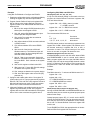
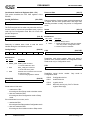
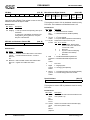
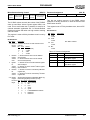
ES1879 DATA SHEET PRELIMINARY PROGRAMMING THE ES1879 PROGRAMMING THE ES1879 Identifying the ES1879 The ES1879 can be identified by reading Mixer Extension register 40h successfully. Mixer Extension register 40h returns the following 8-bit values on four successive reads: 18h, 79h, A[11:8], A[7:0] where 18h and 79h are data reads indicating the part number (1879) and A[11:0] is the base address of the configuration device. Writing to the Mixer Address register (Audio_Base+4h) resets the sequence so that the next read of 40h returns 18h. Resetting the Audio Device via Software The ES1879 audio embedded microcontroller can be reset in one of two ways: hardware reset or software reset. The hardware reset signal comes from the ISA bus. Software reset is controlled by bit 0 of port Audio_Base+6h. To reset the ES1879 audio microcontroller by software: 1. Write a 1 to port Audio_Base+6h. 2. Delay a short period, for example, by reading back Audio_Base+6h for 10 msecs. 3. Write a 0 to port Audio_Base+6h. 4. In a loop that lasts at least 1 msec, poll port Audio_Base+Eh bit 7=1 for read data available. If bit 7=1, then read the byte from port Audio_Base+Ah. Exit the loop if the content is 0AAh; otherwise, continue polling. Both hardware reset and software reset will: Disable Extended mode. Reset the timer divider and filter registers for 8 kHz In addition to performing actions on the above list, a hardware reset will reset all Mixer registers to default values. Modes of Operation The ES1879 can operate the first audio channel in one of two modes: Compatibility mode or Extended mode. In both modes, a set of mixer and controller registers enables application software to control the analog mixer, record source, and output volume. Programming the ES1879 Enhanced Mixer is described later in this document. See “Programming the ES1879 Mixer” on page 59. Compatibility Mode Description The first mode, Compatibility mode, is compatible with the Sound Blaster Pro. This is the default mode after reset. In this mode, the ES1879 microcontroller is an intermediary in all functions between the ISA bus and the CODEC. The ES1879 microcontroller performs limited FIFO functions using 64 bytes of internal memory. Extended Mode Description The ES1879 also supports an Extended mode of operation. In this case, a 256-byte FIFO is used as an intermediary between the ISA bus and the ADC and DAC Control registers, and various Extended mode controller registers are used for control. The ES1879 microcontroller is mostly idle in this mode. DMA control is handled by dedicated logic. Programming for Extended mode operation requires accessing various control registers with ES1879 commands. Some of these commands are also useful for Compatibility mode, such as those that configure DMA and IRQ channels. sampling. Stop any DMA in progress. Clear any active interrupt request. Disable voice input of mixer (see the D1h/ D3h commands). Reset Compatibility mode and Extended mode DMA counters to 2048 bytes. Set analog direction to be DAC, with the DAC value set to mid-level. Set input volume for 8-bit recording with AGC (Automatic Gain Control) to maximum. Set input volume for 16-bit recording to mid-range. ESS Technology, Inc. SAM0025A-062397 47