1
Classic With Blower Installation and Operation Manual
•
•
•
•
•
•
•
•
•
Flue pipe joints should overlap 30 mm (1 1/4 in.)
Each joint in the assembly must be fastened with at least three screws.
The assembly must have allowance for expansion: elbows in assemblies allow for
expansion; straight assemblies should include an inspection wrap with one end
unfastened, or a telescopic section.
Minimum upward slope towards the chimney: 20 mm/m (1/4 in/ft.).
One end of the assembly must be securely fastened to the flue collar with 3 sheet
metal screws and the other end securely fastened to the chimney.
There must be provision for cleaning of the pipes, either through a clean out or by
removal of the pipe assembly. Removal of the assembly should not require that the
stove be moved.
The male ends of the sections must be oriented towards the appliance so that falling
dust and condensation stay inside the pipe.
A flue pipe must never pass through a combustible floor or ceiling or through an attic,
roof space, closet or concealed space.
Where passage through a wall or partition of combustible construction is desired, the
installation shall conform to CAN/CSA-B365, Installation Code for Solid-Fuel-Burning
Appliances and Equipment.
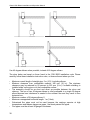
The ideal flue pipe assembly is one that rises straight up from the appliance flue collar and
directly into the chimney with no elbows. A straight up connector assembly needs either a
telescopic length or an inspection wrap (pipe coupler) to allow it to be assembled and
disassembled without moving the stove.
A straight flue pipe assembly offers the least restriction to gas flow and results in stronger
draft. Straight assemblies also need less maintenance because there are no corners to
collect creosote.
The chimney connector must be in good condition.
39