1
REFRESHING MOISTURE
. . . AS NATURE INTENDED
Congratulations on your excellent choice
and sound investment in this addition to
your home comfort system.
Your humidifier represents both the latest
in engineering development and the culmination of many years of experience
from one of the most reputable manufacturers of comfort systems.
Your new unit is among the most energyefficient and reliable home humidifiers
available today. To assure its dependability, spend a few minutes now with this
booklet. Learn about the operation of
your humidifier and the small amount of
maintenance it takes to keep it operating
at peak efficiency.
With minimal care, your humidifier will
provide you and your family with moist,
spring-fresh air—from season to season
and year to year.
YOUR HOME HUMIDIFIER
lustrous appearance. Houseplants thrive.
Static electricity is significantly reduced
in a properly humidified home. Your family will breathe more easily and find relief
from the cool, drafty feeling commonly
experienced in overly dry homes. The additional moisture supplied by your humidifier may enable you to reduce the
temperature setting on your thermostat—
without any loss of indoor comfort.
HOW YOUR HUMIDIFIER
WORKS
Your humidifier adds water molecules to
the air inside your home. Although the
rate of humidification is variable, it may
exceed one-half gallon of water per hour.
That’s a healthy drink for a dry household. The typical process of humidification begins when water flows through the
humidifier valve and soaks the large
evaporator pad. Hot, dry air from the furnace passes through the pad and absorbs
the water. Then, this moisture-laden air is
distributed throughout the house via the
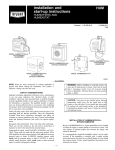
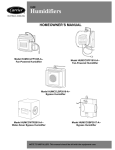
ductwork. See Fig. 1, 2, and 3.
YOUR HOME CAN BE DRIER
THAN DEATH VALLEY
During the heating season, your home
can become uncomfortably dry. This is
because cold winter air holds very little
moisture. When outdoor air is warmed to
average room temperature, its relative
humidity falls to even lower levels. Refer
to Table 1 for a comparison of the levels
of relative humidity for a few sample
environments.
EVAPORATOR
PAD
DRY
AIR
HUMIDIFIED
AIR
DRAIN
Fig. 1
Table 1—Relative Humidity
Comparison
DRY
AIR
HEATED HOME
RECOMMENDED
RELATIVE
HUMIDITY
35%
SAHARA
DESERT
DEATH
VALLEY
25%
23%
HEATED HOME
AVERAGE
HUMIDIFIED
AIR
5-15%
Parched air can cause the wood used in
the construction of your house and furnishings to dry, crack, and split. Draperies and upholstery may age prematurely.
Annoying static electric shock and cling
are more prevalent. Your throat, nasal
passages, sinuses, and skin are more
susceptible to irritating dryness. You may
even have to set the thermostat higher
than otherwise necessary—just to feel
warm.
Fig. 2
Your new humidifier is designed to operate as part of your home heating system.
It will perform at maximum efficiency
if these recommendations are
followed:
• The humidifier is controlled by a humidistat. Adjust the humidistat setting
according to the outside temperature.
Refer to Table 2 as a general guide. If after
several days, the air in your home seems
too moist, lower the humidistat setting.
Condensation on single-pane windows
indicates excessive moisture. If the air is
too dry, increase the setting. Dry throat
and nasal passages indicate dry air.
• All models come with a humidistat.
Continuous blower operation provides for
constant humidification. It may also contribute to greater personal comfort
because continuous blower operation
minimizes temperature differences
throughout the home. Furthermore, a
system equipped with an electronic air
cleaner offers the added benefit of fulltime air filtration.
• Supply- and return-air grilles should
not be blocked by items such as drapes,
furniture, and toys. Restricted airflow
reduces the efficiency of the humidifier,
as well as that of the whole comfort
system.
• The humidifier unit must be properly
maintained on a regular basis.
STARTUP PROCEDURES
1. Open the saddle valve on the
water supply line. (See Fig. 4.) Set
humidistat to the desired relative
humidity. (See Fig. 5 and Table 2.)
2. Turn the furnace on and adjust the
thermostat to a high temperature
setting. Be sure that the furnace
blower is operating.
3. Check to see if water is flowing into
the humidifier.
Table 2—
Humidistat Settings
TYPICAL
INSTALLATIONS
MOISTURE MAKES A
REFRESHING DIFFERENCE
Proper humidity control can alleviate
problems caused by excessive dryness.
Furnishings and fabrics take on a more
OPERATING YOUR
HUMIDIFIER
Fig. 3
—2—
OUTSIDE
TEMPERATURE
(°F)
–20
–10
–0
10
20
30
RECOMMENDED
HUMIDISTAT
SETTING
(% RELATIVE
HUMIDITY)
15
20 (LOW)
25
30
35
40 (MED)