1
DRAFT COPY – DO NOT DISTRIBUTE
Guidelines
The best approach to learning EVOLVE is to run the examples included in this guide. Then
try different substrate profiles for the same processes. Then change the various parameters in
the input file to see how they affect the film profile predictions. For example, if global
kinetic expressions are being used, change the operating conditions to get a feel for their
impact on sticking factors and hence film conformality or step coverage. Of course,
changing the assumed kinetics (parameters in the kinetic expression) of the deposition will
change the film profile predictions. Nevertheless, this may be instructional in order to get
the feel of the dependence of profile evolution on a system’s kinetic parameters. After
running the examples provided and perhaps reading some background on the model upon
which the simulator is based, you should be able to build your own data files. One basic data
file is generally enough for a given process chemistry. Changes to this file can be made to
simulate processes on other starting profiles or to test other kinetic expressions.
EVOLVE has several features designed to improve the accuracy of the predicted rates along
the feature surfaces and hence film profiles. For example, the distance between nodes can be
automatically adjusted after each step in the process in order to be about the same. This
improves accuracy for given number of nodes, particularly in the presence of surface
diffusion. Another feature of EVOLVE which can be used to improve the accuracy of the
simulation results is that the step size is adjusted automatically based on intersections of the
growth vectors.
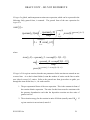
In the low pressure code (EVLP), EVOLVE also has several features added to enhance
convenience for longer simulations. Because of the large number of equations which are
solved during the deposition simulation (easily several thousand), the nonlinear over
relaxation method (NLORM) is used in subroutine CYCLER in which the local film
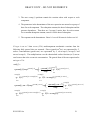
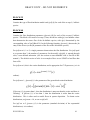
deposition rates are determined. The NLORM parameter relax is input for use in CYCLER,
in addition to the tolerance (upper limit on changes in the unknowns). Relax is a relaxation
parameter, and is often set to one. If the method does not converge in the input maximum
number of steps, you have the option of asking the program to continue with the value of
relax the same or altered. If this occurs, then you may be using a value which is too
conservative (relax too small) If the NLORM method "blows up", you have the option of
EVOLVE5.0i.a
9