1
Our verification method is based on using the approach of abstract regular tree
model checking (ARTMC) [9]. In regular tree model checking, configurations of the
systems being examined are encoded as trees over a suitable ranked alphabet, sets of
configurations are described by tree automata, and transitions of the systems are encoded as tree transducers. Subsequently, one computes the set of all configurations
reachable from an initial set of configurations by repeatedly applying the tree transducers on the set of the so-far reached configurations (encoded as tree automata). In
order to make the method terminate as often as possible and to fight the state explosion
problem arising due to increasing sizes of the automata to be handled, various kinds of
automatically refinable abstractions over automata are used in ARTMC.
In order to be able to apply ARTMC for verification of programs manipulating
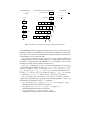
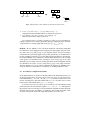
dynamic linked data structures, whose configurations (shape graphs) need not be treelike, we propose an original encoding of shape graphs based on tree automata. We use
trees to encode the tree skeleton of a shape graph. The edges of the shape graph that
are not directly encoded in the tree skeleton are then represented by routing expressions
over the tree skeleton—i.e., regular expressions over directions in a tree (as, e.g., left
up, right down, etc.) and the kind of nodes that can be visited on the way. Both the
tree skeletons and the routing expressions are automatically discovered by our method.
The idea of using routing expressions is inspired by PALE [28] and graph types [24]
although there, they have a bit different form (see below) and are defined manually.
Next, we show how all pointer-manipulating statements of the C programming language (without pointer arithmetics, recursion, and with finite-domain non-pointer data)
may be automatically translated to tree transducers over the proposed tree-automatabased representation of sets of shape graphs.
We implemented our method in a prototype tool based on the Mona tree libraries
[23]. We have tested it on a number of non-trivial procedures manipulating singly-linked
lists (SLL), doubly-linked lists (DLL), trees (including the Deutsch-Schorr-Waite tree
traversal), lists of lists, and also trees with linked leaves. To the best of our knowledge,
verifying some properties on trees with linked leaves have so-far not been considered
in any other fully automated tool. The experimental results obtained from our tool are
quite encouraging (and, moreover, we believe that there is still a lot of room for further improvements as we have, e.g., not used the mechanism of Mona’s guided tree
automata, we have used general-purpose, not specialised abstractions as in [11], etc.).
Related Work. There have been and there are currently being investigated various approaches to verification of programs manipulating dynamic linked data structures that
differ in the degree of automation, generality, and/or principles used. Out of these techniques, we mention TVLA based on 3-valued predicate logic with transitive closure [29,
26], PALE based on WSkS and tree automata [28], approaches based on predicate abstraction [4, 27], memory patterns [32, 15], graph grammars [25], separation logic [18],
alias logic [14], or various (extended) automata [20, 17, 7]. Among these approaches,
our method belongs to the most automated and at the same time most general ones.
The closest approach to what we propose here is the one of PALE that also uses
tree automata (derived from WSkS formulae) as well as the idea of a tree skeleton and
routing expressions. However, first, the encoding of PALE is different in that the routing expressions must deterministically choose their target, and also, for a given memory
node, selector, and program line, the expression is fixed and cannot dynamically change