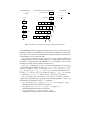
1
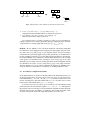
Further, in our Mona-based framework, we encode routing expressions using tree
transducers. A transducer representing a routing expression r simply copies the input
tree memory backbone on which it is applied up to: (1) looking for a data node n 1 that is
labelled with a special token 6∈ V ∪ M ∪ D and (2) moving to a data node n 2 that is
the target of the next pointer described by r and that is also marked with the appropriate
marker. As described in the next section, we can then implement program statements
that follow the next pointers (e.g., x = y->s) by putting the token to a node pointed
to by x, applying the transducer implementing the appropriate routing expression, and
making y point to the node to which was moved. Due to applying abstraction, the target may not always be unique—in such a case, the transducer implementing the routing
expression simply returns a set of trees in which is put to some target data node such
that all possibilities where it can get via the given routing expression are covered.
Note that the use of tree transducers for encoding routing expressions allows us
in theory to express more than using just regular expressions. In particular, we can
refer to the tree context of the nodes via which the given route is going. In our current
implementation, we, however, do not use this fact.
4.3 Encoding Program Statements as Tree Transducers
We encode every of the considered pointer-manipulating statements as a tree transducer.
In the transducer, we expect the tree memory encoding to be extended by a new root
symbol which corresponds to the current program line or to an error indication when
an error is found during the analysis. We now briefly describe how the transducers
corresponding to the program statements work. Each transducer is constructed in such
a way, that it simulates the effect of a program statement on a set of shape graphs
represented by a tree automata memory encoding: if a shape SG represented by a tree
memory encoding is transformed by the program statement to a shape graph SG 0 , then
the transducer transforms the tree memory encoding such that it represents SG 0 . This
makes sure, that although the encoding is non canonical (see end of section 4.1), we
simulate faithfully a program statement.
Non-destructive Updates and Tests. The simplest is the case of the x = NULL assignment. The transducer implementing it just goes through the input tree and copies it
to the output with the exception that (1) it removes x from the labelling of the node in
which it currently is and adds it to the labelling of the null node and (2) changes the current line appropriately. The transducer implementing an assignment x = y is similar, it
just puts x not to the null node, but to the node which is currently labelled by y.
The transducers for the tests of the form if (x == null) goto l1; else goto
l2; are very similar to the above—they just do not change the node in which x is, but
only change the current program line to either l1 or l2 according to whether or not
x is in the null node. If x is in undef , an error indication is used instead of l1 or l2.
The transducers for if (x == y) goto l1; else goto l2; are similar—they just
test whether or not x and y appear in the same node (both different from undef ).
The transducer for an x = y->s statement is a union of several complementary
actions. If y is in null or undef , an error is indicated. If y is in a regular data node and