1
T
ASK
MANAGER
Embedded systems Abound
THE WORLD’S SOURCE FOR EMBEDDED ELECTRONICS ENGINEERING INFORMATION
EDITORIAL CALENDAR
August 2012 – Issue 265
I
2
recently read on CNN.com the transcript of an interview
(May 9, 2002) with arachnologist Norman Platnick who stated: “You're probably within seven or eight feet of spider no
matter where you are. The only place on earth that has no
spiders at all—as far as we know—is Antarctica.” It didn’t
take long for me to start thinking about embedded systems
and my proximity to them. Is the average person always
within several feet of embedded systems? Probably not. But
what about 50% or 60% of the time? E-mail me your
thoughts.
Embedded systems are becoming ubiquitous. They’re in
vehicles, mobile electronics, toys, industrial applications,
home appliances, and more. If you’re indoors, the temperature is likely monitored and controlled by an embedded
system. When you’re engaged in outdoor activities (e.g.,
hiking, golfing, biking, or boating), you probably have a few
MCU-controlled devices nearby, such as cell phones,
rangefinders, pedometers, and navigation systems. This
month we present articles about how embedded systems
work, and our authors also provide valuable insight about
topics ranging from concurrency to project development.
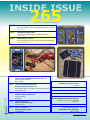
Mark Pedley kicks off the issue with a revealing article
about a tilt-compensating electronic compass (p. 16). Now
you can add an e-compass to your next MCU-based project.
Turn to page 24 for an in-depth interview with Italy-based
engineer Guido Ottaviani. His fascination with electronics
engineering, and robotics in particular, will inspire you.
Have you ever come across a product that you know you
could have designed better? Scott Weber had that experience and then acted on his impulse to build a more effective
system. He created an MCU-based light controller (p. 32).
If you want to ensure a microcontroller works efficiently
within one of your systems, you should get to know it inside
and out. Shlomo Engelberg examines the internal structure
of an I/O pin with a pull-up resistor (p. 40).
Bob Japenga continues his series “Concurrency in
Embedded Systems” on page 44. He covers atomicity and
time of check to time of use (TOCTTOU).
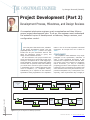
On page 48 George Novacek presents the second part of
his series on project development. He covers project milestones and design reviews.
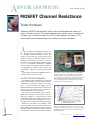
Ed Nisley’s June 2012 article introduced the topic of MOSFET channel resistance. On page 52 he covers MOSFET
tester circuitry and provides test results.
If you read Robert Lacoste’s June 2012 article, you now
understand the basics of frequency mixers. This month he
presents high-level design methods and tools (p. 58).
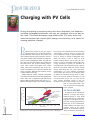
Jeff Bachiochi wraps up the issue with an examination of
a popular topic—energy harvesting (p. 68). He covers PV cell
technology, maximum power point tracking (MPPT), and
charge management control.
[email protected]
2
Issue 194
September 2006
I ssUE
258 January
259 february
260 March
261 April
262 May
263 June
264 July
265 August
266 september
267 October
268 November
269 December
T HEME
Embedded Applications
Wireless Communications
Robotics
Embedded Programming
Measurement & sensors
Communications
Internet & Connectivity
Embedded Development
Data Acquisition
signal Processing
Analog Techniques
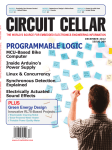
Programmable Logic
Analog Techniques: Projects and components dealing with analog signal
acquisition and generation (e.g., EMI/RF reduction, high-speed signal integrity,
signal conditioning, A/D and D/A converters, and analog programmable logic)
Communications: Projects that deal with computer networking, human-tohuman interaction, human-to-computer interaction, and electronic information
sharing (e.g., speech recognition, data transmission, Ethernet, USB, I2C, and SPI)
Data Acquisition: Projects, technologies, and algorithms for real-world data
gathering and monitoring (e.g., peripheral interfaces, sensors, sensor networks, signal conditioning, A/D and D/A converters, data analysis, and postprocessing)
Embedded Applications: Projects that feature embedded controllers and
MCU-based system design (e.g., automotive applications, test equipment,
simulators, consumer electronics, real-time control, and low-power techniques)
Embedded Development: Tools and techniques used to develop new hardware or software (e.g., prototyping and simulation, emulators, development
tools, programming languages, HDL, RTOSes, debugging tools, and useful tips
and tricks)
Embedded Programming: The software used in embedded applications
(e.g., programming languages, RTOSes, file systems, protocols, embedded
Linux, and algorithms)
Internet & Connectivity: Applications that deal with connectivity and
Internet-enabled systems (e.g., networking chips, protocol stacks, device
servers, and physical layer interfaces)
Measurement & sensors: Projects and technologies that deal with sensors,
interfaces, and actuators (e.g., one-wire sensors, MEMS sensors, and sensor
interface techniques)
Programmable Logic: Projects that utilize FPGAs, PLDs, and other programmable logic chips (e.g., dynamic reconfiguration, memory, and HDLs)
Robotics: Projects about robot systems, devices capable of repeating motion
sequences, and MCU-based motor control designs (e.g., mobile robots, motor
drives, proximity sensing, power control, navigation, and accelerometers)
signal Processing: Projects and technology related to the real-time processing
of signals (e.g., DSP chips, signal conditioning, ADCs/DACs, filters, and comparisons of RISC, DSP, VLIW, etc.)
Wireless Communications: Technology and methods for going wireless (e.g.,
radio modems, Wi-Fi/IEEE 802.11x, Bluetooth, ZigBee/IEEE 802.15.4, cellular,
infrared/IrDA, and MCU-based wireless security applications)
UPCOMING IN CIRCUIT CELLAR
fEATUREs
Miniature Accelerometers, by Mark Csele
fAT Cache for fast sD Card Access, by Kerry Imming
MCU-Based Environmental Data Logger, by Brian Beard
COLUMNs
flowcharting Made simple, by Jeff Bachiochi
software & Design file Organization, by George Martin
Hardware-Accelerated Encryption, by Patrick Schaumont
®
CIRCUIT CELLAR
Project Configuration Control, by George Novacek