1
Traveling with Lithium Ion batteries
Disposing of a battery
With a Lithium Ion battery, certain
restrictions on travel apply. If the terminals
are shorted on a Lithium Ion battery, it
can cause the battery to overheat and
possibly cause a fire. For this reason,
airlines do not allow Lithium Ion batteries
in checked baggage; you must put
Lithium Ion batteries in your carry-on.
Always check with the carrier before
traveling with Lithium Ion batteries.
Under normal conditions, this battery
should last for 300 to 400 charges. The
battery will eventually lose strength. When
the charge no longer lasts as long as it
should, please recycle the old battery.
You can find out where to do this at
call2recycle: http://www.call2recycle.org/
Extending the battery life
The Transmitr battery is a long-life
system. The expected life of the battery is
300 to 400 charges. To extend the battery
life, store it in a mostly-charged (not fullycharged) condition at room temperature,
and avoid extreme temperatures when
recharging.
Storing a battery
When not using the light for long periods
of time such as a week or more, store it
at room temperature in a dry place. Avoid
moisture, or extreme hot or cold.
Store the light with the battery in the
charged condition. Battery life will
decrease if the battery is stored in a fullydischarged condition.
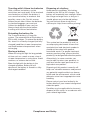
This symbol on the product(s) and / or
accompanying documents means that
used electrical and electronic products
should not be mixed with general
household waste. For proper treatment,
recovery and recycling, please take this
product(s) to designated collection points.
Alternatively, in some countries you
may be able to return your products to
your local retailer upon purchase of an
equivalent new product.
Disposing of this product correctly will
help save valuable resources and prevent
any potential negative effects on human
health and the environment, which could
otherwise arise from inappropriate waste
handling.
Please contact your local authority for
further details of your nearest designated
collection point.
Penalties may be applicable for incorrect
disposal of this waste, in accordance with
your national legislation.
iv
Compliance and Safety