1
174
J.C. Karst et al.
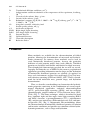
and d the hydration of the macromolecule (g/g). r is the
solvent density (g/mL).
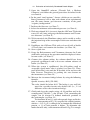
18. Here is a theoretical example describing how to access to
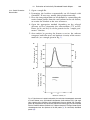
hydrodynamic parameters from M, ½ and RH (Fig. 4). We
consider a protein with a molecular mass of 50,000 g/mol,
an intrinsic viscosity of 12 mL/g, a partial specific volume of
0.73 mL/g, a sedimentation coefficient of 3 S (3 1013 s)
and a translational diffusion coefficient of 5.6 107 cm2/s.
The macromolecule is studied at 25 C in Hepes 20 mM, NaCl
150 mM pH 7.4 of density 1.00382 g/mL and viscosity
0.00908 poise (or 0.00908 g/cm s).
We first calculate the hydrodynamic radius (RH ) using the
Svedberg equation:
RH ¼ M ð1 rnÞ=ð6pNA s Þ
with M in g/mol, r in g/mL, n in mL/g, in poise and s in
seconds.
RH ¼ 50; 000ð1 1:00382 0:73Þ
6p 0:00908 NA 3 1013
RH ¼ 4:32 107 cm
Alternatively, the hydrodynamic radius RH can be calculated from the translational diffusion coefficient measured by
QELS using the Stock Einstein relation
RH ¼ ðkB T Þ=ð6pDt Þ
with kB ¼ 1.38 1016 g cm2/s2K, T in Kelvin, in poise and
Dt in cm2/s.
RH ¼ 1:38 1016 298 6p 0:00908 5:6 107
RH ¼ 4:32 107 cm
From the RH , we calculate the hydrodynamic volume (VH )
of the macromolecule according to
3
VH ¼ 4pRH
=3
with RH in cm.
3
VH ¼ 4pð4:32 107 Þ =3
VH ¼ 3:38 1019 cm3
l
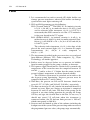
According to the first approach, the shape factor (the viscosity increment, n) is calculated using the Einstein viscosity relation:
n ¼ M ½=VH NA
with M in g/mol, ½ in mL/g, and VH in cm3.