1
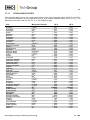
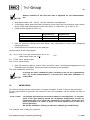
21 17.1.2 CONSIDERATION OF CROSS SENSITIVITIES The selectivity of the above mentioned measuring principle is based on the high suscep tibility of oxygen to other gases (see table). The following examples shall show how cross sensitivities can be considered for the zero calibr ation. Example 1: Determination of the rest content of oxygen in a 100% carbon dioxide (CO2) protective atmosphere at 20°C In the table of cross sensitivities you can read the value for CO 2 at 20°C of –0,27. This means that for calibration with nitrogen the zero point must be set to +0,27% in order to compensate the deviation of the display. In this example, the atmosphere contains exclusively CO 2 and O 2. For this reason, the influence of cross sensitivity can be eliminated without problem by using carbon dioxide (CO 2) instead of nitrogen for the zero calibration. Example 2: Determination of the oxygen content of a gas mixture at 20°C 1 Vol.% C2H6 (Ethane); 5 Vol.% O 2; 40 Vol.% CO 2; 54 Vol.% N2. Zero point calibration with nitrogen (N 2). The cross sensitivity values of above table are based on 100 Vol.% of the respective gases. Therefore, a conversion must be maid to the effective volume concentration. In principle, the fo llowing is valid: Effective cross sensitivity = Table value * Volume concentration [Vol.%] 100 For the components of the gas mixture, the following values are found: C2H6 : -0,0043 Vol.%; CO2 : -0,1080 Vol.%; N2 : 0,0000 Vol.%. = -0,1123 Vol.% To determine the sum of cross sensitivity as exactly as possible, a correction factor has to be determined, because the sum of cross sensitivities relates not on 100% but on 100% minus the oxygen concentration (here 95%). Gas sampling and gas conditioning technology 9-1.1-ME