1
6.2.6
UNC_
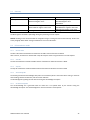
The Uncertain line, UNC_, line is bidirectional and shall not be driven. It is an output during a recognition operation
and an input during a learning operation.
UNC_ is pulled down when the neurons recognizing the last input vector have different categories. This update
occurs each time a Write LCOMP is executed whether it is initiated by an external controller or by the internal
rd
recognition logic of the chip. The actual update occurs at the 3 negative edge of the clock during the execution of
the Write LCOMP. The UNC_ line is released at the next Write COMP.
Note that UNC_ is always pulled down if the mode is KNN and 2 committed neurons have different categories.
The UNC_ line is also continuously latched in bit [2] of the NSR and RSR registers of the chip. at the positive edge of
the clock.
During a Write CAT, this line is asserted by the neurons if the last input vector is recognized as a novelty and must
be stored into a new neuron.
6.3
6.3.1
Other I/O lines
U
S_CHIP
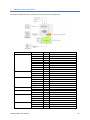
By default the S_CHIP pin is pulled down to configure the parallel bus (DS, RW_l, REG and DATA) as bidirectional
and allow the neurons of multiple CM1K chips to receive commands synchronously and interact with one another.
In order to considerably reduce the power consumption of the CM1K, the S_CHIP pin can be pulled up in the case
of a design with a single CM1K chip connected to a control unit via its I2C bus. If S_CHIP=1, the bidirectional
parallel bus is disabled. Furthermore, if the reco logic is active (RECO_EN=1) and RSR[1]=1, the DATA lines outputs
the last recognized category (equivalent to the RT_CAT register) at each CAT_VAL pulse.
6.3.2
DCI
Until the DCI line of a CM1K chip is high, its neurons are idle. As soon as the DCI line rises, the neurons of the chip
become active, meaning ready to learn and recognize.
In a configuration with multiple chips, the Daisy-Chain-In (DCI) line of the first CM1K chip must be high. For the
subsequent chips, the connection between their DCO and DCI lines allows to physically arrange them in a chain.
The DCI line of a CM1K must be connected to the DCO of the previous CM1K chip in the chain. Its status is then
controlled by the neurons of the previous chip.
6.3.3
DCO
The Daisy-Chain-Out (DCO) line of a CM1K must be connected to the DCI of the next CM1K chip in the chain, if
applicable. It is low by default and will rise when the last neuron of the chip gets committed. If this line is
connected to the DCI of another CM1K chip, the later will awake its neurons to become Ready-To-Learn.
CM1K Hardware User’s Manual
39