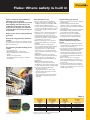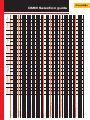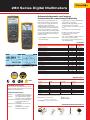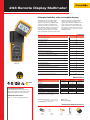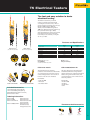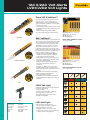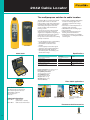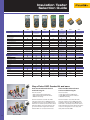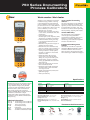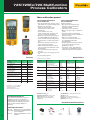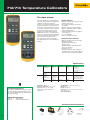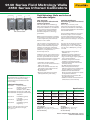
1
2012 2013 Test Tools Catalog Digital Multimeters Portable Appliance Testers Power Quality Tools Clamp Meters Digital Thermometers Field Calibrators Electrical Testers Thermal Imagers Vibration Tester Insulation Testers Distance Meters Radiation Tester Earth Ground Testers Indoor Air Quality Tools EX Test Tools Installation Testers ® ScopeMeter Test Tools Accessories Contents Fluke web and electronic newsletter .................................................... 1 New from Fluke........................................................................................ 2-3 Fluke Combo Kits..................................................................................... 4-5 Application/background articles ...................................................... 6 Fluke After Sales Service .................................................................. 7 Fluke where safety is built in .......................................................... 8-9 Fluke web/campaign......................................................................... 10 Digital Multimeters ............................................................................ 11 DMM Selection Guide ....................................................................... 12 280 Series Digital Multimeters ....................................................... 13 233 Remote Display Multimeter ...................................................... 14 80 Series V Digital Multimeters ....................................................... 15 170 Series Digital Multimeters ........................................................ 16 110 Series II Digital Multimeters ..................................................... 17 27 II / 28 II Rugged Industrial Multimeters .................................... 18 77 IV Digital Multimeter ................................................................... 19 88V Automotive Meter...................................................................... 20 8845A/8846A 6.5 Digit Precision Multimeters ............................... 21 8808A 5.5 Digit Multimeter .............................................................. 22 Clamp Meters and Electrical Testers ................................................ 23 Clamp Meter selection guide ........................................................... 24 381/365 Clamp Meters ...................................................................... 25 370 Series Clamp Meters .................................................................. 26 320 Series / 902 Clamp Meters......................................................... 27 353/355 AC/DC Clamp Meters .......................................................... 28 360 Current Leakage Clamp Meter ................................................. 29 T100 Series Voltage/Continuity Testers .......................................... 30 T5/T5-H5-1AC Kit Electrical Testers................................................ 31 2AC/1AC-II/LVD1/LVD2 Voltage Detectors...................................... 32 9040/9062 Phase Rotation Indicators.............................................. 33 2042 Cable Locator ............................................................................ 34 Insulation Testers/Earth Ground Testers ......................................... 35 Insulation Tester Selection Guide ................................................... 36 1577/1587 Insulation Multimeters .................................................. 37 1503/1507 Insulation Testers ........................................................... 38 1555/1550C Insulation Resistance Testers .................................... 39 1620 Series Earth Ground Testers ................................................... 40 1621 Earth Ground Tester ................................................................. 41 1630 Ground Loop Tester .................................................................. 42 Laser Distance Meters ....................................................................... 73 421D/416D/411D Laser Distance Meters ........................................ 74 Indoor Air Quality Tools .................................................................... 75 975 Air Meter...................................................................................... 76 922 Airflow Meter .............................................................................. 77 971 Temperature Humidity Meter................................................... 78 983 Particle Counter .......................................................................... 79 ScopeMeter® Test Tools...................................................................... 80 ScopeMeter 190 Series II .................................................................. 81-83 ScopeMeter 120 Series ..................................................................... 84 ScopeMeter 225C/S and general specifications ............................ 85 ScopeMeter Accessories ................................................................... 86 Power Quality Tools ........................................................................... 87 Power Quality Selection Guide ........................................................ 88 345 Power Quality Clamp Meter ...................................................... 89 43B Single-phase Power Quality Analyzer ..................................... 90 1710 Single-Phase Voltage Quality Recorder ................................. 91 430 II Series Three-phase Power Quality Analyzers ..................... 92-93 1735 Power Logger ............................................................................. 94 1740 Series Power Quality Loggers.................................................. 95 1750 Power Recorder ......................................................................... 96 1760 Power Quality Recorder ........................................................... 97 Power Quality Current Clamp Accessories .................................... 98 Norma 4000/5000 Series ................................................................... 99-100 Field Calibrators ................................................................................. 101 Field Calibrator Selection Guide...................................................... 102 750 Series Documenting Process Calibrators ................................ 103 726/725/725Ex Multifunction Process Calibrators ........................ 104 724 Temperature Calibrator ............................................................. 105 712/714 Temperature Calibrators .................................................... 106 914X/418X Drywells/IR Calibrators ................................................. 107 717/718/718Ex/719 Pressure Calibrators......................................... 108 705/707/707Ex/715 Loop Calibrators ............................................... 109 771/772/773 mA Clamp Meters........................................................ 110 787/789 ProcessMeters...................................................................... 111 Field Calibrator Accessories............................................................. 112 Vibration Tester.................................................................................. 113 810 Vibration Tester .......................................................................... 114 Installation Testers/Portable Appliance Testers .............................. 43 1650 Series Multifunction Installation Testers.............................. 44-45 6000 Series Portable Appliance Testers .......................................... 46-47 1650/6000 Series Accessories ........................................................... 48 Digital Thermometers ....................................................................... 49 Infrared Thermometer Selection Guide ......................................... 50 570 Series Precision Infrared Thermometers ................................ 51 60 Series Infrared Thermometers ................................................... 52 566/568 Multipurpose Thermometers ............................................ 53 561 Multipurpose Thermometer ..................................................... 54 50 Series II Thermometers ............................................................... 55 1523/1524 Reference Thermometers .............................................. 56 1551A/1552A Ex “Stik” Thermometers ........................................... 57 Thermal Imagers ............................................................................... 58 Ti Series Thermal Imagers ............................................................... 59 Ti32/Ti29/Ti27 Industrial Thermal Imagers ................................... 60-61 TiR32/TiR29/TiR27 Industrial Thermal Imagers for Building Diagnostics ................................................................... 62-63 Ti125/Ti110/Ti100 Industrial / Commercial Thermal Imagers .... 64-65 TiR125/TiR110/Ti100 Building Diagnostic Thermal Imagers ....... 66-67 Ti9/Ti10/Ti25 Thermal Imagers ....................................................... 68-69 TiS/TiR/TiRx/TiR1 Thermal for Building Inspection ..................... 70-71 Hawk IR CRange IRWindows ........................................................... 72 Radation Meter................................................................................... 115 481 Radation Meter ........................................................................... 116 ATEX Certified Test Tools .................................................................. 117 A brief look at ATEX .......................................................................... 118 Fluke intrinsically safe tools............................................................ 119 General Accessories........................................................................... 120 Electronic Test Leads, Probes & Clips ............................................. 121 Industrial Test Leads, Probes & Clips.............................................. 122-123-124 Automotive Accessories ................................................................... 125 Current Clamps ................................................................................. 126-127 Temperature Accessories ................................................................. 128-129 Cases and Holsters............................................................................ 130-131 Software and Other Accessories ..................................................... 132 Other Accessories.............................................................................. 133 Fuse and Warranty Information...................................................... 134 Fluke. Keeping your world up and running Fluke Web and Electronic Newsletter Fluke web Complete information The most complete and in-depth resource for information on Fluke’s products and services including: • Product information • Solution Centers • Interactive selection guides • Virtual product demonstrations • Extended specifications • Application notes • Product manuals • Service information • Promotions • Prices • Where to buy • Distributor and sales office locations Find information fast To quickly find more information on Fluke products, use the “Search by model” box in the top left corner of our web pages. All you have to do is type in the model number. UK: www.fluke.co.uk IE: www.fluke.ie Worldwide: www.fluke.com Fluke web sites are available in all countries around the world and in 18 different languages. Electronic Newsletter E-Test-it! is Fluke’s regular news publication for professional test tool users. It is electronically available 6 times per year. You will be the first to hear about: • New Fluke products • The latest actions and promotions from Fluke • How to get more out of Fluke tools • How to use Fluke tools better in your application • Exclusive offers, promotions and discounts on Fluke Merchandizing • Exclusive offers on Fluke ex-demo equipment E-Test-it! is free of charge. If at any point in time you do not want to receive E-Test-it! anymore, you can unsubscribe with a simple mouse click. E-Test-it! is small in size (on average about 12 KB) and does not fill up your mailbox or take long to download. Try it now and sign-up for your FREE e-Test-it! subscription. Go to the Fluke web site and fill in the on-line subscription form. 1 New from Fluke Fluke 190 Series II Scopemeter For the first time, plant maintenance engineers and technicians can take a high-performance four-channel scope into the harsh world of industrial electronics. See page 81-83. Fluke TiS Thermal Imaging Scanner Fluke proudly introduces an entry level thermal imager for quick, easy, and accurate problem identification and troubleshooting designed specifically for the building inspection professional. See page 70 and 71. Fluke 1654B Multifunction Installation Tester The new 1654B Installation Tester builds upon the rugged reputation of the earlier 1650 Series, only it’s re-designed to meet your need for more productive test tools. See page 44 and 45. Fluke 365 Detachable Jaw True-rms AC/DC Clamp Meter The Fluke 365 is a new, innovative Fluke clamp meter, offering a thin, small jaw design that makes it easy to get around tightly packed wires. See page 25. Fluke 750 series Documenting Process Calibrators Fluke 750 series process calibrators can help you get the job done faster. It does so many different tasks, so quickly and so well, it’s the only process calibrator you need to carry. See page 103. Fluke 370 series Clamp Meters With this new family of clamp meters, Fluke provides a range of state of-the-art capabilities to meet users’ most demanding requirements for flexibility, safety and performance. See page 26. Fluke 381 Remote Display True-rms AC/DC ClampMeter with iFlex The new Fluke 381 does everything you would expect from a clamp meter, and then lets you remove the display for even more flexibility. See page 25. 2 New from Fluke Fluke Ti27/Ti29 Thermal Imagers Designed for industrial and commercial environments, the Fluke P3 series of thermal imagers deliver superior image quality, versatility, and affordability without compromise. See page 60-63. Ti125/Ti110/Ti100/TiR125/TiR110 Thermal Imagers Fluke proudly introduces five new thermal imagers specifically designed to help you do more in less time, while being at home in the harshest of environments. A project that might normally take an hour can now be done in minutes. Our newest imagers are the lightest, most rugged, easiest-to-use professional imagers you can buy. See page 64-67. Fluke 430 Series II Three-Phase Power Quality and Energy Analyzers The new Fluke 434, 435 and 437 Series II models help locate, predict, prevent, and troubleshoot power quality problems in three-phase and single-phase power distribution systems. See page 92-93. 1551A Ex and 1552A Ex “Stik” Thermometer Accurate and repeatable to ± 0.05 °C over its full range, the 1551A/1552A “Stik” Thermometer is the new “gold standard” of industrial temperature calibration. See page 57. Fluke 1555/1550C Insulation Resistance Testers The new 1555 and redesigned Fluke 1550C insulation resistance testers offer digital insulation testing up to 10kV, making them ideal for testing a wide range of high voltage equipment including switchgear, motors, generators and cables. See page 39. TL175 Twistguard™ Test Leads The new Fluke TL175 TwistGuard™ Test Leads are the innovative test leads with adjustable length test tips for use in different measurement environments. See page 124. 3 Fluke Combo Kits Buy a Combo Kit and save Fluke 117/322 Kit Electrician’s Combo Kit • Fluke 117 True RMS Multimeter • Fluke 322 Clamp Meter • Silicon test lead set • TPAK Magnetic Hanger • C115 Deluxe carrying case with shoulder strap Fluke 179/TPAK 179/ToolPak Combo Kit Fluke 117/322 Kit Fluke 179/TPAK Fluke 179/61 Kit Fluke 179/MAG2 Kit Fluke 179/EDA2 Kit Fluke 87V/E2 Fluke 87V/i410 4 • Fluke 179 True RMS Multimeter • TL224 SureGrip™ Silicone Test Lead Set • AC220 SureGrip™ Alligator Clip Set • TP74 lantern tip test probe set • TPAK Magnetic Hanger • 80BK-A Integrated DMM Temperature Probe • C35 Soft Meter Case • + Maglite flashlight Fluke 179/EDA2 Kit Electronics Combo Kit • Fluke 179 True RMS Multimeter • TPAK ToolPak Meter Hanging Kit • Fluke 179 True RMS Multimeter • TL224 SureGrip™ Silicone Test Lead Set • TL910 Electronic Test Probe Set • AC280 SureGrip™ Hook Clip Set • TPAK Magnetic Hanger • 80BK-A Integrated DMM Temperature Probe • C35 Soft Meter Case Fluke 179/61 Kit Multimeter and Infrared Thermometer Combo Kit Fluke 87V/E2 Industrial Electrician Combo Kit • Fluke 179 True RMS Multimeter • Fluke 61 Infrared Thermometer • C550 Hard Meter and Accessory Case Ordering Information Fluke 179/MAG2 Kit Industrial Combo Kit • Fluke 87V True RMS Multimeter • TL224 SureGrip™ Silicone Test Lead Set • TP38 Slim Reach Test Probe Set (insulated) • AC220 SureGrip™ Alligator Clip Set • TPAK Magnetic Hanger • 80BK-A Integrated DMM Temperature Probe • C35 Soft Meter Case Fluke 87V/i410 Combo Kit for Industrial Applications • 87V Industrial Multimeter • TL75 Test Leads • AC172 Alligator Clips • i410 400A AC/DC Current Clamp • 80BK-A Temperature Probe • C115 Soft Carrying Case (Not available in all countries) Fluke Combo Kits Buy a Combo Kit and save Fluke 287/FVF FlukeView Forms Combo Kit • Fluke 287 True RMS Electronic Logging Multimeter with TrendCapture • FVF-SC2 FlukeView Forms Software and cable • 80BK-A Thermocouple Probe • CAT III 1000 V 10 A Modular Test Leads (red, black) • CAT II 300 V 5 A Alligator Clips (red, black) • C280 Soft Case for meter protection and accessory storage Fluke 1587/MDT Advanced Motor & Drive Troubleshooting Kit • Fluke 1587 Insulation Multimeter • Fluke 9040 Phase Rotation Indicator • I400 Current Clamp Fluke 1587/MDT Fluke T5-H5-1AC Kit Fluke 289/FVF Industrial Logging Multimeter and Software Combo Kit • Fluke 289 True-RMS Multimeter • FVF-SC2 FlukeView Forms Software and cable • Silicon Test Lead Set • AC172 Alligator Clips • 80BK-A Integrated DMM Temperature Probe • TPAK Magnetic Meter Hanger for hands-free operation • C280 Soft Case for meter protection and accessory storage • Fluke T5-1000 Electrical Tester • H5 Holster • 1AC-II Volt Alert Fluke T5-600/62/IAC-E Kit • Fluke T5-600 Electrical Tester • Fluke 62 Mini IR Thermometer • Fluke 1AC-II Volt Alert • C115 Soft Meter Case Fluke 1587/ET Advanced Electrical Troubleshooting Kit • Fluke 1587 Insulation Multimeter • Fluke 62 Mini Infrared Thermometer • I400 Current Clamp Fluke 62/322/1AC Kit • Fluke 62 Mini IR Thermometer • Fluke 322 Clamp Meter • Fluke 1AC-II Volt Alert Ordering Information Fluke 287/FVF Fluke 289/FVF Fluke 1587/ET Fluke 1587/MDT Fluke T5-H5-1AC Kit Fluke T5-600/62/IAC-E Kit Fluke 62/322/1AC Kit Fluke 411D/62 Kit Fluke 411D/62 Kit • Fluke 411D Laser Distance Meter • Fluke 62 Mini IR Thermometer • Soft case for each model 5 Application/ background articles As part of our commitment to supporting you in your work we do more than just design and manufacture rugged and versatile test tools: we also provide application notes which all can be downloaded from our web site. Furthermore check out our “total solutions” campaigns on the website. In addition to inspection tips and helpful application information, these campaigns also offer advice on picking the right tool for the job. 6 Let Fluke After Sales Service help you further Did you know that the Fluke after sales service team can offer you much more than just repairing and calibrating your instrument when it is needed? Across our whole Fluke European service organization we have a vast range of capabilities, which can be utilized via your local service centre. Behind the scenes Fluke draws on the expertise of over 150 service staff that are focused on offering only the best and most comprehensive after sales service. What other value added services do we offer? So why should you use Fluke service? • Original manufacturers’ parts used • All instruments reviewed for latest updates • Repair warranty that covers whole unit • In depth product knowledge • Accredited calibrations available • Traceable calibrations available on all products • Full check of unit during verification cycle • Full safety test on mains powered units What other instruments can we help you with? • Gold Support for Fluke Networks • Gold CarePlans for calibration products • A full range of maintenance contracts • Extended warranty programs • Instrument upgrades • Option retrofits • Asset management • Calibration reminders What services do we offer you? • 5 day repairs on all current products • 5 days or less on all calibrations (excl. repairs) • 3 days for all Gold CarePlan calibrations • 1-2 days on all Networks Gold calibration • Pick up services where available We also offer a range of calibrations and repairs on other manufacturer’s equipment upon request. Manufacturers such as: • Tektronix • Agilent • Bruel & Kjaer • Philips • Megger • Seaward • Kewtech • Lecroy • Hioki • Yokogawa • Druck • Iwatzu • plus many more ... Fluke service centres handle a wide range of equipment. As part of Fluke’s continuing focus on improving our service to our customer we now offer a comprehensive range of repairs and calibrations on a vast range of equipment. Fluke manufactures equipments such as: Fluke Brands Fluke Hart Scientific Fluke Networks Fluke Biomedical Raytek Reliable Power Meters Robin LEM Instruments BEHA Norma Wavetek/Datron Metron DHI Comark On-Line booking in system Why not use our On-Line booking in system where you can book your unit in, get pricing and receive a RMA number for a smooth return. www.fluke.com/servicerma Instrument Types Digital Multimeters Electrical Standards Biomedical Equipment Data Loggers Thermal Imagers Thermometers Pressure Function Generators Oscilloscopes Installation Testers PAT Testers Clamp Meters Power Analyzers EX meters Plus many more Contact Information Telephone Telefax Email Address Eindhoven +31 (0)40 267 5300 +31 (0)40 267 5321 [email protected] Science Park 5108 Eindhoven 5692 EC Son Netherlands Norwich +44 (0)1603 256620 +44 (0)1603 256688 [email protected] 52 Hurricane Way Norwich Norfolk NR6 6JB United Kingdom Cologne +49 (0)69 2222 20210 +49 (0)69 2222 20211 [email protected] Heinrich-Pesch-Str. 9-11 50739 Köln Germany 7 Fluke: Where safety is built in As distribution systems and loads become more complex, the possibilities of transient overvoltages increase. Motors, capacitors and power conversion equipment such as variable speed drives can be prime generators of spikes. Lightning strikes on outdoor transmission lines also cause extremely hazardous high-energy transients. If you’re taking measurements on electrical systems, these transients are “invisible” and largely unavoidable hazards. They occur regularly on low-voltage power circuits, and can reach peak values in the many thousands of volts. To protect you against transients, safety must be built into the test equipment. Who Develops Safety Standards? The IEC (International Electrotechnical Commission) develops international general standards for safety of electrical equipment for measurement, control and laboratory use. IEC61010-1 is used as the basis for the following national standards: • US ANSI/ISA-S82.01-94 • Canada CAN C22.2 No.1010.1-92 • Europe EN61010-1:2001 Overvoltage Installation Categories IEC61010-1 specifies categories of overvoltage based on the distance the piece of equipment is from the power source (see Fig. 1 and Table 1) and the natural damping of transient energy that occurs in an electrical distribution system. Higher categories are closer to the power source and require more protection. Within each installation category there are voltage classifications. It is the combination of installation category and voltage classification which determines the maximum transient withstand capability of the instrument. IEC 61010 test procedures take into account three main criteria: steady-state voltage, peak impulse transient voltage and source impedance. These three criteria together will tell you a multimeter’s true voltage withstand value. Figure 1. Understanding categories: location of the 12 Ω test source for CAT II. The CAT III 600 V meter clearly offers superior transient protection compared to the CAT II 1000 V meter, even though its so-called “voltage rating” could be perceived as being lower. See Table 2. Independent testing is the key to safety compliance How can you tell if you’re getting a genuine CAT III or CAT II meter? Unfortunately it’s not always that easy. It is possible for a manufacturer to self-certify that its meter is CAT II or CAT III without any independent verification. The IEC (International Electrotechnical Commission) develops and proposes standards, but it is not responsible for enforcing the standards. Look for the symbol and listing number of an independent testing lab such as UL, CSA, VDE, TÜV or other recognized approval agency. These symbols can only be used if the product successfully completed testing to the agency’s standard, which is based on national and international standards. UL 3111, for example, is based on EN61010-1. In an imperfect world, this is the closest you can come to ensuring that the meter you choose was actually tested for safety. Within a category, a higher working voltage” (steadystate voltage) is associated with a higher transient, as would be expected. For example, a CAT III 600 V meter is tested with 6000 V transients while a CAT III 1000 V meter is tested with 8000 V transients. So far, so good. What is not as obvious is the difference between the 6000 V transient for CAT III 600 V and the 6000 V transient for CAT II 1000 V. They are not the same. This is where the source impedance comes in. Ohm’s Law (Amps = Volts/Ohms) tells us that the 2 Ω test source for CAT III has six times the current Table 1 8 Overvoltage category CAT IV In brief Three-phase at utility connection, any outdoor conductors CAT III Three-phase distribution, including single-phase commercial lighting CAT II Single-phase receptable connected loads CAT I Electronic Examples • Refers to the “origin of installation”; i.e., where low-voltage connection is made to utility power. • Electricity meters, primary overcurrent protection equipment. • Outside and service entrance, service drop from pole to building, run between meter and panel. • Overhead line to d etached building, underground line to well pump. • Equipment in fixed installations, such as switchgear and polyphase motors. • Bus and feeder in industrial plants. • Feeders and short branch circuits, distribution panel devices. • Lighting systems in larger buildings. • Appliance outlets with short connections to service entrance. • Appliance, portable tools, and other household and similar loads. • Outlet and long branch circuits. • Outlets at more than 10 meters (30 feet) from CAT III source. • Outlets at more than 20 meters (60 feet) from CAT IV source. • Protected electronic equipment. • Equipment connected to (source) circuits in which measures are taken to limit transient overvoltages to an appropriately low level. • Any high-voltage, low-energy source derived from a high-winding resistance transformer, such as the high-voltage section of a copier. Overvoltage installation categories. IEC 61010-1 applies to low-voltage (< 1000V) test equipment Fluke: Where safety is built in Safety is everyone’s responsibility but ultimately it is in your hands. No tool by itself can guarantee your safety when working with electricity. It’s the combination of the right tools and safe work practices that gives you maximum protection. Here are a few tips to help you in your work: Make sure you always comply with (local) regulations. Work on de-energized circuits whenever possible. Use proper lock-out/tag-out procedures. If these procedures are not in place or enforced, assume that the circuit is live. Use protective gear when working on live circuits: • Use insulated tools • Wear safety glasses or a face shield • Wear insulated gloves, remove watches or jewelry • Stand on an insulated mat • Wear flame resistant clothing, not ordinary work clothes Select the right test tool: Inspect and test your test tool: • Choose a test tool rated to the highest category and voltage for which it could possibly be used (most often 600 or 1000 volt CAT III and/or 600 volt CAT IV). • Look for the category and voltage marking near the recessed input connectors of your test tool and a “double insulated” symbol on the back. • Verify your test tool has been tested and certified by two or more independent testing laboratories, such as UL in the United States and VDE or TüV in Europe by looking for the symbols of these agencies on (the back of) your test tool. • Make sure that the test tool is made of a high-quality, durable non-conductive material. • Check the manual to verify that the ohms, continuity and capacitance circuits are protected to the same level as the voltage test circuit, to reduce hazards when the test tool is used incorrectly in ohms, continuity or capacitance mode (if applicable). • Verify that the test tool has internal protection to prevent instrument damage when voltage is incorrectly applied to an amperage measurement function (if applicable). • Make sure that the amperage and voltage of your test tool’s fuses meets specifications. Fuse voltage must be as high or higher than the test tool’s voltage rating. • Be sure to use test leads that have: - Shrouded connectors - Finger guards and a non-slip surface - Category ratings that equal or exceed those of the test tool - Double insulation (look for the symbol) - A minimum of exposed metal on the probe tips • Check for a broken case, worn test leads or a faded display. • Make sure the batteries still deliver sufficient power to get reliable readings. Many test tools have a low battery indicator on the display. • Check the test leads resistance for internal breaks while moving the leads around (good leads measure 0.1-0.3 Ohm). • Use the meter’s own test capability to ensure that the fuses are in place and working right (see manual for details). Apply the appropriate working practices when measuring on live circuits: • Hook on the ground clip first, then make contact with the hot lead. Remove the hot lead first, the ground lead last. • Use the three-point test method, especially when checking to see if a circuit is dead. First test a known live circuit. Second, test the target circuit. Third, test the live circuit again. This verifies that your test tool worked properly before and after the measurement. • Hang or rest the test tool if possible. Try to avoid holding it in your hands, to minimize personal exposure to the effects of transients. • Use the old electrician’s trick of keeping one hand in your pocket. This lessens the change of a closed circuit across your chest and through your heart. Use protective equipment such as safety glasses and insulated gloves Table 2 Overvoltage Installation Category CAT I CAT I CAT II CAT II CAT III CAT III CAT IV Use meters with these markings: 1000 V CAT III or 600 V CAT IV Working Voltage (DC or AC RMS to ground) 600 V 1000 V 600 V 1000 V 600 V 1000 V 600 V Peak Impulse Transient (20 repetitions) 2500 V 4000 V 4000 V 6000 V 6000 V 8000 V 8000 V Test Source (Ω = V/A) 30 Ohm source 30 Ohm source 12 Ohm source 12 Ohm source 2 Ohm source 2 Ohm source 2 Ohm source Transient test values for overvoltage installation categories. (50 V/150 V/300 V values not included) 9 Fluke Solution Fluke total solutions campaigns Fluke has launched a total solutions campaign focused on all our products and the benefits for you. Discover how Fluke tools can help you make or save money. You can find a wide range of useful background information, www.flukesolution.co.uk Plant Maintenance Focus on motors and drives, energy saving and process trouble shooting, where Fluke’s Test & Measurement tools can help you make the difference. Learn more about our latest developments in for example inspecting motors and drives. Thermography Focus on the user experience of our Thermal Imagers and experience the wide-ranging benefits of thermal imaging in everyday onthe-job situations. See what Fluke Thermography has to offer to make your work easier. Energy Focus on energy saving benefits in the industrial maintenance market. Fluke Test & Measurement tools help you to detect problems and/or monitoring situations –prevention- before they become critical. Learn how we can help you make or save money in your plant or industry. 10 www.flukesolution.co.uk Visit the full portal to get all your troubleshooting solutions from one source. Every Fluke tool is built around one idea…You! Digital Multimeters Safety, quality and performance: three words that sum up the benefits of our extensive range of digital multimeters. Designed to help you do your job faster, more efficiently and with greater accuracy, there is a model for every budget and application. Choose from handheld troubleshooters to ultra smart instruments packed with features, including the ability to log and graph data, as well as high-precision bench units. 11 12 Basic features Counts True RMS readings Basic DC accuracy Wide bandwidth Auto/manual ranging Measurements Voltage AC/DC Current AC/DC Resistance Frequency Capacitance Temperature dB Conductance Duty cycle/pulse width Continuity with beeper/Diode test 4-20mA loop current as % readout Motor drive measurement RPM/Dwell VoltAlertTM, Non-contact voltage detection LoZ: low input impedance VCHEKTM LoZ Microamps Insulation test Number of insulation test ranges Display Dual display Analog bargraph Backlight Remote display Data storage and exchange Min-Max recording/with time stamp Fast Min-Max Display Hold/Auto (Touch) Hold Relative Stand alone logging/TrendCapture USB interface/RS232 interface Readings memories Other features Source 4-20mA loop current/24V loop supply Automatic selection, AC/DC volts Real time clock Smoothing Integrated holster Removable holster Closed case calibration Seperate battry/fuse access Completely sealed/watertight Automatic power off Low battery indication Warranty and safety Lifetime warranty/warranty (years) Input alert Dangerous voltage indication EN61010-1 CAT III EN61010-1 CAT IV See catalog page 287 O/O 6000 AC 0.25% 233 Remote display 20000 AC 0.05% 20 kHz O/O 87V 0.1% 5 kHz O/O 6000 83V High-end Industrial O/O 6000 AC 0.09% 179 O/O 6000 AC 0.09% 177 O/O 6000 AC 0.15% 175 Industrial maintenance and field service O/O 6000 AC 0.5% 117 Electrical O O O O O/O 250 μs O/O O O/O O/O 10000 O O O O/O O O O O O 1000 V 600 V 13 O O O O/O 250 μs O/O O O/O O/O 10000 O O O O/O O O O O O 1000 V 600 V 13 O 1000 V 600 V 14 3 O O/O O O O O O O O O 1000 V 600 V 15 O O O O O/- O/250 μs O/O O O O O O O O O 1000 V 600 V 15 O O O O O/- O/O O O/- O O O O 1000 V 600 V 16 O O O O O/O O O O/O O/- O O O 1000 V 600 V 16 O O O O O/O O O O/O O/- O O O 1000 V 600 V 16 O O O O O/O O O O/O O/- O O 600 V 17 17 3 O O O 600 V 3 O O O O O/- O O O O O/- O/- O/- O O O 17 O 600 V 3 O O O O O/- O/- O/- O O O/O O/O O 600 V 10 A 40 MΩ 50 kHz 10 mF O/O 6000 AC 0.5% 115 Field Service 600 V 200 μA 40 MΩ 50 kHz 10 mF +400ºC O/O 6000 AC 0.5% 116 HVAC/R O/- O/- O O O O 1000 V 1000 V 1000 V 1000 V 1000 V 1000 V 1000 V 600 V 10 A 10 A 10 A 10 A 10 A 10 A 10 A 10 A 500 MΩ 40 MΩ 50 MΩ 50 MΩ 50 MΩ 50 MΩ 50 MΩ 40 MΩ 1 MHz 50 kHz 200 kHz 200 kHz 100 kHz 100 kHz 100 kHz 50 kHz 100 mF 10 mF 10 mF 10 mF 10 mF 10 mF 10 mF 10 mF +1350ºC +400ºC +1090ºC +400ºC 60 dB 50 nS 60 nS 60 nS O/O O/O/O/O O/O O/O O/O O/O O/O O/O O/O O O O 1000 V 10 A 500 MΩ 1 MHz 100 mF +1350ºC 60 dB 50 nS O/O O/O 50000 50000 AC+DC AC+DC 0.025% 0.025% 100 kHz 100 kHz O/O O/O 289 Highest accuracy 113 17 O 600 V 3 O O O O O/- O O/- O/- O O O O/- 60 kΩ 40 MΩ 17 O 600 V 3 O O O O O/- O/- O/- O O O O/O 10 mF 600 V O/O 6000 AC 2.0% 600 V O/O 6000 AC 0.5% 114 Basic Electrical 28II 20000 AC 0.05% 50 kHz O/O O/O 0.3% 6000 77IV General Purpose O/O 0.1% 20000 88V Automotive O/O 4000 AC 0.1% 789 O O O 1000 V 600 V 18 O O O/O O O O O/O O O/- O O 60 nS O/O O/O O O O 1000 V 600 V 18 O O O/O O O O O/250 μs O/O O O O O 60 nS O/O O/O O 1000 V 600 V 19 O O O O O -/O O/- O O O/O O O O 1000 V 600 V 20 O O O O O/- O/250 μs O/O O O O O/- 60 nS O/O O/O 111 1000 V 3 O O O O/O O O/O O/O -/O O O/- O O O O/O O O/O 6000 AC 0.09% 1587 O/O 6000 AC 0.2% 1577 Insulation test 111 1000 V 3 O O O/- O O/- -/O O O/- O O O/O O O 1000 V 600 V 37 3 O O O O O/O O O/O O/- O O 5 O O/O O 1000 V 600 V 37 3 O O O O O/O O O 2 O/- 1000 V 1000 V 1000 V 1A 400 mA 400 mA 40 MΩ 50 MΩ 50 MΩ 20 kHz 100 kHz 10 mF +500ºC O/O 4000 AC 0.1% 787 Loop calibration 1000 V 1000 V 1000 V 1000 V 1000 V 10 A 10 A 10 A 10 A 1A 50 MΩ 50 MΩ 50 MΩ 50 MΩ 40 MΩ 200 kHz 200 kHz 100 kHz 200 kHz 20 kHz 10 mF 10 mF 10 mF 10 mF +1090ºC +1090ºC 0.1% 20 kHz O/O 6000 27II Heavy duty (IP67) DMM Selection guide 280 Series Digital Multimeters Advanced diagnostic and logging functionality for maximizing productivity Replacing the popular 180 Series, the Fluke 289 and Fluke 287 represent the next generation of high-performance industrial logging multimeters, including higher accuracy and greater troubleshooting convenience than ever before. With the ability to log data and review it graphically on the large display, you can solve problems faster and help minimize downtime, while working at several locations. • Large 50,000 count 320 x 240 (1/4 VGA) dot matrix display • Logging function with TrendCapture for easy review of logged data • Multiple readings per display provide more information at a glance • “I”-info button for convenient on-board help • PC interface for easy data transfer In addition, the Fluke 289 provides: • Lo Pass filter for motor drive measurements • LoZ – Low impedance function prevents false “ghost voltage” readings • 50 Ω range for motor winding and low ohm measurements Features Fluke 289 287 289 AC, AC+DC AC, AC+DC 100 kHz / 100 kHz 100 kHz / 100 kHz 50.000 / 50.000 50.000 / 50.000 O O O O Up to 180 h Up to 180 h O O O O O True-RMS measurements Bandwidth (voltage/current) Fluke 287 Digital display counts (default/selectable) Logging function with TrendCapture Records events and trends Internal memory Saves measurements Optical USB PC communications interface Low input impedance function (LoZ) Motor winding and low ohm measurement range 50 Ω Low pass filter Field upgradeable/expandable meter Navigation keys F1-F4 soft keys/user function menus I-info button/on board help screens Precise performance View logged data graphically on screen O O O O O O O O O O O O O O O O O O O O O O O Multilingual interface Saves preferred measurement setups Current measurement: 20 A (30 seconds momentary; 10 A continuous) Peak capture (records transients as fast as 250 μs) Continuity measurement Min/Max/Average with Time Stamp (records signal fluctuations) IP Rating 54 Specifications (Check the Fluke web for detailed specifications) True RMS Included Accessories TL175 test leads, AC172 alligator clips, probe holder, 6 AA batteries (installed), user manual, Calibration Certificate Sheet. Ordering Information Fluke 287 True-RMS Electronic logging multimeter with TrendCapture Fluke 289 True-RMS Industrial logging multimeter with TrendCapture Fluke 289/FVF Industrial logging multimeter and Software Combo Kit (see page 5) Fluke 287/FVF FlukeView Forms Combo Kit (see page 5) FVF-SC2 FlukeView Forms software including IR/USB cable Functions Maximum Max. resolution Voltage DC 1000 V 1 μV 287 and 289** ±(0.025% + 5) Voltage AC 1000 V 1 μV ±(0.4% + 40) Current DC 10 A 0.01 μA ±(0.15% +2) Current AC 10 A 0.01 μA ±(0.7% + 5) Temperature -200 ºC to 1350 ºC 0.1 ºC ±(1.0% + 1 ºC) Resistance 500 MΩ 0.01 Ω ±(0.05% + 2) Conductance 50 nS 0.01 nS ±(1.0% + 10) Capacitance 100 mF 0.001 nF ±(1.0% + 5) Frequency 1 MHz 0.01 Hz ±(0.005% + 1) Accuracies are best accuracies for each function. ** 287 and 289 accuracy and resolution are stated for 50.000 counts Battery life: 50 hours minimum, 180 hours in logging mode Size (HxWxD): 222 mm x 102 mm x 60 mm Weight: 0,871 kg Lifetime warranty Recommended Accessories TLK289 See page 123 TL910 See page 121 TLK287 See page 121 TPAK See page 132 C280 See page 130 13 233 Remote Display Multimeter Ultimate flexibility with removable display The Fluke 233 remote display digital multimeter allows you to be in two places at once. The removable display solves the problems of holding both the meter and the test leads to make a measurement, making measurements in hard-to-reach places, and making measurements in machines or panels that are physically separated from a limit switch or an isolator switch. Wireless technology allows the display to be carried up to 10 meters away from the point of measurement. The Fluke 233 is also designed to work in areas where the operator can’t be close to the active measurement point, like clean rooms or hazardous areas. Features 233 Removable magnetic display O True-RMS measurement O Digital display counts 6000 Display backlight O Built in thermometer O Resistance, continuity and diode test O Min/Max and average recording O Auto power off maximizes battery life O Radio transmitter automatically turns off when the display is connected to the meter O Use as conventional multimeter when the display is connected O Safety rating CAT IV 600 V / CAT III 1000 V Auto and manual ranging Fluke 233 O Display Hold and AutoHOLD O Unsafe voltage alert warns for voltages above 30V O 2 Low batteries indication O Ergonomic case with integrated holster O Selectable sleep mode preserves battery life O ® Specifications On all inputs Functions True RMS Included Accessories Test leads with 4mm lantern tips, AC 172 alligator clips, 80BK-A temperature probe, CD-ROM, AA batteries and user manual. Voltage DC Voltage AC Current DC Current AC Resistance Capacitance Frequency Temperature Wireless frequency: 2.4 GHz ISM Band 10 meter range Maximum 1000 V 1000 V 10 A 10 A 40 MΩ 9999 μF 50.00 kHz -40 ºC to +400 ºC Fluke 233 Max. Resolution 0.1 mV 0.1 mV 1 mA 1 mA 0.1 Ω 1 nF 0.01 Hz 0,1 ºC Accuracy ±(0.25% + 2) ±(1.0% + 3) ±(1.0% + 3) ±(1.5% + 3) ±(0,9% + 1) ±(1,9% + 2) ±(0,1% + 2) ±(1% + 10) Accuracies are best accuracies for each function Ordering Information Fluke 233 Remote Display Multimeter Battery Life: AA alkaline (3 for main body, 2 for display), 400 hrs typical Size (HxWxD): 193 x 93 x 53 mm Weight: 0.6 kg Three year warranty Recommended Accessories 80AK-A See page 128 14 80PK-9 See page 128 i410 See page 127 Tpak See page 132 C35 See page 130 80 Series V Digital Multimeters Performance and accuracy for maximum industrial productivity The Fluke 80 Series V have improved measurement functions, troubleshooting features, resolution and accuracy to solve more problems on motor drives, in plant automation, power distribution, and electro-mechanical equipment. The Fluke 87V has a unique function for accurate voltage and frequency measurements on adjustable speed motor drives and other electrically noisy equipment. A built-in thermometer conveniently allows you to take temperature readings without having to carry a separate instrument. For 87V Ex see also page 118 and 119. Features 83V Fluke 83V 5 kHz 20 kHz Digital display counts (default/selectable) 6000 20000 / 6000 Selectable filter for accurate voltage and frequency measurements on motor drives Large display with analog bargraph and 2 level bright white backlight Auto and manual ranging for maximum flexibility Fluke 87V 83V/87V 87V / 87V Ex O True-RMS voltage and current for accurate measurements on non linear signals Bandwidth (voltage/current) O O O O O Built-in thermometer lets you carry one less tool O Peak capture to record transients as fast as 250 μs O Relative mode to remove test lead resistance from low ohms measurements Min-Max-Average recording with Min/Max Alert to capture variations automatically AutoHOLD® to capture stable readings avoiding noisy signals Audible continuity, diode test and duty cycle O O O O O O O O Input Alert O O “Classic” design with new removable holster with built in test lead and probe storage Improved selectable sleep mode for long battery life O O O O Easy battery exchange without opening the complete case O O ATEX safety rating 87V Ex II 2 G Eex ia IIC T4 Specifications On all inputs (Check the Fluke web for detailed specifications) Fluke 87V Ex Functions True RMS not 87V Ex Included Accessories TL175 test leads, AC172 alligator clips, yellow holster (H80M excl. TPAK), 80BK temperature probe (87V only), 9 V battery (installed), CD-ROM (user’s manual and technical notes) and operator’s guide. Ordering Information Fluke 83V Multimeter Fluke 87V True RMS Multimeter Fluke 87V Ex Intrinsically safe True RMS multimeter Fluke 87V/E2 Industrial Electrician Combo Kit See page 4 Voltage DC Voltage AC Current DC Current AC Resistance Conductance Capacitance Frequency Temperature 80BK temperature probe Maximum Range 83V 87V/87V Ex* Max. resolution Accuracy Max. resolution Accuracy 0.1 mV 0.1 mV 0.1 μA 0.1 μA 0.1 Ω 0.01 nS 0.01 nF 0.01 Hz ±(0.1%+1) ±(0.5%+2) ±(0.4%+2) ±(1.2%+2) ±(0.4%+1) ±(1.0%+10) ±(1.0%+2) ±(0.005%+1) - 10 μV 10 μV 0.01 μA 0.01 μA 0.01 Ω 0.001 nS 0.01 nF 0.01 Hz 0.1 ºC - ±(0.05%+1) ±(0.7%+2) ±(0.2%+2) ±(1.0%+2) ±(0.2%+1) ±(1.0%+10) ±(1.0%+2) ±(0.005%+1) 1.0% 2.2 ºC or 2% 1000 V 1000 V 10 A ** 10 A ** 50 MΩ 60 nS 9999 μF > 200 kHz -200 to 1090 ºC -40 to 260 ºC Accuracies are best accuracies for each function. * 87V accuracy is stated for 6000 counts and resolution for 20000 counts ** 20 A up to 30 seconds Battery Life: Over 400 hours typical (alkaline). Size (HxWxD): 200 mm x 95 mm x 48 mm Weight: 0.6 kg 83V/87V: Lifetime Warranty 87V Ex: One Year Warranty Recommended Accessories (Not for hazardous zones) C25 See page 130 TL238 See page 122 i410/i1010 See page 127 TPAK See page 132 L215 See page 123 15 170 Series Digital Multimeters Versatile meters for field service or bench repair These meters have the features needed to find most electrical, electromechanical and heating and ventilation problems. They are simple to use and have significant improvements over Fluke’s original 70 Series like True-RMS, more measurement functions, conformance to the latest safety standards, and a much larger display that’s easier to view. Features True-RMS measurements 175 AC 177 AC 179 AC Digital display counts, updates 4 times per second 6000 6000 6000 O O Display backlight Fluke 177 Fluke 179 Fluke 175 Analog bargraph / 33 segments, updates 40 times per second Auto and Manual ranging O O O O O O Display Hold and AutoHOLD® O O O Min-Max-Average recording mode with Min/Max Alert O O O Temperature readings (bead thermocouple probe included) Smoothing mode allows filtering of rapidly changing inputs Audible continuity and diode test O O O O O O Test lead alert O O O Unsafe voltage alert warns for voltages above 30V O O O Low battery indication O O O Ergonomic case with integrated holster O O O Easy battery and fuse exchange without opening the complete case Selectable sleep mode preserves battery life O O O O O O O Specifications On all inputs (Check the Fluke web for detailed specifications) True RMS Included Accessories Test leads with 4 mm lantern tips, installed 9V battery and users manual. The 179 also includes the 80BK temperature probe. Ordering Information Fluke 175 Fluke 177 Fluke 179 Fluke 179/EDA2 Kit Fluke 179/MAG2 Kit True RMS Multimeter True RMS Multimeter True RMS Multimeter Electronics Combo Kit Industrial Combo Kit See page 4 Functions Voltage DC Voltage AC Current DC Current AC Resistance Capacitance Frequency Temperature Max. resolution 0.1 mV 0.1 mV 0.01 mA 0.01 mA 0.1 Ω 1 nF 0.01 Hz 0.1 ºC 175 ±(0.15%+2) ±(1.0%+3) ±(1.0%+3) ±(1.5%+3) ±(0.9%+1) ±(1.2%+2) ±(0.1%+1) 177 ±(0.09%+2) ±(1.0%+3) ±(1.0%+3) ±(1.5%+3) ±(0.9%+1) ±(1.2%+2) ±(0.1%+1) 179 ±(0.09%+2) ±(1.0%+3) ±(1.0%+3) ±(1.5%+3) ±(0.9%+1) ±(1.2%+2) ±(0.1%+1) ±(1.0%+10) Accuracies are best accuracies for each function Battery Life: Alkaline, 200 hrs typical Size (HxWxD): 190 mm x 85 mm x 45 mm Weight: 0.42 kg Lifetime Warranty Recommended Accessories i400 See page 126 16 Maximum 1000 V 1000 V 10 A 10 A 50 MΩ 10000 μF 100 kHz -40 ºC/+400 ºC C90 See page 130 TLK-220 See page 122 SV225 See page 133 i410-i1010 See page 127 110 Series Digital Multimeters Compact design for ergonomic one-handed operation Fluke 115 Field Service Testing Multimeter The Fluke 110 Series has five true-rms DMMs, each for specific users. The compact instruments offer convenient one-handed operation and a backlit display with large, easyto-read digits. An everyday multimeter for technicians, the 115 is for electrical and electronic testing in field service, industrial, and applications where more than the basic functions simplify work. Fluke 117 Electrician’s Multimeter with Non-Contact Voltage Fluke 115 Fluke 114 Electrical Multimeter The 117 is for electricians working in commercial and non-commercial premises (like hospitals and schools). It includes extras like non-contact voltage detection for faster and safer operation. The 114 is for electrical troubleshooting and straightforward ‘go/no-go’ in residential/ commercial testing. It has all the basic functions plus a special feature to prevent false readings caused by ghost voltage. Fluke 116 Multimeter with Temperature and Microamps Fluke 113 Multimeter The 113 is for basic electrical tests and repairing most electrical problems. Features include Fluke’s VCHEK™, added measurement functions, backlight and conformance to the latest safety standards. The 116 is for heating, ventilation and air conditioning (HVAC) engineers. It includes temperature measurement and microamp current ranges to quickly troubleshoot HVAC problems. Fluke 117 Features 113 114 115 116 AC AC AC AC AC 6000 6000 6000 6000 6000 Backlight O O O O O Analog bargraph O O O O O O O True RMS readings Counts Fluke 114 AutoVolt: Automatic AC/DC voltage selection O 117 VoltAlert™, Non-contact voltage detection O Built-in thermometer for HVAC applications O LoZ: low input impedance to prevent ghost voltage O VCHEK™ LoZ low impedance measurement function to simultaneously test for voltage or continuity O Min/Max/Average to record signal fluctuations O O Resistance, continuity O O -/ O/O Frequency, Capacitance, Diode test O O O O O O O O O O O Microamps to test flame sensors Fluke 116 O Display hold O O O O O Auto/manual ranging O O O O O Low battery indication O O O O O Compact case with removable holster O O O O O Specifications (Check the Fluke web for detailed specifications) Functions Fluke 113 On all inputs True RMS Included Accessories Test leads with 4 mm lantern tips, holster, installed 9V battery and users manual Maximum Max. resolution 113 114 115 116 117 ±(0.5%+2) ±(0.5%+2) ±(0.5%+2) ±(0.5%+2) ±(0.5%+2) ±(1.0%+3) ±(1.0%+3) Voltage DC 600V 1mV Voltage AC 600V 1mV Current DC 10.00A 1mA Current AC 10.00A 0.01A Resistance 40MΩ (113: 60KΩ) 0.1Ω ±(0.9%+2) Capacitance 10000μF 1nF ±(1.9%+2) Frequency 50kHz 0.01Hz Temperature -40°C/+400°C 0.1°C VCHEK™ 600.0V AC/DC 0.1V ±(1.0%+3) ±(1.0%+3) ±(1.5%+3) ±(0.9%+1) ±(1.0%+3) ±(1.0%+3) ±(1.5%+3) ±(0.9%+1) ±(0.9%+1) ±(0.9%+1) ±(1.9%+2) ±(1.9%+2) ±(1.9%+2) ±(0.1%+2) ±(0.1%+2) ±(0.1%+2) ±(1.0%+10) ±(2.0%+3) Accuracies are best accuracies for each function Ordering Information Fluke 113 Fluke 114 Fluke 115 Fluke 116 Fluke 117 Fluke 117/322 Kit True RMS Multimeter True RMS Multimeter True RMS Multimeter True RMS Multimeter True RMS Multimeter Electricians Combo Kit (see page 4) Battery type: 9 volt Alkaline, 400 hours typical Weight: 0.55 kg (including batteries) Size (HxWxD): 167 mm x 84mm x 46 mm Three Year Warranty Recommended Accessories C50 See page 130 TL223-1 See page 122 MC6 See page 133 TPAK See page 132 17 27II / 28II Rugged IP67 Industrial Multimeters Designed to survive water, dust and rough handling and yet troubleshoot most electrical problems The Fluke 27 II and 28 II digital multimeters define a new standard for operating in harsh conditions with the features and accuracy to troubleshoot most electrical problems. Both meters have IP 67 (waterproof and dustproof) rating, MSHA approvals, extended operating temperature range of -15° C to + 55°C and 95% humidity, and a 3-meter drop. They withstand hazardous 8.000 volt spikes caused by load switching and faults on industrial circuits and complies with second edition IEC and ANSI electrical safety standards. Furthermore, the 28 II has a unique function for accurate voltage and frequency measurements on adjustable speed motor drives and other electrically noisy equipment. The new Fluke 20 series multimeters are built to work in the toughest environments. Features 27 II 28 II IP 67 waterproof & dustproof protection O O Withstands 3 meter drop (with holster) O O True-RMS measurements Fluke 27 II O Digital display counts 6000 20000/6000 Bright, two-level backlight O O Backlit keypad buttons O O Reversible, rubber holster O O Resistance, continuity and diode test O O Min/Max and average recording O O Improved sleep mode for long battery life O O Relative mode to remove test lead resistance from low ohms measurements O O Auto and manual ranging O O CAT III 1000 V CAT IV 600 V CAT III 1000 V CAT IV 600 V Built-in thermometer O Safety rating Specifications True RMS Fluke 28 II Functions Maximum Voltage DC Voltage AC Current DC Current AC Temperature On all inputs Resistance Low pass filter (Measurement on VSD’s) Capacitance Frequency Peak transient capture 1000 V 1000 V 10 A 10A -200°C to +1090°C 50MΩ 9999μF 200 kHz Max. Resolution 0.1 mV 0.1 mV 0.1 μA 0.1 μA 0.1°C 27 II 28 II ±(0.1% + 1) ±(0.5% + 3) ±(0.2% + 4) ±(1.5% + 2) ±(0.05% + 1) ±(0.7% + 4) ±(0.2% + 4) ±(1.0% + 2) ±(1% + 10) 0.1Ω 0.01nF 0.01 Hz ±(0.2% + 1) yes ±(1% + 2) 0.005% + 1 250 μS Accuracies are best accuracies for each function Included Accessories Battery Life: 3x AA alkaline, 800 hrs typical Size (HxWxD): 198 x 100 x 63.5 mm TL175 Test leads, AC172 alligator clips, 80BK-A temperature probe (28 II), holster, manual, CD-ROM, three AA batteries (installed) Weight: 0.75 kg Lifetime Warranty Recommended Accessories Ordering Information 18 Fluke 27 II IP 67 Industrial Multimeter Fluke 28 II IP 67 True-RMS Industrial Multimeter PV 350 See page 125 i200 See page 126 i410 See page 127 80K-6 See page 133 77IV Digital Multimeter Versatile multimeter for field service or bench repair The 77-IV digital multimeter has the features needed to repair most electrical and electronic problems. This meter is simple to use and has significant improvements over Fluke’s original 70 Series with more measurement functions, conformance to the latest safety standards, and a much larger display that’s easier to view. Features 77 IV 6000 O O O 31 O O O O O CAT IV 600 V / CAT III 1000 V Digital display counts Large display with backlight Min-Max-Average recording mode with Min/Max Alert High contrast digital display with large digits Analog bargraph/segments Auto and Manual ranging Automatic Touch Hold® Audible continuity / diode test Ergonomic case with integrated holster Sleep Mode preserves battery life EN 61010-1 safety rating Fluke 77 IV Specifications Function Voltage DC Voltage AC Current DC Current AC Resistance Capacitance Frequency Maximum 1000 V 1000 V 10 A 10 A 50 MΩ 9999 μF 99.99 kHz Max. resolution 1 mV 1 mV 0.01 mA 0.01 mA 0.1 Ω 1 nF 0.01 Hz Accurancy ±(0.3%+1) ±(2.0%+2) ±(1.5%+2) ±(2.5%+2) ±(0.5%+1) ±(1.2%+2) ±(0.1%+1) Accuracies are best accuracies for each function. Battery Life: 400 hours typical Weight: 0.42 kg Size (HxWxD): 185 mm x 90 mm x 43 mm Lifetime Warranty On all inputs Recommended Accessories Included Accessories Test leads with 4mm lantern tips, operator’s manual, 9V battery (installed) Ordering Information Fluke 77IV Multimeter i400 See page 126 C35 See page 130 Tpak See page 132 TL225 See page 133 TLK-225 See page 123 19 88V Automotive Meter The right meter for auto-electric diagnosis Perhaps the most important tool you’ll use in troubleshooting auto electrical systems is the multimeter. Basic multimeters measure voltage, current and resistance, while automotive multimeters like the Fluke 88V have features that can check frequency, duty cycle, make diode tests, and measure temperature, pressure and vacuum. Features Continuity for detecting open and shorts 88V/A O Frequency for “pulsed-DC” and AC tests O Duty cycle to verify operation of feedback carburetors O Diode test for alternator testing O Built-in thermometer; thermocouple probe included O Min/Max/Average recording with Min/Max Alert O Peak capture to record transients as fast as 250 μs O Relative mode to remove test lead resistance from low ohms measurements O Millisecond pulse width measurements for fuel injectors O AutoHOLD® to capture stable readings O Large display with bright, two-level backlight O Magnet hanger to attach meter to the vehicle O RPM80 Inductive Pickup for both conventional and distributorless (DIS) ignitions O Fluke 88V/A Hard Meter Case O Safety rating CAT III 1000 V, CAT IV 600 V Specifications On al inputs Included Accessories H80M Holster with TPAK Meter Hanging Solution, TL224 SureGrip Silicone Test Lead Set, TP74 Test Probe Set, AC285 SureGrip Large Jaw Alligator Clip Set, 80BK Integrated Temperature Probe, RPM80 Inductive Pick-up Probe, C800 Hard Case, User’s Manual + Quick Reference Guide Range 1000V 1000V (5 kHz) 10A 10A 50MΩ 10mF 200kHz 1090ºC Voltage DC Voltage AC Current DC Current AC Resistance Capacitance Frequency Temperature Fluke 88V Resolution 0.1mV 0.1mV 0.1μA 0.1μA 0.1Ω 0.01nF 0.01Hz 0.1ºC Accuracy 0.1% 0.5% 0.4% 1.2% 0.4% 1% 0.01% 1% Battery Life: 88V – Over 400 hours typical Weight: 88V – 0.36 kg (alkaline) Lifetime Warranty Size (HxWxD): 88V – 186 mm x 86 mm x 32 mm Ordering Information Fluke 88V/A Automotive Meter Combo Kit Recommended Accessories TL82 See page 125 20 TLK-282-1 See page 125 90i-610s See page 125 80PK-27 (requires 80AK) See page 128 PV350 See page 125 8845A/8846A 6.5 Digit Precision Multimeters Precision and versatility for bench or systems applications The Fluke 8845A and 8846A, 6.5 digit precision multimeters have the precision and versatility to handle your most demanding measurements on the bench or in a system. Fluke 8845A Perform 4-wire measurements easily with two leads: Patented split terminal jacks for 2x4 Ohms function allows you to perform precise 4-wire measurements with only two leads instead of four. Optional Kelvin leads accessories are available to enable you to establish a 4wire connection even in tight spaces. Systems Capabilities: Both instruments include an RS-232, IEEE-488 and Ethernet interface as standard, with popular DMM emulation modes makes systems integration a simple task. Software: Transfer data points from your meter to your PC with the free copy of FlukeView Forms Basic. To customize your forms upgrade with FVF-UG. Dual Display offers versatile graphical capabilities: The 8845A and 8846A features a unique graphical display that can reveal signal quality issues like drift, intermittent and stability by viewing the measurement data as a real time TrendPlot™, Histogram or Statistics using the unique analyze mode. Wide Measurement Ranges: Resistance or current has been extended to cover the widest range possible. Fluke 8846A Features 8845A Use the built-in TrendPlot paperless chart recorder to graphically identify the extent of drift and intermittent events in analog circuits Display Resolution Measurement Rate (Rdgs/s) Continuity / Diode Test Analytical Functions Math Functions USB Device Port Real Time Clock Interfaces Programming Languages/ Emulation Modes Safety View results in Histogram mode to reveal stability or noise problems in analog circuits 8846A Dual VFD Dot Matrix 6.5 Digits 1000 Yes Statistics, Histogram, TrendPlot™, Limit Compare NULL, Min/Max, dB/dBm – USB Memory Drive port – Yes RS232, IEEE-488.2, Ethernet SCPI (IEEE-488.2), Agilent 34401A, Fluke 45 Designed to comply with IEC 61010-12000-1, ANSI / ISA-S82.01-1994, CAN / CSA-C22.2 No.1010.1-92 1000V CATI / 600V CATII Specifications (Check the Fluke web for detailed specifications) 8845A Handle even the most demanding measurements with high accuracy and 6.5 digit resolution True RMS Included Accessories LCI Line Power Cord, Test Lead Set, Spare Line Power fuse, Programmers Manual/ User Manual on CD-ROM, 884X-USB USB to RS232 Cable Adapter, FVF-BASIC FlukeView Forms Software Basic Version. Function* Voltage DC Voltage AC (Freq 300 Hz) Resistance (2x4 Wire) Current DC Current AC (Freq. 3Hz-10kHz) Freq/Period Capacitance Temperature RTD Resolution Accuracy* (%) Range Resolution Accuracy* (%) 1000 V 750 V 100 MΩ 10 A 10 A 300 kHz - 100 nV 100 nV 100 μΩ 100 pA 10 μA 1 μHz - 0.0035 0.06 0.01 0.05 0.10 0.01 - 1000 V 1000 V 1 GΩ 10 A 10 A 1 MHz 1 nF to 100 mF -200 to +600º 100 nV 100 nV 10 μΩ 100 pA 100 pA 1 μHz 1 pF 0.001º 0.0024 0.06 0.01 0.05 0.10 0.01 1 0.06 * Accuracy =+/- (% of reading) Size (HxWxD): 88 mm x 215 mm x 293 mm Weight: 3.6 kg Three Year Warranty Recommended Accessories Ordering Information Fluke 8845A 6.5 Digit Precision Multimeter Fluke 8845A/SU 6.5 Digit Precision Multimeter (software + cable) Fluke 8846A 6.5 Digit Precision Multimeter Fluke 8846A/SU 6.5 Digit Precision Multimeter (software + cable) Calibration & Service agreements 8846A Range 884X-case Hard case TL2X4W-TWZ 2x4 Wire Ohms Tweezer Test Leads TL2X4W-PT II 2x4 Wire Ohms Test lead 2mm Probe Tip 884X-512M USB Memory 512M FVF-UG FlukeView Forms Software Upgrade 21 8808A 5.5 Digit Multimeter Versatile multimeter for manufacturing, development and service applications Fluke 8808A Manufacturing test, R&D, development and service applications demand performance and flexibility from a bench meter. The Fluke 8808A delivers a wide variety of measurement functions, including volts, ohms, and amps, plus frequency - all at superior accuracy and resolution with a basic V dc accuracy of 0.015 %. Measure sensitive leakage current: The Fluke 8808A includes two low impedance low current ranges for measuring sensitive leakage currents (i-Leakage). The Fluke 8808A includes two low impedance low current ranges for measuring sensitive leakage currents Use setup keys (S1-S6) for fast access to repetitive measurements. Setups can include limit compare mode with pass/fail indicators Eliminate production mistakes: The 8808A has a limit compare mode with built in display enunciators that clearly show whether a test is within or out of limits. Perform 4-wire measurements with only two leads: Patented split terminal jacks for 2x4 Ohms function allow you to perform precise 4-wire low ohms measurements with only two leads instead of four. Optional test lead accessories are available to enable you to establish a 4-wire connection even in tight spaces or on surface mount devices. Perform routine manufacturing functional tests with consistency: Use setup keys (S1 – S6) for fast access to repetitive measurements. Operators no longer need to press multiple buttons to make routine measurements. Features 8808A VFD multi segment 5.5 digits V ac, V dc, I dc, I ac, Ω, Cont, Diode 2X4 Wire Ohms, Freq, i-Leakage Yes Limit Compare dBm, dB, Min, Max RS-232, USB via optional adapter Simplified ASCI, Fluke 45 CAT I 1000 V, CAT II 600 V Display Resolution Measurements Advanced Measurements Continuity / Diode Test Analytical Functions Math Functions Interfaces Programming Languages/Modes Safety Rating Specifications (Check the Fluke web for detailed specifications) Functions Voltage DC Voltage AC (Freq. 10 Hz to 100 kHz) Resistance (2x4 Wire) Dual Display True RMS Range 200 mV to 1000 V 200 mV to 750 V 1 μV 1 μV Accuracy* 0.015 0.2 200 Ω to 100 MΩ 1 mΩ 0.02 Current DC 200 μA to 10 A 1 nA 0.02 Current AC (Freq. 20 Hz to 2 kHz) Freq. Period 20 mA to 10A 0.1 μA 0.3 20 Hz to 1 MHz (Freq. only) 0.1 mHz 0.01 Included Accessories * Accuracy = +/- (% of reading) LCI Line Power Cord, Test Lead Set, Spare Line Power fuse, 884X-USB USB to RS232 Cable Adapter, FlukeView Forms Software Basic Version, Programmers Manual/User Manual on CD-ROM. Size (HxWxD): 88 mm x 217 mm x 297 mm Weight: 2.1 kg Three year Warranty Recommended Accessories Ordering Information Fluke 8808A Fluke 8808A/SU Fluke 8808A/TL 22 Resolution 5.5 digit multimeter 5.5 digit multimeter, (software & cable) 5.5 digit multimeter, 2X4W Test Lead Kit TL2X4W-TWZ 2x4 Wire Ohms Tweezer Test Leads 884X-case Hard case TL2X4W-PT II 2x4 Wire Ohms Test lead 2mm Probe Tip 884X-short 4-Wire Short FVF-UG/SC4/SC5 FlukeView Forms Software Clamp Meters and Electrical Testers The ergonomic clamp meters feature wide opening jaws for safe, fast non-contact current measurement. The Fluke leakage clamp meter is ideal for non-invasive checks of insulation resistance. The range of electrical testers includes two-pole testers for taking quick measurements in tight spaces, phase rotation indicators to take the guess work out of checking phase/motor rotation, a multipurpose cable locator and handy voltage alerts. The new Fluke iFlex flexible current probes expand the measurement range of select Fluke meters to 2500 A ac and allow technicians to reach crowded spaces. 23 24 Resistance range Frequency measurement range Unit power Auto off Warranty and safety Warranty (years) Category ratings (EN61010-1) 0 to 400 Ω O 2 CAT III 600 V O 2 CAT III 600 V 3 CAT III 600 V 0 to 6000 Ω 2% ± 5 counts 0 to 400 Ω 0 to 600.0 V 1% ± 5 counts 2% ± 5 counts 0 to 600.0 V 2% ± 5 counts True-rms 0 to 200 A 2% ± 5 counts O 0 to 6000 Ω 1% ± 5 counts 0 to 600.0 V 1,5 % ± 5 counts 0 to 600.0 V 2% ± 5 counts True-rms 0 to 600.0 A 2% ± 5 counts 34 mm 0 to 600.0 A O O O 0 to 6000 Ω 500 Hz 1% ± 5 counts 0 to 600.0 V 1,5 % ± 5 counts 0 to 600.0 V 2% ± 5 counts True-rms 0 to 600.0 A 2% ± 5 counts 34 mm 0 to 600.0 A O O Optional Optional O 0 to 60 kΩ 500 Hz 1% ± 5 counts 0 to 1000 V 1,5 % ± 5 counts 0 to 1000 V 2% ± 5 counts True-rms 0 to 999.9 A 2% ± 5 counts 34 mm 0 to 999.9 A O O Included Optional O Optional Optional O O O O O O O O O O O O O O O O O O O O O O O O 376 O 375 O O O O O O O O O O O O O 0 to 60 kΩ 500 Hz 1% ± 5 counts 0 to 1000 V 1,5 % ± 5 counts 0 to 1000 V 2% ± 5 counts True-rms 0 to 999.9 A 2% ± 5 counts 34 mm 0 to 999.9 A O O O Included Optional 381 Industrial electrical O O O O O O O O O O O O O 0 to 9999 Ω 1% ± 5 counts 0 to 600.0 V 1% ± 5 counts 600.0 V 1% ± 5 counts True-rms 0 to 200 μA 2% ± 5 counts 30.5 mm 0 to 600.0 A 902 HVAC/R O 5 to 1000 Hz 1,5 % ± 5 counts True-rms 0 to 2000 A 1.5 % ± 5 counts 58 mm 0 to 1400 A O O O O O O O O O O O 0 to 400 kΩ 5 to 1000 Hz 1% ± 5 counts 0 to 1000 V 1% ± 5 counts 0 to 600.0 V 1,5 % ± 5 counts True-rms 0 to 2000 A 1.5 % ± 5 counts 58 mm 0 to 1400 A O O O O O O O O O O O O O O O High end industrial, utility 353 355 500 Hz True-rms 3% ± 5 counts 7.5 mm coil 0 to 2500 A O O O O O iFlex accessory i2500-10/ i2500-18 O Averaging 1% ± 5 counts 40 mm 0 to 60 A O O O Leakage 360* 3 3 3 3 3 3 3 3 3 1 CAT III 600 V, CAT III 1000 V, CAT III 1000 V, CAT III 1000 V, CAT III 1000 V, CAT III 600 V CAT III 1000 V, CAT III 1000 V, CAT III 1000 V, CAT III 300 V CAT IV 300 V CAT IV 600 V CAT IV 600 V CAT IV 600 V CAT IV 600 V CAT IV 600 V CAT IV 600 V CAT IV 600 V O 0 to 6000 Ω 1% ± 5 counts 0 to 600.0 V 1% ± 5 counts 0 to 600.0 V True-rms 2% ± 5 counts 32 mm 0 to 600.0 A O O 18 mm 0 to 200.0 A O O O O O O O O O O O O O O O O O O 374 O 373 General purpose O O 0 to 600.0 V 1.2 % ± 5 counts 1.2 % ± 5 counts Voltage range dc Accuracy dc voltage 0 to 600.0 V 0 to 600.0 V Voltage range ac Accuracy ac voltage Averaging 1.8 % ± 5 counts 1.8 % ± 5 counts Averaging 25.4 mm 0 to 400.0 A 25.4 mm 0 to 400.0 A O O O O O O O O O O O O O O 365 O AC Response Current range dc Accuracy dc current Measurements AC current AC volts Resistance Continuity DC Volts DC current True-rms Frequency AC + DC voltage AC + DC current Min/Max/Avg Temperature Capacitance Special features Inrush current mode Low Pass filter Harmonics, power, data logging 18-inch iFlex Flexible Current Probe 10-inch iFlex Flexible Current Probe Remote display Flashlight/torch Display Display hold Backlight Graphing display Specifications Jaw opening Current range ac rms Accuracy ac current (50/60 Hz) Residential/commercial electrical 321 322 Clamps Selection Guide 381 Remote Display True-rms AC/DC Clamp Meter with iFlex™ New All the bells and whistles True RMS The Fluke 381 Clamp Meter combines iFlex flexibility with remote reading capability for the ultimate in innovation and safety. • Remote display reads measurements up to 30 feet away • iFlex flexible current probe included, 18-inch circumference • 2500 A ac current measurement with iFlex • 1000 A ac and dc current measurement with fixed jaw • 1000 V ac and dc voltage measurement • Frequency measurement to 500 Hz • 60 kΩ resistance measurement • Min/Max/Avg and inrush recording • CAT IV 600 V, CAT III 1000 V • Three-year warranty See specifications chart on page 24. 365 Detachable Jaw True-rms AC/DC Clamp Meter New Where rugged meets reliable The Fluke 365 Clamp Meter offers a small, detachable jaw—with four feet of coil—that makes it easy to take and read measurements in tight or hard-to-reach places. • 200 A ac and dc current measurement • 600 V ac and dc voltage measurement • 6000 Ω resistance measurement • Built-in flashlight • Large, easy-to-read backlight display • Three-year warranty True RMS See specifications chart on page 24. Included Accessories 18-inch iFlex™ Flexible Current Probe (Fluke 381), test leads, soft carrying case, instruction card, safety information sheet, two AA alkaline batteries. Recommended Accessories Ordering Information Fluke 381 Fluke 365 Remote Display True-rms AC/DC Clamp Meter with iFlex™ Detachable Jaw True-rms AC/DC Clamp Meter TL223-1 See page 122 TL175 See page 124 25 370 Series Clamp Meters New Be ready for anything Our new family of true-rms clamp meters provides a range of state of-theart features to meet even the most demanding job requirements. All four of the new clamp meters have improved base features such as a large, backlit display, true-rms standard, CAT IV safety rating and a durably constructed body. Additionally, the 376, 375 and 374 are compatible with the iFlex flexible current probe (included with the 376, sold separately for the 375 and 374), and provide increased measurement readings to 1000 A and 1000 V ac and dc. Features Fluke 376 (with i2500) 373 374 375 376 True-rms O O O O AC current O O O O AC voltage O O O O Resistance O O O O Continuity O O O O DC volts O O O O O O O Frequency O O Low pass filter O O O O O 18-inch iFlex Flexible Current Probe Optional Optional Included 10-inch iFlex Flexible Current Probe Optional Optional Optional DC current Inrush current mode Specifications Functions Range 373 374 375 Current AC 0 to 600.0 A 2% ± 5 counts 2% ± 5 counts 2% ± 5 counts Current DC 0 to 600.0 A 2% ± 5 counts 2% ± 5 counts Voltage AC 0 to 600.0 V 1% ± 5 counts 1.5% ± 5 counts 1.5% ± 5 counts 1.5% ± 5 counts Voltage DC 0 to 600.0 V 1% ± 5 counts 1% ± 5 counts 1% ± 5 counts 0 to 6000 Ω 0 to 6000 Ω 0 to 6000 Ω 32 mm 34 mm 34 mm 34 mm 750 MCM 750 MCM 750 MCM 750 MCM 500 Hz 500 Hz 0 to 999.9 A Fluke 375 Fluke 374 Fluke 373 2% ± 5 counts 0 to 999.9 A 2% ± 5 counts 0 to 1000 V Resistance range Jaw opening Max. wire size 376 1% ± 5 counts Frequency measurement range 0 to 60 kΩ iFlex™ Flexible Current Probe Fluke i2500 True RMS Included Accessories 18-inch iFlex™ flexible current Probe (Fluke 376), test leads, soft carrying case, instruction card, safety information sheet, two AA alkaline batteries. Ordering Information Fluke 376 True-rms AC/DC Clamp Meter with iFlex™ Fluke 375 True-rms AC/DC Clamp Meter Fluke 374 True-rms AC/DC Clamp Meter Fluke 373 True-rms AC Clamp Meter i2500-10 iFlex™ Flexible Current Probe 25 cm (10 in) i2500-18 iFlex™ Flexible Current Probe 45 cm (18 in) 26 The new Fluke iFlex flexible current probes expand the measurement range of select Fluke meters to 2500 A ac and allow technicians to reach crowded spaces. • Expands the measurement range to 2500 A ac while providing increased display flexibility, ability to measure awkward sized conductors and improved wire access • Compatible to Fluke 374, 375, 376 and 381 • CAT IV 600 V, CAT III 1000 V • 7.5 mm coil diameter allows measurement in tight spaces • Ergonomic design allows easy operation with one hand • 1.8 m (6 ft) cable • Three-year warranty Recommended Accessories TL223-1 See page 122 AC285 See page 124 TL175 See page 124 320 Series Clamp Meters Get more done • • • • • The Fluke 321 and 322 are designed to verify the presence of load current, ac voltage and continuity of circuits, switches, fuses and contacts. These small and rugged clamp meters are ideally suited for current measurements up to 400 A in tight cable environments. • Precised measurements with 1.8 % basic accuracy Resolution up to 0.01 A and 0.1 V Measures ac current 40.00 A/400.0 A Measures ac and dc volts to 600 V Resistance measurement to 400 Ω Continuity for quick checking of shorts See specifications chart on page 24 for details per model. Features 321 322 902 AC current O O O AC voltage O O O Resistance O O O Continuity O O O O O True-rms O DC volts Fluke 322 Fluke 321 DC current O Min/Max/Avg O Temperature O Capacitance O 902 True-rms HVAC Clamp Meter Just for our HVAC pros HVAC (heating, ventilation, air conditioning) technicians require a service tool that can consistently keep up with their demands. The Fluke 902 expands the existing line of quality Fluke clamp meters by delivering the features necessary to diagnose and repair HVAC systems. Combined with true-rms technology and a CAT III 600 V rating, the Fluke 902 helps technicians do their jobs safely and accurately. • Designed for HVAC applications with capacitance, dc current (μA), and temperature measurements • Small body and jaws fit perfectly in your hand and into tight places • Handy “Display Hold” button keeps measurements on the display • Meter controls are positioned so current measurements can be done with one hand (index finger on clamp opening lever and thumb on rotary switch) • Three-year warranty See specifications chart on page 24. Specifications Functions Range Current AC 0 to 400.0 A 321 322 0 to 600.0 A True RMS Current DC 0 to 200.0 A Voltage AC 0 to 600.0 V Voltage DC 0 to 600.0 V 2% ± 5 counts 1% ± 5 counts 1.2% ± 5 counts 1.2% ± 5 counts 600.0 V Fluke 902 902 1.8% ± 5 counts 1.8% ± 5 counts 1% ± 5 counts 1% ± 5 counts 1% ± 5 counts 0 to 9999 Ω Resistance range 0 to 400 Ω 0 to 400 Ω Jaw opening 25.4 mm 25.4 mm 30.5 mm Max. wire size 500 MCM 500 MCM 750 MCM Included Accessories Recommended Accessories Test leads, temperature probe (Fluke 902), soft carrying case, instruction card, safety information sheet, two AA alkaline batteries. Ordering Information Fluke 321 Fluke 322 Fluke 902 Clamp Meter Clamp Meter True-rms HVAC Clamp Meter TL223-1 See page 122 TL175 See page 124 LVD2 See page 32 H3 See page 131 27 350 Series AC/DC Clamp Meters True-RMS, 2000 A Clamp Meters for industrial and utility applications Confidently take reliable readings with the true-rms, Fluke 353/355 Clamp Meters; the tools of choice for high current measurement up to 2000 A. The extra-wide jaw easily clamps around large conductors, typically found in high current applications. The rugged design and CAT IV 600 V, CAT III 1000 V ratings add an extra element of protection when taking high-powered measurements. Accurate peak measurements can be taken using the in-rush current mode ideal for motors and inductive loads. The 355 also measures voltage and resistance, making this the most versatile tool for utilities, electrical contractors and industrial service technicians. Features True-RMS measurements Display backlight Motor start-up current Min/Max/Average Voltage AC/DC Resistance measurement Continuity measurement with beeper Fluke 353 353 355 O O O O O O O O O O O Specifications (Check the Fluke web for detailed specifications) Fluke 355 Functions Current AC/DC Crest Factor Voltage AC/DC Resistance Continuity beeper Frequency True RMS Range 0-40.00 A 0-400.0 A 0-2000 A; 1400 AC rms 0-4.000 V 0-40.00 V 0-400.0 V 0-600 V AC rms 0-1000 V DC 0-400.0 Ω 0-4.000 kΩ 0-40.00 kΩ 0-400.0 kΩ Appr. ≤ 30 Ω 5.0Hz to 100.0Hz 100.1Hz to 999Hz 353 1.5% ± 15 counts 355 1.5% ± 15 counts 1.5% ± 5 counts 1.5% ± 5 counts 2.4 2.4 1% ± 10 counts 1% ± 5 counts 1.5% ± 5 counts 0.2% ± 2 counts 0.5% ± 5 counts Included Accessories Fluke 353: C43 Soft Meter Case, 6 AA batteries, users manual Fluke 355: C43 Soft Meter Case, 6 AA batteries, TL224 SureGrip® Silicone Test Lead Set, TP2 Slim Reach Test Probe Set (2 mm), AC285 SureGrip® Alligator Clip Set, users manual Power Supply: Battery Life: 6 x 1.5V AA NEDA 15A or IEC LR6 100 hours (with typical usage, backlight off) Size (HxWxD): 300 mm x 98 mm x 52 mm Jaw opening: 58 mm Weight: 0.814 kg Two year warranty Ordering information Fluke 353 Fluke 355 AC/DC Clamp Meter AC/DC Clamp Meter Recommended Accessories TL223-1 (Fluke 355) See page 122 28 L215 (Fluke 355) See page 123 360 Leakage Clamp Meter Leakage current measurements with a tough, pocket sized clamp meter The Fluke 360 is ideal for non-invasive checks of insulation resistance. The unique jaw design eliminates the influence of adjacent current conductors. The ergonomic design of the Fluke 360 ensures easy measuring. The measuring clamp fits into tight spaces and the wide display angle clearly shows the measurement result. The data hold button keeps the measured value on the display after removing the clamp for the measured conductor. The light Fluke 360 offers the widest range of current measurement for maintenance professionals and contractors. Features • Measurement of leakage protectives conductor and touch current with a resolution of 1μA • Advanced shielding to ensure accurate results when measuring near other conductors • Automatic ranging within the manually selected mA or A range • Easily viewed measurements on digital and bargraph display and HOLD when measuring in hard to see locations • Broad range of measurements currents up to 60 A for all installation needs • Easy carrying, pocket sized clamp with wide 40 mm jaw size • Display-Hold for convenience in use • Auto power off with audible warning buzzer • Conformance to IEC61010 and EMC standard • Meets all the applications and performance classes in safety standard VDE0404-4 and the new VDE0702 Fluke 360 Specifications (Check the Fluke web for detailed specifications) Functions Range 3mA 30mA 30A 60A 50 and 60Hz Current AC Frequency Resolution 0.001A 0.01mA 0.01A 0.1A Accuracy 1% ± 5 counts 1% ± 5 counts (0~50A) 5% ± 5 counts (50~60A) Battery type: 3 Volt Lithium, 90 hours typical Size (HxWxD): 176 mm x 70mm x 25 mm Weight: 0.2kg One Year warranty Included accessories Soft carrying pouch and users manual display: 1.7mA Ordering information Fluke 360 leakage current 0.5mA Leakage Clamp Meter ground leakage current 1.2mA (e.g. via motor shaft) 29 T100 Series Voltage and Continuity Testers The fast and easy solution to voltage, continuity and phase rotation testing The fast and easy solution to voltage, continuity and resistance measurements. Ideal for site conditions, the 3 models of the T100 Series 2-pole testers have a rugged construction and ergonomically formed housing for perfect handling. All models offer a patented three-phase rotation detection system providing quick phase rotation indication. Moreover they have a special electrical torch function for working in low light level environments and have an ingress protection rating of IP65. The T100 Series are compliant with EN 61010-1 and EN61243-3 requirements. Fluke T120 Features T100 Fluke T140 Fluke T100 Display Led Bargraph Backlight Resistance measurement Switchable load Voltage test Optical and acoustical continuity test Rotary field indication Single pole test for phase detection Indication of polarity Electrical torch function Probe tip protection The voltage display also functions when using discharged - or o batteries 12 LED’s T120 LCD 12 LED’s O O O O O O O O O O O O O O O O T140 LCD 12 LED’s O O O O O O O O O O O Specifications Included Accessories Two 1.5V batteries and instruction sheet Voltage AC/DC Continuity Frequency Phase rotation Resistance measurement Response time T100 12 - 690 V 0 - 400 kΩ 0 - 400 Hz 100 to 690 V < 0.1 s T120 12 - 690 V 0 - 400 kΩ 0 - 400 Hz 100 to 690 V < 0.1 s T140 12 - 690 V 0 - 400 kΩ 0 - 400 Hz 100 to 690 V Up to 1999 Ω < 0.1 s Ordering Information Fluke T100 Fluke T120 Fluke T140 Voltage/Continuity Tester Voltage/Continuity Tester Voltage/Continuity Tester Size (HxWxD): 240 mm x 56 mm x 24 mm Case: IP65 (water-jet and dust tight protection) Weight: 180 g Two year warranty UK versions are compliant with GS38 Recommended Accessories C33 (T100 Series) See page 130 30 T5 Electrical Testers The fast and easy solution to basic electrical testing The Fluke T5 testers let you check voltage, continuity and current with one compact tool. Select volts, ohms or current and the instrument does the rest. Model T5-600 measures 600 volts AC/DC, model T5-1000 is designed for 1000 volts. OpenJaw™ current technology lets you check current up to 100 A, without breaking the circuit. The optional H5 holster keeps the test probes and leads ready to test and lets you clip the T5 onto your belt. Features and Specifications Fluke T5-1000 (incl. TP1-1 test probes) Fluke T5-600 (incl. TP1-1 test probes) T5-600 1000 O O O 600 V 600 V 100 A 1000 Ω 600V CAT III Display Count Automatic Selection Continuity and Bleeper Sleep Mode AC Voltage DC Voltage AC Current Resistance Safety range Battery life: 400 hours Size (HxWxD): 203 mm x 51 mm x 30.5 mm Fluke T5-H5-1AC Kit Fluke T5-600/62/1AC-E Kit T5-1000 1000 O O O 1000 V 1000 V 100 A 1000 Ω 1000 V CAT III / 600 V CAT IV Weight: 0.38 kg Two year warranty Fluke T5-H5-1AC Kit Fluke T5-600/62/1AC-E Kit The ideal kit for busy electrical contractors and electricians. The benefits of a voltage and current meter and noncontact voltage detector all in one kit. A holster for the T5 is also included. This kit is designed to help electricians and HVAC technicians solve problems quicker. Test first for overheated electrical devices using an IR thermometer; then use elecrtrical test tools to find out more about the problem. Kit includes: - Fluke T5-1000 - H5 holster - Free Fluke 1AC-II Kit includes: • Fluke T5-600 • Fluke 62 • Fluke 1AC II • C115 Included Accessories 2 TP38 detachable probe (CAT III), 2 TP1-1 detachable probe (CAT II), (detachable GS38 probes for the UK) and instruction sheet Ordering Information Fluke T5-600 Fluke T5-1000 Fluke T5-H5-1AC Kit Electrical Tester Electrical Tester Electrical Tester with holster and IAC Fluke T5-600/62/1AC-E Electrical Tester, IR Thermometer, Voltage Detector Kit Recommended Accessories H5 See page 131 ACC-T5-Kit See page 123 AC285 See page 124 31 1AC II/2AC Volt Alerts LVD1/LVD2 Volt Lights Fluke 1AC II VoltAlert™ The Fluke VoltAlert AC voltage detector is very easy to use – just touch the tip to a terminal strip, outlet or cord. When the tip glows red and the unit beeps, you know there is voltage on the line. • It continually tests its battery and its circuit integrity with a periodic double flash visual indication. • Highest safety rating: CAT IV 1000 V • Detects voltage without metallic contact Fluke 1AC II Fluke 2AC VoltAlert™ 2AC VoltAlert™ 2AC is the latest addition to the VoltAlert™ ac non- contact voltage tester family from Fluke and is designed to be pocket-sized and easy to use. The 2AC tests for energized circuits and defective grounds, whether it’s for an electrician on the factory floor or the do-ityourselfer around the house. The tip of the pocket-sized tester will glow red when within close proximity of an outlet, terminal strip, or power cord where voltage is present. • Voltage detection from 200 to 1000 V ac, suitable for a wide range of residential, commercial and industrial needs. • NEW! Always on, using special low power circuitry to sustain battery life and ensure your 2AC is always ready. • NEW! Innovative ‘Battery Check’ button function ensures battery is in good condition* • Category IV – 1000 V overvoltage rated product for best in class user protection • Integrated clip design, optimized for pocket storage • Powered by 2x AAA batteries (included) • Fluke ruggedness and reliability • Two-year warranty storage. • Powered by 2x AAA batteries (included)Fluke reliability and ruggedness, Two-year warranty. Operating range: 200 – 1000 V AC Batteries: Two AAA Alkaline Size (H): 148 mm Two Year Warranty Fluke 1AC II VoltAlert™ 5-pack • Buy 4 get 1 FREE Operating range: 200 – 1000 V AC Batteries: Two AAA Alkaline Size (H): 148 mm Two Year Warranty Fluke 2AC VoltAlert™ 5-pack • Buy 4 get 1 FREE Features LVD2 LVD2 Volt Light Combines bright light and voltage detection in one pen style design • Dual sensitivity • Detects voltage from 90 V to 600 V AC • Blue light means you’re close • Red light means you’re at the source • Rated to CAT IV 600 V Voltage Detection Battery Included Battery Check On/Off Button LVD1 Ordering Information Fluke 1AC II Fluke 1AC II Fluke 2AC Fluke 2AC LVD2 LVD1 Volt Alert Volt Alert (5-pack) Volt Alert Volt Alert (5-pack) Volt Light Volt Light Voltbeat™ LVD1 Volt Light Dual sensitivity voltage detector • Detects voltage from 40 V to 300 V AC • Blue light means you’re close • Red light means you’re at the source • Comes with a versatile clip to secure light to pocket, hat or even panel door Audible/Silent Dual Sensitivity LED Flashlight 32 2AC 1AC-II 200-1000 V AC 200-1000 V AC CAT IV 1000 V CAT IV 1000 V LVD2 90-600 V AC CAT IV 600 V 9040/9062 Phase Rotation Indicators Take the guess work out of phase/motor rotation measurements Fluke 9040 Fluke 9062 The Fluke 9040 is effective for measuring phase rotation in all areas where three-phase supplies are used to feed motors, drives and electrical systems. The Fluke 9040 is a rotary field indicator and can provide clear indication of the 3 phase via an LCD display and the phase rotation direction to determine correct connections. It allows rapid determination of phase sequence and has a voltage (up to 700 V) and frequency range suitable for commercial and industrial applications. Test probes supplied with the instrument have a variable clamping range for safe contact, especially in industrial sockets. The unique Fluke 9062 provides rotary field and motor rotation indication with the benefits of contact-less detection. Purpose made for commercial and industrial environments, the Fluke 9062 provides rapid indication of 3 phase rotation using test leads supplied or can be used to determine motor rotation on synchronous and asynchronous 3 phase motors. The contact-less detection is ideal for use on motors where the shaft is not visible. Test probes supplied with the instrument have a variable clamping range for safe contact, especially in industrial sockets. Fluke 9040 Features 9040 Via LCD O 3 phase indication Indication of phase rotation Indication of motor rotation direction Contact free determination of the rotation direction of running motors Clear LCD display No battery required 9062 Via LED O O O O O Fluke 9062 9040: Specifications 9062: Voltage range Phase display Frequency range Operating time Size (HxWxD) Fluke 9040: 124 mm x 61 mm x 27 mm Size (HxWxD) Fluke 9062: 124 mm x 61 mm x 27 mm 9040 40 - 700 V 15 - 400 Hz Continuous 9062 Up to 400 V 120 - 400 V AC 2-400 Hz Continuous Power supply 9040: from unit under test Power supply 9062: 1 x 9V Weight 9040: 0.20 kg Weight 9062: 0.15 kg Two Year Warranty Fluke 9062 Applications Included Accessories Fluke 9040: Alligator clips - black (3) Standard test probes - black (3) Flexible test probes - black (3) Fluke 9062: Alligator clips - black (3) Flexible test probes - black (3) Test leads - black (3) Ordering Information Fluke 9040 Fluke 9062 Phase Rotation Indicator Motor and Phase Rotation Indicator Determine the presence of phase sequence of multiphase electrical supplies. Determine the rotation of running motors simply by placing the instrument on the motor casing. Check the correct rotation of motors prior to connection. Recommended Accessories TLK290 See page 123 TLK291 See page 123 C25 See page 130 33 2042 Cable Locator The multipurpose solution to cable location The Fluke 2042 is a professional general purpose cable locator. It is ideal for tracing cables in walls and underground, locating fuses/breakers on final circuits and locating interruptions and shortcircuits in cables and electrical floor heating systems. It can also be used for tracing metallic water and heating pipes. The unit is supplied as a complete kit comprising of a transmitter and receiver in a purposemade carry case. The receiver also incorporates a torch function for working in dimly lit locations. Transmitter Receiver Fluke 2042 • Receiver with a backlight LCD-display for level of receiving signal, code of receiving signal and live voltage indication • Automatic or manual adjustment of receiving signal sensitivity • Switchable acoustic receiving signal • Auto-Power-Off • Additional torch lamp function for working in dark environments • Additional transmitters are available for extension or to distinguish between several signals. • For all applications (live or dead cables) without additional instruments • Set includes a transmitter and a receiver • Proven digitally coded sender signal guarantees clear signal identification • Transmitter with LCD-display for transmitting level, transmitting code and external voltage Specifications Transmitter 12V, 50V,120V, 230V, 400V 0..60 Hz 125 kHz Up to 400V AC/DC Voltage Measurement Range Frequency Range Output signal Voltage Tracing depth cable location Receiver 0...2.5m wall/underground cables 0...0.4m Main voltage detection Batteries Transmitter: 6 pc Batteries 1.5V Batteries Receiver: 1 pc Battery 9V Size (HxWxD) Transmitter: 190 mm x 85 mm x 50 mm Size (HxWxD) Receiver: 250 mm x 65 mm x 45mm Weight Locator: 0.45 kg Weight Receiver: 0.36 kg Two Year Warranty Fluke 2042 applications Included Accessories TL27 Heavy Duty Test Lead Set (2) TP74 Lantern Tip Test Probe Set AC285 Alligator Clip Set Soft carrying case Hard case Ordering Information Fluke 2042 Fluke 2042T Cable Locator (transmitter + receiver) Cable Locator Transmitter Location of fuses/breakers and assignment to circuits Tracing of underground cables (max. depth 2.5 m) Precise location of cable interruptions with additional transmitter Recommended Accessories Fluke 2042T 34 Insulation Testers and Earth Ground Testers With a 10kV insulation resistance tester and a range of compact handheld instruments, we offer a solution for every troubleshooting and preventive application. Two of the digital hand-held insulation testers also include full-featured multimeters. The Fluke Earth Ground Testers can perform all four types of earth ground measurement, including stakeless testing with earth ground loop resistances using only clamps. 35 Insulation Tester Selection Guide InstallationTest Functionality Test voltages Insulation Resistance Test Range Polarization Index/Dielectric Absorption Ratio Auto Discharge Time Ramp test (Breakdown) Pass/Fail Comparison Estimated Number of Insulation resistance Tests Voltage > 30V Warning Memory Remote Test Probe Lo Ohms Display Continuity Multimeter Functionality AC/DC Volts Current Resistance Temperature (contact) Lo-Pass Filter Capacitance Diode Test Frequency MIN/MAX Other Hold/Lock Backlight 1577 1587 1587T 1503 1507 1550C 1555 500V, 1000V 50V, 100V, 250V, 500V, 1000V 50V, 100V 500V, 1000V 50V, 100V, 250V, 500V, 1000V 250V, 500V, 1000V, 2500V, 5000V 250V, 500V, 1000V, 2500V, 5000V, 10000V 0.1MΩ - 600MΩ 0.01 MΩ - 2GΩ 0.01MΩ - 100MΩ 0.1MΩ - 2GΩ 0.01MΩ - 10GΩ O 200KΩ - 1TΩ O 200KΩ - 2TΩ O O O O O O O O O O 1000 1000 1000 1000 O 1000 1000 @ 5000 V 1000 @ 10000 V O O O O O O (99 locations) O (99 locations) O O O Digital LCD Digital LCD Digital LCD O O Digital LCD O O Digital LCD O O O (200mA) (200mA) O O O O O O O O O O O O O O O O O O O O O O O O O O O O O O O O O Digital LCD / Analog Digital LCD / Analog Bar Graph Bar Graph O O O O O O (Fluke View Forms (Fluke View® Forms Basic) Basic) 3 3 ® Software Warranty (in years) Battery 3 4 AA (NEDA 15A or IEC LR6) 3 4 AA (NEDA 15A or IEC LR6) 3 4 AA (NEDA 15A or IEC LR6) 1 4 AA (NEDA 15A or IEC LR6) 1 4 AA (NEDA 15A or IEC LR6) Rechargeable Rechargeable Buy a Fluke 1587 Combo Kit and save Fluke 1587/ET Advanced Electrical Troubleshooting Kit Fluke 1587/MDT Advanced Motor & Drive Troubleshooting Kit This kit contains: • Fluke 1587 Insulation Multimeter • Fluke 62 Mini Infrared Thermometer • i400 Current Clamp This kit contains: • Fluke 1587 Insulation Multimeter • Fluke 9040 Phase Rotation Indicator • i400 Current Clamp Perform insulation tests with the Fluke 1587 plus a wide-range of DMM tasks with confidence and ease. Use the i400 with your Fluke 1587 to accurately measure AC current without breaking the circuit. Check for hot spots and measure temperature with the Fluke 62 Mini non-contact thermometer. Perform insulation tests with the Fluke 1587 plus a wide-range of DMM tasks with confidence and ease. Use the i400 with your Fluke 1587 to accurately measure AC current without breaking the circuit. Check the phaserotation of three-phase motors easily and safely with the Fluke 9040. Fluke 1587/ET 36 Fluke 1587/MDT 1577/1587 Insulation Multimeters Two powerful tools in one The Fluke 1587 and 1577 Insulation Multimeters combine a digital insulation tester with a full-featured True RMS digital multimeter in a single compact, handheld unit, which provides maximum versatility for both troubleshooting and preventive maintenance. Whether you work on motors, generators, cables, or switch-gear, the Fluke 1587/1577 Insulation Multimeters are ideally suited to help you with your tasks. The Fluke 1587T is specially designed for the telecom environment. Features Multimeter Features True RMS Voltage and Current for accurate measurements Digital display counts Autorange and manual range for easy testing. Selectable filter for accurate voltage and frequency measurements on motor drives Min Max Recording, Diode test, temperature, capacitance & frequency measurement for maximum flexibility. Fluke 1577 1577 O 6000 O Insulation features User selectable test voltages for many applications Additional test voltages 50V, 100V, 250V Special remote control probe for easy and safe measurements Auto-discharge of capacitive voltage for added user protection Live circuit detection prevents insulation test if voltage > 30V is detected for added user protection Fluke 1587 Fluke 1587T General features Auto Power off to save batteries Large display with backlight Input Alert to warn for incorrect connections Continuity 1587 O 6000 O O 1587T O 6000 O O O O O O O O O O O O O O O O O O O O O O O O O O O O Insulation Specifications Functions Measurement range Test voltages 1577 0.1MΩ to 600MΩ 500V, 1000V Test voltage accuracy Insulation test current Auto discharge + 20%, -0% 1mA nominal Discharge time < 0.5s for C = 1 μF or less Up to 1 μF load Maximum capacitive load 1587 0.01MΩ to 2GΩ 50V, 100V, 250V, 500V, 1000V + 20%, -0% 1 mA nominal Discharge time <0.5s for C = 1 μF or less Up to 1 μF load 1587T 0.01MΩ to 100MΩ 50V, 100V + 20%, -0 % 1 mA nominal Discharge time <0.5s for C = 1 μF or less Up to 1 μF load Multimeter Specifications Included Accessories C101 Rugged, utility hard case TL224 SureGrip Silicone Test Lead Set AC285 SureGrip Alligator Clip Set 80BK Integrated DMM Temperature Probe (Type K) TP165X Remote Test Probe Functions Voltage DC Voltage AC Current DC Current AC Resistance Capacitance Frequency Temperature Battery life: Maximum 1000V 1000V 400mA 400mA 50.0MΩ 9999μF 99.99kHz -40°C to +537°C Max. resolution 1 mV 0.1mV 0.01mA 0.01mA 0.1Ω 1 nF 0.01 Hz 0.1°C Meter: 1000 hrs, Insulation Test: >1000 tests 1577 ± (0.2% + 2) ± (2% + 3) ± (1.0% + 2) ± (2% + 2) ± (1.2% + 2) - 1587/1587T ± (0.09% + 2) ± (2% + 3) ± (0.2% + 2) ± (1.5% + 2) ± (0.9% + 2) ± (1.2% + 2) ± (0.1% + 1) ± (1% + 10) Weight: 0.55 kg Three Year Warranty Size (HxWxD): 203 mm x 100 mm x 50 mm Recommended Accessories Ordering Information Fluke 1577 Fluke 1587 Fluke 1587T Insulation Multimeter Insulation Multimeter Insulation Multimeter (for Telecom) C25 See page 130 i400 See page 126 TPAK See page 132 L215 See page 123 TL238 See page 122 37 1503/1507 Insulation Testers Truly portable insulation resistance testers When you need a low cost solution to general purpose insulation testing look no further than the new Fluke insulation tester range. The Fluke 1507 and 1503 Insulation Testers are compact, rugged, reliable and easy to use. The multiple test voltages on both models make them ideal for many troubleshooting, commissioning and preventive maintenance applications. Additional features like the remote probe save both time and money when performing tests. Features 1503 O User selectable test voltages for many applications Additional test voltages 50V, 100V, 250V Special remote control probe for easy and safe measurements Auto-discharge of capacitive voltage for added user protection Live circuit detection prevents insulation test if voltage > 30 V is detected for added user protection Save both time and money with Automatic calculation of Polarization Index and Dielectric Absorption Ratio Auto Power off to save batteries Large display with backlight Continuity function (200 mA) Compare function (pass/fail) for fast repetitive tests Fluke 1503 O O O 1507 O O O O O O O O O O O O O Fluke 1507 Specifications Insulation specifications Insulation test range Test voltages Test voltage accuracy Insulation test current AC/DC Voltage measurement Resistance measurement range Auto discharge 1503 0.1 MΩ to 2 GΩ 500 V, 1000 V + 20 %, - 0 % 1mA nominal 600 V (0.1 V resolution) 0.01 Ω to 20 kΩ Discharge time < 0.5 second for C = 1 μF or less Up to 1 μF > 4V ,< 8V > 200 mA Maximum capacitive load Open circuit test voltage Short circuit current Battery life: Insulation Test: > 1000 tests Size (HxWxD): 203 mm x 100 mm x 50 mm Weight: 0.55 kg One Year Warranty Fluke 1503/1507 Applications Included Accessories TP165x TL224 TP74 1507 0.01 MΩ to 10 GΩ 50 V, 100 V, 250 V, 500 V, 1000 V + 20 %, - 0 % 1mA nominal 600 V (0.1 V resolution) 0.01 Ω to 20 kΩ Discharge time < 0.5 second for C = 1 μF or less Up to 1 μF > 4V ,< 8V > 200 mA Remote Test Probe SureGrip Silicone Test Lead Set Lantern Tip Test Probe Set Alligator clips Ordering Information Fluke 1503 Fluke 1507 Insulation Tester Insulation Tester Insulation test at a distribution panel Wiring test in a small distribution box – all in one spot Recommended Accessories C101 See page 131 38 PAK See page 132 TLK 225 See page 123 AC285 See page 122 L210 See page 133 1555/1550C Insulation Resistance Testers New Digital insulation testing up to 10kV The new 1555 and redesigned Fluke 1550C insulation resistance testers offer digital insulation testing up to 10kV, making them ideal for testing a wide range of high voltage equipment including switchgear, motors, generators and cables. Fluke insulation testers can now conduct the entire range of test voltages specified in IEEE 43-2000 with a best in class, 3-year warranty and CAT IV 600 V safety rating. With measurement storage and PC interface, the 1555 and 1550C are perfect tools for preventative or predictive maintenance programs designed to identify potential equipment failures before they occur. Fluke 1555 Fluke 1550C • Selectable test voltages in 50 V steps from 250 to 1000 V, and 100 V steps above 1000 V • Measurements can be stored in up to 99 memory locations, with each location assigned a unique, user defined, label for easy recall • Long battery life gives the user over 750 tests between charges • Automatic calculation of Dielectric Absorption (DAR) and Polarization Index (PI) with no additional setup • Guard system eliminates the effect of surface leakage current on highresistance measurements • Large digital/analog LCD for easy viewing • Capacitance and leakage current measurement • Ramp function for breakdown testing • Resistance measurements up to 2TΩ • Timer settings up to 99 minutes for timed tests • 3-year warranty • Test voltages up to 10 kV (1555) provides solutions for all applications • CAT III 1000 V, CAT IV 600 V safety rating • Voltage breakdown detection alerts the user that voltage is present and gives the voltage reading up to 600 V ac or dc for increased user safety Specifications (Check the Fluke web for detailed specifications) Test voltage (dc) Range Accuracy (± reading) 250 V < 200 kΩ 200 kΩ to 5 GΩ 5 GΩ to 50 GΩ > 50 GΩ < 200 kΩ 200 kΩ to 10 GΩ 10 GΩ to 100 GΩ > 100 GΩ < 200 kΩ 200 kΩ to 20 GΩ 20 GΩ to 200 GΩ > 200 GΩ < 200 kΩ 200 kΩ to 50 GΩ 50 GΩ to 500 GΩ > 500 GΩ < 200 kΩ 200 kΩ to 100 GΩ 100 GΩ to 1 TΩ > 1 TΩ < 200 kΩ 200 kΩ to 200 GΩ 200 GΩ to 2 TΩ > 2 TΩ unspecified 5% 20 % unspecified unspecified 5% 20 % unspecified unspecified 5% 20 % unspecified unspecified 5% 20 % unspecified unspecified 5% 20 % unspecified unspecified 5% 20 % unspecified 500 V 1000 V 2500 V Included accessories Test Cables with Alligator Clips (red, black, green) Infrared adapter with interface cable FlukeView Forms Basic CD-ROM AC Power Cord Soft Carrying Case (base models only) English Manual Users Manual on CD-ROM Quick Reference Card Software License Agreement Registration Card FlukeView Forms Installation Guide USB-IR Cable Installation Guide IP67 Hard Case (kit only) Certificate of Calibration (kit only) Ruggedized Alligator Clips (kit and 1555 only) 5000 V 10000 V (1555 only) Bar Graph Range 0 to 1 TΩ & 0 to 2 TΩ (1555 only) Insulation test voltage accuracy -0 %, +10 % at 1 mA load current Induced ac mains current rejection 2 mA maximum Charging rate for capacitive load 5 seconds per μF Discharge rate for capacitive load 1,5 s/μF Leakage current measurement Capacitance measurement Timer Software specifications Fluke ViewForms basic software requires a PC running Windows 2000, Windows XP and Windows Vista. Live circuit warning Range Accuracy 1 nA to 2 mA ± (5% + 2 nA) 0,01 uF to 15,00 μF ± (15% rdg + 0,03 μF) Range Resolution 0 to 99 minutes Warning range Setting: 1 minute Indication: 1 second Voltage accuracy 30 V to 660 V ac/dc, 50/60 Hz ± (15% + 2 V) Optional Accessories TL1550EXT 25 Foot Extended Test Lead Set Ordering information Fluke 1550C 5 kV Fluke 1555 10 kV Fluke 1550C/Kit 5 kV Fluke 1555/Kit 10 kV Insulation Tester Insulation Tester Insulation Tester Kit Insulation Tester Kit Temperature (operating): -20 °C to 50 °C ( -4 °F to 122 °F) Temperature (storage): -20 °C to 65 °C (-4 °F a 149 °F) Humidity: 80 % to 31 ºC decreasing linearly to 50 % at 50 ºC Enclosure sealing: IP40 Altitude: 0 to 2000 m Power: 12 V lead-acid rechargeable battery, Yuasa NP2.8-12 Dimensions: 170 mm x 242 mm x 330 mm Weight: 3,6 kg (7,94 lb) 3-year warranty 39 1620 Series Earth Ground Testers GEO Advanced technology for all your earth ground testing applications Fluke 1623 The new Fluke 1620 Series Earth Ground Testers not only measure ground resistance using the classic ‘fall of potential test’ but also enable time saving testing using the ‘selective’ and ‘stakeless’ methods. ‘Selective’ testing does not require the electrode under test to be disconnected during the measurement, thus increasing safety. The simple ‘stakeless’ method quickly checks ground connections using two current transformers (probes) clamped around the ground conductor under test. Offering ‘one-button’ simplicity, the 1623 is an all-in-one earth ground tester, while the 1625 has extra versatility for more demanding applications. Earth ground resistance and soil resistivity should be measured when: • Designing earth ground systems • Installing new ground system and electrical equipment • Periodically testing ground and lightning protection systems • Installing large electrical equipment such as transformers, switchgears, machines, etc. Features Fluke 1625 1623 O O O One-button measurement concept 3- and 4-pole earth ground measurement 4-Pole soil resistivity testing 2-Pole resistance measurement AC 2-and 4-pole resistance measurement DC Selective testing, no disconnection of ground conductor (1 clamp) Stakeless testing, quick ground loop testing (2 clamps) Measuring frequency 128 Hz Earth impedance measurement at 55 Hz Automatic frequency control (AFC) (94 – 128 Hz) Measuring voltage switchable 20/48V Programmable limits, settings Continuity with buzzer Dust/water resistance Safety rating 1625 O O O O O O O O O IP56 CAT II 300 V O O O O O IP56 CAT II 300 V Specifications (Check the Fluke web for detailed specifications) Fluke 1625 kit Included accessories Fluke 1623: Protective holster, 2 test leads, 2 alligator clips, users manual Fluke 1623 Kit: same as above plus stake/reel Set 4 pole and selective/stakeless clamp set Fluke 1625: Protective holster, 2 test leads, 2 alligator clips, users manual Fluke 1625 Kit: same as above plus stake/reel set 4 pole and selective/stakeless clamp set Fluke 1623 Kit Fluke 1625 Fluke 1625 Kit 40 Basic GEO Earth Ground Tester Basic GEO Earth Ground Tester Kit Advanced GEO Earth Ground Tester Advanced GEO Earth Ground Tester Kit 1625 0 to 300 kΩ ± 5% 20 / 48 V 250 mA Battery type: 6 x AA alkaline cells Size (HxWxD): 110 mm x 180 mm x 240 mm Weight – 1623 Geo: 1.1 kg (including batteries) 1625 Geo: 1.1 kg (including batteries) Two Year Warranty Recommended Accessories Ordering information Fluke 1623 1623 0 to 20 kΩ ± 5% 48 V > 50mA Resistance ranges Operating error Test voltage Short circuit current EI-1623 EI-1625 Selective/stakeless clamp Selective/stakeless clamp set for 1623 set for 1625 ES-162P3 Stake/reel set for 3 pole measurements ES-162P4 Stake/reel set for 4 pole measurements EI-162BN 320mm Split core transformer for selective measurements on high voltage pylons 1621 Earth Ground Tester Handheld earth ground testing for mobile use The Fluke 1621 is an easy-to-use earth ground tester. The first line of defense in detecting reliable ground connections, the unit features basic ground testing methods including 3-pole Fall-of-Potential as well as 2-pole ground resistance. Its convenient size, rugged holster, and large, clear LCD display make it an ideal field earth tester, for most work environments. With a simple user interface and intuitive functionality, the Fluke 1621 is a handy tool for electrical contractors, utility test engineers, and earth ground specialists. Features • 3-pole Fall-of-Potential earth testing for basic measurements • 2-pole resistance measurements for added versatility • Easily capture values with single-button operation • Ensure accurate measurements with automatic ‘noise’ voltage detection • Hazardous voltage warning offers increased user protection • Clearly read and record data with a large, backlit display • Rugged holster and design for tough work environments • Portable size allows for easy transportation • Instantly be alerted to measurements outside of your set limit, when you use the adjustable limit setting • Safety rating CAT II 600 V Fluke 1621 Specifications (Check the Fluke web for detailed specifications) 1621 0.15 Ω to 2 kΩ ± 6% of measured value + 5D ± 18% of measured value +5D 23 to 24 V AC > 50 mA AC Resistance range Basic accuracy Operating error according EN61557 Test voltage Short circuit current Battery type: 1 x 9 V alkaline (LR61) Size (HxWxD): 216 mm x 113 mm x 54 mm Weight: 0.850 kg Two Year Warranty Recommended Accessories Included accessories Two measuring leads with alligator clips 2 m, protective holster, users manual, CD-ROM Ordering information Fluke 1621 Earth Ground Tester GEO CABLE-REEL 25M Ground Earth Cable Reel 25 M Wire GEO CABLE-REEL 50M Ground Earth Cable Reel 50 M Wire GEO EARTH STAKE Ground Earth Stake ES-162P3 Stake/reel set for 3 pole measurements 41 1630 Earth Ground Clamp Meter Fast and easy earth ground loop testing The Fluke 1630 earth ground clamp meter simplifies ground loop testing and enables non-intrusive leakage current measurement. The ground loop testing is also known as “stakeless” earth ground testing. To carry out the measurement there is no need for placing earth stakes and disconnecting the earth system from the electrical installation. The Fluke 1630 combines the two current clamps needed to perform the stakeless ground loop test in one compact and easy to use instrument. • Ground loop resistance testing without any disconnection or additional earth stakes • Earth ground leakage current measurement for system troubleshooting • True RMS AC current measurement range up to 30 A • Rapid evaluation of continuity without disconnection and audible HI/LO alarm • Display-HOLD function to freeze measurements • Recording function for automatic storage of measured values, which can be recalled later on the LCD display • Automatic self calibration ensures correct measurement every time The Fluke 1630 is ideally suited for the following applications: • Ground loop checks on any earthing system • Continuity tests on earth bonding circuits and connections • Inspection of lightning protection systems • Leakage current measurement for troubleshooting on earth ground systems Specifications (Check the Fluke web for detailed specifications) Fluke 1630 Range 0.025 to 1500 Ω < app. 40 Ω 0.2 to 1000 mA 0.2 to 30 A Resistance Cntinuity buzzer Leakage current Current Max. resolution 0.002 Ω 0.001 mA 0.01 A Weight: 0.64 kg Conductor Size: 35 mm approx. Size (HxWxD): 257 mm x 100 mm x 47 mm Battery type: 9 V IEC 6 LR 61 Two Year Warranty Ground resistance measurements principle Ground resistance measurements principle 1630 EARTH D GROUN CLAMP A OFF CAT 300 HOLD mA V FUNC REC Rg R1 R2 R3 .....Rn Equivalent circuit diagram Included Accessories 0 163 TH EAR GRO UND R1 CLAM P OFF A CAT 300 D HOL mA R2 V FUNC Rugged carrying case with belt, Resistance test loop, 9 V battery, Operating instructions. REC Ordering Information Fluke 1630 Earth Ground Clamp Meter Rg 163 0 TH EAR UND GRO P CLAM A OFF CAT 300 D HOL mA V FUNC REC 42 Rg .....Rn Installation Testers/ Portable Appliance Testers Our multifunction testers have redefined the standards for ease-of-use. With new features like the fast, high current loop test, RCD Type B compatibility, extended memory, and the fact they are designed for ensuring fixed wiring installed according to IEC 60364,they perform all tests required to verify safety. Our Portable Appliance Testers verify the safety and operation of portable appliances, and are designed for ‘onetouch’ operation and a fast throughput.” 43 1650 Series Multifunction Installation Testers New RCD Type B Compatibility Fluke 1654B Extra functionality, faster testing, and as rugged as ever Safer, easier installation testing. The new 1650 Series builds on the rugged reputation of the earlier 1650 Series, only it’s re-designed to meet your need for more productive test tools. With new features like the fast, high current loop test (including a non-trip test) and a variable RCD trip current setting, accuracy is even better and the test cycle even faster. And with the addition of a unique zero adapter accessory for accurate mains test lead compensation, the 1650 Series continues to set the standard in installation testers. The 1650 Series testers verify the safety of electrical installations in domestic, commercial and industrial applications. They can ensure that fixed wiring is safe and correctly installed to meet the requirements of IEC 60364, HD 384 and BS 7671 17th Edition wiring regulations. Fluke 1653B 1654B - The complete tester for advanced users This is the instrument that has it all, in a word: it’s complete. From all the test functions you need to in-built memory for documenting results. This makes it the complete solution for professionals, especially contractors, everyone who would want to have the best tool available and always understands (or know) how to use. 1653B - The ideal tester for professional trouble-shooters This is the instrument that is indeed ideal for professional users due to its additional functionality. It is also ideal since even though it has high-end features, it is still easy to use – even after longer periods of non-use; because operating it is intuitive and not forgotten easily. 1652C - The everyday tester, for every electrical installer This is the instrument that can be used every single day (day in, day out), and covers all the basic needs. It is the preferred tester for every front-line electrician/installer. Features 1652C 1653B 1654B O O O O O O Insulation Resistance O O O Continuity & Resistance O O O Loop & Line Resistance O O O O O Measurement Function Voltage & Frequency Fluke 1652C O Loop & Line Resistance–m1 resolution Prospective Earth Fault Current (PEFC/IK) Prospective Short-Circuit current (PSC/IK) RCD switching time O O O RCD tripping level ramp test O ramp test O ramp test O RCD variable current O O O Automatic RCD test sequence O O O Test pulse current sensitive RCDs (Type A) O O O O Test smooth dc sensitive RCDs (Type B) O O O O O Self-test O O O Illuminated Display O O O O O Earth Resistance Phase Sequence Indicator BS7671 17th Edition IEE Wiring Regulations IEC 60364.6.61, HD 384 O Other Features Memory, Interface Included Accessories 6 AA Cell batteries C1600 Hard carrying case Zero Adapter Mains test cord TL165X STD Standard Test Lead Set TL165/UK Fused Test Lead Set (UK only) Padded carrying strap Quick reference guide TP165X Remote control probe and lead Users manual on CD-ROM Memory O Extended Memory Computer Interface O O Time and date (When used with FlukeView software) O O Software O O Included Accessories Hard case O O O Remote control probe O O O Zero Adapter O O O Recommended Accessories See also page 48 for more details Ordering Information Fluke 1652C Multifunction Installation Tester Fluke 1653B Multifunction Installation Tester Fluke 1654B Multifunction Installation Tester 44 Check the Fluke website for the various software modules TLK290 MTC1363 (UK) MTC77 (Europe) ES165X 1653B & 1654B FVF-SC2 1650 Series Multifunction Installation Testers Extra functionality, faster testing, and as rugged as ever Specifications (Check the Fluke web for detailed specifications) AC Voltage Measurement Range Resolution Overload Protection 0.1 V Accuracy 50 Hz - 60 Hz ± (0.8% + 3 digits) Input Impedance 500 V 3.3 M1 660 Vrms Resolution Test Current Open Circuit Voltage Accuracy 00.1 1 0.1 1 11 > 200 mA >4V ± (1.5%+3 digits) Continuity Testing Ratnge (autoranging) 20 1 200 1 2000 1 Insulation Resistance Measurement Slim probe design Thanks to its slim probe with integral test button, you can safely make one-handed measurements on hard to reach points, while keeping your eyes on the panel. This remote probe is powered by the tester so always operable (does not require additional batteries!). Model Test Voltage 1653B / 1654B 1653B / 1654B 50 V 100 V Insulation Resistance Range 10 k1 to 50 M1 20 k1 to 100 M1 1653B / 1654B 1653B / 1654B 1653B / 1654B 1652C 1653B / 1654B 1653B / 1654B 1652C 250 V 20 k1 to 200 M1 500 V 20 M1 200 M1 500 M1 20 M1 200 M1 1000 M1 1000 V Resolution Test Current Accuracy 0.01 M1 0.01 M1 0.1 M1 0.01 M1 0.1 M1 0.01 M1 0.1 M1 1 M1 0.1 M1 1 M1 1 mA @ 50 k1 1 mA @ 100 k1 ± (3%+ 3 digits) ± (3%+ 3 digits) 1 mA @ 250 k1 ± (1.5%+ 3 digits) 1 mA @ 500 k1 ± (1.5%+ 3 digits) + 10% 1 mA @ 1 M1 ± (1.5%+ 3 digits) + 10% Loop Impedance Measurement Range 10 1 Resolution 0.001 1 20 1 0.01 1 200 1 0.1 1 2000 1 11 Accuracy [1] Hi Current m1 mode: ± (2 % + 15 digits) No Trip mode: ± ( 3 % + 6 digits) Hi Current mode: ± (2 % + 4 digits) No Trip mode: ± (3 %) Hi Current mode: ± (2 %) ±6 % [2] Notes [1] Valid for resistance of neutral circuit <20 1 and up to a system phase angle of 30°. Test leads must be zeroed before testing. [2] Valid for mains voltage >200 V. PFC. PSC Test Range Resolution and Units Accuracy 1000A / 10kA(50kA) 1A / 0.1kA Determined by accuracy of loop resistance and mains voltage measurements Computation Prospective Earth Fault Current (PEFC) or Prospective Short Circuit Current (PSC) determined by dividing measured mains voltage by measured loop (L-PE) resistance or line (L-N) resistance, respectively. Zero Adaptersign For easy, always reliable and accurate compensation for test leads and mains cords. This adapter can be used for all different kind of mains plugs as well as test accessories like probes, alligator clips etc. RCD Testing AC [1] AC A [4] A B [5] B RCD Type [6] G [2] S [3] G S G S Notes [1] AC - Responds to ac [2] G - General, no delay [3] S - Time delay [4] A - Responds to pulsed signal Model 1652C Model 1653B Model 1654B • • • • • • • • • • • • • • [5] B - Responds to smooth dc [6] RCD test inhibited for V >265 ac RCD tests permitted only if the selected current, multiplied by earthing resistance, is <50 V. Tripping Time Test (6T) Current Settings 10, 30, 100, 300, 500, 1000 mA, VAR 10, 30, 100 mA Multiplier x 1/2 X5 Test Current Accuracy + 0% - 10% + 10% - 0% Trip Time Accuracy ± (1% Reading + 1 digit) ± (1% Reading + 1 digit) Tripping Current (Ramp) Test Current Range Dwell Time Step Size Type G 30 % to 110 % of RCD rated current [1] 10 % of I 6 N [2] Notes [1] 30 % to 150 % for Type A 6 N >10 mA 30 % to 210 % for Type A 6 N =10 mA 20 % to 210 % for Type B Specified trip current ranges (EN 61008-1): 300 ms/step 50 % to 100 % 35 % to 140 % 35 % to 200 % 50 % to 200 % [2] 5% for Type B for for for for Type Type Type Type Type S Measurement Accuracy 0 ms/step ±5 % AC A ( >10 mA) A ( )10 mA) B Earth Resistance Test (RE) – Fluke 1654B and 1653B only Range 200 1 2000 1 Complete kit All 1650 models are equipped with detachable leads that can be replaced in case of damage or loss. A durable hard case will protect your instrument in tough field conditions. Battery type: Alkaline supplied. usable with 1.2 V NiCD or NiMH rechargeable batteries Size (HxWxD): 100 mm x 250 mm x 125 mm Resolution 0.1 1 11 Accuracy ± (2% + 5 digits) ± (3.5% + 10 digits) Weight: 1.3 kg Three Year Warranty 45 6000 Series PAT Testers Versatile PAT testing at your fingertips The Fluke 6200 and 6500 PAT testers verify the electrical safety and operation of portable appliances in accordance with relevant guidelines and regulations. With powerful auto test capabilities and simplified controls they increase the number of tests you can perform per day without compromizing results. Fluke 6200 Fluke 6500 A choice of automatic and manual PAT testers Both models perform all the tests required for class I and class II appliances. For manual testing and low volume applications, choose the costeffective 6200 PAT model. If you need a more powerful instrument to test large numbers of appliances, the 6500 is the right choice. Fluke simplifies portable appliance testing • Compact and lightweight… Efficient to work with and easy to carry around– and has extra space in the hard case for accessories. • One touch simplicity… Pre-set and user-definable test routines are initiated from a single button – to speed up test procedures and save you time on site. • A better way of working… Rapid data entry via a QWERTY keyboard (or optional Fluke barcode scanner) and fast data transfer from the main memory or the Compact Flash memory card (6500). 6200 6500 • Dedicated key for each test for ‘onetouch’ testing • Pre-set pass/fail levels to save time • Large backlit display for easy reading As 6200 but also with: • Integral QWERTY keyboard for rapid data entry • Slot for Compact Flash memory card for back-up data storage and transfer to PC • Pre-set, auto-test sequences for user convenience Also available with European mains socket. Features Included Accessories Test lead, Test probe, Crocodile clip, Mains cord Ordering Information Fluke 6200 Fluke 6500 PAT Tester PAT Tester Not available in all countries Measurement functions L N Mains Volts Outside Limits Indicators Null out facility for earth bond lead Protective Earth Resistance PE (200mA) Protective Earth Resistance PE (25A) Insulation 500V dc Protective Earth Conductor Current Touch Current Substitute Leakage Current Appliance Power kVA Appliance Load Current Seven Segment Custom LCD Graphical LCD Back Light Compact Flash Card receptacle Serial Port - Printing / Downloading O O 6500 O O O O O O O O O O O O O O O External printer output Front Panel QWERTY Key pad O O O IEC Lead Test Auto-testing Pass / Fail Level Programmable Indicators Data Storage Limited Data Storage Polarity Checks Graphical Help Menu On Line Programme Mode Real time clock O O O O O Front panel results management 230V BS1363 Test socket / 230V Mains BS1363 input power plug 46 6200 O O O O O O O O O O O O O O O O O O O O O 6000 Series PAT Testers Specifications The accuracy specification for the display range is defined as ± (%reading + digit counts) at 23 °C ± 5 °C, ≤ 75 % RH. Between 0 °C and 18 °C and between 28 °C and 40 °C, accuracy specifications may degrade by 0.1 x (accuracy specification) per °C. The measurement range meets the service operating errors specified in EN61557-1: 1997, EN61557-2: 1997 , EN61557-4: 1997. Separate hard case The compact Fluke PAT testers are supplied with a hard carrying case that not only offers protection during transit but also includes extra storage space for accessories and other tools. They’re extremely light, weighing approximately 3 kg (without case) and have integral carrying handles for extra convenience. Power-on Test Touch Current Test The test indicates reversed L-N, missing PE, and measures the mains voltage and frequency. Display Range 90 V to 264 V Display Range 0 to 1.99 mA ac Accuracy ± (4% + 2 counts) Resolution 0.01 mA Accuracy at 50 Hz ± (2% + 3 counts) Resolution 0.1V (1V - model 6200) Input Impedance > 1 MΩ // 2.2 μF Maximum Input Mains Voltage 300 V Internal Resistance (via probe) 2 kΩ Measuring method Probe The appliance under test is energized at mains potential. Substitute Leakage Current Test Display Range 0 to 19.99 mA ac Display Range 0 to 19.99 Ω Accuracy ± (5% + 5 counts) Accuracy (after Bond Test zeroing) Resolution ± (5% +4 counts) Resolution 0.01 mA Test Voltage 35 V AC ± 20% Test Current Operational Error 10% Open Circuit Voltage 200 mA AC - 0% + 40% into 1.99Ω 25 A AC ± 20% into 25 mΩ at 230 V > 4 V AC, < 24 Vac Bond Test zeroing can subtract up to 1.99Ω Earth Bond Test 0.01Ω Load/Leakage Test: Load Current Display Range 0 to 13 A Accuracy ± (4% + 2 counts) Resolution 0.1 A The appliance under test is energized at mains potential Insulation Test (Riso) Special PAT Kit If you need a complete PAT tester solution, a purpose made kit is available. Fluke 6500/UK Kit Contains: • 6500, Mainframe • EXTL 100, Extension lead test adaptor • SP Scan 15, Barcode scanner • Fluke PowerPat Plus • Pass 560R, Appliance pass labels • Fail 100S, Appliance fail labels APP 1000, Barcode appliance number labels Load/Leakage Test: Load Power Display Range 0 to 299 MΩ Accuracy Auto discharge time ± (5% + 2 counts) from 0.1 to 50 MΩ ± (10% + 2 counts) from 50 to 299 MΩ 0.01 MΩ (0 to 19.99 MΩ) 0.1 MΩ (20 to 199,9 MΩ) 1 MΩ (200 to 299 MΩ) 500 V DC - 0% + 25% at 500 kΩ load > 1 mA at 500 kΩ load, < 15 mA at 0 Ω < 0.5 s for 1 μF Max. Capacitive Load Operational up to 1 μF Resolution Test Voltage Test Current Display Range 0 to 999 VA 1.0 kVA to 3.2 kVA ± (5% + 3 counts) Accuracy Resolution 1 VA (0 to 999 VA) 0.1 kVA (1.0 kVA to 3.2 kVA) The appliance under test is energized at mains potential Load/Leakage Test: Leakage Current Display Range 0.25 to 19.99 mA Accuracy ± (4% + 4 counts) Resolution 0.01 mA The appliance under test is energized at mains potential (Kit contents may vary per country) PELV Test Accuracy at 50 Hz ± (2% + 3 counts) Overload protection 300 Vrms Warning threshold 25 Vrms Display Screens Size (HxWxD): 200 mm x 275 mm x 100 mm Weight: 3 kg Two Years Warranty Substitute Leakage Current Test Earth Bond Test (RPE) Recommended Accessories See also page 48 for more details Insulation Test (RISO) Touch Current Test Fluke PowerPat Plus software SP1000-02 Mini printer SP-SCAN-15 Barcode scanner (6500 Fluke only) BDST3 Snap Tags Cable Tie PASS Appliance 560R Pass Labels 47 1650 Series/6000 Series Accessories Accessories for Fluke 1650 Series Installation Testers Accessories for Fluke 6500 Series Portable Appliance Testers PASS560R Appliance Pass Labels ES165X Earth Spike Test Kit (Fluke 1653B and 1654B) Quantity 500 SP1000 Mini Printer Without using any additional software the SP1000 can be used to directly printout stored test records on to thermal paper. The printer is compact and easily transported and is ideal for test professionals who need to issue an immediate written account of work carried out. The printer is powered by a rechargeable battery and comes complete with mains charger and RS232 Printer Lead. Earth Spike Test kit contents: • Auxiliary earth probes • Test connection leads and crocodile clips • Purpose-made carry case APP1000/APP2000 Bar Code Appliance Number Labels APP1000: Labels numbered 0001-1000 APP2000: Labels numbers 1001-2000 Label number >2000 on request FVF-SC2 Fluke ViewForms Software (Fluke 1653B) To address the increasing demands for reporting and documentation, Fluke presents FlukeView Forms documenting software. Download the data from the Fluke 1653B and create an easy report. The Fluke ViewForms Software also supports other Fluke tools. See page 132. Replacement thermal paper for the SP1000 Mini Printer Fluke DMS software for 1650/6000 Series BDST3/BDST4 Snap Tags BDST3: Cable Tie BDST4: Clip On Quantity 20. Without labels. TLK 290 Test Probe Kit • Kit includes three flexible socket probes and a large alligator clip • To be used on three phase sockets • Probes have flexible width test points that fit securely in 4 to 8 mm sockets • CAT III 1000 V, 8 A SP1000 Paper EXTL100-02 (UK plug) EXTL100-02 (Schuko plug) EXTL100 Extension Lead Test Adaptor Adaptor for testing extension leads. Allows the earth test lead to be connected to the extension leads to perform insulation and earth bond tests. The Fluke DMS (Data Management Software) is an efficient program for administration and reporting of installation tests in compliance with EN 60364, DIN VDE 0100/0105, BS7671 17th edition wiring resulation and appliance tests in compliance with DIN VDE 0701/0702, ÖVE E 8701. DMS 0100/INST Software for Installation Tester Fluke 1653B and 1654B Supporting reports for Austria, Germany, UK, Switzerland, Netherlands DMS 0702/PAT Software for Portable Appliance Tester Fluke 6500 Supporting reports for Austria, Germany, UK, Netherlands DMS COMPL PROF Software for the Fluke 1654B, 1653B and Fluke 6500 Supporting reports for Austria, Germany, UK, Switzerland, Netherlands MTC1363 MTC77 Mains Test Cord for 1650B series MTC1363 MTC77 48 UK plug Schuko plug SPScan15 Barcode Scanner Easy to use, low current, intelligent barcode reader. SPScan15 can be used to scan barcodes attached to curved surfaces or where actual contact with the barcode surface is difficult. Digital Thermometers For troubleshooting systems where temperature is a critical symptom, our digital thermometers provide you with laboratory accuracy wherever you need it. We offer a choice of non-contact, laser-guided infrared thermometers for safely getting at hard-to-reach, electrically live or particularly hot targets, and contact thermometers with a full range of thermocouple probes. 49 See catalog page Adjustable emissivity MIN/MAX readings AVG readings DIF readings Backlit LCD Bar graph display Audible Hi/Lo alarm Visible Hi/Lo alarm Includes contact probe Probe input (types) Data logging (number of measurements) PC interface Compatible with FlukeView Forms software Laser sighting Close focus model available Recommended distance to spot Contact thermometers For our complete range of contact thermometers, see page 55. 50 Temperature range Accuracy Response time Optical resolution Infrared Thermometer Selection Guide 52 O -/O single-point laser Up to 2 m Fluke 60 Series Fluke 62 -30 to 500 ºC 1.5% < 500 mSec 10:1 Plant/facilities maintenance Preventive and predictive maintenance Energy audits Vehicle and fleet maintenance programs Faulty electrical/circuit connections Petrochemical/hazardous locations Motors, pumps and bearings 52 O single-point laser Up to 2 m Fluke 61 -18 to 275 ºC 2% < 500 mSec 8:1 54 O Type K Thermocouple O O single-point laser O O Up to 2.5 m Fluke 561 - 40 to 550 ºC 1% < 500 mSec 12:1 Heating/ventilation/air conditioning/ refrigeration Leaky ductwork Thermostats Temperature balancing Steam distribution systems Compressor lines 52 O -/O single-poimt laser Up to 2.5 m Fluke 63 - 32 to 535 ºC 1% < 500 mSec 12:1 Manufacturing processes Molding temperature measurement Printing, paper and converting Thermoforming plastics Electronics Paint curing/drying Food Chemical and pharmaceutical Safety and protection Fire localization Hazardous materials Faulty ballasts Search and rescue Smoldering embers Equipment maintenance Recommended Applications 51 51 O O 53 RS232 USB 53 100 points 99 points 20 points O O O/O/- O O O Type K Thermocouple 300 mm (with close focus) up to 10.5 m 3-point laser O O O O O O O O O Type K Thermocouple O O O Type K Thermocouple 300 mm (with close focus) up to 10.5 m 3-point laser O O Fluke 570 Series Fluke 572 Fluke 574 - 30 to 900 ºC - 30 to 900 ºC 0.75% 0.75% < 250 mSec < 250 mSec 60:1 (50:1 60:1 (50:1 with close with close focus) focus) O O single-point laser O O O O O Up to 7.5 m Fluke 568 - 40 to 800 ºC 1% < 500 mSec 50:1 single-point laser O O O O O Up to 4.5 m Fluke 560 Series Fluke 566 - 40 to 650 ºC 1% < 500 mSec 30:1 Infrared Thermometer Selection Guide 570 Series Precision Infrared Thermometers Measure temperature with ease and precision The Fluke 570 series are the most advanced IR non-contact thermometers, and are ideal for predictive and preventative maintenance applications. Offering a broad temperature range and a true dimension laser sighting system for precise targeting resulting in more accurate measurements. When requiring analysis and documentation use the 100-point data logging and software for graphing and analysis. From close-up electrical connections, to far-distance room balancing checks, the Fluke 570 series can take IR temperature measurements with ease and precision. • Enhanced optics allows measurements of smaller objects from farther away • True Dimension™ three-dot laser sighting system highlights the true diameter of measurement spots at all distances • Adjustable emissivity setting and 30 pre-set common material values for more accurate measurements • 100 data point memory for storage of measurements (Fluke 574). Fluke 574 Features 572 Temperature range Optical resolution 574 -30 to 900ºC Standard: 60:1 Close focus: 50:1 3 dot laser beam for accurate targeting Adjustable emissivity Bar graph display Backlit LCD display Use selectable ºC or ºF Audible and visible Hi/Lo Alarm MIN/MAX AVG/DIF readings Datalogging (number of measurements) PC interface O O O O O O/O O O O O O O/O O O 100 RS232 Specifications 572 Fluke 572 Included Accessories Fluke 572: Hard case, 2 batteries Fluke 574: Hard case, 2 batteries, Thermocouple K probe, 220V power supply, IRGraph software, RS232 cable Ordering Information Fluke 572 Precision Infrared Thermometer Fluke 574 Precision Infrared Thermometer Fluke 572CF Precision Infrared Thermometer with close focus option Fluke 574CF Precision Infrared Thermometer with close focus option Temperature range Response time Resolution Repeatability Accuracy: (assumes ambient operating temperature of 23 ºC to 25 ºC ) Typical distance to target Emissivity 574 -30 to 900°C 250ms (95 % of reading) 0.1°C of reading up to 900°C ±0.5% of reading or ±1°C* ±0.75% of reading, ±0.75°C * 10,5 m Digitally adjustable from 0.10 to 1.0 by 0.01 *whichever is greater. Battery Life: 10 hours typical Weight: 0.480 kg Size (HxWxD): 200 mm x 170 mm x 55 mm Two years warranty Recommended Accessories AN5 Analog data cable 51 60 Series Infrared Thermometers Point, press and read temperature The Fluke 60 Series non-contact thermometers are the ideal professional diagnostic tools for quick and accurate temperature measurements. These handheld tools are ideal for measuring surface temperatures of rotating, hard-to-reach, electricity live or dangerously hot targets like electrical motors and – panels, and heating and ventilation systems. The laser sighting system guides measurements to the right target and in less than a second, the large temperature display provides a readout of the surface temperature. Fluke 63 The 60 Series IR thermometers feature: • Laser guided sighting system for easy targeting with 1% accuracy • Up to 12:1 optical resolution • Backlit display for easy reading in the dark • Temperatures up to 535°C Features Fluke 62 61 62 63 Flat grip Pistol grip Pistol grip Temperature range -18 to 275°C -30 to 500 °C -32 to 535°C Optical resolution 8:1 10:1 12:1 Laser beam for accurate targeting O O O O O O O O O Max Max Form factor Backlit LCD display Use selectable °C or °F Min/max/avg/dif readings Specifications Range Response time Resolution Fluke 61 62 63 - 30 to 500 ºC - 32 to 535 ºC < 500ms < 500ms (95 % of reading) 0.2 ºC ≤ 0.5 second ± 0.5% or < ± 1 ºC* For targets at: 10 °C to 30 °C: ±1 °C ± 1.5% of reading or ± 1.5°C whichever is greater over the balance of the range ± 0.5% or ≤ ± 1 ºC* For targets at: -32 to -26°C: ± 3°C -26 to -18°C: ± 2.5°C -18 to 23°C: ± 2°C 23°C -510°C: ± 1% of reading or ± 1°C* For targets above 510°C: ± 1.5% of reading 0.2 ºC Repeatability (% of reading) Accuracy: (assumes ambient operating temperature of 23ºC) The Fluke FoodPro™ thermometer series provide advanced temperature measurement solutions for the foodservice industry. Check the Fluke web for more information. 61 - 18 to 275ºC ± 2% or ± 2 ºC* For targets at: -18 to -1ºC: ± 3ºC -1 to 275ºC: ± 2% of reading or ± 2ºC Typical distance to target Emissivity 0.2 ºC Up to 1m Up to 1.5 m Up to 2 m Fixed at 0.95 Pre-set to 0.95 Fixed at 0.95 * whichever is greater Included Accessories Fluke 61: 9V Battery Fluke 62: 9V Battery, storage holster Fluke 63: Hard carrying case, 9V batteries Ordering information Fluke 61 Infrared Thermometer Fluke 62 Mini Infrared Thermometer Fluke 63 Infrared Thermometer Fluke 62/322/1AC-E (see page 5) Fluke T5-600/62/1AC (see page 5) Fluke FP FoodProTM Food Safety Thermometer Fluke FP Plus FoodProTM Plus Food Safety Thermometer 52 Battery Life: Fluke 63: Fluke 62: Fluke 61: 10 hours with laser and backlight on 12 hours with laser and backlight on 12 hours with laser and backlight on Size (HxWxD): Fluke 63: Fluke 62: Fluke 61: 200 mm x 160 mm x 55 mm 152 mm x 101 mm x 38 mm 184 mm x 45 mm x 38 mm Kits Fluke 62/322 kit Weight: Fluke 63: Fluke 62: Fluke 61: 0.320 kg 0.200 kg 0.227 kg Fluke 62: 2 years warranty Other models: one year warranty Recommended Accessories T5-600/62/1AC-E C23 See page 130 H6 See page 131 566 and 568 Multipurpose Thermometers The two-in-one infrared and contact thermometer with an innovative graphical display With a straight-forward, menu-driven user interface and graphical display, the Fluke 566 and 568 multipurpose thermometers make even complex temperature measurements easy. Quickly navigate and adjust emissivity, start data logging, or turn on and off alarms, with just a few pushes of a button. For added convenience, both rugged handheld thermometers combine contact and non-contact temperature measurement capability, providing a total temperature measurement solution for any service and maintenance program. Fluke 566 • Easily access advanced features with the soft-key buttons and graphical display • Measure smaller targets from farther away using the IR thermometer • Adjustable emissivity and built-in table of common materials for higher IR accuracy • Quickly identify problems with the MIN, MAX, AVG, and DIF functions • 2-color flashing alarm alerts you visually when measurements exceed limits • Includes Type K thermocouple bead probe • Compatible with all standard miniconnector K-type thermocouples • Data logging with a date/time stamp • Soft rubber boot for increased ruggedness • User interface available in 6 languages Fluke 568 Choose your language Select the measurement surface See complete measurement details in seconds Specifications (Check the Fluke web for detailed specifications) Infrared temperature range Infrared accuracy The Fluke 566 and included accessories Display resolution Infrared spectral response Infrared response time Input temperature range Input accuracy D:S (Distance to measurement spot size) Laser sighting Minimum spot size Emissivity adjustment Data logging with Date/Time stamp PC interface and cable Hi/Low alarms Min/Max/Avg/Dif Display Backlight Trigger Lock Switchable between Celsius and Fahrenheit The Fluke 568 and included accessories Included accessories 566 568 -40 °C to 650 °C -40 °C to 800 °C < 0 °C : ± (1.0 °C + 0.1°/1 °C); > 0 °C : ± 1 % or ± 1.0 °C, whichever is greater 0.1 °C 8 μm to 14 μm < 500 msec -270 °C to 1372 °C -270 °C to -40 °C: ± (1 °C + 0.2 °/1 °C) -40 °C to 1372 °C: ± 1 % or 1 °C, whichever is greater 30:1 50:1 Single-point laser < 1 mw output Class 2 (II) operation, 630 nm to 670 nm 19 mm By built-in table of common materials or digitally adjustable from 0.10 to 1.00 by 0.01 20 points 99 points None USB 2.0 with FlukeView® Forms software Audible and two-color visual Yes Dot matrix 98 x 96 pixels with function menus Two levels, normal and extra bright for darker environments Yes Yes Power: 2 AA/LR6 Batteries (566); 2 AA/LR6 Batteries and USB for use with a PC (568) Battery life: Used continuously; laser and backlight on: 12 hours; laser and backlight off: 100 hours FlukeView® Forms software (568 only), USB cable (568 only), K-type thermocouple bead probe, 2 AA batteries, hard carrying case, quick start guide, and users manual. Weight: 0.965 kg (566); 1.026 kg (568) Size (HxLxW): 25.4 cm x 19.1 cm x 6.9 cm Operating temperature: 0 °C to 50 °C Storage temperature: -20 °C to 60 °C Two years warranty Recommended Accessories Ordering information Fluke 566 Fluke 568 Infrared thermometer Infrared thermometer H6 See page 131 80PK-8 See page 128 80PK-9 See page 128 80PK-11 See page 128 80PK-25 See page 128 80PK-26 See page 128 53 561 Multipurpose Thermometer Combined Infrared and Contact Thermometer Fluke 561 The Fluke 561 combines the temperature measurement functions that industrial, electrical, and HVAC/R professionals need, all in one tool. It measures both IR and contact temperature, replacing several other test tools. It’s fast, efficient, and easy to use, saving you valuable time and effort. With the Fluke 561, you can take contact and ambient temperatures in the way that’s best for you. Use the IR thermometer to measure hot, moving, electrically energized, and hard-toreach objects instantly. Check motors, insulation, breakers, radiant heating, pipes, corroded connections, and wires. Plus, scan ducts, and other hard-to-reach objects from the floor—leave your ladder in the truck. You can use the Fluke 561’s handy Velcro® pipe probe or, plug in any industry standard, K-type mini-connector thermocouple probe you already own. • IR thermometer for quick measurements up close or at a distance • Single-point laser sighting • Easy emissivity adjustment for measuring pipes and ducts more accurately • Includes a Velcro pipe probe for superheat and sub-cooling as well as other surface contact measurements • Also compatible with all standard miniconnector K-type thermocouples • MIN, MAX and DIF temperature readings • Lightweight (only 340 grams) and portable • Includes measurement guide Specifications The Fluke 561 includes everything you need for immediate inspections. Temperature range Display resolution D:S (Distance to spot size) Easy emissivity selector Display accuracy (Assumes ambient operating temperature of 23° to 25°C) Response time Repeatability Spectral focus Laser sighting Laser shutoff Laser power Relative humidity Power Display hold Backlit display Operating temperature Storage temperature MAX, MIN, DIF temperatures Thermocouple type K mini-adapter input Thermocouple type K Velcro pipe probe Measurement guide -40° to 550°C 0.1° of reading 12:1 Adjustable with three settings: low (0.3), medium (0.7), high (0.95) ± 1.0% of reading or ± 1°C, whichever is greater; below 0°C, ± 1°C, ± 1°/1° 500 mSec (95% or reading) ± 0.5% of reading or ± 1°C, whichever is greater 8 μm to 14 μm Single-point laser Laser turns off above ambient temperature of 40°C Class 2 (II) operation; output ‹ 1 mW, wavelength 630 nm to 670 nm 10% to 90% RH non-condensing, at < 30°C 2 AA batteries (alkaline or NiCD) 7 seconds Yes, LCD with dual temperatures (current and MAX/MIN/DIF/KTC), low battery, F/C indicator, and Scan/Hold options 0° to 50°C -20 to 65°C Yes Yes, compatible with industry standard type K probes with mini-connector Yes, with a temperature range of 0° to 100°C and accuracy of ± 2.2°C Yes Battery Life (alkaline): 12 hours Weight: 340 grams Size (HxLxW): 176,9 mm x 163,6 mm x 51,8 mm Two years warranty Included accessories Thermocouple K-type Velcro pipe probe, hand carrying case, 2 AA batteries and user manual with measurement guide. Recommended Accessories Ordering information Fluke 561 HVACPro Thermometer H6 Se page 131 54 80-PK-1 See page 128 80PK-8 See page 128 80PK-25 See page 128 50 Series II Thermometers Laboratory accuracy. Wherever you go. Additional features for the 53 and 54 Series II: The Fluke 50 Series II contact thermometers offer fast response and laboratory accuracy (0.05% + 0.3°C) in a rugged handheld test tool. • Large backlit dual display shows any combination of T1, T2 (52 and 54 only), T1-T2 (52 and 54 only) plus MIN, MAX, or AVG • Relative time clock on MIN, MAX, and AVG provides a time reference for major events • Electronic Offset function allows compensation of thermocouple errors to maximize overall accuracy • Readout in °C, °F, or Kelvin (K) • Sleep mode increases battery life • Battery door allows easy battery replacement without breaking the calibration seal • Data Logging up to 500 points of data with user adjustable recording interval • Real time clock captures the exact time of day when events occur • Recall function allows logged data to be easily reviewed on the meter display • IR communication port allows data to be exported to optional FlukeView® PC software Features Thermocouple types Number of inputs Time stamp Splash/Dust resistant Dual display with backlight Min/Max/Avg recording (T1-T2) True differential Data logging up to 500 points IR data port for interface to PC Compatible with optional FlukeView Software Fluke 54 II B 51 II J,K,T,E Single Relative Time O O O 52 II J,K,T,E Dual Relative Time O O O O 53 II B J,K,T,E,N,R,S Single Time of Day O O O O O 54 II B J,K,T,E,N,R,S Dual Time of Day O O O O O O O O Specifications Fluke 51 II Fluke 52 II Fluke 53 II B Included Accessories Impact absorbing holster Two bead probe thermocouples 80PK-1 (54+52) One bead probe thermocouple 80PK-1 (51+53) Ordering Information Fluke 51 II Fluke 52 II Fluke 53 II B Fluke 54 II B FVF-SC2 Thermometer Thermometer Thermometer Thermometer FlukeView Forms Software including USB interface cable Temperature range: J-type Thermocouples K-type Thermocouples T-type Thermocouples E-type Thermocouples N-type** Thermocouples R** and S-type** Thermocouples Temperature accuracy Above –100°C (-148°F): J, K, T, E, and N-type** R** and S-type** Below –100°C (-148°F): J, K, E, and N-types T-type -210°C to 1200°C -200°C to 1372°C -250°C to 400°C -150°C to 1000°C -200°C to 1300°C 0°C to 1767°C ± [ 0.05% + 0.3°C ] ± [ 0.05% + 0.4°C ] ± [ 0.20% + 0.3°C ] ± [ 0.50% + 0.3°C ] **Only the Fluke Models 53 and 54 Series II thermometers are capable of measuring N, R, and S-type Battery life: 1000 hours typical, AA Size (HxWxD): 173 x 86 x 38 mm Weight: 0.4 kg Three Year Warranty Recommended Accessories C25 See page 130 80PK-26 See page 128 80PK-25 See page 128 FVF-SC 2 See page 132 TPAK See page 132 55 1523 and 1524 Reference Thermometers A new standard in accuracy and versatility. Measure, graph and record three sensor types with one tool. The Fluke 1523/24 Reference Thermometer deliver high accuracy, wide measurement range, logging, and trending, all in a handheld tool you can take anywhere. For top accuracy, a memory chip inside the probe connector feeds probe calibration information to the readout. In addition, any thermocouple with a mini-thermocouple connector can be read using the optional universal thermocouple adapter. Choose the 1523 for single channel or the 1524 for dual channel measurement. Three sensor types Fluke 1524 Fluke 1523 • PRTs: –200 °C to 1000 °C • Thermocouples –200 °C to 2315 °C • Precision thermistors: –50 °C to 150 °C High accuracy • PRTs: ±0.011 °C • Thermocouples: ±0.24 °C for J,K,L,M • Precision thermistors: ±0.002 °C Fast measurement • PRTs: up to 0.45 seconds/sample • Thermocouples: up to 0.3 seconds/ sample • Precision thermistors: up to 0.3 seconds/sample Two models • 1523: Single channel standard model; memory for 25 readings & statistics • 1524: Two channels; memory for 25 readings and statistics plus logging 15,000 measurements; real-time clock for time and date stamps Features Note: The 1523/24 are pictured with probes connected which may be purchased seperately. Included Accessories NIST traceable certificate of calibration, users guide, CD-ROM (contains technical manual), 12 V dc universal power supply, RS-232 cable, 9940 I/O ToolKit software Sensor Types Thermocouple Types Number of inputs Data trending (graphing) Graphical display with backlight Min/Max/Avg/Standard deviation recording High speed measurement RS-232 PC communications T1-T2 True differential Data logging up to 15,000 points Time and date stamp 1523 1524 PRT & RTD, Thermistor, and Thermocouple B,C,E,J,K,L,M,N,R,S,T,U Single Dual O O O O O O O O O O O O O Ordering Information Fluke 1523* Reference Thermometer Fluke 1524* Reference Thermometer Fluke 1523-P1 Reference Thermometer, PRT(–200 °C to 420 °C, 6.35 mm x 298 mm), Universal Thermocouple Adapter, TPAK, and Case Fluke 1524-P1 Reference Thermometer, PRT(–200 °C to 420 °C, 6.35 mm x 298 mm), Universal Thermocouple Adapter, TPAK, and Case * Requires an optional probe Specifications (Check the Fluke web for detailed specifications) Temperature range Thermocouple PRT & RTD Thermistor Resolution and best accuracy Thermocouple PRT & RTD Thermistor Operating temperature Storage temperature –200 °C to 2315 °C –200 °C to 1000 °C –50 °C to 150 °C 0.01 °, ±0.24 °C 0.001 °, ±0.011 °C 0.001 °, ±0.002 °C –10 °C to 60 °C –20 °C to 70 °C Optional Accessories 2384-P 2384-T 2373-LPRT INFO-CON Connector, PRT (Gray Cap), Spare INFO-CON Connector, Thermocouple (Blue Cap), Spare RTD Adapter, Lemo to Mini Grabbers (4-wire) Battery life (alkaline): 20 hours Power supply: Universal 12 Vdc Size (HxWxD): 200 x 96 x 47 mm Weight: 0.65 kg Warranty: 1 year Recommended Accessories Optional probes: 5616-12-P 5615-9-P 5610-9-P 56 PRT, 6.35 mm x 298 mm, –200 °C to 420 °C PRT, 4.76 mm x 229 mm, –200 °C to 420 °C Thermistor, 3.2 mm x 229 mm, 0 °C to 100 °C TPAK FLK80P1 (80PK1 with universal thermocouple adapter) FLK80P3 (80PK-3A with universal thermocouple adapter) 2384P and 2384T Spare INFO-CON Adapters 2373-LTC Universal TC adapter 1551A Ex / 1552A Ex Intrinsically Safe “Stik” Thermometers New The new “gold standard” of industrial temperature calibration 1552A Ex 1551A Ex temperature range. The large backlit LCD display rotates 90° making it easy to read from any position. Minimize measurement errors with the userconfigurable temperature trend/stability indicator which tells you when your temperature source is stable or if your temperature is trending up or down. Finally, a digital substitute for your mercury-in-glass thermometers! Highly accurate and durable, the Fluke 1551A Ex/1552A Ex “Stik” Thermometer is soon to become the new “gold standard” of industrial temperature calibration. Whether working outdoors in environments where potentially explosive gases may be present or on the floor of a processing plant, the intrinsically safe, battery-operated, portable reference thermometer is designed to go where you work. • ± 0.05 °C accuracy over full range • Intrinsically safe (ATEX compliant) • Display temperature in °C or °F • Optional data logging to internal memory • Temperature trend indicator • User selectable resolution (0.1, 0.01, 0.001) • 300 hour battery life • Percent battery-life and low battery indicator • NVLAP accredited calibration (NIST traceable) The RTD sensor of the “Stik” Thermometer is housed in a rugged stainless steel sheath—you no longer have to worry about breaking a mercury-in-glass thermometer and the subsequent cleanup. The probe and digital readout are fixed together, calibrated as a system, and accurate to ± 0.05 °C over the full Specifications Temperature range Accuracy (1 year) Display units Sensor type Probe temperature coefficient Sensor length Sensor position (from sheath tip) Minimum immersion depth1 Probe sheath material Response time Included Accessories NVLAP –accredited report of calibration, user’s guide on CD-ROM, 3 AAA batteries Ordering Information 1551A-9 1551A-12 1551A-20 1551A-9-DL “Stik” Thermometer “Stik” Thermometer “Stik” Thermometer “Stik” Thermometer with datalogging 1551A-12-DL “Stik” Thermometer with datalogging 1551A-20-DL “Stik” Thermometer with datalogging 1552A-12 “Stik” Thermometer 1552A-12-DL “Stik” Thermometer with datalogging Probe hysteresis Temperature resolution Sample rate Operating temperature range of readout Storage temperature Optional data logging2 Logging intervals2 Averaging Communications EMC compliance Enclosure rating Calibration Characterization 1 2 1551A Ex –50 °C to 160 °C 1552A Ex –80 °C to 300 °C ±0.05 °C °C, °F 100 Ω thin film RTD 100 Ω wire-wound PRT 0.00385 Ω/Ω/°C nominal ≤ 10 mm ≤ 30 mm 3 mm 70 mm 120 mm SST 4.8 mm diameter probe (3/16 in): 14 seconds 6.35 mm diameter probe (1/4 in): 21 seconds ±0.01 °C Selectable: 0.1, 0.01, 0.001 (default 0.01) Selectable: 0.5, 1, 2, seconds (default 1) –10 to 50 °C –20 °C to 60 °C , 0 to 95% RH, non-condensing Up to 10k time-stamped readings stored to internal memory 2, 5, 10, 30, or 60 seconds; 2, 5, 10, 30, or 60 minutes Moving average of most recent 2 to 10 readings, user selectable (ON/OFF, 2,5,10) RS-232 stereo jack (access calibration parameters only) EN61326:2006 Annex C; CISPR II, Edition 5.0-2009; Class “B” IP50 NVLAP accredited, NIST Traceable System Calibration CVD ITS-90 Per ASTM E 644 See ordering information for optional data logging configurations Battery Life: 300 hours typical without LCD, 3 AAA Size (HxWxD): 114 x 57 x 25 mm Weight: 196 grams Warranty: 1 year Recommended Accessories Note: Model number appended with a -9, -12, -20 indicates probe sheath length in inches. All probe diameters are 6.35 mm with the exception of the 1551A-9, which is 4.8 mm diameter 1551-CASE Carrying case 1551-CBL RS-232 cable 57 Thermal Imagers Temperature changes can indicate problems in many everyday applications and a thermal imager makes it quick and easy to visually check surface temperatures. Often problems can be discovered before contact measurements even need to be made. Fluke offers a complete range of handheld thermal imagers for both industrial and building diagnostic applications. Models are available for any budget. 58 Ti Series Thermal Imagers Find it, fix it, fast! Temperature changes can indicate problems in many areas you see everyday, some include: • Inside electrical distribution and service (Switch gear, panels, controls, fuses,transformers, receptacles, lighting, conductors, bus bars, motor control centers) • Motors, pumps and mechanical (Electric motors and generators, pumps, compressors, evaporators, bearings, couplings, gearboxes, gaskets/seals, belts, rollers, disconnects) • Process (Tanks and vessels, pipes, valves and traps, reactors, process insulation) • HVAC/R (air conditioning, heating, air handlers, refrigeration) • Outside electrical distribution - utilities (Transformers, bushings, insulators, transmission lines, other exterior conductors, service connections, disconnects, capacitor banks) Overheating bearing cap IR-Fusion® Technology: Infrared and visual images fused together in one image See things both ways - Infrared and visual (visible light) images fused together communicating critical information faster and easier – traditional infrared images are no longer enough. Patented IR-Fusion® Technology, only available from Fluke, simultaneously captures a digital photo and the infrared image and fuses them together taking the mystery out of IR image analysis. Full IR Picture-in-Picture IR/Visible Alarm Full Visible Light Alpha Blending Three-phase switch-gear load imbalance SmartView® Software Overheated motor Cool corner in a building Fluke SmartView® software is included with each Fluke Thermal Imager. This powerful software is a modular suite of tools that annotates, views, edits and analyzes IR images. It also generates fully customizable and professionallooking reports in a few easy steps. The IR-Fusion technology is fully supported. FREE webinars/webcasts on Thermal Imaging Keep up-to-date on the latest troubleshooting techniques. Attend a FREE Fluke webinar (web-based seminar) about thermal imaging applications. Go to the Fluke website for more information. 59 Ti32/Ti29/Ti27 Industrial/ Commercial Thermal Imagers The New P3 Series from Fluke Designed for industrial and commercial environments, the Fluke P3 Series of thermal imagers deliver superior image quality, versatility, and affordability without compromise. They also boast superior infrared resolution, industry leading spatial resolution, and a high definition display creating the sharpest images in their price classes. Finding a potential problem before it becomes a costly disaster shows you just how much a Fluke thermal imager can save you in time, money and even lifes. Superior image quality Fluke Ti32 New • Delivers the clear, crisp images needed to find problems fast with up to 320 x 240 sensor. • Identify even the smallest temperature differences that could indicate problems with industry-leading thermal sensitivity (NETD), down to 45 mK. • Automatic alignment (parallax correction) of visual and infrared images with Fluke patented IR-Fusion®. • Optional telephoto and wide angle lenses available for added versatility and special applications (easily installable in the field). Easy to use Fluke Ti29 • Field replaceable batteries give you maximum flexibility no matter where your work takes you. • Intuitive, three-button menu is easy to use—simply navigate with the push of a thumb. • No need to carry pen and paper—record findings by speaking into the imager. Voice annotations can be recorded with every image you take. Voice comments are saved along with individual images for future reference. • One-handed focus capability, emissivity correction, reflected background temperature compensation, and transmission correction increase the accuracy of measurements in most situations. • Adjustable hand strap for left-or right-handed use. • Everything needed to get started is included. New Rugged • Optimized for field use in challenging work environments. • Engineered and tested to withstand a 2 m drop for the ultimate peace of mind. • Withstands dust and water—tested to an IP54 rating. • With their rugged design, integrated lens cover, protected display and 2 meter drop test, they are designed to handle the harshest environments. Fluke Ti27 60 Ti32/Ti29/Ti27 Industrial/ Commercial Thermal Imagers Specifications Thermal imaging performance Detector type Fluke Ti27 Fluke Ti29 Fluke Ti32 240 x 180 Focal Plane Array, uncooled microbolometer 280 x 210 Focal Plane Array, uncooled microbolometer 320 x 240 Focal Plane Array, uncooled microbolometer Field of view (FOV) Spatial resolution (IFOV) Min focus distance Thermal sensitivity (NETD) Minimum span (auto/manual) Focus Optional telephot infrared lens type Field of view (FOV) Minimum focus distance Optional wide-angle infrared lens type Field of view (FOV) Minimum focus distance Visual imaging performance Minimum focus distance On camera operating modes Color Alarm Visible light camera Temperature measurement Temperature range Accuracy Measurement modes Image presentation Digital display LCD backlight Palettes Ultra Contrast Palettes Voice Annotation Voice annotation Image and data storage Storage medium 23 º horizontal x 17 º vertical 1.49 mRad 15 cm ≤0.05 °C at 30 °C (50 mK) 2.5 °C / 5 °C Manual 1.67 mRad 1.25 mRad ≤0.045 °C at 30 °C (45 mK) 11.5” x 8.7” 45 cm 46” x 34” 7.5 cm 46 cm Picture-in-Picture and full screen IR plus Blending High temperature alarm 2.0 MegaPixel -20 °C to 600 °C ±2 °C or 2% Center point and hot and cold markers 9.1 cm (3.7”) landscape color VGA (640x480) LCD Selectable bright or auto Ironbow, Blue-Red, High Contrast, Amber, Amber Inverted, Hot Metal, Grayscale, Grayscale Inverted O O 2GB SD Card (3000 .bmp IR images/1200 .IS2 images) File formats supported Controls and adjustments Set-up controls JPG, JPEG, JPE, JFIF, BMP, GIF, DIB, PNG, TIF, and TIFF Date/time, Cº/ºF, language On screen emissivity correction On-screen reflected background temperature compensation On-screen transmission correction Language selection Eng, ger, fre, spa, por, ita, swe, fin, rus, cze, pol, tur Image controls Power Battery type Battery operating time Smooth auto scaling and manual scaling Two replaceable rechargeable battery packs (Lithium ion) 4+ hours per battery pack Water and dust resistant: IP54 Size (HxWxD): 277 x 122 x 170 mm Weight: 1.05 kg Two Years Warranty Complete package Included Accessories SmartView® software 2 GB SD card SD card reader Rugged hard carrying case Soft carrying case Hand strap Rechargeable battery (extra) AC charger/power supply User manual FLK-LENS/TELE1 Telephoto Infrared Lens FLK/LENS/WIDE Wide-angle Infrared Lens Recommended Accessories Ordering Information Fluke Ti27 Fluke Ti29 Fluke Ti32 Thermal Imager Thermal Imager Thermal Imager Ti-Car Charger Car charger FLK-TI-SPB3 Extra battery FLK-TI-SBC3 Charging base 61 TiR32/TiR29/TiR27 Building Diagnostic Thermal Imagers The New P3 Series from Fluke Designed specifically for the building inspection professional, the Fluke P3 Series of thermal imagers deliver the perfect balance between performance and price. They also boast superior infrared resolution, spatial resolution, and high definition displays. The P3 Series delivers crisp images and impressive reports with the included professional SmartView® software. Whether you’re searching for energy waste, leaky roofs or moisture problems, Fluke P3 thermal imagers offer tested and proven technology that takes the guesswork out of finding problems and provides solutions. Fluke TiR32 Superior image quality New • Delivers the clear, crisp images needed to find problems fast • Identify even the smallest temperature differences that could indicate problems with industry-leading thermal sensitivity (NETD), down to 40 mK. • Automatic alignment (parallax correction) of visual and infrared images with Fluke patented IR-Fusion® • Optional telephoto and wide angle lenses available for added versatility and special applications (easily installable in the field). Easy to use Fluke TiR29 New • Field replaceable batteries give you maximum flexibility no matter where your work takes you. • Intuitive, three-button menu is easy to use—simply navigate with the push of a thumb. • No need to carry pen and paper—record findings by speaking into the imager. Voice annotations can be recorded with every image you take. Voice comments are saved along with individual images for future reference. • One-handed focus capability, emissivity correction, reflected background temperature compensation, and transmission correction increase the accuracy of measurements in most situations. • Adjustable hand strap for left-or right-handed use. • Everything needed to get started is included. Rugged • Optimized for field use in challenging work environments. • Engineered and tested to withstand a 2 m drop for the ultimate peace of mind. • Withstands dust and water—tested to an IP54 rating. • With their rugged body, integrated lens cover, protected display and 2 meter drop test, they are designed to handle the harshest environments. Fluke TiR27 62 TiR32/TiR29/TiR27 Building Diagnostic Thermal Imagers Specifications Thermal imaging performance Detector type Fluke TiR27 Fluke TiR29 Fluke TiR32 240 x 180 Focal Plane Array, uncooled microbolometer 280 x 210 Focal Plane Array, uncooled microbolometer 320 x 240 Focal Plane Array, uncooled microbolometer Field of view (FOV) Spatial resolution (IFOV) Min focus distance Thermal sensitivity (NETD) Minimum span (auto/manual) Focus Optional telephot infrared lens type Field of view (FOV) Minimum focus distance Optional wide-angle infrared lens type Field of view (FOV) Minimum focus distance Visual imaging performance Minimum focus distance On camera operating modes Color Alarm Visible light camera Temperature measurement Temperature range Accuracy Measurement modes Image presentation Digital display LCD backlight Palettes Ultra Contrast Palettes Voice Annotation Voice annotation Image and data storage Storage medium File formats supported Controls and adjustments Set-up controls 23 º horizontal x 17 º vertical 1.49 mRad 15 cm ≤0.045 °C at 30 °C (50 mK) 2.5 °C / 5 °C Manual 1.67 mRad 1.25 mRad ≤0.040 °C at 30 °C (40 mK) 11.5” x 8.7” 45 cm 46” x 34” 7.5 cm 46 cm Picture-in-Picture and full screen IR plus Blending Dewpoint alarm 2.0 MegaPixel -20 °C to 150 °C ±2 °C or 2% Center point and hot and cold markers 9.1 cm (3.7”) landscape color VGA (640x480) LCD Selectable bright or auto Ironbow, Blue-Red, High Contrast, Amber, Amber Inverted, Hot Metal, Grayscale, Grayscale Inverted O O 2GB SD Card (3000 .bmp IR images/1200 .IS2 images) JPG, JPEG, JPE, JFIF, BMP, GIF, DIB, PNG, TIF, and TIFF Date/time, Cº/ºF, language On screen emissivity correction On-screen reflected background temperature compensation On-screen transmission correction Language selection Image controls Power Battery type Battery operating time Eng, ger, fre, spa, por, ita, swe, fin, rus, cze, pol, tur Smooth auto scaling and manual scaling Two replaceable rechargeable battery packs (Lithium ion) 4+ hours per battery pack Water and dust resistant: IP54 Size (HxWxD): 277 x 122 x 170 mm Weight: 1.05 kg Two Years Warranty Complete package Included Accessories SmartView® software 2 GB SD card SD card reader Rugged hard carrying case Soft carrying case Hand strap Rechargeable battery (extra) AC charger/power supply User manual Ordering Information Fluke TiR27 Thermal Imager for Building Diagnostics Fluke TiR29 Thermal Imager for Building Diagnostics Fluke TiR32 Thermal Imager for Building Diagnostics FLK-LENS/TELE1 Telephoto Infrared Lens FLK/LENS/WIDE Wide-angle Infrared Lens Recommended Accessories Ti-Car Charger Car charger FLK-TI-SPB3 Extra battery FLK-TI-SBC3 Charging base 63 Ti125/Ti110/Ti100 Industrial / Commercial Thermal Imagers Industrial and commercial maintenance made easy New Technology isn’t working for you if it’s slowing you down. Fluke proudly introduces five new thermal imagers specifically designed to help you do more in less time, while being at home in the harshest of environments. A project that might normally take an hour can now be done in minutes. Our newest imagers are the lightest, most rugged, easiest-to-use professional imagers you can buy. IR-OptiFlex™ focus system Discover issues significantly faster with Fluke’s revolutionary, ultra-rugged focus system. The IR-OptiFlex focus system gives you optimum focus by combining focus-free ease-of-use with the flexibility of manual focus on the same camera! Ti125 IR-Fusion® technology Enjoy the industry’s best point-and-shoot IR-Fusion camera. Fluke patented technology blends digital and infrared images into a single image to precisely document problem areas. Rugged one-hand operation Experience the most rugged and reliable, lightweight professional camera around. One-touch focus, laser pointer, and torch. Point-and-shoot simplicity. No one builds more rugged, ergonomic tools than Fluke. Ti110 Multi-mode video recording Troubleshoot with the industry’s only thermal imager that records focus-free video in visible light and infrared with full IR-Fusion capabilities. Monitor processes over time, easily create infrared video reports, and troubleshoot. IR-PhotoNotes™ annotation system Get an exact reference to your problem area by capturing up to three digital photos per file. Add images of equipment, motor nameplates, workroom doors or any other useful or critical information. Electronic compass Ti100 64 Make sure you and others know the location of the problem. Compass readings easily appear in images and reports. Ti125/Ti110/Ti100 Industrial / Commercial Thermal Imagers Specifications Fluke Ti125 Fluke Ti110 Industrial-Commercial Thermal imaging performance IR resolution (FPA size) Field of view (FOV) Spatial resolution (IFOV) Thermal sensitivity (NETD) 160 x 120 FPA Uncooled Microbolometer 22.5 °H x 31 °V 3.39 mRad ≤ 0.10 °C at 30 °C target temp (100 mK) Minimum span in auto mode Minimum span in manual mode Minimum IR focus distance Focus mechanism 5 °C 2.5 °C 15.25 cm (6 in) IR-OptiFlex™ focus system PIP, FULL IR, FULL VISIBLE, AutoBlend PIP, FULL IR, FULL VISIBLE No, full IR only Color alarms High temperature, low temperature, isotherm High temperature - Multi-mode video recording (radiometric .IS3) 2 megapixel industrial-grade 3.5 inch diagonal (portrait format) Yes Three on camera and in SmartView® Yes Manual and auto Yes (3 images) Yes Yes Yes Yes Yes Streaming USB video output Yes (AVI with MPEG encoding) Ultra Contrast™ palettes in SmartView® only - - -20 °C to +350 °C Accuracy Image presentation Standard palettes n/a - Yes, radiometric .is3 for approx.. 2.5 to 5 minutes depending upon thermal scene Temperature measurement Temperature measurement range (not calibrated below -10° C) SmartView® software AC power adapter Lithium ion smart battery USB cable 2 GB SD memory card Hard carrying case Soft transport bag Adjustable hand strap User manual Two-bag charging base and multi-format USB memory card reader (Ti125 only) 1.2 m (4 ft) Focus-free 1.2 m and beyond IR-Fusion® technology Visual imaging performance Visible camera LCD display Hot/Cold markers User definable spot markers Centerbox (MIN/AVG/MAX) Level and span control IR-PhotoNotes™ annotation system Laser pointer Torch Electronic (cardinal) compass Emissivity correction Transmission correction Video Multi-mode video output Multi-mode video recording (standard AVI with MPEG encoding) Included Accessories Fluke Ti100 General -20 °C to +250 °C ± 2 °C or 2 % (at 25 °C nominal, whichever is greater) Blue-Red, Grayscale, Inverted Grayscale, High-contrast, Hot Metal, Ironbow, Amber, Inverted Amber Blue-Red, Grayscale, Inverted Grayscale, High-contrast, Hot Metal, Ironbow, Amber, Inverted Amber Voice Annotation Voice annotation Image and data storage Memory storage Power Battery (field-replaceable, rechargeable) Battery life Blue-Red, Ironbow, Grayscale, Amber Blue-Red, Grayscale, Ironbow - Yes (60 seconds) per image - 2 GB SD memory card Two One 4+ hours (each) (assumes 50% brightness of LCD) Water and dust resistant: IP54 Size (HxWxD): 284 x 86 x 135 mm Weight: 0.726 kg Two Years Warranty Ordering Information Fluke Ti125 Fluke Ti110 Fluke Ti100 Industrial-Commercial Thermal Imager Industrial-Commercial Thermal Imager General Use Thermal Imager Recommended Accessories Ti-Car Charger Car charger FLK-TI-SPB3 Extra battery FLK-TI-SBC3 Charging base 65 TiR125/TiR110/Ti100 Building Diagnostic Thermal Imagers Building diagnostics made easy New Technology isn’t working for you if it’s slowing you down. Fluke proudly introduces five new thermal imagers specifically designed to help you do more in less time, while being at home in the harshest of environments. A project that might normally take an hour can now be done in minutes. Our newest imagers are the lightest, most rugged, easiest-to-use professional imagers you can buy. IR-OptiFlex™ focus system Discover issues significantly faster with Fluke’s revolutionary, ultra-rugged focus system. The IR-OptiFlex focus system gives you optimum focus by combining focus-free ease-of-use with the flexibility of manual focus on the same camera! TiR125 IR-Fusion® technology Enjoy the industry’s best point-and-shoot IR-Fusion camera. Fluke patented technology blends digital and infrared images into a single image to precisely document problem areas. Rugged one-hand operation Experience the most rugged and reliable, lightweight professional camera around. One-touch focus, laser pointer, and torch. Point-and-shoot simplicity. No one builds more rugged, ergonomic tools than Fluke. Multi-mode video recording TiR110 Troubleshoot with the industry’s only thermal imager that records focus-free video in visible light and infrared with full IR-Fusion capabilities. Monitor processes over time, easily create infrared video reports, and troubleshoot. IR-PhotoNotes™ annotation system Always have references handy – IR-PhotoNotes™ annotation system – quickly identify and keep track of inspection locations by adding digital images of important information and surrounding areas (TiR110 and TiR125). Electronic compass Make sure you and others know the location of the problem. Compass readings easily appear in images and reports. Ti100 66 TiR125/TiR110/Ti100 Building Diagnostic Thermal Imagers Specifications Fluke TiR125 Fluke TiR110 Building diagnostics Thermal imaging performance IR resolution (FPA size) Field of view (FOV) Spatial resolution (IFOV) Thermal sensitivity (NETD) 160 x 120 FPA Uncooled Microbolometer 22.5 °H x 31 °V 3.39 mRad ≤ 0.08 °C at 30 °C target temp (80 mK) ≤ 0.10 °C at 30 °C target temp (100 mK) Minimum span in auto mode Minimum span in manual mode Minimum IR focus distance Focus mechanism IR-Fusion® technology Color alarms Visual imaging performance Visible camera LCD display Hot/Cold markers User definable spot markers Centerbox (MIN/AVG/MAX) Level and span control IR-PhotoNotes™ annotation system Laser pointer Torch Electronic (cardinal) compass Emissivity correction Transmission correction Video Multi-mode video output Multi-mode video recording (standard AVI with MPEG encoding) Multi-mode video recording (radiometric .IS3) 2.5 °C 2.0 °C 15.25 cm (6 in) IR-OptiFlex™ focus system PIP, FULL IR, FULL VISIBLE No, full IR only High temperature, low temperature (dewpoint), and isotherm Low temperature (dewpoint) - 2 megapixel industrial-grade 3.5 inch diagonal (portrait format) Yes Three on camera and in SmartView® Yes Manual and auto Yes (3 images) Yes Yes Yes Yes Yes Streaming USB video output Yes (AVI with MPEG encoding) SmartView® software AC power adapter Lithium ion smart battery USB cable 2 GB SD memory card Hard carrying case Soft transport bag Adjustable hand strap User manual Two-bag charging base and multi-format USB memory card reader (Ti125 only) n/a in SmartView® only - - Yes, radiometric .is3 for approx.. 2.5 to 5 minutes depending upon thermal scene -20 °C to +150 °C Accuracy Image presentation Standard palettes Included Accessories 5 °C 2.5 °C 1.2 m (4 ft) Focus-free 1.2 m and beyond PIP, FULL IR, FULL VISIBLE, AutoBlend Temperature measurement Temperature measurement range (not calibrated below -10° C) Ultra Contrast™ palettes Fluke Ti100 General -20 °C to +250 °C ± 2 °C or 2 % (at 25 °C nominal, whichever is greater) Blue-Red, Grayscale, Inverted Grayscale, High-contrast, Hot Metal, Ironbow, Amber, Inverted Amber Blue-Red, Grayscale, Inverted Grayscale, High-contrast, Hot Metal, Ironbow, Amber, Inverted Amber Voice Annotation Voice annotation Image and data storage Memory storage Power Battery (field-replaceable, rechargeable) Battery life Blue-Red, Ironbow, Grayscale, Amber Blue-Red, Grayscale, Ironbow - Yes (60 seconds) per image - 2 GB SD memory card Two One 4+ hours (each) (assumes 50% brightness of LCD) Water and dust resistant: IP54 Size (HxWxD): 284 x 86 x 135 mm Weight: 0.726 kg Two Years Warranty Ordering Information Fluke TiR125 Fluke TiR110 Fluke Ti100 Building Diagnostics Thermal Imager Building Diagnostics Thermal Imager General Use Thermal Imager Recommended Accessories Ti-Car Charger Car charger FLK-TI-SPB3 Extra battery FLK-TI-SBC3 Charging base 67 Ti9/Ti10/Ti25 Thermal Imagers The rugged and affordable tools for electricians and technicians Get the full picture instantly with the Fluke Ti9/Ti10/Ti25 thermal imagers. Built for tough work environments, these fully radiometric imagers are ideal for detecting problems in a wide range of equipment including switchgear, motor control centers and lighting systems. Fluke Ti25 • Delivers the clear images to find problems fast with its 160x120 sensor • Even the smallest details become visible with the large, widescreen full color LCD display • Optimized for field use in harsh work environments - Engineered and tested to withstand a 2 meter drop - Withstands dust and water – tested to an IP54 rating - Innovative protective lens cover protects the lens when not in use • Enhanced problem detection and analysis capabilities with patent pending IR-Fusion® Technology (Ti10 and Ti25) • Intuitive, three-button menu is easy to use ... simply navigate with the push of a thumb • Store more than 3.000 screen images (.bmp format) or 1.200 fully radiometric images (.IS2 format) on included 2 GB SD memory card IR-Fusion® Technology Fluke Ti10 Fluke Ti9 68 See things both ways—infrared and visual (visible light) images fused together communicating critical information faster and easier—traditional infrared images are no longer enough. IR-Fusion, a patent-pending technology that simultaneously captures a digital photo in addition to the infrared image and fuses it together taking the mystery out of IR image analysis. IR-Fusion is standard on Ti10 and Ti25 models. The Fluke Ti9 can be upgraded to a full Fluke Ti10 with IR-Fusion at a later time. Ti9/Ti10/Ti25 Thermal Imagers Specifications Fluke Ti9 Thermal imaging performance Detector type Field of view (FOV) Spatial resolution (IFOV) Min focus distance Thermal sensitivity (NETD) Minimum span (auto/manual) Focus Visual imaging performance Minimum focus distance On camera operating modes Visible light camera Temperature measurement Temperature range Accuracy Measurement modes Image presentation Digital display LCD backlight Palettes Image and data storage Storage medium File formats supported Controls and adjustments Set-up controls Language selection Image controls Power Battery type Battery operating time Fluke Ti10 Fluke Ti25 160 x 120 Focal Plane Array, uncooled microbolometer 23 º horizontal x 17 º vertical 2.5 mRad 15 cm ≤0.2 °C at 30 °C (200 mK) ≤0.13 °C at 30 °C (130 mK) ≤0.09 °C at 30 °C (90 mK) 10 ˚C / 5 ˚C 10 ˚C / 5 ˚C 2.5 °C / 5 °C Manual 46 cm Picture-in-Picture and full screen IR plus -20 ˚C to 250 ˚C ± 5 °C or 5% Center point 46 cm Picture-in-Picture and full screen IR plus Blending 1.3 MegaPixel 1.3 MegaPixel -20 ˚C to 250 ˚C ± 2 °C or 2% Center point -20 ˚C to 350 ˚C ± 2 °C or 2% Center point and hot and cold markers 9.1 cm (3.6”) landscape color VGA (640x480) LCD Selectable bright or auto Ironbow, blue-red, high contrast, grey Ironbow, blue-red, high contrast, grey, amber and hot metal 2GB SD Card (3000 .bmp IR images/1200 .IS2 images) JPG, JPEG, JPE, JFIF, BMP, GIF, DIB, PNG, TIF, and TIFF Date/time, Cº/ºF, language Date/time, Cº/ºF, language On screen emissivity correction On-screen reflected background temperature compensation Eng, ger, fre, spa, por, ita, swe, fin, rus, cze, pol, tur Smooth auto scaling and manual scaling Internal rechargeable battery NiMh (included) 3 to 4 hours continuous operation Water and dust resistant: IP54 Size (HxWxD): Ti9/Ti10/Ti25: 267 x 127 x 152 mm Weight: Ti9/Ti10/Ti25: 1.2 kg Two Years Warranty Complete package Included Accessories SmartView® software 2 GB SD card SD card reader Rugged hard carrying case Soft carrying case Hand strap Rechargeable battery AC charger/power supply User manual Recommended Accessories Ordering Information Fluke Ti9 Fluke Ti10 Fluke Ti25 Electrical Thermal Imager Electrical Thermal Imager Industrial Thermal Imager Ti-Visor Sun Visor (for complete Ti Series) Ti-Car Charger Car charger 69 TiS/TiR/TiRx/TiR1 Thermal Imagers for Building Diagnostics Entry-level Thermal Imager New Fluke TiS Fluke’s entry level thermal imager for quick, easy, and accurate problem identification and troubleshooting designed specifically for the building inspection professional. Whether you are a building inspector, plumber, roofer, electrician, energy auditor, HVAC, insulator, or windows installer the Fluke Thermal Imaging Scanner is the perfect tool to help you identify hidden building construction issues, find moisture intrusion, detect energy loss/missing insulation, and many basic electrical connection and load problems. Now Fluke quality, durability, and performance are available in a thermal imager engineered for the valueconscious building professional. The Fluke TiS Thermal Imaging Scanner is the top-performing imager in its price class. • Highest resolution (120x120) in price class • Only imager in price class with versatile, manual focus • Largest display size (3.7”) in price class. • Long battery life lasts ~4 hours • Rugged body engineered to withstand 2 m drop test • Easy to use—the TiS Thermal Imaging Scanner provides you with a basic, reliable solution for the building professional • NETD 100 mK Optimized for energy audits, restoration and remediation Fluke TiR The affordable rugged Fluke TiRx and TiR Thermal Imagers are workhorse tools for the demands of building envelope, restoration and remediation, inspection and roofing applications. Whether to perform energy audits, locate the origins of construction problem or to find roof leaks, the TiRx and TiR offer an economical solution for complete detection, analysis and documentation. • Delivers the clear images to find problems fast with its 160x120 sensor • Enhanced problem detection and analysis capabilities with patent pending IR-Fusion® Technology (TiR) • The Fluke TiRx can be upgraded to a full Fluke TiR with IR-Fusion at a later time. • NETD 90 mK Fluke TiRx The professional’s choice The TiR1 Thermal Imager is the professional’s choice for building diagnostics. The Fluke TiR1 has all the features of the Fluke TiR, but with an NETD of 0.07ºC for the TiR1 to identify even small temperature differences that could indicate problems. • IR-Fusion®, full option (combines visible image with IR image in full screen or picture-in-picture views) • Voice recording; record findings by speaking into the camera. Voice annotations can be recorded with every image you take. Voice comments are saved along with individual images for future reference • NETD 70 mK 70 Fluke TiR1 TiS/TiR/TiRx/TiR1 Thermal Imagers for Building Diagnostics Specifications Fluke TiS Thermal imaging performance Detector type Field of view (FOV) 23 º horizontal x 17 º vertical ≤0.1 °C at 30 °C (100 mK) ≤0.09 °C at 30 °C (90 mK) 5 ˚C (in auto mode) - ≤0.07 °C at 30 °C (70 mK) 2.5 ˚C / 5 ˚C (Auto/Manual) Manual 46 cm Picture-in-Picture and full screen IR Picture-in-Picture and full screen IR plus Blending 1.3 MegaPixel -20 ˚C to 100 ˚C ± 5 °C or 5% Center point Image presentation Digital display -20 ˚C to 150 ˚C ± 2 °C or 2% Center point and hot and cold markers 9.1 cm (3.6”) landscape color VGA (640x480) LCD LCD backlight Selectable bright or auto Ironbow, blue-red, greyscale Image and data storage Storage medium File formats supported Controls and adjustments Set-up controls Language selection Image controls Fluke TiR1 2.5 mRad 15 cm Visible light camera Temperature measurement Temperature range Accuracy Measurement modes Palettes Fluke TiR 160 x 120 Focal Plane Array, uncooled microbolometer 17 º horizontal x 17 º vertical Spatial resolution (IFOV) Min focus distance Thermal sensitivity (NETD) Minimum span Focus Visual imaging performance Minimum focus distance On camera operating modes Fluke TiRx 120 x 120 Focal Plane Array, uncooled microbolometer Ironbow, blue-red, high contrast, grey Ironbow, blue-red, high contrast, grey, amber and hot metal 2GB SD Card (3000 .bmp IR images/1200 .IS2 images) JPG, JPEG, JPE, JFIF, BMP, GIF, DIB, PNG, TIF, and TIFF Date/time, Cº/ºF, language Smooth auto-scaling and lock of level and span Power Battery type Battery operating time Date/time, Cº/ºF, language On screen emissivity correction On-screen reflected background Eng, ger, fre, spa, por, ita, swe, fin, rus, cze, pol, tur Smooth auto scaling and manual scaling Internal rechargeable battery NiMh (included) 3 to 4 hours continuous operation Water and dust resistant: IP54 Size (HxWxD): 267 x 127 x 152 mm Weight: 1.2 kg Two Years Warranty Complete package Included Accessories SmartView® software 2 GB SD card SD card reader Rugged hard carrying case Soft carrying case Hand strap Rechargeable battery AC charger/power supply User manual Ordering Information Fluke TiS Fluke TiRx Fluke TiR Fluike TiR1 Thermal Imaging Scanner Inspector Thermal Imager Thermal Imager for Building Diagnostics Thermal Imager for Building Diagnostics Recommended Accessories Ti-Visor Sun Visor (for complete Ti Series) Ti-Car Charger Car charger FLK-TI-SBC3 Charging base (Ti32) 71 CRange IRWindows Increase the safety and speed of electrical thermography Infrared windows mount into panel doors and covers for switchgear, transformers, bus bars and other live electrical equipment, allowing Infrared, Ultraviolet, Visual and IRfusion technologies to be used without exposing personnel to live equipment. All infrared windows from Fluke use the unique Quadraband™ multispectral optic, allowing inspection with any camera for total flexibility both now and in the future. • Reduce the arc flash risk associated with electrical thermography • Increase efficiency as thermographer can work alone without being accompanied by an electrician to isolate and open panels • Stay safety compliant with NFPA70E and other safety protocols and leave the panels closed • Extend the life of your equipment with more frequent IR scans • Easy to install • Durable enough to withstand extreme outdoor conditions yet practical for indoor applications as well. Specifications (Check the Fluke web for detailed specifications) Included Accessories Installation CD, self-adhesive drilling template, security access key, warranty statement. Ordering Information FLK-075-CLKT FLK-100-CLKT IP-200-UK 72 75mm C-Range IR Window, Kwik Twist 100mm C-Range IR Window, Kwik Twist Window Installation Kit 220/240V Optic Data Crystal Insert Diameter Viewing Aperture Diameter Viewing Aperture Area Thickness CLIRVU Coating Shortwave IR Capable Midwave IR Capable Longwave IR Capable Ultraviolet (UV) Capable Visual Capable Fusion Capable General Maximum Temperature Gaskets Body Optic Gaskets IP rating NEMA rating Vibration rating Humidity rating Pull out strength FLK-075-CLKT FLK-100-CLKT 75 mm 68 mm 3632 mm2 2 mm 100 mm 89 mm 6322 mm2 4 mm O O O O O O O O O O O O O O 250º C 659 º C 1400º C Low Smoke & Fume (LSF) compliant silicone IP65 Typo 3/12 (UL & CSA Third Party Certified) IEC60068-2-6 IEC60068-2-3 Up to 630 kg Warranty: Lifetime replacement against manufacturing defects Laser Distance Meters The Fluke Laser Distance Meters bring you the most advanced measuring technology. Unlike ultrasonic distance meters with laser pointers, these meters use a precision narrow laser beam that can avoid the common errors caused by extraneous objects near measurement targets. 73 421D, 416D, 411D Laser Distance Meters Professional-grade laser distance measuring tools that are fast, easy to use, and fit in your pocket. The Fluke laser distance meters bring you the most advanced measuring technology. These meters are fast, accurate, durable, and easy to use — just point and shoot. Their straightforward design and easy, one-button operation mean you spend less time measuring. Unlike ultrasonic distance meters with laser pointers, the Fluke 421D, 416D and 411D use a precision narrow laser beam that can avoid the common errors caused by extraneous objects near measurement targets. These compact and handy Fluke distance meters are designed for indoor, and limited outdoor applications. Addition, subtraction, area, and volume calculations could not be simpler. The extra bright laser is clearly visible so you can see your targeting point even if an object is hard-to-reach or distant. The Fluke 421D, 416D and 411D have a large LCD screen and buttons positioned for onehanded measurements. Features Fluke 421D 411D 416D 421D Reduction of estimation errors, saving both time and money O O O Instant measurement with one-button operation O O O Easy targeting with bright laser O O O Quick calculation of area (square footage) and volume O O O Easy addition and subtraction of measurements O O O Improved battery life from automatic shut-off feature O O O Pythagoras calculation for determining distance indirectly from two other measurements O O O Pouch O O O Ability to view more with large, 3-line display with backlight Ability to measure up to Storage capacity of measurements for quick recall of distance Fluke 411D Fluke 416D O O 30 m 60 m 100 m - 10 20 MIN/MAX function O O Enhanced Pythagoras calculation for determining distance indirectly from three other measurements O O Audible feedback of on and off modes O O Strong environment protection with IP54 (water spray & dust proof) sealing O O Audible feedback for taking room angle and incremental measurements O ± 45° Tilt sensor for taking indirect measurements in hard to reach areas O Tripod mode allows you to mount to a tripod for measuring long distances O Built in light sensor for activating the backlight saving battery life O Corner angle feature, allows you to determine the angle of a corner O Specifications (Check the Fluke web for detailed specifications) Range (for extended distances, use a target plate) Accuracy 411D/62 Kit Combo kit includes: - Fluke 62 Mini IR Thermometer - Fluke 411D Laser Distance Meter - Soft pouch for each model Included Accessories Two AAA batteries, Users manual on CD, Quick start guide, Nylon carrying case, Wrist wrap (421D) Measurement units Fluke 411D Fluke 416D 30 m 60 m 100 m ± 3 mm ± 1.5 mm ± 1.5 mm 00.000 m Measurement storage Backlight Automatic power off Operating temperature: 0°C to 40°C Storage temperature: -25°C to 70°C Operating altitude: up to 3500 m Battery Life: 411D: up to 3000 readings 416D, 421D: up to 5000 readings After 180 seconds Fluke 421D 00.000 m 00.000 m 10 locations 20 locations O O After 180 seconds After 360 seconds Size (HxWxD): 411D: 123 mm x 50 mm x 26 mm 416D: 135 mm x 46 mm x 31 mm 421D: 127 mm x 52 mm x 25 mm Weight: 411D: 0.150 kg 416D: 0.110 kg 421D: 0.125 kg Warranty: 2 years Ordering Information 74 Fluke 411D Fluke 416D Fluke 421D Laser Distance Meter Laser Distance Meter Laser Distance Meter 65 Indoor Air Quality Tools In response to the growing importance of air quality in buildings, workplaces and homes, Fluke offers you a range of tools that monitor temperature, humidity, air velocity, particulate, and carbon monoxide levels. These tools help you to quickly and easily troubleshoot and maintain indoor air quality, as well as to verify the efficient operation of heating, ventilation and air conditioning systems. 75 975 AirMeter Combined inspection tool for complete air quality inspections The Fluke 975 AirMeter combines five air monitoring tools into one, rugged and easy-to-use handheld tool. Use the Fluke 975 to verify the efficient operation of heating, ventilation and air conditioning systems, and test for dangerous carbon monoxide leaks in all types of buildings. • Simultaneously measures, logs, and displays temperature, humidity, CO2, and CO on a bright, backlit LCD display • One-touch air flow and velocity measurements with available probe • Min/Max/Average on all measured and calculated readings • Audible and visual threshold alarms • Multi-language user interface • Extensive discrete or continuous data logging capacity, down-loadable to PC via USB interface Specifications (Check the Fluke web for detailed specifications) Feature Measured specifications Temperature Range Display resolution Accuracy -20 °C to 60 °C 0.1 °C 10 % to 90 % RH noncondensing 50 fpm to 3000 fpm 0.25 m/sec to 15 m/sec 1 fpm 0.005m/sec CO2 0 to 5000 ppm 1 ppm CO 0 to 500 ppm 1 ppm ± 0.9 °C from 40 °C to 60 °C ± 0.5 °C from 5 °C to 40 °C ± 1.1 °C from -20 °C to 5 °C ± 2 % RH (10 % RH to 90 % RH) 4 % or 4 fpm* 3 % or 0.015 m/sec* whichever is greater *Accuracy specification only valid for velocity readings above 50 fpm. Warm up time 1 min (5 minutes for full specification) 2.75 % + 75 ppm ± 5 % or ± 3 ppm, whichever is greater, @ 20 °C and 50 % RH Calculated specifications Dew point temperature -44 °C to 57 °C 0.1 °C Wet bulb temperature -16 °C to 57 °C 0.1 °C 0 to 3,965 M3/m 0 to 140,000 cfm) 0.001 M3/min (1 cfm) 0 to 100 % 0 to 100 % 0.1 % 0.1 % Relative humidity Air velocity 1% Fluke 975 Volume flow rate (in a duct) % outside air (based on temperature) % outside air (based on CO2) Operating temperature (CO and CO2 sensors): -20 °C to 50 °C Operating temperature (all other functions): -20 °C to 60 °C Storage temperature: -20 °C to 60 °C Humidity: 10% to 90% Altitude: Up to 2000 m Included Accessories ± 1 °C when temp: -20 °C to 60 °C RH: 40 % to 90 % ± 2 °C when temp: -20 °C to 60 °C RH: 20 % to 40 % ± 4 °C when RH: 10 % to 20 % ± 1.2 °C when RH: 20 % to 90 % temp: -20 °C to 60 °C ± 2.1 °C when RH: 10 % to 20 % N/A: The volume flow calculation will be a simple average of the data points times the duct area N/A N/A Shock and vibration: MIL-PRF-28800F, Class 2 Battery: Rechargeable Li-Ion (primary), threeAA (backup) Weight: 0.544 kg Size (HxWxD): 28.7 cm x 11.43 cm x 5.08 cm Data logging: 25,000 records (continuous), 99 records (discrete) Multilanguage interface: English, French, Spanish, Portuguese and German Two-year warranty A4 alkaline batteries (3), Users Manual, Calibration Cap, FlukeView Forms Software, Power Adapter, International Power Plugs, Air Velocity Probe (Fluke 975V only) Ordering Information Fluke 975 Fluke 975V 975R 975VP Recommended Accessories AirMeter AirMeter with Velocity Regulator Air Velocity Probe 975VP AirMeter Velocity Probe 76 922 Airflow Meter Measures pressure, air flow and velocity for maintaining balanced and comfortable ventilation The Fluke 922 makes airflow measurements easy by combining pressure, air flow, and velocity into a single, rugged meter. Compatible with most Pitot tubes, the Fluke 922 allows technicians to conveniently enter their duct shape and dimensions for maximum measurement accuracy. • Provides differential and static pressure, air velocity and flow readings • Convenient colored hoses help you properly diagnose pressure readings • Bright, backlit display for clear viewing in all environments • Min/Max/Average/Hold functions for easy data analysis • Auto power off saves battery life Use the Fluke 922 to: Ensure proper air flow balance and maintain a comfortable environment; measure pressure drops across filters and coils; match ventilation to occupant loads; monitor indoor vs. outdoor pressure relationships and manage the building envelope; and perform duct traversals for accurate airflow readings. Specifications (Check the Fluke web for detailed specifications) Feature Range Resolution Accuracy Operating Specifications Air Pressure Air Velocity Fluke 922 Air Flow (Volume) Temperature ± 4000 Pascals ± 16 in H2O ± 400 mm H2O ± 40 mbar ± 0.6 PSI 250 to 16,000 fpm 1 to 80 m/s 0 to 99,999 cfm 0 to 99,999 m3/hr 0 to 99,999 l/s 0 °C to 50 °C 1 Pascal 0.001 in H2O 0.1 mm H2O 0.01 mbar 0.0001 PSI 1 fpm 0.001 m/s 1 cfm 1 m3/hr 1 l/s 0.1°C ± 1% +1 Pascal ± 1% + 0.01 in H2O ± 1% + 0.1 mm H2O ± 1% +0.01 mbar ± 1% + 0.0001 PSI ± 2.5 % of reading at 10 m/s (2000 p/min) Accuracy is a function of velocity and duct size ± 1 % + 2 °C General Specifications General specifications Operating Temperature Storage Temperature Operating Relative Humidity IP Rating Operating Altitude Storage Altitude EMI, RFI, EMC Vibration Max Pressure at Each Port Included Accessories Fluke 922: Two Rubber Hoses, Wrist Strap, Four AA Batteries 1.5 V Alkaline, Users Manual and Soft Carrying Case Fluke 922 Kit Includes: Fluke 922 Airflow Meter, 30.48 cm Pitot tube, ToolPak, Two Rubber Hoses, Wrist Strap, Four AA Batteries 1.5 V Alkaline, Users Manual and Hard Carrying Case Ordering Information Fluke 922 Fluke 922/Kit 0 ºC to +50 ºC -40 ºC to +60 ºC Non condensing (<10 ºC) 90% RH (10 ºC to 30 ºC) 75% RH (30 ºC to 40 ºC) 45% RH (40 ºC to 50 ºC) Without Condensation IP40 2000 m 12000 m Meets requirements for EN61326-1 MIL-PREF-28800F, Class 3 10 PSI Data Storage: 99 readings Size (HxWxD): 175 x 775 x 419 mm Weight: 0.64 kg Battery: Four AA batteries Battery Life: 375 hours without backlight, 80 hours with backlight Two Year Warranty Fluke 922/Kit Recommended Accessories Air Flow Meter Airflow Meter with 30.48 cm Pitot Tube PT12 Pitot Tube, 30.48 cm TPAK Toolpak See page 132 77 971 Temperature Humidity Meter Carbon Monoxide Meters Fluke 971 Temperature Humidity Meter Quickly take accurate humidity and temperature readings in the air. Temperature and humidity are two important factors in maintaining optimal comfort levels and good indoor air quality. The Fluke 971 is invaluable for facility maintenance and utility technicians, HVAC-service contractors, and specialists who assess indoor air quality (IAQ). Lightweight, rugged, and easy to hold, the Fluke 971 is the perfect tool for monitoring problem areas. • Simultaneously measures humidity and temperature • Measures dew point and wet bulb • 99 record storage capacity • Min/Max/Avg Data Hold • Ergonomic design with built-in belt clip and protective holster • Backlit, dual readings display • Twist-open protective cap • Low battery indicator Specifications Fluke 971 Other useful tools Fluke 561 Fluke 416D Combined Contact and Non-contact Thermometer See page 54. Laser Distance Meter See page 74 . Temperature range Temperature accuracy 0 ºC to 45 ºC -20 ºC to 0 ºC and 45 ºC to 60 ºC Resolution Response time (temperature) Temperature sensor type Relative humidity range Relative humidity accuracy 10% to 90% R.H. @ 23 ºC <10%, >90% R.H. @ 23 ºC Humidity sensor Data storage Response time (humidity) -20 ºC to 60 ºC ± 0.5 0C ± 1.0 ºC 0.1 ºC 500 ms NTC 5% to 95% R.H. ± 2.5 % R.H. ± 5.0 % R.H. Electronic capacitance polymer film sensor 99 points For 90% of total range - 60 sec with 1 m/s air movement Operating temperature: Temperature: -20 °C to 60 °C Humidity: 0 °C to 60 °C Storage temperature: : -20 °C to 55 °C Battery life: 4 AAA alkaline, 200 hours Safety: Complies with EN61326-1 Weight: 0.188 kg Size (HxWxD): 194 mm x 60 mm x 34 mm One Year Warranty Carbon Monoxide Meters CO-220 Carbon Monoxide Meter Included Accessories Fluke CO-220: C50 soft carrying case and battery The CO-220 Carbon Monoxide Meter makes it easy to take quick and accurate measurements of CO levels. A large, backlit LCD display shows CO levels from 0 to 1000 PPM. The MAX Hold function stores and displays the maximum CO level. 1 year warranty. Fluke CO-220 Ordering Information Fluke 971 Fluke CO-220 CO-205 78 Temperature Humidity Meter Carbon Monoxide Meter Aspirator Kit CO-205 Aspirator Kit Allows flue gas samples up to 371°C to be drawn with the CO-220 for carbon monoxide measurement. 1 year warranty. Fluke CO-205 983 Particle Counter / RLD2 Leak Detector Flashlight Easy to use tool for troubleshooting and maintaining indoor air quality The Fluke 983 Particle Counter simultaneously measures and displays six channels of particle size distribution, temperature and humidity. This compact, lightweight, self-contained tool allows for one-handed operation. As the Fluke 983 doesn’t require level holding, it can make accurate measurements in any position. The 8 hour rechargeable battery together with a large 5000 sample record allows for complete air quality surveys in one go. The Fluke 983 is the ideal tool for determining size distribution of airborne particles or tracking down a particle source. • Simultaneously measure and display 6 channels of particle sizes, temperature and humidity • Measure particle size down to 0.3 μm • Selectable sample time, count data, programmable delay • Store 5000 records of date, time, counts, relative humidity, temperature, sample volumes, alarms and location label • Upload stored data to a PC with included software • Compact, self-contained package allows for one-handed operation • Intuitive, easy-to-use user interface • Always ready to run, with no fluids to refill • Backlit LCD for use in any lighting condition Specifications Fluke 983 6 size channels Flow rate Count modes Counting efficiency Zero count Coincidence loss Relative humidity Temperature Data storage Alarms Delay time Sample inlet Interface Calibration 0.3, 0.5, 1.0, 2.0, 5.0, 10.0 μm 0.1 cfm (2.83 L/min) controlled by internal pump Concentration, totalize, audio 50 % @ 0.3 μm; 100 % for particles > 0.45 μm (per JIS B9921:1997) 1 count/5 minute (per JIS B9921:1997) 5 % at 56,000 particles per m3 ± 7 %, 20 % to 90 %, non-condensing ± 3 °C, 10 °C to 40 °C 5000 sample records (rotating buffer) of date, time, counts, relative humidity, temperature, sample volumes, alarms, label Counts, low battery, sensor fail 0 to 24 hours Isokinetic probe RS-232 and RS-485 via RJ-45 PSL particles in air (NIST traceable) Operating temperature: 10 °C to 40 °C, 20 % to 90 % relative humidity, non-condensing Storage temperature: -10 °C to 50 °C, up to 90 % relative humidity, non-condensing Power: AC adapter, 90 to 250 V AC, 50 to 60 Hz Battery life/recharge time: 8 hours/2 hours Included Accessories Fluke 983: Certificate of Calibration (NIST) Isokinetic probe Zero count filter Windows-compatible software download utility DB9 to RS-232 adapter and cable High purity tubing 1/8 in. hose barb adapter Power supply Operation manual Hard molded carrying case Fluke RLD2: Key chain carabiner and batteries. Ordering Information Fluke 983 Particle Counter Fluke RLD2 Leak Detector Flashlight Rechargeable battery: NiMH, 4.8V at 4.5 Ah; replaceable Size (HxWxD): 209 mm x 114 mm x 57 mm Weight: 1 kg Warranty: 1 year RLD2 Leak Detector Flashlight RLD2 Leak Detector Flashlight. Leak detection made easy. The compact RLD2 uncovers refrigerant leaks instantly. Use the UV light to find the leakage area, then, use the laser pointer to pinpoint the exact leak location. • Six UV LEDs detect leak detection dyes • Laser pointer clearly locates center of the UV field for accuracy • Three LED flashlight with 100,000 hour LED life • Operating temperature 0ºC to 50ºC • Four operating modes: flashlight, UV light, laser light, UV/laser light combination • One year warranty 79 ScopeMeter® Test Tools ScopeMeter portable oscilloscopes take you into territory standard bench scopes can’t go: where it’s harsh, hazardous and dirty – without sacrificing any capabilities. They provide you with unmatched speed, performance and analysis power while working on site. 80 ScopeMeter 190 Series II New The toughest portable scopes ever built What could you do with four channels? Combining rugged portability with the performance of a bench scope, the Fluke 190 Series can take you from troubleshooting microelectronics all the way into power electronic applications. See more, fix more and go where you’ve never gone with a scope before. The first high-performance two and four Channel scopes built for harsh industrial environments. Introducing the first high-performance portable oscilloscopes with 2 or 4 independently insulated input channels, an IP51 dust- and drip waterproof rating and a CAT III 1000 V / CAT IV 600 V safety rating. Choose from 500 MHz, 200 MHz, 100 MHz or 60 MHz bandwidth models. Now plant maintenance engineers can take a four-channel scope into the harsh world of industrial electronics. Safely troubleshoot three-phase systems like variable speed drives, UPS or back-up generators. Measure input, output and feedback signals simultaneously to diagnose industrial electronics. • 4 independent isolated input channels enable 3-axis industrial testing, simultaneous testing of input signals, output signals and feedback loops or safety interlocks • 190-XX4 model with four independent isolated inputs • 190-XX2 models with two independenet isolated scope inputs and DMM input • Fast sample rate: up to 5 GS/s with up to 200 ps resolution • Single shot, pulse width and video triggering • Deep memory: 10,000 points per trace waveform capture • CAT III 1000 V / CAT IV 600 V, safety rated • Up to seven hours of operation with high performance Li-ion batteries, that extend usage time plus optional external charger • Battery door for conveniently swapping out • Two isolated USB ports, for memory devices and PC connectivity • Security slot to lock down instrument using standard Kensington® lock • Connect & View™ triggering for intelligent, automatic triggering on fast, slow and even complex signals • Frequency Spectrum using FFT analysis • Automatic capture and REPLAY of 100 screens • ScopeRecord™ mode gives 30000 points or more per input channel for low frequency signal analysis • TrendPlot™ paperless recorder mode with deep memory for long-term automatic measurements Technologies Equipment Take multiple measurements simultaneously to track down the root cause of your most complex troubleshooting challenges. • Easily diagnose timing-related issues with multiple signals • Real-time inspection of multiple signals simultaneously • Meaure a combination of input and output signals and system safety interlocks and feedback loops Fluke 190-502 brings wide bandwidth test applications in the palm of your hand! With the new 500 MHz model, the verification of telecommunication equipment, high frequency and wide bandwidth systems such as radar equipment has become truly portable. Conveniently verify the systems performance right ‘on the spot’, fully safely without carrying bulky lab equipment around. Battery powered and fully floating – up to 600V CAT III, for each channel and in between channel references. Application driven Find problems in industrial systems including: • • • • • • • • Circuit voltage/current overloading Attenuation/input impedance mismatch Signal fluctuation/drift Conditioning circuits signal integrity Test point verification for critical signals Input/output/feedback timing issues Induced noise and disturbances Random shutdowns/reset Diagnose VSDs* or power inverters and converters • Harmonics, transients and loads in three phase power input • Troubleshoot dc to ac converters for faulty control circuits or output IGBT gate stages • Cable interface - test PWM output for reflections and transients • Vpwm measurement to measure the effective voltage on drive outputs Electrical Electromechanical Process Controls Automation Medical Imaging Avionics Switch Gear, Interlocks, Motors, Pumps, Fans, Furnaces, Presses, Mixers, Refrigeration Actuators, VFD Drives, Linear Motors, Pressure-LevelFlow-Position Sensors, Packaging Equipment Transducers, Sensors, Loop Controllers, Calibrated Gauges PLC´s, Sensors, Transducers, Motion Controllers, Rotory Encoders, Scanners, Readers, Printers XRay, MRI, Ultrasound Imaging equipment Flight Line Navigation Systems, Communication systems, Radar, On board aircraft control systems A/V & Security Systems Retail security devices, Surveillance and monitoring equipment, RFID 81 ScopeMeter 190 Series II New Multiply your diagnostic powers with the new Fluke 190 Series II portable oscilloscopes Rated all the way to CAT IV ScopeMeter test tools are rugged solutions built for industrial troubleshooting. The new Fluke 190 Series II are double-insulated floating oscilloscopes safety rated for measurements up to CAT III 1000 V/CAT IV 600 V environments. The new 500 MHz model is rated all the way up to 600 V CAT III. Measure from mV to kV safely Independently isolated inputs allow you to make measurements in mixed circuits having different ground references reducing the risk of accidental short circuits. Conventional bench oscilloscopes without special differential probes and isolation transformers can only reference measurements to line power earth ground. With standard probes that cover a wide application range from mV to kV, you are ready for anything from micro-electronics to heavy-duty higher voltage electrical applications. Fluke 190-204 IP-51 rated for harsh environments Rugged and shock-proof, ScopeMeter portable oscilloscopes are built for dirty, hazardous environments. With its sealed case, it can endure dust, drips, humidity and airborne pollutants. Every time you reach for ScopeMeter you can be confident it will work reliably wherever your work takes you. USB connectivity makes it easy to capture and share waveforms Fluke 190-202 True RMS Optional Accessories C290 HH290 SCC290 VPS410-R VPS410-G VPS410-B VPS410-V VPS420-R BC190 EBC290 TL175 BP290 BP291 SW90W VPS510-X 82 Hard shell protective carrying case for 190 Series II Hanging Hook for 190 Series II instruments FlukeView Software (full version) and C290 Carrying Case kit Voltage Probe set, 10:1, 300 MHz, one set red Voltage Probe set, 10:1, 300 MHz, one set grey Voltage Probe set, 10:1, 300 MHz, one set blue Voltage Probe set, 10:1, 300 MHz, one set green High working voltage probe set 150 MHz, 100:1, CAT III 2000 V (1000 V to earth) Mains adapter/battery charger External battery charger for BP290 and BP291 TwistGuard™ safety designed Test Leads set (1 red, 1 black) Li-Ion battery pack, 2400 mAh Li-Ion battery pack, 4800 mAh FlukeView® ScopeMeter Software for Windows® Wide bandwidth probe set, 10:1, 500 MHz, 600V CAT III The new Fluke 190 Series II offers two USB ports, electrically isolated from measurement input circuits. Easily transfer data to a PC. Archive and share waveforms with OEMs, colleagues and support staff. Store waveforms, screen captures and instrument setups onto USB memory devices. FlukeView ScopeMeter software for documenting, archiving and analysis Get more out of your ScopeMeter with FlukeView® ScopeMeter® SW90W Software for Windows. • Documentation—transfer waveforms, screens and data to your PC for printing or importing data into a report • Add text to ScopeMeter settings—give operators guidance when recalling settings • Archive—create a library of waveforms for easy reference, waveform comparison, or pass/fail testing • Analysis—use cursors, perform spectrum analysis or export data to another analysis program ScopeMeter 190 Series II p lic at io n N o Connect-and-View™ triggering for an instant, stable display te g fyin on No te n A sti aliesel plic io il Ap my is at a hann ng De anom ope ic s/F ke II 2-C Connect the ScopeMeter seei tly, t e Series IIoscillosctest tool ande ap un s lu s ty ou l. the ali le or view 0 driv m Pa a F rie ction Voge cut ?M ris e 19 portab rk ng of funevery result: the start of Ch uk wo mm s it’s nce lievi his co e nFl o ing ith Se ou leter t ou ment, l has be g. s. th the al las d is a measurement in c g hroeM ge pic for uip o c ery c pti eth lse eing tand ing ev test eq ies, Vorunning a’s tro90 °F usin Scynop le us w 0 u rid O Se ders t S us t m p pe n wr ctronic chnolog ms in Flo nstop jus ca o s ste U un s t’s te nt ing 19 Te sy mers a no te IT sc rm ” ele ne g ly no d tha mens le AC ro ch ro rd rd illo o ils HV custo eming . An g e st er stin ns If anayopiece of Building Sie ing su nch da da osc perf “fa Te ial by se levels ns at eeping tio ns n ep n of n s erc i y, me y y m e t ke d dit Sie m S sta sta ble to 100 hnicia re sw icienc d Func e At for him commmarke humi tec st ip k t e a ed to ste the e e ge service is a mo and t y eff ss, an er by are%automatically detected as yIt frequentlyouhappens larthat ich d 95 sy d quir t th port us p e ed plays energ u M ’s ce C tow wh n u fac ny d adjusted, followed by displayengineers have to spend a lot of ac g T q as e pa on a re ins II be g er, s an ges which office n a s n rized orratio ath measuring Stu time adjusting ing the signalsu inrin the correct their ati e a e p we peraturechallen ies, s: en autho ic rop ric ag rie ca tori ing respect un to the horizontal device such as a portable oscil- logwith es ild un Eu me d Se at f s m co the no tem cc st bu m in and vertical loscope for an optimal il ch rs’ su ain axis. e of setting. A ste 0 th o l ery At least 1.5 aTe e onspent h te r 19 n ble ing /f om ) me rt tto 4ag periodsev of the signal are Valuable time is completing ne o S e ction d for rs. of tim Buildsscusto po ee l c DH ort re te tio pa an tw th p ati ® Application Note ® ex un before the pattern is ote measured this set up, and ideally, could a thispr N a e nc a me h ita (S pits slice Vogel, to n shar-bero sto c in als eM fu -c g ks een ial the shown. be done automatically. ort,ca ad le ein s ga m cu dig hy ) is il yre yecanit by le sin s or th comf weof orin rtant, say n be abms by s rc ET ign op a t fet With the introduction spthe ip u ma betwcoax atch sym ial e Stprovides eto ef Connect and View g s firewsa icia the ay ra N l s Sc ss/f en d ble a II, at av reliable and repeatin late 190 ult ng t ed a m Ω ax th k. new ScopeMeter impo techn D pro from A ie Series pl w a stable, to ste ad Hie (SO ica ke pa um r n, itrevamped It’s any M sti ren us and e to 120 Ω co ut of mas IIFluke has VF m a se: en fo e-display intru the orm p ukeVenits icia of virtually unique tr tr lu te g ow al eable om Ed m that terize wavef premi g wh m te iffe n is nel lin e 75 tp ific ries feature, cr hn en disment N igit ork lec e F ard ins . at tec ul rac anda motor drive Connect or View. lin itin His s frincluding ou te h Fl efand d r lu m st plACsignal, d on th beized ve. re tel view HV stomed difm wh D etw e e Th nd he sis it know invfoest ®withoutcha turingg Hdri ba pa si of a d ec Se si teScope users . signals, touchan m n control or an cu how mo W wav tr cap , g, ter A tch is nce e to t an s sp 190 can /fail e by gel N Th ks. sta . T aly efurnaaton l. ,ceeste en dinSD caerg a dbe. is ch veform tsite changes in Me Signal ing button. triggering VoceWrong a dcan g av a sts an ret pa ansm da l lin pu it er es ss ficult rmSco th ard offen are n isD mu a wa tic volhas a d uspee large lete Exbe com /s w instantly as fold m re stginthe nal ted in k recognized and settings . II showan unstable and , sta nal tr pe ca e in has et op pa ofsettings Ω sig ub Mb ea s nd igi- e an tal g he on m ers e te er g fe sin 2 75 n nd te viha cr results. ut rieks ol er wrong orat for, d tro sen a single e sig may loojust im etri Th ch eM sc m a tpSe in recuslFluke’s .csvadjusted once again, apre stable ef t or an ed et sta rd orvoic digi mdrives off es rth 0 massometimes us A /fin ai his in statTo ld m e. ea op cillo or19ou sa inol. “Ou g. Th that encyis rep display. This all air done autounique Connect and View th r fu To wav rf d r®t Te than readin value but cou n or monitfrequ ls: 03 anda for er reco T) M l- lin lun e Sc too ss by stiew os pe el isol opeMake en ce e , we ete Te d ov g ta lev pa fo .7 an le le matically, but manual overruling signal ba Thing ly eM age U CIT PC gi ed eVand st ed nce tortio ntary th ere t ffer d recognizes in r, patterns, iab nent- differen G un and Sc s m spe an at ukwh g al ak ve wup correct pu di g an e automatically Scop rtabl us po possible. is still oversha at a glave a dis mome be e is a uc sion IT ly C the di B ol asur in ot varcom the paIfrtmanual m eosets Fl itsho a lo po ne to ACpoing air I the neo in ith in Fluk Th 03 introdsmis is anmer with ce toing to of Me in an right ily ha ” or is/s needed, ScopeMeter rt to a host triggering, attenuator know al t andedtime l, stHV tsild of Mor Ds), ruling mean ta the n w float ege g Ch h Mb Ωrep Bu es ithou e en risksettings. 2 00 bill. recently . as eas “edge, too shom, or s, would 190 $2 Series from on (VF the often th II te G.7ally tran . It (for ed -voi rd idth ltin 2.” auto12 airwill switch ug at lu eris Vo nsmbase gh gs ob wSwitching a ost can een a rep t th oscilloscope e we nario n ta orks on ciat og acco dw su ro T1 ba Ch Th of riesmesure ScopeMeter matic0 to 1/2 automatic, which isrou ke alm r probleomalie th just th ndin pr tsportable ou tial betw 00,00 cause very sceuses his n ), re . Th a da etw dati so nal n he tto ator: forts Sie wi l an spi en ithge Eit nal. be pe visible on the display. correct signal patterns nce men t , na $1 oudisplay lta ble n. n en as . A rsio a ba m .703 s in Oper nicianinpu 0 Se mea hou gr a w ffer nd tha Vogel illosco , see er sig h ha the sig to da red vo l ted 1 gives Figure an couple of seconds, firsthatcne m at’s rd nve es 0 pp r G sult of Tech di 19 ese wit d only Ds, oscexample pe takes an andator logies ics blems of of othr y istinguis g of su me m a Pa en ble ofpro al th anda co ir 10 fo re E1 im nt din th ble ante rre thelar different types waveforms is exactly what an ge VF rta Pa eathisefac rist chno docum r aind ric rea allowsand fro ves h and /s po mwelinr tern and e. st ta requ (± it is d be teTe e tanceps, by si ts: On w Cu ig operator ter Mb Ω which can deacidetected e wa ac ar on 2 0 i b me scope on, gat da M /s c un g th an , ctpothe exwants. un e hsisre sha 12 peMe er&cap ar es ti a inemen Connect View. If srequired the/ l nu “The ormatirces—sinputs of d, on a basiPC 4 kb si in b/s Sco g r an regarding th di Settings aly ng migh ch rfac da r nur inf sou AC/DC m uncov for out r firibest e—an 6 e ba plex M s. r iscano ,” settings be al te en s fo as ord coupling m an for adind foamplitude, tocriteria of ow and voltag parirec -throunsisto itch e Glitch nsisto edby th ulti 44 b/ tric k in mm itMe lo ee timebase, sh vefor optimized switchingswon mberdetect tra onge . c onedor nu e. inputs t and ke com e so m 1.5 8 M elec or co lim ewa n blerse, a tra -fast ba n obtriggering, e ck ansed, Figure ph eveofcou tag all the following le an ing options: 2 shows the different tor k of .04 e etw in re gnal al ar on the r, ma pr currentte Te ch ues and clo to d vol r fac itch lightn Ds, Ex l 2 Th e n d si gn Automatic trigger an “Of etc. settings. ma a we sw t s, VF rt t f en ren a po tha th be e si cally s. “It een. op mes sta happen for of cur rive say tw w eti t of scri 3. Th b/s s de 30 k he be w som en tha weird N son I can or de .70 8 M . t.” tw w ISD forth it can 1 d ing . Wh circui G .04 that ne the and@ down start dole, at loa 30 2 gure for ak ll DN Fi IS r ybre tors wi examp ly see and 2. re r a mo ngs. For’ll actual back which gu thi Fi we bangingt sure ib y L ar stagemotor is no br l i it l if / a the as m n.” it forth to tur .co ig ke way D flu re gu Fi 1. 03 G7 - E1 e at pl m te F th F ro Figure 1. lu k e e m Fr om th e Flu ke Di git al Lib ra ry @ ww w. If you’ve used other scopes, you know how tricky triggering can be. If settings are incorrect, results can be unstable or incorrect. Connect-andView™ automatically sets up correct triggering by recognizing signal patterns. Without touching a button, you get a stable, reliable and repeatable display of virtually any signal including motor drive and control signals. It’s especially fast and convenient when you’re measuring a number of test points in rapid succession. Connect-and-View™ captures even the most complex motor drive signals. From the Fluke Digital Library @ www.fluke.com/library A range of application notes is available. See the Fluke website. Included Accessories Fluke 190 Series II 4-channel instruments include a set of four probes, hanging strap, handstrap, USB cable with mini-B connector, double capacity Li-ion battery BP291, battery charger/power adapter BC190, a FlukeView demo package and users manuals on CD-ROM. The /S-versions also include the C290 hard-shell carrying case and the FlukeView software package. The 2-channel models come with two probes plus a set of TL175 test leads and a single capacity battery BP290. The 190-502 also includes two pieces TRM50 coaxial feedthrough terminator. The SCC290 kit includes: C290 hardshell carrying case and FlukeView® for Windows® software (full version). Built-in digital multimeter (2 channel models) 190 Series II models with isolated dual input scope and dedicated digital multimeter. Conveniently switch from waveform analysis to precise multimeter measurements using the built in 5000 count digital multimeter. Measurement functions include Vdc, Vac, Vac+dc, resistance, continuity and diode test. Measure current and temperature using suitable shunt, probe or adapter with wide range of scaling factors. The built in multimeter provides convenient precision measurements. Ordering Information Fluke-190-502/S Color ScopeMeter (500 MHz, 2 channel), with SCC290-kit Fluke-190-204/S Color ScopeMeter (200 MHz, 4 channel), with SCC290-kit Fluke-190-204 Color ScopeMeter (200 MHz, 4 channel) Fluke-190-202/S Color ScopeMeter (200 MHz, 2 channel), with SCC290-kit Fluke-190-202 Color ScopeMeter (200 MHz, 2 channel) Fluke-190-104/S Color ScopeMeter (100 MHz, 4 channel), with SCC290-kit Fluke-190-104 Color ScopeMeter (100 MHz, 4 channel) Fluke-190-062/S Color ScopeMeter (60 MHz, 2 channel), with SCC290-kit Fluke-190-062 Color ScopeMeter (60 MHz, 2 channel) AS400 Probe Accessory Extension set for VPS400 Series probes BP291 Double capacity Li-Ion battery (4800 mAh) pack for 190C Series II BP290 Single capacity Li-ion battery (2400 mAh) pack for 190-series II C195 Soft padded carrying case for ScopeMeter and accessories C290 Protective Carrying Case for Fluke 190-series II EBC290 External Battery Charger for charging BP290 or BC291 outside the instrument HH290 Hanging Hook RS400 Probe Accessory Replacement set for VPS400 series probes RS500 Probe Accessory Replacement set for VPS510 series probes SCC290 Software and Case kit for Fluke 190 Series 190 Series II. Includes SW90W and C290. SW90W FlukeView® ScopeMeter Software for Windows® (full version) TRM50 Coaxial 50 Ω feedthrough terminator VPS410-x Probe-set, 10:1, 1000V CAT III / 600V CAT IV (colors: blue, green, red, grey) VPS420-R Probe-set, bicolor (r/b), 100:1, 150 MHz, 1000V CAT III / 600V CAT IV, working voltage (voltage between probe tip and reference lead): 2000V CAT III / 1200V CAT IV. VPS510-x Wide bandwidth probeset, 500 MHz, 10:1, 600V CAT III Automatic capture and replay op 100 screens Scope users know how frustrating it is to see a onetime anomaly flash by, never to be seen again. Not with the ScopeMeter 190-series! Now you can look back in time with the touch of a button. In normal use, the instrument continuously memorizes the most recent 100 screens. At any moment in time, you can ‘freeze’ these latest screens and scroll through them picture-by-picture or replay them as a ‘live’ animation. Cursors and zoom can be used for further analysis. You can even use the advanced trigger capabilities to capture up to 100 specific events. Two sets of 100 screens with individual time stamps can be stored for later recall or download to a PC. See dynamic signal behavior instantly The digital Persistence mode helps to find anomalies and to analyze complex dynamic signals by showing the waveforms amplitude distribution over time using multiple intensity levels and user selectable decay time – it’s as if you’re looking at the display of an analog, real time oscilloscope! A fast display update rate reveals signal changes instantaneously, useful for instance when making adjustments to a system under test. Recommended Accessories SW90W SCC290 VPS420-R EBC290 AS400 83 ScopeMeter® 120 Series Three-in-one simplicity Fluke 125 Fluke 124 The compact ScopeMeter 120 Series is the rugged solution for industrial troubleshooting and installation applications. It’s a truly integrated test tool, with oscilloscope, multimeter and “paperless” recorder in one affordable, easy-to-use instrument. Find answers to problems in machinery, instrumentation, control and power systems quickly and easily. unique Connect-and-View recognizes signal patterns, and automatically sets up correct triggering. It provides a stable, reliable and repeatable display of virtually any signal - including motordrive and control signals - without touching a button. Signal changes are instantly recognized and settings adjusted for - once again - a stable display. • Dual-input 40 MHz or 20 MHz digital oscilloscope • Two 5,000 counts true-RMS digital multimeters • A dual-input TrendPlot™ recorder • Bus Health Test for industrial bus systems (Fluke 125) • Connect-and-View™ trigger simplicity for hands-off operation • Power Measurements and Harmonics measurement (Fluke 125) • Shielded test leads for oscilloscope, resistance and continuity measurements • Up to 7 hours battery operation • 600 V CAT III safety certified • Optically isolated interface for PC and Printer connection (optional) • Rugged, compact case Use TrendPlot™ to help find intermittents fast Connect-and-View™ triggering for an instant, stable display Fluke 123 Scope users know how difficult triggering can be. Wrong settings show unstable and sometimes wrong results. Fluke’s The toughest faults to find are those that happen only once in a while: intermittents. They can be caused by bad connections, dust, dirt, corrosion or simply broken wiring or connectors. You may not be around to see it – your Fluke ScopeMeter will. In this “paperless recorder” mode, you can plot the minimum and maximum peak values and average over time – up to 22 days (Fluke 190 Series) or 16 days (Fluke 120 Series). Bus Health mode (Fluke 125) Bus Health mode gives a clear “Good/ Bad” indication for the electrical signals on industrial buses and networks, such as CAN-bus, Profi-bus, RS-232 and many more. The Fluke 125 validates the quality of the electrical signals as soon as any electrical signals are passed along the network. True RMS Included Accessories PM 8907 line adapter/charger, STL120-III shielded test leads set (1 red, 1 grey) including hook clips, BB120 shielded BNC adapter, BP120MH NiMH battery pack, VPS40-III wide bandwidth Voltage Probe (Fluke 124/125), TL175 Safe-guard testlead, i400s current clamp (Fluke 125), Getting Started booklet, user’s manual (cd-rom) Ordering Information 84 Fluke 123 Industrial ScopeMeter® (20MHz) Fluke 123/S Industrial ScopeMeter® (20MHz) + SCC120 kit Fluke 124 Industrial ScopeMeter® (40MHz) Fluke 124/S Industrial ScopeMeter® (40MHz) + SCC120 kit Fluke 125 Industrial ScopeMeter (40 MHz) Fluke 125/S Industrial ScopeMeter (40 MHz) + SCC120 kit SCC120 FlukeView® Software + OC4USB Cable + Carrying Case OC4USB USB Interface Cable PM9080 RS-232 Interface Cable DP120 Differential Voltage Probe ITP120 Isolated Trigger Probe SW90W FlukeView Software BHT190 Set of 3 break-out adapters (Fluke 125) Connect-and-View captures even the most complex motor drive signals. Bus Health mode allows for an analysis of the signal quality on an industrial network. See page 85 for specifications. Recommended Accessories SCC120 C125 See page 124 DP120 See page 86 OC4USB See page 86 SCC128 See page 125 ScopeMeterTest Tools Fluke 225C/S Industrial Networks and Bus Health Test Built on the Fluke 190C-series, the 225C/S makes Bus Health Test analysis on the electrical signals on an industrial bus or network, giving a clear “Good”, “Weak” or “Bad” validation of the relevant parameters, presented next to the actual measurement value. The Fluke 225C/S can make the signal quality validation as soon as electrical signals are passed along the network, without looking at the data content. It finds errors like improper cable connections, bad contacts, incorrect grounding and missing or superfluous terminators. Included Accessories BHT190 Set of three break-out adapters for industrial networks BC190 Mains adapter/Battery charger BP190 NiMH battery pack (installed) VPS210 Voltage probe sets (1 red, 1 grey) TL175 SafeGuard(r) Testlead set C190 Hard shell protective carrying case OC4USB Optically insulated USB interface cable for PC connectivity SW90W FlukeView software package (full version) Ordering Information 225C/S Color ScopeMeter (200 MHz, 2.5 GS/s) with Bus Health Test capabilities and SCC-kit. Typical status overview of a bushealth measurement. General ScopeMeter Specifications Model: 190-502 190-204 190-202 190-104 190-102 190-062 225C/S 125 124 123 Oscilloscope Specifications Bandwidth 500 MHz 200 MHz 100 MHz 60 MHz 200 MHz 5 GS/s 2.5 GS/s 1.25 GS/s 625 MS/s 2.5 GS/s Max. timebase speed 1 ns/div. 2 ns/div. 10 ns/div. 5 ns/div. Inputs and digitizers 2 + Ext.Tr. 2 + Ext.Tr. 2 + Ext.Tr. 2 (+ Ext.Trig. Optional) 600 V CAT III - Max. real time sample rate Input sensitivity Independently floating isolated inputs Dedicated test capabilities 4 5 mV/div. 4 ns/div. 2 + Ext.Tr. 600 V CAT III 4 2 + Ext.Tr. 1000 V CAT III, 600 V CAT IV 10 000 samples per trace 30 000 min/max pairs 8 ns peak detect at full timebase range yes - yes - V/Hz ratio - V/Hz ratio - BP291 BP291 BP290 2.1 kg 2.2 kg 2.1 kg 20 MHz 25 MS/s 2 mV/div. Max.record length …. In Scope mode …. In ScopeRecord mode Glitch capture True RMS multimeter built-in (5000 counts) 40 MHz 3000 27500 50 ns 10 ns/div. 512 min/max pairs per input 40 ns yes V/Hz ratio 20 ns/div. dual 5000 counts DMM Bus health test - General Specifications Mains adapter/battery charger incl. (type) Battery installed BC 190 Size Weight Safety certified BP291 PM8907 BP290 BP290 265 x 190 x70 mm 2.2 kg 1000 V CAT III / 600 V CAT IV 2.1 kg BP190 BP120MH ** 232 x 115 x 50 mm 2 kg 1.2 kg 600 V CAT III 85 ScopeMeter® Accessories VPS410-X ScopeMeter series STL120-III VPS510-x VPS420-R 190-series II Description VPS40-III 120-series VPS410-x VPS420-R VPS510-x STL120-III VPS40-III DP120 Voltage probe Wide bandwidth voltage probe red, grey, blue, green Shielded Test leads Voltage probe red + grey (1 set) red, grey, blue, green High working voltage probe* bicolor (red & black) black Differential Voltage Probe red + grey (1 set) Attenuation 10:1 100:1 10:1 1:1 10:1 200:1 / 20:1 Bandwidth 300 MHz 150 MHz 500 MHz 12.5 MHz 40 MHz 20 MHz 1.2 m 1.2 m 1.2 m 1.2 m 1.2 m 1.5 m (2x) Colors available Length Safety Rating CAT II -- -- -- 1000 V 1000 V 1000 V Safety Rating CAT III 1000 V 1000 V* 300 V 600 V 600 V 600 V Safety Rating CAT IV 600 V 600 V* -- -- -- -- * High Working Voltage Probe is specified for working voltages (between probe tip and reference lead) up to 2000V in CAT III or 1200V in CAT IV environments. Reference lead voltage (between reference lead and earth ground): 1000V in CAT III, 600V in CAT IV. These specification applies only when used with Fluke 190-series II Test Tool. PM9091 Description Safety Rating CAT III RS400 RS400 AS400 PM9080 OC4USB BP120MH BP290 BP291 EBC290 TRM50 RS500 C437-II RF-AM90 86 PM9092 Safety designed 50 Ω BNC Cable set (1 red, 1 black, 1 grey) 1.5 m each 0.5 m each Length 300 V 600 V AS400 PM9093 PM9082 PM9081 PM9091/9092 BP291 DP120 PM9081 PM9082 PM9093 Dual banana plug (m) to female BNC -- Dual banana jack (f) to BNC plug (m) -- BNC (m) to dual BNC (f) ‘T-piece’ -- 600 V 600 V 10:1 OC4USB Probe Accessory Replacement set for VPS200 and VPS400 series probes Accessory Extension set for VPS200 and VPS400 series probes RS232 interface cable for 120-series Optocoupler to USB interface cable for 120 series Ni-MH battery pack for Fluke 120-series and Fluke 43B Single capacity Li-ion battery pack for 190-series II Double capacity Li-ion battery pack for 190-series II External battery charger for BP290 and BP291 Coaxial 50 Ω feedthrough terminator Probe Accessory Replacement set for VPS510 series probes Hard shell protective carrying case with rollers for 190-II and 430-II RF Detector and Demodulation probe EBC290 Power Quality Tools and Power Analyzers We offer an extensive range of power quality test tools for troubleshooting, predictive maintenance and long-term recording in industrial and utility applications. For the development and test of electrical equipment, our high-precision power analyzers enable easy and reliable use in the field or as a bench unit in test laboratories. Additionally, the Fluke-patented energy loss algorithm, Unified Power Measurement, measures and quantifies energy losses due to harmonics and unbalance issues, allowing the user to pinpoint the origin of energy waste within a system. 87 88 Detailed RMS trending shows how connected loads behave. RMS voltage RMS Current Energy studies Measure V, I, kW, Cos/DPF, kWhr Measure MIN/MAX and AVG values 10 day logging Energy aggregation Utility meter pulse input Energy Loss (Eff. kW, Reactive kVAR, Unbalance kVAR, Distortion kVAR, Neutral kVAR) Energy loss calculator Basic harmonics study THD measurement (V & I) Harmonics 1 to 25 for V & I Tabular values Neutral current measurement Crest factor Advanced harmonics study Full harmonic spectrum Power harmonics Harmonics 1 to 50 and dc k-factor %Fundamental and %RMS Basic Industrial PQ Troubleshooting Oscilloscope function Voltage dips and swells Phasor diagram Trend recording Inrush current Advanced industrial PQ troubleshooting Comprehensive logging capability Transient capture Flicker EN50160 analysis Complex System interaction event capture (manual threshold setting) Random/variable system event capture (Adaptive threshold setting) 400 Hz Utility PQ benchmarking Phase sequence components Interharmonics Mains signaling IEC61000-4-30 Class A Software Power Log PQ Log Power Analyze PQ Analyze FlukeView Forms FSD card (max 32 GB) O(only 437-II) O O O O O O O O O O 8 GB O O O O O O O O O O O O O O O O O O O O O O O O O 430 II O O To make use of the power data you collect, you need software that can help analyze your findings and share them with equipment providers and plant management. O O O O O O O O O O O O O O O O O O O O O O O O O O 43B O O O O O O Single phase 345 O O O O O O O O O O O O VR1710 O Before you install sensitive loads, make sure you understand the existing quality of power delivered by your utility. Comparing benchmarks over time can help pinpoint potential areas of concern. Complex installations often require a deeper dive into measurement data. Multiple loads may be interacting randomly to cause a single problem. When troubleshooting in the field, graphical data enables you to trace the source of the problem at hand. If distorting loads are causing problems in your installation, you need comprehensive data to intentify the source and create a solution. Discover the source of distortion in your installation, so that you can filter those loads or move them to separate circuits. Get detailed power and energy consumption profiles during energy audits and pinpoint savings opportunities. Application use Basic measurements Power quality tools help pinpoint problems fast O O O O O O O O O O O O O O O 1735 O O O O O O O O O O DC) O (no (not 1743) O O O(not 1743) O O O O O O O O Three phase 1740 O O 8 GB O O O O O O O O O O O O O O O O O O O O O O O O O O O O O 1750 O O O O O O O O O O O O O O O O O O O O O O O O O O O O O O O O 1760 O O Power Quality Selection Guide 345 Power Quality Clamp Meter The ideal troubleshooting tool for modern electrical loads The Fluke 345 measures a wide range of electrical parameters for troubleshooting power disturbances in single- and three-phase electrical loads. With a bright color display to see waveforms and trends, a low-pass filter to remove high frequency noise, and a high EMC immunity design, the Fluke 345 is ideal for measurements on switching loads such as variable speed drives, electronic lighting and UPS systems. • High safety rating: 600V CAT IV / 1000V CAT III rated for use at the service entrance • ac/dc current measurements: Clampon measurement of ac peak and dc current up to 2000 A without breaking the circuit • Harmonic analysis: Analyze, display and log harmonics up to the 30th harmonic (40th harmonic for 15 Hz to 22 Hz) • Verify batteries: Direct measurement of dc ripple (%) for battery and dc systems Specifications (Check the Fluke web for detailed specifications) Fluke 345 Current measurement DC, DC rms, AC rms All measurements DC and 15 Hz to 1 kHz. Maximum overload 10,000 A or RMS x frequency < 400,000. Amps rms is a true rms measurement (AC + DC). 0 – 2000 A dc or 1400 AC rms All measurements up to 30th harmonic (40th harmonic for 15 Hz to 22 Hz); Frequency range F0 : 15 Hz to 22 Hz and 45 Hz to 65 Hz; Iacrms > 10A Measuring range Harmonics Voltage measurement DC, DC rms, AC rms All measurements DC and 15 Hz to 1 kHz. Maximum overload 1,000 V rms. Volts rms is a true-rms measurement (AC + DC). 0 – 825 V DC or AC rms All measurements up to 30th harmonic; Frequency range F0 : 15 Hz to 22 Hz and 45 Hz to 65 Hz; Vacrms > 1V Measuring range Harmonics Watts measurement (single- and three-phase) Measuring range View waveforms for equipment checking and setup VA measurement (single- and three-phase) Measuring range DC, DC rms, AC rms 0 – 1650 kW DC or 1200 kW ac DC, DC rms, AC rms 0 -1650 kVA DC or 1200 kVA ac VAR measurement (single- and three-phase) Measuring range 0 – 1250 kVAR Power factor (single- and three-phase) Measuring range 0.3 cap…1.0… 0.3 ind (72.5° cap…0°… 72.5° ind) Displacement power factor Measuring range 0.3 cap … 1.0 … 0.3 ind (72.5° cap ... 0° ... 72.5° ind) Kilowatt Hour (kWHr) Measuring range 40,000 kWHr Scope function Time base Current management: Ranges Voltage measurement: Ranges 2.5 ms, 5 ms, 10 ms, 25 ms, 50 ms/div 10 A/20 A/40 A/100 A; 200 A/400 A/1000 A/2000 A 4 V/10 V/20 V/40 V/100 V; 200 V/400 V/1000 V All measurements dc and 15 Hz to 1 kHz 40, 400 and 2000 A Up to 50 screen shots and over 150,000 individual measurement values Inrush current function Ranges Log parameters over time to track down intermittent faults Memory Power supply: 1.5 V Alkaline AA MN 1500 or IEC LR6 x 6 Battery Battery life (typical): >10 hours (backlight on full); >12 hours (backlight reduced) Safety: IEC 61010-1 600 V CAT IV, 1000V CAT III (maximum input phase-phase 825V rms) double or reinforced insulation, pollution degree 2 Protection: IP40; EN60529 Operating temperature: 0 °C to 50 °C Display: Color transmissive LCD 320 x 240 pixels (70 mm diagonal) with 2 level backlight Digital output: USB interface to a PC Size (HxWxD): 300 mm x 98 mm x 52 mm Jaw opening: 60 mm Jaw capacity: 58 mm diameter Weight (including batteries): 0.82 kg Two Year Warranty Included Accessories Soft carrying case, Power Log software, Test probes, Test leads, Alligator clips, International ac adapter / battery eliminator, Printed English User manual, Multi-language manual on CD Recommended Accessories Ordering Information Fluke 345 Power Quality Clamp Meter TLK291 See page 123 TP220-1 See page 123 AC220 See page 124 TP1-1 See page 123 C550 See page 130 89 43B Single-phase Power Quality Analyzer The perfect tool for tracking down single-phase power-related problems The Fluke 43B is the choice for diagnosing and troubleshooting power quality and general equipment failures. Ease to use thanks to menu selection of the power modes, it combines the capabilities of a power quality analyzer, a 20 MHz oscilloscope, a multimeter and a data recorder in a single instrument. • Voltage, current, and power harmonics • Up to 51st harmonic • Total harmonic distortion (THD) • Phase angle of individual harmonics • Continuously measure volts and amps on a cycle-by-cycle basis for up to 16 days • Use cursors to read time and date of sags and swells • Watts, power factor, COS ƴ, VA and VAR • Voltage and current waveforms • Connect-and-View™ scope for quick waveform display • View voltage and current channels simultaneously Fluke 43B Specifications (Check the Fluke web for detailed specifications) Menu items Volts/Amps/Hz On all inputs Power Harmonics True RMS Sags & Swells Transient Capture Inrush Current Ohms/Continuity/ Capacitance Temperature (with accessory) Scope Included Accessories TL224 test lead set, AC220 alligator clip set, TP4 test probe set, BP120MH rechargeable battery pack, BB120 shielded BNC adapter, PM8907 line adapter/charger, i400s AC current clamp, AB200 alligator clip set, TP1-1 test probe set, C120 hand carrying case, OC4USB interface cable, SW43W FlukeView software, VPS 40 voltage probe, Fluke 61 IR thermometer, user and application manual. Ordening information Fluke 43B Power Quality Analyzer (single-phase) Screen saves Recording Measurements Volts Amps Mains frequency CF Crest Factor Watts, VAR, VA PF, DPF, COS ƴ Volts Amps Watts K-factor Voltage and Current 40 ns pulse width Up to 40 transients 1 sec. to 5 min selectable Ohms Capacitance ºC ºF DC, AC, AC+DC, peak, peak-peak, Hz, duty cycle, phase, pulse width, crest factor All functions V/A/Hz, Power, Harmonics, Ω/Cap, Temperature, Scope Ranges 5.000 V - 1250 V 50.00A - 50.00 kA 40.0 - 70.0 Hz 1,0 à 10,0 250 W - 1.56 GW 0.25 W-0.9 0.90-1.00 1 st to 51 st harmonic 1 st to 51 st 1 st to 51 st 1.0 to 30.0 4 min-16 days selectable Select 20/50/100/200% above or below line voltage 1 A to 1000 A 500.0 Ω to 30.00 MΩ 50.00 nF to 500.0 μF -100.0ºC to 400.0ºC -200.0ºF to 800.0ºF Sampling rate: Bandwidth: Voltage BW (Channel 1) Current BW (Channel 2) 20 screens 4 min - 16 days selectable ± 5% of full scale ± (0.6%+5) ± (2%+10) ± (0.5%+5) 25 MS/sec 20 MHz 15 kHz Select any two parameters display mode in each Battery life: Rechargeable Ni-MH pack (charger included), 6 hrs typical (continuous) Shock & Vibration: Mil 28800E, Type 3, Class III, Style B. Operating temperature: 0°C to 50°C; Case: IP51 (dust, drip, waterproof) Size (HxWxD): 232 mm x 115 mm x 50 mm; Weight: 1.1 kg Three Years Warranty Recommended Accessories i2000flex See page 126 90 Accuracy ±(1%+10) ±(1%+10) ±(0.5%+2) ±(5%+1) ±(4%+4) ±0.04 ±0.03 ±(3%+2) to ±(15%+5) ±(3%+8) to ±(15%+5) ±(5%+2) to ±(30%+5) ±10% ±(2%+10) ± 5% of full scale i1000s See page 126 80TK See page 128 VR1710 Single-Phase Voltage Quality Recorder Easy-to-use solution for detecting and recording voltage quality problems Fluke VR1710 The Fluke VR1710 is a single-phase, plugin voltage quality recorder that provides fast and easy recording of voltage trends, dropouts, harmonics and general power quality including dips and surges to help maintenance and facilities management personnel easily pinpoint the root cause of voltage problems. Voltage quality parameters including RMS average, transients, flicker, and harmonics up to the 32nd are recorded using a userselected average period from 1 second to 20 minutes. • Clear graphical summary of data and quick overview of key power quality parameters • Get the complete picture with Min, Max, Average RMS values (1/4 cycle) with time stamps • See the detailed with actual transient display (> 100 μs) with time stamp • Comprehensive analysis of Individual harmonic and THD values with trends Applications • Voltage recording – Monitors and records supply voltage; measures RMS average, minimum and maximum values, and checks whether the socket outlet is providing voltage within tolerance. • Distortion measurement – Measure frequency and harmonics; check whether the distorting loads (UPS systems, drives, etc.) are affecting your other equipment. • Flicker measurement – Quantify the affects of switching loads on lighting systems. • Voltage transients – Capture those intermittent, momentary events that may be affecting your equipment; the full waveform is captured with date, timestamp, and duration. Fluke VR1710 and included accessories PowerLog Setup – Simple set up of internal clock, logging periods, and intervals with default values for quick results. PowerLog View – Data presentation showing RMS voltage and harmonic trends, actual transients, summary information and statistics in accordance with EN50160. Actual transient display (> 100 μs) with time stamp– Quickly identify issues with included graphical software. Statistical analysis of voltage event – reduces analysis time by tracking event quantities and magnitudes. Specifications (Check the Fluke web for detailed specifications) Includes PowerLog software Included Accessories Plug-in Fluke VR1710, USB cable, PowerLog software CD, universal power cord adapters. Operating voltage Min/Max/Avg RMS value Number of events Dips/Interruptions Time resolution Voltage resolution) Over-voltages Frequency Harmonics measurement Flicker measurement Number of recording channels Recording time Transients Frequency range Safety category rating 70 V to 300 V Resolution 0.125 V 175,000 Yes 5 ms 0.125 V Yes Yes EN 61000-4-7 (up to 32nd) EN 61000-4-15 1 Phase to Neutral 2 Phase/Neutral to Ground 1 day to 339 days depending on average time from 1 second to 20 minutes Yes (> 100μs) 50 Hz ± 1 Hz and 60 Hz ± 1 Hz CAT II 300 V Ordering Information Fluke VR1710 Voltage Quality Recorder Display: LED Size (HxWxD): 23 x 19.75 x 22.2 cm Weight: 0.8 kg Two years warranty 91 430 Series II Three-Phase Power Quality and Energy Analyzers New More detailed power quality analysis capability, and a Fluke-patented energy monetization function The new Fluke 434, 435 and 437 Series II models help locate, predict, prevent, and troubleshoot power quality problems in three-phase and singlephase power distribution systems. Additionally, the Fluke-patented energy loss algorithm, Unified Power Measurement, measures and quantifies energy losses due to harmonics and unbalance issues, allowing the user to pinpoint the origin of energy waste within a system. Fluke 437-II Fluke 435-II Fluke 434-II Compliant Fluke 435 II / 437 II True RMS On all inputs Phasor diagram. 92 • Energy loss calculator: Classic active and reactive power measurements, unbalance and harmonic power, are quantified to pinpoint true system energy losses in dollars. • Power inverter efficiency: Simultaneously measure AC output power and DC input power for power electronics systems using optional DC clamp. • PowerWave data capture: 435 and 437 Series II analyzers capture fast RMS data, show half-cycle and waveforms to characterize electrical system dynamics (generator start-ups, UPS switching etc.). • Waveform capture: 435 and 437 Series II models capture 100/120 cycles (50/60Hz) of each event that is detected in all modes, without set-up. • Automatic Transient Mode: 435 and 437 Series II analyzers capture 200 kHz waveform data on all phases simultaneously up to 6 kV. • Fully Class-A compliant: 435 and 437 Series II analyzer conduct tests according to the stringent international IEC 61000-4-30 Class-A standard with 435 and 437 Series II analyzers. • 400 Hz measurement: 437 Series II analyzer captures power quality measurements for avionic and military power systems. • Troubleshoot real-time: Analyze the trends using the cursors and zoom tools. • Highest safety rating in the industry: 600 V CAT IV/ 1000 V CAT III rated for use at the service entrance. • Automatic Trending: Every measurement is always automatically recorded, without any set-up. • System-Monitor: Ten power quality parameters on one screen according to EN50160 power quality standard • Logger function: Configure for any test condition with memory for up to 600 parameters at user defined intervals. Track harmonics up to the 50th, and measure and record THD in accordance with IEC61000-4-7 requirements. Unified Power Measurement Fluke’s patented Unified Power Measurement system (UPM) provides the most comprehensive view of power available, measuring: • Parameters of Classical Power (Steinmetz 1897) and IEEE 1459-2000 Power • Detailed Loss Analysis • Unbalance Analysis • These UPM calculations are used to quantify in dollars the cost of energy loss caused by power quality issues. Energy savings The cost of power quality could only be quantified in terms of downtime caused by lost production and damage to electrical equipment. The Unified Power Measurement (UPM) method now goes beyond this to achieve energy savings by discovering the energy waste caused by power quality issues. Using the Unified Power Measurement, Fluke’s Energy Loss Calculator will determine how much money as facility is losing due to waste energy. Unbalance UPM gives a more comprehensive breakdown of the energy consumed in the plant. In addition to measuring reactive power (caused by poor power factor), UPM also measures the energy waste caused by unbalance; the effect of unevenly loading each phase in three-phase systems. Harmonics UPM also provides details of the energy wasted in your facility due to the presence of harmonics. The presence of harmonics in your facility can lead to: • Overheating transformers and conductors • Nuisance tripping of circuit breakers • Early failures of electrical equipment The System-Monitor overview gives instant insight into whether the voltage, harmonics, flicker, frequency and the number of dips and swells fall outside the set limits. A detailed list is given of all events falling outside the set limits. 430 Series II Three-Phase Power Quality and Energy Analyzers Energy Loss Calculator Useful kilowatts (power) available Kilowatts made unusable by harmonics Kilowatts made unusable by unbalance issues Total billable kilowatt hours wasted Total cost of wasted kilowatt hours Logging provides instantaneous analysis of user selectable parameters. Input characteristics Voltage inputs Number of inputs 4 (3 phase + neutral) dc-coupled Maximum input voltage 1000 Vrms Nominal voltage range Selectable 1 V to 1000 V Max. peak measurement voltage 6 kV (transient mode only) Input impedance 4 MΩ//5 pF Bandwidth > 10 kHz, up to 100 kHz for transient mode Scaling 1:1, 10:1, 100:1, 1,000:1 10,000:1 and variable Current inputs Fluke 437 II with all standard accessories. Number of inputs 4 (3 phase + neutral) dc- or ac-coupled Type Clamp or current transformer with mV output or i430flex-TF Range 0.5 Arms to 600 Arms with included i430flex-TF (with sensitivity 10x) 5 Arms to 6000 Arms with included i430flex-TF (with sensitivity 1x) 0.1 mV/A to 1 V/A and custom for use with optional ac or dc clamps Input impedance 1 MΩ Bandwidth > 10 kHz Scaling 1:1, 10:1, 100:1, 1,000:1 10,000:1 and variable Measurement modes Scope Volts/amps/hertz Vrms phase to phase, Vrms phase to neutral, Vpeak, V Crest Factor, Arms Apeak, A Crest Factor, Hz Dips and swells Vrms½, Arms½, Pinst with programmable threshold levels for event detection Harmonics dc, 1 to 50, up to 9th harmonic for 400 Hz Harmonics Volts, THD, Harmonic Amps, K factor Amps, Harmonic Watts, THd Watts, K factor Watts, Interharmonic Volts, Interharmonic Amps, Vrms, Arms (relative to fundamental or to total rms) Vrms, Arms, Wfull, Wfund., VAfull, VAfund., VAharmonics, VAunbalance, var, PF, DPF, CosQ, Efficiency factor, Wforward, Wreverse Wfund, VAharmonics, VAunbalance, var, A, Loss Active, Loss Reactive, Loss Harmonics, Loss Unbalance, Loss Neutral, Loss Cost (based upon user defined cost / kWh) Wfull, Wfund, Wdc, Efficiency, Vdc, Adc, Vrms, Arms, Hz Power and energy Energy loss calculator Inverter efficiency (requires optional dc current clamp) Included Accessories TL430 test lead and alligator clip set, i430flex-TF, 61 cm, 4 clamps, BC430 power adapter, BP290 single capacity Li-ion battery, International plug adapter set, WC100 color coding clips and regional decals, 8 GB SD card, PowerLog on CD USB cable A-Bmini C1740 softcase (434-II, 435-II), C437 hard case (437-II) Ordering information Fluke 434-II Fluke 435-II Fluke 437-II Three-Phase Energy Analyzer Three-Phase Power Quality and Energy Analyzer Three-Phase Power Quality and Energy Analyzer 4 voltage waveforms, 4 current waveforms, Vrms, Vfund. Arms, A fund, V @ cursor, A @ cursor, phase angles Unbalance Vneg%, Vzero%, Aneg%, Azero%, Vfund, Afund, V phase angles, A phase angles Inrush Inrush current, Inrush duration, Arms½, Vrms½ Monitor Flicker (435-II and 437-II only) Vrms, Arms, harmonic Volts, THD Volts, PLT, Vrms½, Arms½, Hz, dips, swells, interruptions, rapid voltage changes, unbalance and mains signalling. All parameters are measured simultaneously in accordance with EN50160 Flagging is applied according to IEC61000-4-30 to indicate unreliable readings due to dips or swells Pst(1min), Pst, Plt, Pinst, Vrms ½, Arms ½, Hz Transients (435-II and 437-II only) Transient waveforms 4x Voltage 4x Amps, triggers: Vrms ½, Arms ½, Pinst Mains Signaling (435-II and 437-II only) Relative signaling voltage and absolute signaling voltage averaged over three seconds for up to two selectable signaling frequencies UPower Wave (435-II and 437-II only) Vrms½, Arms½ W, Hz and scope waveforms for voltage amps and watts Logger Custom selection of up to 150 PQ parameters measured simultaneously on 4 phases Battery life: 7 hours operating time per charge on Li-ion battery pack Safety: EN61010-1 (2nd edition) pollution degree 2; 1000 V CAT III / 600 V CAT IV Case: Rugged, shock proof with integrated protective holster, IP51 (drip and dust proof) Shock: 30 g; Vibration: 3g according to MIL-PRF-28800F Class 2 Operating temperature: 0°C to +50°C Size (HxWxD): 265 mm x 190 mm x 70 mm; Weight: 2.1 kg Three Years Warranty Recommended Accessories i430-FLEXI-TF-4PK See page 98 i5sPQ3 See page 98 BP291 See page 86 See page 98 for power quality current clamps 93 1735 Power Logger Performs electrical load studies, energy consumption testing, and general power quality logging The Fluke 1735 Power Logger is the ideal tool for electricians and maintenance technicians for conducting energy studies and basic power quality logging. The 1735 is easy to set up with its color display and four included new thinner flexible current probes. Fluke 1735 The 1735 logs most electrical power parameters, harmonics and captures voltage events. View graphs and generate reports with the included Fluke Power Log software. View recorded data in simple graphs and tables with Fluke Power Log software. • Record power and associated parameters for up to 45 days • Monitor maximum power demand over user-defined averaging periods • Prove the benefit of efficiency improvements with energy consumption tests • Measure harmonic distortion caused by electronic loads • Improve reliability by capturing voltage dips and swells from load switching • Confirm instrument setup easily with color display of waveforms and trends Conduct load studies for up to 45 days and view saved data on-screen or on a computer. Access voltage and current harmonics up to the 50th. Quantify energy consumption quickly on-screen or log to memory for extended periods. Capture voltage events using user-defined thresholds. Customize the report generator to easily generate professional looking reports. Specifications (Check the Fluke web for detailed specifications) Volts rms Amps rms Frequency Harmonics and THD Power measurement (P - Active, S - Apparent, Q - Reactive, D - Distorting) Energy Measurement (kWh, KVAh, kVARh) PF (Power factor) Events General Memory Sample rate Line frequency Included Accessories FS17X5-TF 4-phase flexible current clamp set, VL1735/1745 voltage lead set, Power Log software, color localization set, PC interface cable, international ac adapter, BC1735 battery charger, soft carrying case, printed English manual and multi-language manual on CD. V-rms wye measurement ranges: 57 V/66 V/110 V/120 V/127 V/220 V/230 V/240 V/260 V/277 V/347 V/380 V/ 400 V/417 V/480 V AC V-rms delta measurement ranges: 100 V/115 V/190 V/208 V/220 V/380 V/400 V/415 V/450 V/480 V/600 V/660 V/ 690 V/720 V/830 V AC Flexi set measurement range: 15 A/150 A/3000 A rms (at sine) Current clamp measurement range: 1 A/10 A Measurement range: 46 Hz to 54 Hz and 56 Hz to 64 Hz To 50th harmonic (< 50 % of nom) Measuring range: see V-rms and A-rms measurement ranges Measuring range: see V-rms and A-rms measurement rangeso 0.000 to 1.000 Detection of voltage dips, voltage swells and voltage interruptions with a 10 ms resolution and measuring error of the half period sine wave of rms. 4 MB Flash memory, 3.5 MB for measuring data 10.24 kHz 50 Hz or 60 Hz, user-selectable, with automatic synchronization Display: VGA Graphic Color transmissive displays 320 x 240 pixels with additional background lighting and adjustable contrast, text and graphics in color Interface: USB with Mini USB B socket. Firmware updates are possible with the USB interface Housing: IP65; EN60529 (refers only to the main housing without the battery compartment) Power supply: NiMH battery-pack, with AC adapter (15 V to 20 V/0.8 A) Battery Life: Typical > 16 hours without backlight and > 6 hours with backlight high Operating temperature: 0°C to +40°C Size (HxWxD): 240 mm x 180 mm x 110 mm Weight: 1.7 kg, including battery Two Year Warranty Ordering Information Fluke 1735 FS17X5-TF 3000/6000A-TF-4 94 Power Logger 4-phase thin flexi current clamp set, 3000 A 4-phase thin flexi current clamp set, 6000 A See page 98 for power quality current clamps 1740 Series Three-Phase Power Quality Loggers Memobox Assess power quality and conduct long-term studies with ease Compact, rugged and reliable, the Fluke 1740 Series three-phase power quality loggers are everyday instruments for technicians who troubleshoot and analyze power distribution systems. Capable of simultaneously logging up to 500 parameters for up to 85 days and capturing events, the Fluke 1740 Series helps uncover intermittent and hard-tofind power quality issues. There are three models to choose from to meet your basic or advanced power logging needs. Fluke 1743 Fluke 1744 Fluke 1745 Fluke 1743: IP65 waterproof monitor for logging the most common power parameters including V, A, W, VA, VAR, PF, energy, flicker, voltage events and THD. • Plug and play: Set up in minutes with automatic current probe detection and powering • Installs inside the cabinet: Compact, fully-insulated housing and accessories fit easily in tight spaces next to live power • Monitors power for the long-term: Data can be downloaded during recording without interruption • Measure voltage with premium accuracy: IEC61000-4-30 Class-A compliant voltage accuracy (0.1%) • Quickly validate quality of power: Assess power quality according to EN50160 power quality standard with statistical overview Fluke 1744: Includes the same features as the Fluke 1743. In addition to common power parameters, the Fluke 1744 also measures voltage and current harmonics, interharmonics, mains signaling, unbalance, and frequency. Fluke 1745: Advanced IP50 power quality logger with the same measurement capability as the 1744, plus real-time LCD, five hour UPS. Specifications The included PQ Log software helps you to quickly identify the root cause of a disturbance. Included Accessories Fluke 1743/1744/1745: FS17XX IP65-TF thin flexible current clamp set (1743 & 1744), FS17X5-TF thin flexible current clamp set (1745), VL1735/1745 voltage lead set (1745 only), Power Log software, RS232 interface cable and RS232-USB adapter, 4 black dolphin clips, WC17XX color localization set, carrying bag, test certificate with measurement values, printed English manual and multi-language manual on CD. Basic models: Excl. current clamps FS17XX-TF Ordering Information Fluke 1743 Basic Fluke 1743 Fluke 1744 Basic Fluke 1744 Fluke 1745 FS17x5-TF 3000/6000A-TF-4 Power Quality Logger Memobox Power Quality Logger Memobox Power Quality Logger Memobox Power Quality Logger Memobox Power Quality Logger Memobox 4-phase thin flexi current clamp set, 3000 A 4-phase thin flexi current clamp set, 6000 A (Check the Fluke web for detailed specifications) Measurement of common power parameters: V, A, W, VA, VAR, PF, energy, flicker, voltage events (dips, swells, interruptions), and THD Measurement of voltage and current harmonics to the 50th, unbalance, frequency and mains signaling Dust/water resistance Display Memory UPS ride-through EN 50160 1745 O 1744 O O O IP 50 LED + LCD 8 MB > 5 hrs O LED 8 MB 3s O Power supply: 88 V … 660 V AC Safety: IEC/EN 61010-1 600 V CAT III, 300 V CAT IV, pollution degree 2, double insulation Housing: Fully insulated housing and accessories Operating temperature: 0 °C to 35°C Interface: RS 232, 9600 ... 115 000 Baud, automatic Baud rate selection, 3-wire communication 1743 O IP 65 waterproof LED 8 MB 3s O Fluke 1745: 282 mm x 216 mm x 74 mm; Fluke 1743/44: 170 mm x 125 mm x 55 mm Weight: Fluke 1745 – approx. 3 kg; Fluke 1743/44: approx. 2 kg Two Year Warranty Size: See page 98 for power quality current clamps 95 1750 Three-Phase Power Recorder Never miss capturing a disturbance With its exclusive threshold-free measurement system, the Fluke 1750 Power Recorder captures every measurement, every event, on every cycle, all the time. Outstanding accuracy and resolution provide complete visibility into your installation or distribution system. On all inputs • Power quality that meets the standard: All measurements comply with IEC61000-4-30 standards for correct evaluation of all measured values including voltage, current, power, harmonics, flicker etc. • Quick and reliable configuration: PDA wireless “front panel interface” provides the ability to verify setup without a laptop along with a window into what the instrument is recording, even in awkward test locations. • Threshold-free setup: Apply thresholds after data is collected with Fluke Power Analyzer Software so there is no need to worry about missed information due to incorrect set-up. • Captures everything: Cross-channel and current triggering capture every measurement, on every channel, every time. • Intuitive PC software: Easily analyze data and generate reports. Automated EN50160 reporting and compliance. • Plug and play: Set up in minutes with selfidentifying current probes and single-lead voltage connections. • No need to reconnect wires: Swap channels internally with the wireless PDA or PC when connections are not correct. • Measure every parameter: Voltage and current on three phases, neutral, and ground. • 5 MHz, 8000 Vpk waveform capture: Get a detailed picture of even the shortest events. • Quickly retrieve data: With included SD memory card or via the 100BaseT highspeed Ethernetv connection View measurements real time with wireless PDA interface Specifications (Check the Fluke web for detailed specifications) Power quality measurement standards Conformance Clock/calendar Real-time clock accuracy Internal memory capacity for data Maximum recording period Measurement time control Maximum number of events Power requirements Operating time during interruptions (internal UPS operation) Included Accessories PDA and charger power plug adapters, 4 current probes, 5 test leads and clips, SD memory card., Fluke Power View and Fluke Power Analyze software, power cord with international plug set, Ethernet cable, color localization set, soft carrying case, Printed Getting Started manual, CD with software and users manual PDF Basic model: excl. 4 current probes Ordering Information Fluke 1750/B Fluke 1750 96 Three-Phase Basic Power Recorder Three-Phase Power Recorder IEC 61999-1-4 Class 1, IEC 61000-4-30, IEEE519, IEEE1159, IEEE1459 and EN50160 Leap years, 24-hour clock Not more than ± 1 s/day At least 1 GB At least 31 days Automatic Limited only by the size of the internal memory 100 to 240 V rms ± 10 %, 47-63 Hz, 40 W 5 minutes per interruption, 60 minutes total operating time without recharging Safety: EN 61010-1 2nd Edition; 2000 Weight: 6.3 kg Size (H x W x D): 215 x 310 x 35 mm One Year Warranty Recommended Accessories Model 3210-PR-TF 3310-PR-TF 3312-PR-TF 3140-PR i40S-PR i4S-PR FLUKE-1750/SEAT-L FLUKE-1750/SITE-L FLUKE-1750/CASE CS1750 HP IPAQ 2490 FLUKE-1750/MC Description 1000A Thin flexible current transformer 61 cm (24") (20 A - 1000 A) 5000A Thin flexible current transformer 61 cm (24") (100 A - 5000 A) 5000A Thin flexible current transformer 122 cm (48") (100 A - 5000 A) Clamp-on current transformer (2 A - 400 A) Clamp-on current transformer (0,1 A - 40 A) Clamp-on current transformer (0,01 A - 5 A) Fluke Power Analyze – Additional SEAT LICENSE Fluke Power Analyze – Additional SITE LICENSE Hard Case Soft Case Additional Wireless Interface PDA Additional 512 MB SD Memory Card 1760 Three-Phase Power Quality Recorder Topas Class-A compliance for the most demanding power quality tests Fluke 1760 The Fluke 1760 Three-Phase Power Quality Recorder is fully compliant to IEC 61000-4-30 Class-A, for advanced power quality analysis and consistent compliance testing. Designed for analysis of utility and industrial power distribution systems, in medium and low-voltage networks, the Fluke 1760 provides the flexibility to customize thresholds, algorithms, and measurement selections. It has 8 input channels (4 currents/4 voltages or 8 voltages), and captures the most comprehensive details on user selectable parameters. • GPS time synchronization: Correlate data with events or datasets from other instruments with precision • Uninterrupted power supply (40 minutes): Never miss important events - even record the beginning and end of interruptions and outages • 10 MHz, 6000 Vpk waveform capture: Get a detailed picture of even the shortest event • 2 GB data memory: Enables detailed, simultaneous recording of numerous power parameters for long periods of time • Includes Comprehensive software: Provides trend diagrams for root cause analysis, statistical summaries, report writing and real-time data monitoring in the online mode Features (Check the Fluke web for detailed specifications) Power quality statistics according to EN50160 Voltage event list (dips, swells and interruptions) Continuous recording of: Voltage Current Power P, Q, S Power factor kWh Flicker Unbalance Frequency Voltage and current harmonics to the 50th/ Interharmonics THD Mains signaling Triggered recordings Online mode (Oscilloscope, transients and events) Fast transient analysis up to 10 MHz 4 voltage probes 4 dual-range flexible current probes (1000 A / 200 A ac) GPS time sync receiver Memory The included PQ Analyze software provides a detailed overview of several power quality parameters on one dashboard according to the EN50160 power quality standard. Included Accessories 4 x TPS Flex 24-TF flexible current probe, 4 x TPS VoltProbe 600V, 2 GB internal flash memory, ST1760 standard Ethernet cable, RS232 interface cable and RS232-USB adapter, CS1760 crossover Ethernet cable, 1 mains cable, PC software on CD-ROM, WC17xx color localization set, GPS-time sync (1760TR only) CS 1750/1760 carrying bag, hardware and software manual Basic models: Excl. current clamps TPS Flex 24-TF Ordering Information Fluke 1760 Basic Fluke 1760TR Basic Fluke 1760 Fluke 1760TR Power Quality Recorder Topas Power Quality Recorder Topas Power Quality Recorder Topas Power Quality Recorder Topas 1760 Basic 1760TR Basic 1760 1760TR O O O O O O O O O O O O O O O O O O O O O O O O O O O O O O O O O O O O O O O O O O O O O O O O O O O O O O O O O O O O O O O O O O O O 2 GB Flash memory Power supply: 83 V to 264 V, 45 to 65 Hz Battery pack: NIMH, 7.2 V, 2.7 Ah (up to 40 minutes back-up power supply) Safety: 600V CAT IV/1000V CAT III (Rated for use at the service entrance) Housing: Fully insulated robust plastic housing Operating temperature: 0 °C to 35°C Interfaces: Ethernet (100 MB/s), RS-232, external modem via RS-232 Size (HxWxD): 325 mm x 300 mm x 65 mm Weight: Approxiamtely 4.9 kg Two Year Warranty Recommended Accessories (Check the Fluke web for complete accessory list) Model • TPS VOLTPROBE 10 V • TPS VOLTPROBE 100 V • TPS VOLTPROBE 400 V • TPS VOLTPROBE 600 V • TPS VOLTPROBE 1 KV • TPS FLEX 18-TF • TPS FLEX 24-TF • TPS FLEX 36-TF • TPS CLAMP 10 A / 1 A • TPS CLAMP 50 A / 5A • TPS CLAMP 200 A / 20 A • TPS SHUNT 20 MA • TPS SHUNT 5 A Description 10 V Voltage Probes (Range: 0.1 V to 17 V) 100 V Voltage Probes (Range: 1 V to 170 V) 400 V Voltage Probes (Range: 4 V to 680 V) 600 V Voltage Probes (Range: 10 V to 1000 V) 1000 V Voltage Probes (Range: 10 V to 1700 V) Flexible Current Probe (Range: 1 A to 100 A / 5 A to 500 A) Flexible Current Probe (Range: 2 A to 200 A / 10 A to 1000 A) Flexible Current Probe (Range: 30 A to 3000 A / 60 A to 6000 A) Clip-on Current Transformer (Range: 0.01 A to 1 A / 0.1 A to 10 A) Clip-on Current Transformer (Range: 0.05 A to 5 A / 0.5 A to 50 A) Clip-on Current Transformer (Range: 0.2 A to 20 A / 2 A to 200 A) 20 mA ac/dc Shunt (Range: 0 to 55 mA) 5 A ac/dc Shunt (Range: 0 to 10 A) 97 98 Basic accuracy: % reading plus floorspec. n/a = not applicable 1 BNC to banana adapters included One connector n/a 2 CAT III 600 V 75 mV/A 40 Hz ... 10 kHz 20 A 10 mA 0.5% 10 mA ... 1 A 100 mA ... 10 A i3000 flex-4PK (4x i3000s flex24) One connector n/a 2 CAT III 600 V Output cable (m) Safety rating Connection 75 mV/A 40 Hz ... 10 kHz 20 A 10 mA 0.5% 10 mA ... 1 A 100 mA ... 10 A 1A 10 A AC 1A 10 A AC Output level(s) Requires battery Flex head length Usable frequency Highest current Lowest measurable current Basic accuracy (48 ... 65 Hz) 1) Cont. AC current range O O MBX CLAMP 1A/10A+N (EPO451A) 4 ... phase 1A/10A Mini current clamp set i1A/10A CLAMP PQ4 O O CURRENT CLAMPS 1A (EPO450A) Old Fluke model # Fluke 1735 Fluke 174X Fluke 43X Nominal current range(s) 3 ... phase 1A/10A Mini current clamp set i1A/10A CLAMP PQ3 Description Fluke model number One connector n/a 2 CAT III 600 V 15 mV/A 40 Hz ... 10 kHz 100 A 50 mA 0.5% 50 mA ... 5 A 500 mA ... 50 A 5A 50 A AC O O MBX CLAMP 5A/50A (EPO452A) 3 ... phase 5A/50A Mini current clamp set i5A/50A CLAMP PQ3 i400s One connector n/a 2 CAT III 600 V 15 mV/A 40 Hz ... 10 kHz 100 A 50 mA 0.5% 50 mA ... 5A 500 mA ... 50 A 5A 50 A AC O O MBX CLAMP 5A/50A+N (EPO453A) 4 ... phase 5A/50A Mini current clamp set i5A/50A CLAMP PQ4 One connector n/a 2 CAT III 600 V 3.75 mV/A 40 Hz ... 10 kHz One connector n/a 4 CAT III 1000 V CAT IV 600V 92 cm 0.8 A 30A 300A 3000A 6000A AC 0.8 ... 6.000 A AC O O 4 Phase flexiset 3000/6000A-TF-4 i430-FLEXI-TF-4PK One connector n/a 2 CAT III 600 V 3.75 mV/A 40 Hz ... 10 kHz 300 A 200 mA 0.5% 200 mA ... 20 A 2 A ... 200 A 200 mA ... 20 A 2 A ... 200 A 300 A 200 mA 0.5% 20 A 200 A AC O O MBX CLAMP 20/2000A+N (EPO456A) 4 ... phase 20A/2000A Mini current clamp set i20A/200A CLAMP PQ4 20 A 200 A AC O O MBX CLAMP 20A/200A (EPO455A) 3 ... phase 20A/200A Mini current clamp set i20A/200A CLAMP PQ3 15A 150A 1500A 3000A AC 450mA … 15A 600mA… 150A 6A… 1500A 12A… 3000A 3300 A 450 mA MBX Lem Flex (15/150/3000) (EP0404A) O O 4 Phase flexiset, IP65 FS17xx IP65-TF One connector n/a 2 CAT III 1000 V CAT IV 600V 0.1 mV/A 61 cm 40Hz …5kHz i5sPQ3 One connector n/a 2 CAT III 1000 V CAT IV 600V 0.1 mV/A 61 cm 40Hz …5kHz 2%+2% position 2%+2% position influence influence 15A 150A 1500A 3000A AC 450mA … 15A 600mA… 150A 6A… 1500A 12A… 3000A 3300 A 450 mA MBX Lem Flex (15/150/3000) (EP0404A) O O 4 Phase flexiset, IP41 FS17X5-TF O 4 x BNC 10 mV/A 1 mV/A 0.1 mV/A 2.1 CAT III 600 V 10 Hz ... 100 kHz O 4000 A 1A 2% + 2 A O 30 A 300 A 3000 A 1 A ... 30 A 1 A ... 300 A 1 A ... 2400 A 4 ... phase 3000A Flexible current clamp set i3000 flex ... 4PK 4 x BNC 2.5 CAT III 1000 V CAT IV 600 V Clamp opening: 32 mm 10 mV/A 1 mV/A 45 Hz ... 3 kHz 1000 A 0.5 A 2% + 0.15 A 0.5 A ... 40 A 5 A ... 400 A O 40 A 400 A Single phase 400A current clamp (4 required) i400s 4 x BNC 2.5 CAT III 1000 V CAT IV 600 V 0.085 mV/A @50 Hz 61 cm 10 Hz ... 7 kHz 100 kA 30 A 1% 30 A ... 3000 A O 3000 A 4 ... phase 3000A Flexible current clamp set i430-FLEXI-TF-4PK 3 x BNC 2.5 CAT III 600 V Clamp opening: 15 mm 400 mV/A 40 Hz ... 5 kHz 70 A 10 mA 1% 0.01 A ... 6 A O 5A 3 ... phase 5A Current clamp set i5sPQ3 Power Quality Current Clamps Norma 4000/5000 Power Analyzers Reliable, highly accurate measurements for the test & development of power electronics Fluke Norma Series Power Analyzers The compact Fluke Norma Series Power Analyzers provide the latest measurement technology to assist engineers with the development and testing of motors, inverters, lighting, power supplies, transformers and automotive components. The Series consists of the Fluke Norma 4000 Three-Phase Power Analyzer and the Fluke Norma 5000 Six-Phase Power Analyzer. These rugged analyzers provide unmatched price performance for easy and reliable use in the field, or as a bench unit in laboratories and on test benches. Based on a patented, high-bandwidth architecture, the instruments deliver high-precision measurements of single or three-phase current and voltage, harmonics analysis, Fast Fourier Transformation (FFT) analysis, as well as calculations of power and other derived values. • Simple user interface ensures easy, intuitive operation • Unique user-configurable modular design • Simultaneous parallel acquisition of all phases • Voltage, current and power harmonics up to the 40th • Includes FFT analysis, vector diagram display, recorder function, and Digital Oscilloscope (DSO) mode • User selectable average time – from 15ms to 3600s • Expandable on-board memory for storage of measured values A unique user-configurable system design with plug-in power phases and other optional modules provides the flexibility to meet a variety of application measurement requirements. Recorded data and waveforms can be viewed clearly in the large color display and easily downloaded to a PC for analysis and report writing. Fluke Norma 4000 Fast Fourier Transformation (FFT) analysis Digital Oscilloscop (DSO) mode Vector Display Recorder function Specifications (Check the Fluke web for detailed specifications) Fluke Norma 5000 Included Accessories Number of Phases Weight Size (HxWxD) On-board Printer Display Bandwidth Basic Accuracy Sampling Rate Voltage Input Range Current Input Range (direct, not via shunt) Memory for Configurations Memory for Settings Fast Fourier Transformation (FFT) RS232 Interface PI1 Process Interface (8 analog/impulse inputs and 4 analog outputs) IEEE 488.2 /GPIB Interface (1 MBit/s Ethernet / 10 MBit/s or 100 Mbit/s) Fluke NormaView PC Software (for data download, analysis & report writing) Fluke Norma 4000 Fluke Norma 5000 1 or 3 3, 4 or 6 Approx. 5 kg Approx. 7 kg 15 cm x 23.7 cm x 31.5 cm 15 cm x 44.7 cm x 31.5 cm No Yes (optional) Color, 5.7“ / 144 mm - 320 x 240 pixel dc to 3 MHz or dc to 10MHz depending on input module 0.2%, 0.1% or 0.03% depending on input modules 0.33 MHz or 1 MHz depending on input modules 0.3 V to 1000 V 0.03 mA – 20 A depending on input module 4 MB, expandable to 128 MB 0.5 MB To the 40th harmonic Standard Optional Optional Standard Power Supply Cable, RS232 Interface and USB adaptor for Data Download, Fluke NormaView PC Software, User’s Manual, Test Certificate, and Calibration Values. Ordering Information Fluke Norma 4000 Fluke Norma 5000 Three-Phase High Precision Power Analyzer Six-Phase High Precision Power Analyzer Operating temperature: + 5 °C to 35 °C Storage temperature: - 20 °C to 50 °C Climatic class: KYG DIN 40040, maximum 85% relative humidity, non-condensing. Housing: Solid metal case Safety: EN 61010-1 / 2nd Edition, 1000 V CAT II (600 V CAT III) Two Year Warranty 99 Norma 4000/5000 Power Analyzer Accessories Power Phases Fluke Norma 4000 (rear view) The Fluke Norma 4000 Power Analyzer can be equipped with up to three power phases and the Fluke Norma 5000 Power Analyzer can be equipped with up to six power phases. Users can select the power phase best suited for their application. Specifications vary depending on the model of the power phase. Each plug-in power phase consists of a voltage and a current measurement channel. Each measuring channel is available for each basic unit. Power Phase Overview Channel Accuracy Current range Sampling rate Bandwidth 3024770 PP42 0.2% (0.1% rd + 0.1% rg) 20 A 341 kHz 3 MHz 3024812 PP50 3024820 PP54 0.1% 0.05% rd + 0.05% rg 10 A 10 A 1 MHz 341 kHz 10 MHz 3 MHz 3024835 PP64 0.03% (0.02% rg + 0.01% rg) 10 A 341 kHz 3 MHz Fluke Norma 5000 (rear view) Shunts The input modules can take up to 10 A or 20 A directly or measure current via wideband precision shunts. The available range of shunts enables measurements up to 1500 A and can be used in conjunction with all of the available input modules. 3024677 3024689 3024886 3024899 3024847 3024858 3024864 3024873 3024692 32 A Planar Shunt Cables for 32 A Planar Shunt 10 A Triaxial Shunt with Cables (0.333 ., 0 to 0.5 MHz) 30 A Triaxial Shunt with Cables (0.010 ., 0 to 0.5 MHz) 100 A Shunt with Cables (0.001 Ω, 0 to 0.5 MHz) 150 A Shunt with Cables (0.5 mΩ, 0 to 0.5 MHz) 300 A Shunt with Cables (0.1 mΩ, 0 to 1 MHz) 500 A Shunt with Cables (0.1 mΩ, 0 to 0.2 MHz) LG Shunt Cables for High Current Shunts Cables & Adaptors 3024661 3024704 Measurement Cable Set (for one power phase) Fluke Norma WYE Adaptor (external accessory box) Printer Accessories 3024650 Printer Cable for Fluke Norma 5000 (RS232-Centronics) All accessories have a two-year warranty. 100 Optional shunts for Fluke Norma Series Power Analyzers 32 A Planar Shunt Field Calibrators Fluke process calibration tools include a full range of calibrators and troubleshooting tools for instrument technicians working in the process industries. The range of process calibrators include: Documenting Process Calibrators, Multifunction Process Calibrators, single function and multifunction temperature calibrators, a variety of mA loop calibrators and a range of intrinsically safe products. 101 2 1 O O O O 26 V O 3 103 O O O 26 V O 3 103 15 V 10 kΩ 22 mA O 50 kHz 8 13 8 13 O 15 V 10 kΩ 22 mA O 50 kHz 8 13 Fluke 700 pressure modules required Ranges for the internal sensor. Ranges for use of Fluke 700 pressure modules, see page 108. Record Min/Max Hold As Found/As Left results Log data Upload data to PC Remote operation Features Loop supply Hart communication Integrated hand pressure pump Electric Pump Intrinsically safe (ATEX) NIST traceable certification Warranty in years See catalog page Source/Simulate Voltage DC Resistance mA DC/% scale mA source; auto step, auto ramp Frequency Temperature: RTD types Temperature: TC types 8 13 50 kHz O1 Current AC Frequency Pressure Temperature: RTD types Temperature: TC types 300 V 300 V 10 kΩ 110 mA 300 V 300 V 10 kΩ 110 mA 50 kHz O1 753 754 102 Model Measure Voltage DC Voltage AC (true RMS) Resistance Current DC Documenting Process Calibators 24 V O 3 104 725Ex O 3 104 O 20 V 4000 Ω 24 mA O 15 kHz 8 10 8 12 24 V/12 V O/- 10 V 3200 Ω 24 mA O 10 kHz 7 10 7 12 15 kHz O1 4000 Ω 24 mA 3200 Ω 24 mA 10 kHz O1 30V 726 30 V 725/725Ex Multifunction Process Calibrator O 3 105 24 V 7 10 10 V 3200 Ω 7 12 3200 Ω 24 mA 30 V 724 O 3 106 9 75 mV 9 75 mV 714 O 3 106 7 3200 Ω 7 3200 Ω 712 Temperature Calibrators 718Ex O 3 108 O 24 V/- O O 68,9 mbar to 20 bar / 2 to 7 bar2 24 mA 718/718Ex O 3 108 24 V O O 68,9 mbar to 345 bar2 24 mA 717 719 O 3 108 O 24 V O O O 2 bar to 7 bar2 24 mA Pressure Calibrators O 3 109 24 V 24 mA O 10 V 24 mA 10 V 715 707Ex O 3 109 24 V 24 mA O 24 mA 28 V 707/707Ex 3 110 O 100 mA 771 3 110 24 V O 24 mA O 100 mA 772 Loop Calibrators 3 110 24 V O 24 mA O 10 V 100 mA 30 V 773 O 3 109 24 V 24 mA O 24 mA 28 V 705 3 111 24 V O O O 24 mA O 1000 V 1000 V 40 MΩ 30 mA, 1A O 20 kHz 789 3 111 O O 24 mA O O 20 kHz 1000 V 1000 V 40 MΩ 30 mA, 1A 787 ProcessMeters Field Calibrator Selection Guide 750 Series Documenting Process Calibrators New Work smarter. Work faster Fluke 754 Fluke 753 Whether you’re calibrating instruments, troubleshooting a problem or running routine maintenance, Fluke 750 series process calibrators can help you get the job done faster. It does so many different tasks, so quickly and so well, it’s the only process calibrator you need to carry. • Measure volts, mA, RTDs, thermocouples, frequency, and ohms to test sensors, transmitters and other instruments • Source/simulate volts, mA, thermocouples , RTDs, frequency, ohms, and pressure to calibrate transmitters • Power transmitters during test using loop supply with simultaneous mA measurement • Measure/source pressure using any of 29 Fluke pressure modules • Measure and source simultaneously with one compact, rugged, reliable tool • Create and run automated as-found/ as-left procedures to satisfy quality programs or regulations. Record and document results • Advanced features like autostep, custom units, user entered values during test, one-point and two-point switch testing, square root DP flow testing, programmable measurement delay and more • Control the temperature of selected Hart Scientific Dry Blocks • Handle fast pulsed RTD transmitters and PLCs in RTD source mode with 1 ms response time • English, French, German, Italian, and Spanish languages • Three-year warranty 753: A complete documenting calibrator The 753 Documenting Process Calibrator automates calibration procedures and captures your data. Use the PC interface for downloading procedures, lists, and instructions to the 753 and for uploading data for printing, archiving and analysis. 754: Get HART-ability The 754 offers all of the capabilities of the 753, plus integrated HART communication capability. This rugged, reliable tool is ideal for calibrating, maintaining, and troubleshooting HART and other instrumentation. Instrumentation Management Software The Fluke 753 and 754 are compatible with Fluke 700SW DPC/TRACK software and with software from Cornerstone, Fisher-Rosemont, Honeywell, Yokogawa, Prime Technologies and On Time Support. Specifications Included Accessories Stackable test leads (3 sets), TP220 test probes (3 sets) with extended tooth” alligator clips (3 sets), AC280 hook clips (2 sets), BP7240 Li-ion battery pack, BC7240 battery charger, C799 field soft case, USB communication cable, getting started guide, instruction manual on CDROM, NIST traceable certificate of calibration, DPCTrack™ 2 sample software that enables upload and printing of calibration records. HART communication cable (754 only). Ordering Information Fluke 753 Fluke 754 700 TLK BP7240 750 SW BC7240 754HCC Documenting Process Calibrator Documenting Process Calibrator Process test lead kit 753/754 Spare battery DPC/Track2 753/754 Battery charger/eliminator 754 HART communication cable (Check the Fluke web for detailed specifications) Function Voltage DC Current DC Resistance Frequency Thermocouples RTDs Pressure Measure Sourcing 0.02% + 0.005 mV 0.01% + 0.005 mV 0.01% + 5 μA 0.01% + 0.003 mA 0.05% reading + 50 mΩ 0.01% output + 10 mΩ 0.05 Hz 0.01 Hz 0.3ºC 0.2ºC 0.07 ºC 0.06 ºC To 0.05% of full scale. See Pressure Module specifications. Operating temperature: -10º C to 50º C Storage temperature: -20º C to 60º C Safety: CAT II 300V Battery Life: Typically over eight hours Internal Battery Pack: li-ion, 7.2V, 4400 mAh, 30 Wh Battery Replacement: Via snap-shut door without opening calibrator; no tools required Weight: 1.2 kg Size (HxWxD): 245 mm x 136 mm x 63 mm Three Year Warranty Recommended Accessories C799 See page 130 TL220-1 See page 122 80PK-8 See page 128 80PK-25 See page 128 700P27 See page 112 103 725/725Ex/726 Multifunction Process Calibrators More calibration power! Fluke 725 Fluke 726 Fluke 725Ex Features Simultaneous Function Capability 24.000 mA DC 24.000 mA DC with 24 V loop supply 100.00 mV DC 30.000V DC measure 20.000V DC Measure 10.000V DC Source 20.000V DC Source 15 to 3200 Ohms 5 to 4000 Ohms Thermocouple J, K, T, E, R, S, B, M, L, U, N, XK, BP RTD Cu 10, Ni120; Pt100 (392); Pt100 (JIS); Pt100, 200, 500, 1000 (385) Pressure (requires Fluke 700 PXX Modules) Frequency; 10 kHz; (15 kHz) Channel A Channel B M M M or S M or S M M or S M or S M or S M or S M or S M or S M 725/725Ex/726 Multifunction Process Calibrators 726 Precision Multifunction Process Calibrator • Two separate channels; measure, source and view process signals simultaneously • Measure volts, mA, RTDs, thermocouples, frequency, and resistance to test sensors and transmitters • Source/simulate volts, mA, thermocouples, RTDs, frequency, and pressure to calibrate transmitters • Measure or *source pressure using any of 29 Fluke 700Pxx Pressure Modules • Source mA with simultaneous pressure measurement to conduct valve and I/P tests • Perform fast linearity tests with auto step and auto ramp features • Power transmitters during test using 24 V loop supply and simultaneous mA measurement • Store frequently-used test setups for later use • For 725Ex version see also page 118 and 119 *Pressure pump required Additional features: • More precise measurement and calibration source performance, accuracies of 0.01% • Transmitter error% calculation • Memory storage for up to 8 calibration results • Frequency totalizer and frequency pulse train source mode for enhanced flowmeter testing • HART mode inserts 250 ohm resistor in mA measure and source for compatibility with HART instrumentation • Integrated pressure switch test allows you to capture the set, reset and deadband of a switch • Custom RTD curves, add calibration constants for certified RTD probes for enhanced temperature measurement Function Measure or Source Voltage Range or Type Resolution Accuracy Notes 0 to 100 mV 725: 0 to 10V (source) 0 to 20V (source) 725/726: 0 to 30V (measure) 0 to 24 0.01 mV 0.001 V 0.001 V 0.001 V 0.001 mA 0.01% 0.02% Rdg + 2 LSD Max load, 1 mA 0.01%; 0.02% Rdg +2 LSD Max load, 725/726: 1000Ω 725Ex: 250Ω mV (TC terminals) -10.00 mV to +75.00 mV 0.01 mV Ohms 15Ω to 3200Ω 5Ω to 4000Ω 2.0 to 1000 CPM 1 to 1100 Hz 1.0 to 10.0 kHz 10.0 to 15.0 kHz 0.01Ω to 0.1Ω 0.1 CPM 1 Hz 0.1 kHz 0.1 kHz 0.01% 0.02% of range + 1 LSD 0.10Ω to 1.0Ω 0.015% ±0.05% ±0.05% ±0.25% ±0.05% 725/726: 24 V DC 725Ex: 12 V DC J, K, T, E, L, N, U, XK N/A 10% 0.1 ºC, 0.1 ºF to 0.7 ºC to 0.2 ºC to 1.7 ºC to 1.2 ºC to 0.15 ºC mA Hz - CPM M used as S M or S Loop Supply T/C M = Measure S = Source/Simulate Unique 726 features are in bold 725Ex: ATEX cerfified (Ex ATEX II IG EEX 1a IIB 171°C) Included Accessories Test Leads, AC172 Test Clips, one pair of stackable test leads, user’s Manuals on CD-ROM (725Ex also includes CCD control drawing, Statement of Quality Assurance Practices, NIST Traceable calibration certificate) Specifications Unique 726 features are in bold T/C B, R, S, BP 1 ºC, 1 ºF RTDs Cu (10), Ni 120 (672) Pt 100, 200, 500, 1000 (385) Pt 100 (3916), Pt 100 (3926) 0.01 ºC 0.01 ºF Maximum voltage: 30V Operating temperature: 10°C to 55°C Safety: CSA C22.2 No. 1010.1:1992 EMC: EN50082-1:1992 and EN55022: 1994 Class B 0.1 ºC, 0.1 ºF Source; 5V p-p 1V - 20 V p-p squarewave, -0.1 V offset to 0.2 ºC Size (HxWxD): 200 mm x 96 mm x 47 mm Weight: 0.65 kg Battery: Four AA alkaline batteries. Battery life: 25 hours typical; battery door Warranty: Three years Recommended Accessories (Not for hazardous zones) Ordering Information 104 Fluke 725 Multifunction Process Calibrator Fluke 725Ex Intrinsically Safe Multifunction Process Calibrator Fluke 726 Precision Multifunction Process Calibrator C125 See page 130 TL220-1 See page 122 80PK-27 See page 128 TPAK See page 132 700P27 See page 112 724 Temperature Calibrator The temperature solution The Fluke 724 Temperature Calibrator is a powerful yet easy-to-use calibrator. Use the measure and source functions to test and calibrate almost any temperature instrument. • Easy to read dual display lets you view input and output simultaneously • Measure RTDs, thermocouples, ohms, and volts to test sensors and transmitters • Source/simulate thermocouples, RTDs, volts, and ohms to calibrate transmitters • Perform fast linearity tests with 25% and 100% steps • Execute remote tests with auto step and auto ramp • Power transmitters during test using loop power supply with simultaneous mA measurement • Store frequently-used test setups for later use Features Simultaneous Function Capability 24.000 mA DC 24.000 mA DC with 24V loop supply 100.00 mV DC 30.000V DC Measure 20.000V DC Measure 10.000V DC Source 0 to 3200 Ohms Thermocouple J, K, T, E, R, S, B, L, U, N RTD Ni120; Pt100 (3926); Pt100 (JIS); Pt100, 200, 500, 1000 (385) Fluke 724 M = Measure Channel A Channel B M M M or S M M or S M or S M or S M or S S = Source/Simulate Specifications Function Measure or Source Voltage Range Resolution Accuracy Notes 0 to 100 mV 0.01 mV 0.02% Rdg + 2 LSD Max load, 1 mA mA (measure) 0 to 10V (source) 0 to 30V (measure) 0 to 24 mA 0.01 V 0.001 V 0.001 mA 0.02% Rdg +2 LSD Max load, 1000Ω mV -10.00 mV to +75.00 mV 0.01 mV Resistance 0Ω to 3200Ω (measure) 15Ω to 3200Ω (source) 24V DC J, K, T, E, L, N, U B, R, S Ni120 (672) Pt 100, 200, 500, 1000 (385) Pt 100 (3916) Pt 100 (3926) 0.01Ω to 0.1Ω 0.025% of range + 1 LSD 0.10Ω to 1.0Ω N/A 0.1 ºC 1 ºC 0.1 ºC 10% to 0.7 ºC to 1.4 ºC to 0.2 ºC Loop Supply Thermocouples Thermocouples RTDs Included Accessories Test Leads, AC172 Test Clips, one pair of stackable test leads. Maximum voltage: 30V Operating temperature: -10°C to 55°C Safety: CSA C22.2 No. 1010.1:1992 EMC: EN50082-1:1992 and EN55022: 1994 Class B Size (HxWxD): 200 mm x 96 mm x 47 mm Weight: 0.65 kg Battery: Four AA alkaline batteries Battery life: 25 hours typical; battery door Three Year Warranty Ordering Information Fluke 724 Temperature Calibrator Recommended Accessories C25 See page 130 TL220-1 See page 122 TL81A See page 121 80PK-25 See page 128 80PK-3A See page 128 105 712/714 Temperature Calibrators The clear choice The Fluke 710 Series Process Calibrators offer clear new choices in single-function calibrators. Whatever you want to measure - temperature, pressure or basic electrical parameters - you’ll find one of these easy-to-carry handheld tools gives you exactly the functions you need. They combine the rugged, ready-for-action package of the proven Fluke 80 Series DMMs with the easy-to-use pushbutton operation of the multifunction Fluke 740 Series Documenting Process Calibrators. These calibrators are EMI tolerant, dust and splash resistant, and have a removable battery door for quick battery changes. Fluke 714 712 RTD Calibrator • Measure temperature from RTD output • Simulate RTD output • Rosemount pulsed RTD transmitter compatible • Operates with seven types of RTDs • Measure additional RTDs using Ohms measurement function • Simulate additional RTDs using Ohms source function • °F or °C selectable • Four shrouded banana jacks 714 Thermocouple Calibrator • Measure temperature from TC output • Simulate TC output • Operable with nine types of thermocouples • Calibrate linear TC transmitter with mV source function • Selectable °F or °C • Thermocouple mini-jack termination • Available as accessories; Fluke 700 TC1 and TC2 Thermocouple Mini-plug Kits Fluke 712 Specifications Model Fluke 712 Fluke 714 Function Measure/ simulate RTD Range -200 to 800ºC (Pt 100) Resolution 0.1ºC, 0.1ºF Accuracy 0.33ºC, 0.6ºF (Pt 100) Measure/ simulate Resistance Measure/ simulate Thermocouple 15 Ω to 3200 Ω 0.1 Ω 0.1 Ω to 1 Ω -200 to 1800ºC, depending on type (K, -200 to 1370ºC) -10 to 75 mv 0.1–C or ºF (1ºC or ºF; BRS) 0.3ºC to 10 μV 0.01 mV 0.025% + 1 count Measure/ simulate mV Included Accessories Yellow Holster (H80M excl. TPAK), Test Leads and AC172 Alligator Clips (excluding model 714), single 9V alkaline battery and Instruction Sheet (14 languages) Maximum voltage: 30 V Operating temperature: -10°C to 55°C Safety: CSA C22.2 No. 1010.1:1992 EMC: EN50082-1:1992 and EN55022: 1994 Class B Notes Pt; 100, 200, 500, 1000 (385); Pt 100 (3926); Pt 100 (3916) JIS; Ni 120 (672) 9 TC types: J K T E R S B per NIST 175 and ITS-90, L U per DIN 43710 and IPTS-68 Size (HxWxD): 201mm x 98 mm x 52 mm Weight: 0.6kg Battery: 9V alkaline Battery Life: 4 to 20 hours, typical, depending on functions used Three Year Warranty Ordering Information Fluke 712 Fluke 714 RTD Calibrator Thermocouple Calibrator Recommended Accessories C25 See page 130 106 C550 See page 130 TL970 See page 121 TL220-1 (714) See page 122 80PK-24 (714) See page 128 9140 Series Field Metrology Wells 4180 Series Infrared Calibrators Field Metrology Wells and infrared calibration targets Fluke 9142/9143/9144 9142, 9143, 9144 Field temperature calibration with precision and speed 4180/4181 IR Calibrators True metrology solution for infrared Calibration The Fluke 9140 series Field Metrology Wells extend high performance portable temperature calibration to the industrial process environment by maximizing portability, speed, and functionality with little compromise to metrology performance. Now it’s easy to increase your IR temperature measurement accuracy in the lab or the field with the new 4180/81 Precision Infrared Calibrators from Fluke’s Hart Scientific division. Offering a broad temperature covered by three models you can easily cover varied contact temperature probe workloads between -25 ºC to 660 ºC. They are quick to reach temperature set points, yet they are stable, uniform, and accurate. These industrial temperature calibrators are perfect for performing transmitter loop calibrations, comparison calibrations, or simple checks of thermocouple sensors. Adding the process option means there is no need to carry additional tools into the field. The optional built-in two-channel readout measures resistance, voltage, and 4–20 mA current with 24V loop power. Fluke 4180/4181 • Lightweight, portable, and fast • Cool to –25 °C in 15 minutes and heat to 660 °C in 15 minutes • Built-in two-channel readout for PRT, RTD, thermocouple, 4-20 mA current • On-board automation and documentation • Metrology performance in accuracy, stability, uniformity, and loading Included Accessories 914x: 9930 Interface-it Software, Report of Calibration, Test leads (P Version Only), 6-pin DIN Connector for Reference Probe (P Version Only) Their accredited calibrations from Hart’s IR laboratory help to ensure traceable, consistent measurements accurate to +0.25 ºC. Select from eight preconfigured Fluke thermometer settings or set up your own. The large 152 mm (6 inch) target helps eliminate errors. So whether you’re measuring from -15 ºC to 120 ºC (4180) or from 35 ºC to 500 ºC (4181) you’ll get a 4:1 TUR. • High performance, designed for industrial use • Guaranteed accuracy specifications • Excellent stability and uniformity • Large 152 mm targets capture peripheral vision of IR thermometer • Portability and speed for field use including convenient bail handle • Simulates individual IR thermometer emissivity settings • No difficult infrared calculations • Fluke and Raytek thermometer calibration points can be loaded directly into the calibrator for convenience • Calibrated in accredited infrared laboratory by Hart Scientific, the experts in temperature calibration • At least 4 times more accurate than most IR thermometers • Calibration includes uncertainties from surface heat loss and emissivity Ordering Information Fluke 4180 Precision Infrared Calibrator, –15 °C to 120 °C Fluke 4181 Precision Infrared Calibrator, 35 °C to 500 °C Fluke 4180-CASE Carrying Case, 4180, 4181 Fluke 4180-DCAS Carrying Case with wheels, 4180, 4181 Fluke 9142-X Fluke 9143-X Fluke 9144-X Field Metrology Well, Low Temp Field Metrology Well, Mid Temp Field Metrology Well, High Temp Add -P to order optional Process option (914X-X-P). X represents insert type, A, B, C, D, E or F Specifications 9142 9143 9144 4180 Temp Range –25 °C to 150 °C 33 °C to 350 °C 50 °C to 660 °C –15 °C to 120 °C 35 °C to 500 °C Stability ±0.01 °C Full Range ±0.2 °C at 250 °C ±0.01 °C Full Range ±0.1 °C at 0 °C ±0.1 °C at 35 °C Target Size diameter Emissivity Range NIST Accredited Calibration N/A ±0.03 °C at 50 °C ±0.04 °C at 420 °C ±0.05 °C at 660 °C ±0.02 °C at 50 °C ±0.05 °C at 420 °C ±0.15 °C at 660 °C N/A ±0.05 °C at 0 °C Uniformity ±0.02 °C at 33 °C ±0.02 °C at 200 °C ±0.03 °C at 350 °C ±0.01 °C at 33 °C ±0.015 °C at 200 °C ±0.02 °C at 350 °C N/A 152.4 mm N/A N/A N/A 152.4 mm diameter Preset to 0.95 Preset to 0.95 YES YES YES YES YES 9142/9143/9144: Size (HxWxD): 290 x 185 x 295 mm Weight: 9142: 8.2 kg, 9143: 7.3 kg, 9144: 7.7 kg One Year Warranty 4181 4180/4181 Size (HxWxD): 241 x 356 x 241 mm Weight: 4180: 9.1 kg, 4181: 9.5 kg One Year Warranty For the complete line of Fluke heat sources check the Fluke website 107 717/718/718Ex/719 Pressure Calibrators Pump up the pressure Fluke 719 Fluke 717 717 Pressure Calibrators 718 Pressure Calibrators • Measure pressure, 0.025% of full scale with internal sensor - 1/8 NPT pressure fitting - Compatible with non-corrosive gasses and liquids • Pressure measurement to 690 bar • Wide range of selectable measurement units for pressure • Current measurement with 0.015% accuracy and 0.001mA resolution • Simultaneous pressure and current measurement for easy P/I testing • 24 volt loop power supply • Zero, Min-Max, Hold and Damping functions • Pressure switch test captures set, reset and deadband values Same features as Fluke 717 plus: • Newly designed built-in pressure/ vacuum hand pump with vernier and bleed valve helps protect the pump from damage and is easier to clean For 718Ex Intrinsically Safe Pressure Calibrator see chapter on Ex products in this catalog. 719 Electric Pressure Calibrator Same features as Fluke 717 plus: • Electric pump for one handed operation • mA source for calibrating I/P devices and 4-20 mA I/O • Best in class pressure measurement accuracy of 0.025% • Programmable pump limit settings can eliminate overpressurization - set ‘pump to’ pressure values Specifications Fluke 718Ex Fluke 718 Included Accessories Fluke 717, 718, 718Ex and 719: Yellow Holster (718Ex red holster), Test leads, AC172 Alligator Clips, Single 9V alkaline battery (two 9V batteries in 718 and 719), User manual on CD ROM. 719 also includes: Push fit connectors, Translucent test hose. Ordering Information Fluke 719 30G Fluke 719 100G Fluke 718 1G Fluke 718 30G Fluke 718 100G Fluke 718 300G Fluke 718Ex 30G 108 Electric Pressure Calibrator Electric Pressure Calibrator Pressure Calibrator Pressure Calibrator Pressure Calibrator Pressure Calibrator Intrinsically Safe Pressure Calibrator Fluke 718Ex 100G Intrinsically Safe Pressure Calibrator Fluke 717 1G Pressure Calibrator Fluke 717 15G Pressure Calibrator Fluke 717 30G Pressure Calibrator Fluke 717 100G Pressure Calibrator Fluke 717 300G Pressure Calibrator Fluke 717 500G Pressure Calibrator Fluke 717 1000G Pressure Calibrator Fluke 717 1500G Pressure Calibrator Fluke 717 3000G Pressure Calibrator Fluke 717 5000G Pressure Calibrator Fluke 717 10000G Pressure Calibrator Model 719 30G 719 100G 718 1G 718 30G 718 100G 718 300G 717 1G 717 15G 717 30G 717 100G 717 300G 717 500G 717 1000G 717 1500G 717 3000G 717 5000G 717 10000G Range -850 mbar to 2 bar -850 mbar to 7 bar -68.9 mbar to 68.9 mbar -850 mbar to 2 bar -850 mbar to 7 bar -850 mbar to 20 bar -68.9 mbar to 68.9 mbar -830 mbar to 1 bar -850 mbar to 2 bar -850 mbar to 7 bar -850 mbar to 20 bar 0 mbar to 34.5 bar 0 mbar to 69 bar 0 bar to 103.4 bar 0 bar to 207 bar 0 bar to 345 bar 0 bar to 690 bar Resolution 0.1 mbar 1 mbar 0.001 mbar 0.1 mbar 0.1 mbar 1 mbar 0.001 mbar 0.01 mbar 0.1 mbar 0.1 mbar 1 mbar 1 mbar 1 mbar 0.01 bar 0.01 bar 0.01 bar 0.01 bar Over Pressure Over pressure 2xFS Over Pressure 2xFS Over Pressure 5xFS Over Pressure 2xFS Over Pressure 2xFS Over Pressure 375 PSI, 25 bar Over Pressure 5xFS Over Pressure 2xFS Over Pressure 2xFS Over Pressure 2xFS Over Pressure 375 PSI, 25 bar Over Pressure 2xFS Over Pressure 2xFS Over Pressure 2xFS Over Pressure 2xFS Over Pressure 2xFS Over Pressure 2xFS For Fluke 717/718/719 models: Supported Pressure Units; psi, in. H2O(4°C), in. H2O(20°C), cm H2O(4°C), cm H2O(20°C), bar mBar, kPa, inHg, mmHg, kg/cm2 Functions: Zero, Min, Max, Hold, Damp functions Max. Voltage: 30 V Operating temperature: -10°C to 55°C Safety: CSA C22.2 No. 1010.1:1992 EMC: EN50082-1:1992 and EN55022:1994 Class B Fluke 717: For use with non corrosive gasses and liquids Fluke 718/719: For use with Dry Air only 717 Size (HxWxD): 201 mm x 98 mm x 52 mm Weight: 0.6 kg Three years Warranty 719 Size (HxWxD): 210 mm x 87 mm x 60 mm Weight: 0.912 kg Three Year Warranty (Pump one year) 718/718Ex Size (HxWxD): 216 mm x 94 mm x 66 mm Weight: 0.992 kg Warranty: Three years (Pump one year) Recommended Accessories (Not for hazardous zones) C43 (718) See page 130 C125 (717) See page 130 TL220-1 See page 122 700P27 See page 112 700 LTP-1 See page 112 705/707/707Ex/715 Loop Calibrators 4-20 mA, source, measure, simulate 705 Loop Calibrator 715 Volt/mA Calibrator • Simultaneous mA and % • mA accuracy of 0.02% • Measure, source and simulate mA • Push button 25% steps for fast, easy linearity checks • “Span Check” for fast confirmation of zero and span • Selectable slow ramp, fast ramp, and step function • 24 volt internal loop supply • 0 - 20 mA or 4 - 20 mA default start up modes • Measure loop current (0-20 mA, 4-20 mA) signals with 0.015% accuracy and 0.001 mA resolution • Measure voltage output process signals from PLCs, transmitters • Source or simulate 24 mA loop current • Source voltage to 100 mV or 10 V • 24 V loop supply with simultaneous current measurement 707 Loop Calibrator Fluke 705 Fluke 715 • Features of the Fluke 705 • “Quick Click” detented rotary knob for one handed operation • Higher accuracy: 0.015% • Mains Voltage Input protection • 250 Ohm loop resistance for with Hart instrumentation 707Ex Intrinsically Safe Loop Calibrator • Same features as Fluke 707 • For use in explosion endangered areas • ATEX certified ( II 2 G Eex ia IIC T4) Specifications Functions Voltage measurement Range Resolution Accuracy Current measurement Range Resolution Accuracy Fluke 707 Current sourcing Range Accuracy Drive capability Fluke 707Ex Loop power while measuring mA Voltage sourcing Display current and % of span Auto step, auto ramp Span Check 1 705/707/707 Ex 715 0-28 V DC 1 mV 705: 0.025% Rdg + 2 LSD 707/707Ex: 0.015% Rdg + 2 LSD 0-200 mV, 0-20 V 10 μV 1 mV 0.01% Rdg + 2 LSD 0-24 mA 0.001 mA 705: 0.025% Rdg + 2 LSD 707/707Ex: 0.015% Rdg + 2 LSD 0-24 mA 0.001 mA 0.015% 0-20 mA or 4-20 mA1 705: 0.025% Rdg + 2 LSD 707/707Ex: 0.015% Rdg + 2 LSD 705: 1000 Ω @ 24 mA 707: 1200 Ω @ 24 mA 707Ex: 700 Ω 20 mA 24 V N/A Yes Yes Yes 0-20 mA or 4-20 mA1 0.015% + 2 LSD 1000 Ω @ 24 mA 24 V 0-100 mV or 0-10 V mA or % Yes Yes will over-range to 24 mA Included Accessories Fluke 705/707: C10 Yellow Holster, Test Leads, AC172 Alligator Clips, Single 9V alkaline battery, Instruction Sheet Fluke 707Ex: Red Ex-holster, Test Leads, AC172 Alligator Clips, Single 9V alkaline battery, Instruction Sheet Fluke 715: Yellow Holster (H80M excl. TPAK), Test Leads and AC172 Alligator Clips, Single 9V alkaline battery, Instruction Sheet Fluke 705, 707, 707Ex Maximum voltage: 30 V (28 V - 707Ex) Operating temperature: -10 to 55°C Safety: CSA C22.2 No. 1010.1: 1992 EMC: EN50082-1:1992 and EN55022: 1994 Class B Size (HxWxD): 164 mm x 75 mm x 47 mm; Weight: 0.35 kg Battery: One 9 V alkaline Battery life: 18 hours typical, at 12 mA Three Year Warranty Size (HxWxD): 201 mm x 98 mm x 52 mm Weight: 0.6 kg Battery: One 9V alkaline Battery life: 4 to 20 hours Three Year Warranty Recommended Accessories Ordering Information Fluke 705 Fluke 707 Fluke 707Ex Fluke 715 715 (Not for hazardous zones) Loop Calibrator Loop Calibrator Intrinsically Safe Loop Calibrator Volt/mA Calibrator C12A (705/707) See page 130 C25 (715) See page 130 TL220-1 See page 122 TP920 See page 121 T PAK (715) See page 132 109 771, 772 and 773 mA Process Clamp Meters mA measurements without breaking the loop. Save time. Save money. Fluke 771, 772 and 773 Fluke 773 • Measure 4 to 20 mA signals without ”breaking the Loop,” save time and money troubleshooting 4 to 20 mA signals • DC voltage measurement to verify 24 V power supplies or voltage I/O signals • Source dc voltage to test voltage input devices • Scaled mA output signal enables a logging DMM (289) to record 4 to 20 mA signal without breaking the loop • mA in/out: simultaneously source a mA signal while measuring a mA signal with the clamp Fluke 772 and 773 • Source 4 to 20 mA signals for testing control system I/O or I/Ps • Simulate 4 to 20 mA signals for testing control system I/O • Measure 4 to 20 mA signals with incircuit measurement • Power a transmitter with the 24 V loop power supply • Automatically ramp and step change the 4 to 20 mA output for remote testing Fluke 771 Features Fluke 772 771 O mA measure w/jaw mA measure In circuit mA source mA sim Loop power 24 V DCV source 0-10 V DCV measure 0-30 V Scaled mA output to mA input mA in/out Function mA measurement Resolution and range 0 to 20.99 mA 21.0 mA to 100.0 mA Accuracy 0.2 % + 5 counts 1 % + 5 counts 772 and 773 mA measurement 0 to 24.00 mA 0.2 % + 2 counts 772 and 773 mA source 0 to 24.00 mA 0.2 % + 2 counts 772 and 773 mA simulate 0 to 24.00 mA 0.2 % + 2 counts 773 Voltage source 0 to 10.00 V dc 0.2 % + 2 counts 773 Voltage measure 0 to 30.00 V dc 0.2 % + 2 counts 771, 772, 773 Fluke 771: soft carrying case and user’s manual Fluke 771 + 772: plus test leads, AC172 alligator clip set and TL940 mini-hook test lead set 773 O O O O O O O O O Specifications Fluke 773 Included Accessories 772 O O O O O Notes Measured by clamp Measured in series with test jacks Maximum mA drive: 24 mA into 1,000 ohms Maximum voltage 50 V dc 2 mA maximum drive current Ordering Information Fluke 771 Fluke 772 Fluke 773 110 Milliamp Process Clamp Meter Milliamp Process Clamp Meter Milliamp Process Clamp Meter Size (HxWxD): 771: 212 mm x 59 mm x 38 mm 772 + 773: 248 mm x 76 mm x 41 mm Weight: 771: 0.26 kg 772 + 773: 0.42 kg Battery: 771: 2x 1.5V Alkaline, IEC LR6 772 + 773: 4x 1.5V Alkaline, IEC LR6 Battery Life: 771: 20 hours typical 772 + 773: 12 hours @ 12 mA source into 500 ohms IP Rating: IP 40 Warranty: 3 years, 1 year on mA clamp accessory and cable 787/789 ProcessMeters Double your power The Fluke 787 and 789 ProcessMeters combine a Digital Multimeter and a Loop Calibrator in one rugged handheld tool, giving process technicians double the power. The Fluke 789 has a built-in 24 V loop supply which reduces the need for taking a separate power supply when doing offline transmitter testing. The IR communication port of the Fluke 789 allows data to be logged to optional FlukeView Software for graphical analysis and reporting. Features Fluke 787 Fluke 789 787 O O O DMM and Loop Calibrator in one tool Precision 1000 V, 440 mA True RMS Digital Multimeter DC current source and Loop Calibrator 24 V Loop power supply Min/Max / Average / Hold / Relative Modes Diode Test and Continuity Beeper Manual Step (100%, 25%, Coarse, Fine) plus Auto Step and Auto Ramp Simultaneous mA and % of scale read-out Externally accessible battery / fuses HART mode setting with loop power and a built-in 250 Ω resistor 0% and 100% buttons to toggle between 4 and 20 mA sourcing for a quick span check Infrared I/O serial port O O O O O/- 789 O O O O O O O O O/O O O O Specifications 787 True RMS Included Accessories 787: Yellow Holster (H80M excl. TPAK), Hard Point Test Lead Set plus AC172 Alligator Clips, one 9V battery, user manual 789: Test Lead Set plus AC172 Alligator Clips, four 9V AA alkaline batteries, user manual and quick reference guide. Ordering Information Fluke 787 Fluke 789 FVF-SC2 ProcessMeter ProcessMeter FlukeView Forms Software including interface cable Voltage measurements Range Resolution Accuracy Current measurement Range Resolution Accuracy Current Sourcing Range Accuracy Other specifications Max drive capability Loop power Resistance measurement Frequency Continuity Span Check 789 0-1000 V AC or DC 0.1 mV to 1.0 V 0.1% Rdg+1 LSD (V DC) 0-1000 V AC or DC 0.1 mV to 1.0 V 0.1% Rdg+1 LSD (V DC) 0-1 A 1 mA 0.2%+2 LSD 0-1 A 1 mA 0.2%+2 LSD 0-30 mA 0.001 mA 0.05%+2 LSD 0-30 mA 0.001 mA 0.05%+2 LSD 0-20 mA or 4-24 mA 0.05% of span 0-20 mA or 4-24 mA 0.05% of span 500 Ω N/A To 40 MΩ, 0.2%+1 LSD To 19.999 kHz, 0.005%+1 LSD Beeps for resistance < 100 Ω No 1200 Ω 24 V To 40 MΩ, 0.2%+1 LSD To 19.999 kHz, 0.005%+ LSD Beeps for resistance < 100 Ω Yes Maximum voltage: 1000 V Operating temperature: -20 to 55ºC 787 Size (HxWxD): 201 mm x 98 mm x 52 mm Weight: 0.642 kg Battery: One 9 V alkaline Battery life: 12 to 50 hours typical Three Year Warranty 789 Size (HxWxD): 203 mm x 100 mm x 50 mm Weight: 0.6 kg Battery: Four AA alkaline batteries Battery life: 14 to 140 hours typical Three Year Warranty Recommended Accessories C125 See page 130 TL220-1 See page 122 80T-150U See page 128 i400 See page 126 i410 See page 127 111 Field Calibrator Accessories Fluke 700 Series Pressure Modules • Ranges from 2.5 mbar to 700 bar. • Gage, differential, dual (compound), absolute and vacuum modules • Very high accuracy: up to 0.025% FS • Features internal temperature compensation from 0°C to 50°C for full-accuracy performance • Pressure readings update twice per second, and may be displayed in any of 11 different units Model Differential 700P00 700P01/700P01Ex 700P02 700P22 700P03 700P23 700P04 700P24/700P24Ex Gage 700P05/700P05Ex 700P06/700P06Ex 700P27/700P27Ex 700P07 700P08 700P09/700P09Ex Absolute 700PA3 700PA4/700PA4Ex 700PA5 700PA6 Vacuum 700PV3 700PV4 Dual 700PD2 700PD3 700PD4 700PD5 700PD6 700PD7 High 700P29/700P29Ex 700P30 700P31 • Compatible with Fluke 717, 718, 725 and 75x series. • Rugged cases protect the modules from harsh environments • All modules include NIST traceable certificate and test data • ATEX certified Ex versions available ( II 1 Eex ia IIB T4) Range (approx.) Resolution uncertainty (23 ± 3°C) (FS) Reference High side media Low side media Fitting material Max overpressure2) 2.5 mbar 25 mbar 70 mbar 70 mbar 340 mbar 340 mbar 1000 mbar 1001 mbar 0.001 mbar 0.01 mbar 0.007 mbar 0.007 mbar 0.01 mbar 0.01 mbar 0.1 mbar 0.1 mbar 0.3 % 0.2 % 0.15 % 0.1 % 0.05 % 0.025 % 0.025 % 0.025 % Dry 1) Dry Dry 316 SS Dry 316 SS Dry 316 SS Dry 1) Dry Dry Dry Dry Dry Dry Dry 316 SS 316 SS 316 SS 316 SS 316 SS 316 SS 316 SS 316 SS 30x 3x 3x 3x 3x 3x 3x 3x 2 bar 7 bar 20 bar 34 bar 70 bar 100 bar 0.1 mbar 0.7 mbar 1 mbar 1 mbar 7 mbar 10 mbar 0.025 % 0.025 % 0.025 % 0.025 % 0.025 % 0.025 % 316 SS 316 SS 316 SS 316 SS 316 SS 316 SS N/A N/A N/A N/A N/A N/A 316 SS 316 SS 316 SS 316 SS 316 SS 316 SS 3x 3x 3x 3x 3x 2x 340 mbar 1000 mbar 2 bar 7 bar 0.01 mbar 0.1 mbar 0.1 mbar 0.7 mbar 0.05 % 0.05 % 0.05 % 0.05 % 316 SS 316 SS 316 SS 316 SS N/A N/A N/A N/A 316 SS 316 SS 316 SS 316 SS 3x 3x 3x 3x -340 mbar -1000 mbar 0.01 mbar 0.1 mbar 0.04 % 0.04 % 316 SS 316 SS Dry Dry 316 SS 316 SS 3x 3x ± 70 mbar ± 340 mbar ±1000 mbar -1000/+2000 mbar -1000 mbar/+6.9 bar -1000 mbar/+13.8 bar 0.007 mbar 0.01 mbar 0.1 mbar 0.1 mbar 1 mbar 1 mbar 0.15 % 0.04 % 0.025 % 0.025 % 0.025 % 0.04 % 316 SS 316 SS 316 SS 316 SS 316 SS 316 SS Dry Dry Dry N/A N/A N/A 316 SS 316 SS 316 SS 316 SS 316 SS 316 SS 3x 3x 3x 3x 3x 3x 200 bar 340 bar 700 bar 0.01 bar 0.01 bar 0.07 bar 0.05 % 0.05 % 0.05 % C276 C276 C276 N/A N/A N/A C276 C276 C276 2x 2x 1.5x 1)“Dry” indicates dry air or non-corrosive gas as compatible media. “316 S S” indicates media compatible with Type 316 Stainless Steel. “C276” indicates media compatible with Hastelloy C276. 2)Maximum overpressure specification includes common mode pressure. Other accessories 700LTP-1 Low-pressure Test Pump 700PRV-1 Pressure Relief Valve • For low pressure applications • Vacuum to -13 psi / -.90 bar • Pressure to 100 psi / 6.9 bar • With fine-control, adjustable relief valve and slow bleed capability • Pressure relief valve for 700HTP-1 • Adjustable from 725 to 5800 PSI (50 to 200 bar) 700PTP-1 Pneumatic Test Pump-1 700HTH-1 Hydraulic Test Hose • Hydraulic test hose is a 10,000 psi, 690 bar • Handheld pressure pump • Pressures up to 600 psi, 40 bar 700ILF In-Line Filter for the Fluke 718 700HTP-2 Hydraulic Test Pump 700PCK Pressure Module Calibration Kit • Pressures up to 10,000 psi/690 bar. BE9005 Battery Eliminator Fluke 700HTP-2 112 Fluke 700LTP-1 Fluke 700PTP-1 Vibration Tester With the Fluke 810 Vibration Tester you will be able to control unplanned downtime, prevent recurring problems, set repair priorities and manage your resources with an entirely new approach to vibration testing. In three quick, easy steps, the new Fluke 810 helps you locate and diagnose common mechanical problems and prioritize their repair actions. The combination of powerful algorithms and a database of real-world measurement experience make the Fluke 810 the most advanced troubleshooting tool for mechanical maintenance teams who need an answer now. 113 810 Vibration Tester Motor diagnosis and repair in three simple steps The Fluke 810 Vibration Tester is the most advanced troubleshooting tool for mechanical maintenance teams who need an answer now. The unique diagnostic technology helps you quickly identify and prioritize mechanical problems, putting the expertise of a vibration analyst in your hands. Use the vibration tester to: Fluke 810 Set-up • Troubleshoot problem equipment and understand the root cause of failure • Survey equipment before and after planned maintenance and confirm the repair • Commission new equipment and ensure proper installation • Provide quantifiable proof of equipment condition and drive investment in repair or replacement • Prioritize and plan repair activities and operate more efficiently • Anticipate equipment failures before they happen and take control of spare parts inventories • Train new or less-experienced technicians and build confidence and skill across the team Measure Features and benefits • On-board identification and location of the most common mechanical faults (bearings, misalignment, unbalance, looseness) focus maintenance efforts on root cause, reducing unplanned downtime • Fault severity scale with four severity levels help you prioritize maintenance work • Repair recommendations advise technicians on corrective action • On-board context sensitive help provide real-time tips and guidance to new users • 2 GB expandable on-board memory provide enough space for your machinery’s data • Self-test functions ensure optimal performance and more time on the job • Laser tachometer for accurate machine running speed promotes confident diagnoses • Tri-axial accelerometer reduces measurement time by 2/3 over single axis accelerometers • Viewer PC Software expands data storage and tracking capacity • Color LCD display and intuitive multilingual, icon-based user interface promote use right out of the box Specifications (Check the Fluke web for detailed specifications) Diagnose Language support: eng, ger, fre, ita, spa, por Included Accessories Tri-axial TEDS accelerometer, accelerometer magnet mount, accelerometer mounting pad kit with adhesive, accelerometer quick disconnect cable, laser tachometer and storage pouch, smart battery pack with cable and adapters, shoulder strap, adjustable hand strap, Viewer PC application software, mini-USB to USB cable, getting started guide, illustrated quick reference guide, users manual CD-ROM, instructional training CDROM, hard carrying case. Ordering Information 114 Fluke 810 Vibration Tester Diagnostic specifications Standard faults Unbalance, looseness, misalignment and bearing failures Analysis for Motors, fans, blowers, belts and chain drives, gearboxes, couplings, centrifugal pumps, piston pumps, sliding vane pumps, propeller pumps, screw pumps, rotary thread/gear/ lobe pumps, piston compressors, centrifugal compressors, screw compressors, closed coupled machines, spindles Machine rotational 200 rpm to 12000 rpm speed range Diagnosis details Plain-text diagnosis, fault severity (slight, moderate, serious, extreme), repair details, cited peaks, spectra Electrical specifications Ranging Automatic A/D converter 4 channel, 24 bit Usable bandwith 2 Hz to 20 kHz Sampling 51.2 kHz Digital signal Automatically configured anti-alias filter, high-pass filter, decimation, overlapping, processing functions windowing, FFT, and averaging Sampling rate 2.5 kHz to 50 kHz Dynamic range 128 dB Amplitude accuracy ±0.1 dBV FFT resolution 800 lines Spectral windows Hanning Frequency units Hz, orders, cpm Amplitude units in/sec, mm/sec, VdB (US), VdB (Europe) Non-volatile nemory SD micro memory card, 2 GB internal + user accessible slot for additional storage Battery type: Lithium-ion, 14.8 V 2.55 Ah Size (HxWxD): 186 x 267 x 70 Weight: 1.9 kg Warranty: Three years on tester One year on sensor and tachometer 481 Radiation Detection Meter Radiation safety quality assurance is top of mind for hospitals, nuclear power facilities, nuclear medicine laboratories, x-ray manufacturers, government agencies, state inspectors, emergency response and HAZMAT (hazardous materials) teams, and police and fire departments around the world. With the 481 Fluke offers these professionals the versatility they need to get the job done and the quality they trust in a radiation-safety device. 115 481 Radiation Detection Meter Fluke 481 Radiation Detection Meter The Fluke 481 Radiation Detection Meter is a portable and practical means for discovering irradiated goods, and for helping remediate contaminant and safety issues while minimally affecting performances. Ideal for detecting irradiated goods, equipment, surfaces or environments in industrial settings, the 481 Radiation Meter helps ascertain worker safety and compliance to national regulations. Fluke 481 Use of the Fluke 481 assures employees that radiation dangers are known, monitored and calculated for their security. Whenever radiation is found, a clear and quantifiable result provides handlers to comply with national guidelines while avoiding unnecessary steps that could stop procedures, impact productivity or lead to missed revenue. • Detects skin-dose (beta particle) and deep-dose (gamma) and X-ray radioactivity • Requires no adjustments; simple two button process • Provides promptly read, correct value through autoranging capability • Easily visible inside truck trailers and other low-light situations with automated backlight • Works dependably inside or outside thanks to sealed case • 30 % more precise than other available meters • Delivers more than one week of uninterrupted functioning with two 9-volt alkaline batteries • Proven in use by state and local governmental emergency response professionals, state inspectors, HAZMAT teams and nuclear power workers • Measures both dose and dose-rate • Valuable for contamination-detection, general radiation area metering, radiation-level monitoring, and hazardous materials assessment • Rugged Fluke design Specifications General specifications Radiation detected Fluke 481 Beta > 100 keV Gamma > 7 keV Fluke 481-DESI Operating ranges 0 mR/h to 5 mR/h (8 sec) 0 mR/h to 50 mR/h (2.5 sec) 0 mR/h to 500 mR/h (2 sec) 0 R/h to 5 R/h (2 sec) 0 R/h to 50 R/h (2 sec) Accuracy Within 10 % of readings between 10 % and 100 % of full scale indication on any range, exclusive of energy response Detector Chamber (cc volume air ionization) 349 cc Chamber wall (phenolic) 246 mg/cm2 Chamber window (mylar) 6.6 mg/cm2 Beta slide 440 mg/cm2 Automatic features Power requirements Warm-up time Battery life Auto-zeroing, auto-ranging, and auto-backlight Two 9 V alkaline, 200 hours operation One minute Four+ hours continuous use per battery pack (assumes 50 % brightness of LCD) 0 μSv/h to 50 μSv/h (8 sec) 0 μSv/h to 500 μSv/h (2,5 sec) 0 mSv/h to 5 mSv/h (2 sec) 0 mSv/h to 50 mSv/h (2 sec) 0 mSv/h to 500 mSv/h (2 sec) Dimensions (W x D x H) 10 cm x 20 cm x 15 cm Weight 1.11 kg Display LCD analog/digital with backlight Analog 100 element bar graph 6.4 cm long. Bar graph is divided into 5 major segments, each labeled with the appropriate value for the range of the instrument Ordering Information Digital 190HPS Modes Integrate mode Fluke 481 Fluke 481-DESI Ion Chamber Survey Meter DESI Ion Chamber Survey Meter, dose equivalent SI Single Unit Carrying Case Freeze mode Environmental Temperature range Relative humidity Geotropism 116 2.5 digit display is followed by a significant zero digit depending on the operating range of the instrument. The units of measurement are indicated on the display at all times. Digits are 6.4 mm high. Low battery and freeze indicators are also provided on the display Operates continuously 30 seconds after the instrument has been turned on. Integration is performed even if the instrument is displaying in mR/h or R/h Will place a tick mark on the bar graph display to hold on the peak displayed value. The unit will continue to read and display current radiation values -20 °C to 50 °C 0 % to 100 % (at 50 °C) <1% ATEX Certified Test Tools The Fluke line of intrinsically safe tools is designed to meet the needs of technicians working in and around hazardous areas. The tools are ideal for environments in chemical plants, petro-chemical plants, oil platforms, refineries and other locations where risk of explosion exists. The products are easily recognizable from standard Fluke products by their lighter grey colour and red holster. 117 A brief look at ATEX Intrinsic safety is a protection standard employed in potentially explosive atmospheres. Devices that are certified as “intrinsically safe” are designed to be unable to release sufficient energy, by either thermal or electrical means, to cause ignition of flammable material (gas, dust/ particulates). What is “Intrinsically Safe”? Intrinsically safe standards apply to all equipment that can create one or more of a range of defined potential explosion sources: • Electrical sparks • Electrical arcs • Flames • Hot surfaces • Static electricity • Electromagnetic radiation • Chemical reactions • Mechanical impact • Mechanical friction • Compression ignition • Acoustic energy • Ionizing radiation What industries are intrinsically safe products designed for? • Petro-chemical • Oil platforms and refineries • Pharmaceutical • Bulk materials (e.g. grain) • Mining • Pipelines • Any environment where explosive gases are present What is ATEX? The primary intrinsically safe standard has been set in the European Union with the 9/94/EC Directive, commonly called ATEX (“Atmosphères Explosibles,” French for explosive atmospheres). The stated goal of the guidelines is to “help ensure the free movement of products in the European Union” by “minimizing the number of safeguard clause applications, at least those originating from divergent interpretations The ATEX rules have been in place as a voluntary standard since 1 March 1996. The rules are mandatory on electrical and electronic equipment for use in environments subject to explosion hazard sold in the EU starting 1 July 2003. From this date onwards, all products sold for use in explosive atmospheres must have ATEX certification and carry the distinctive symbol: The Fluke Ex (IS) product line Fluke is among the first manufacturers to produce handheld test tools according to the latest ATEX standards. The Fluke line of intrinsically safe tools is designed to meet the needs of technicians working in and around hazardous areas: • Install, maintain and troubleshoot equipment by using the new Fluke 87V Ex Digital Multimeter • Maintain and calibrate sensors, transmitters and control loops with the line of Ex field calibrators The tools are ideal for environments in petro-chemical plants, oil platforms, refineries and other locations subject to risk of explosion. Apart from having the ATEX markings, the visual difference between a standard Fluke tool and the corresponding Ex version is the different grey body colour and a red, conductive holster designed specifically to eliminate the potential for electrical discharge. Inside, the Fluke Ex tools have been reengineered to reduce energy avoiding generation of heat and electrical sparks. They are premium products designed for ultimate safety. Making sense of ATEX certification Fluke 707Ex is ATEX-compliant and is certified II 2 G EEx ia IIC T4— but what exactly does that mean? Here a brief explanation of the ATEX certification designations. ATEX certification 707Ex II 2 G EEx ia IIC T4 118 The ATEX examination mark. This sign is required on all devices used in European hazardous areas. The classification of zones. “II” designates the tool is approved for all non-mining areas. “2” represents the category of the device, in this case the device is rated for the second most hazardous areas. “G” designates atmosphere, in this case gas, vapors and mist. Explosion protection based on European Ex-regulations. The type of protection from explosion, in this case the energy in a device or connector has been reduced to a safe value. Gas Group. “IIC” indicates compatibility with the most dangerous gas group. Temperature class gives the user the maximum temperature of a surface that may be in contact to the Ex atmosphere under fault conditions. T4 is rated at 135°C. ATEX-certified Test Tools Fluke intrinsically safe tools for tough measurement and calibration tasks Fluke 87V Ex Intrinsically safe version of the world’s most popular multimeter Fluke 87V Ex With its high performance, accuracy and motor drive compatibility, the Fluke 87V is the most popular industrial multimeter around. Now Fluke has introduced a new intrinsically safe version – the 87V Ex – for measurements in and around hazardous areas. The Fluke 87V Ex has all the measurement and troubleshooting functions of the proven Fluke 87V. Unlike other ATEX-certified tools, it can be used both inside and outside the hazardous zone (ATEX Zones 1 & 2) without compromising performance or compliance. So there’s no need to carry different tools for use in specific zones. It also has a builtin thermometer with TC probe, further reducing technicians’ tool counts. • ATEX safety rating II 2G EEx ia IIC T4 • EN61010-1 CAT III 1000V/CAT IV 600V electrical safety rating Fluke 707Ex Fast, one-handed tool for loop checks The Fluke 707Ex is the ideal, stand alone tool for calibration and maintenance of 4 to 20 mA control loops. It provides 24V loop power while measuring mA, and lets you measure and source/simulate mA with 1 μA resolution. • ATEX safety rating II 2G EEx ia IIC T4 See also page 109 Fluke 707Ex Fluke 718Ex Self-contained Pressure Calibrator The Fluke 718Ex offers a convenient, self contained solution for pressure measurements and calibration. With its internal pressure sensor and pump, it’s ready for immediate, stand alone use. The pressure range can easily be extended to up to 200 bar with any of the 8 Fluke 700PEx Pressure Modules. • ATEX safety rating II IG EEx ia IIC T4 See also page 15 Fluke 725Ex Intrinsically safe Multifunction Process Calibrator The Fluke 725Ex intrinsically safe Multifunction Process Calibrator is powerful yet easy-to-use. Combined with the Fluke 700PEx Pressure Modules, the 725Ex is able to calibrate almost any process instrument likely to need service in any area where explosive gases may be present. • ATEX safety rating II IG EEx ia IIB 171°C Fluke 725Ex See also page 104 See also page 108 Fluke 718Ex 1551A Ex and 1552A Ex “Stik” Thermometer 1551A Ex/1552 Ex Finally, a digital substitute for your mercury-in-glass thermometers! Accurate and repeatable to ± 0.05 °C over its full range, the 1551A/1552A “Stik Thermometer is the new “gold standard” of industrial temperature calibration. Whether working outdoors in environments where potentially explosive gases may be present or on the floor of a processing plant, the intrinsically-safe, battery operated, portable reference thermometer is designed to go where you work. • ATEX and IECEx compliant Fluke 700Ex Pressure Modules These intrinsically safe pressure modules for use with the Fluke 725Ex Multifunctional Process Calibrator and Fluke 718Ex Pressure Calibrator cover the most commonly used pressure calibration ranges from 0-25 mbar and 0-200 bar. There’s a choice of 8 gage, differential and absolute modules. • ATEX safety rating II 1G EEx ia IIC T4 Fluke 700Ex See also page 112 See also page 57 119 General Accessories The best test tools deserve accessories designed and manufactured to the same high quality and safety standards. So we also provide a comprehensive range of test leads, probes and clips, current clamps, temperature accessories and dedicated electronic and automotive accessories. And to protect your valuable instrument, choose a rugged Fluke tailor-made holster or case. 120 Electronic Test Leads, Probes & Clips Test Leads Test Leads / Patch Cords TL910 Electronic Test Lead Set TL960 Micro-Hook Test Lead Set TP920 Test Probe Adapter Kit • Very small 1 mm tips to access hard to reach test points • Probe tip length up to 100 mm, test lead length: 1m • Included: 3 sets of spring loaded gold tips and 2 sets of stainless steel tips • CAT II 1000 V, 3 A rating • 1 pair (red, black) of test leads with multi-stacking 4 mm banana plugs and micro-hooks • Micro-hooks attach to component leads up to 1 mm diameter • 90 cm long PVC insulated leads • 30 V rms or 60 V DC, 15 A • Set of push-on adapters for TL71 and TL75 test probes • IC test adapters, extended probe tips, medium alligator clips (max.opening 7.6 mm) • CAT I 300 V, 5 A rating TL930 Patch Cord Set (60 cm) TL970 Hook and Pincer Kit • 1 pair (red, black) multi-stacking 4 mm banana plug patch cords • Nickel-plated banana plugs • 61 cm long PVC insulated leads • 30 V rms or 60 V DC, 15 A • TL940 Mini-Hook Test Lead Set • TL950 Mini-Pincer Test Lead Set • TL960 Micro-Hook Test Lead Set TP912 Replacement Tips for TL910 • Replacement tips for TL910 • Five sets of gold plated and stainless steel tips TL40 Retractable Tip Test Lead Set • One pair (red, black) of test leads with sharp needle point tips adjustable to desired length from 0 to 76 mm • Extra hard probe tips to provide long service life • Flexible silicone insulated test leads • CAT II 150 V, 3 A rating, UL listed TL932 Patch Cord Set (90 cm) • 1 pair (red, black) multi-stacking 4 mm banana plug patch cords • Nickel-plated banana plugs • 90 cm long PVC insulated leads • 30 V rms or 60 V DC, 15 A TL935 Patch Cord Kit (60, 90, 120 cm) TL940 Mini-Hook Test Lead Set • 1 pair (red, black) of test leads with multistacking 4 mm banana plugs and mini-hooks • Mini-hooks attach to component leads up to 1.5 mm diameter • 90 cm long PVC insulated leads • 30 V rms or 60 V DC, 15 A TL950 Mini-Pincer Test Lead Set • 1 pair (red, black) of test leads with multi-stacking 4 mm banana plugs and mini-pincers • Mini-pincers open to 2.3 mm • 90 cm long PVC insulated leads • 30 V rms or 60 V DC, 15 A • 3 sets (red and black pairs) of multi-stacking 4 mm banana plug patch cords • Nickel-plated banana plugs • 60 cm, 90 cm, 120 cm long PVC insulated leads • 30 V rms or 60 V DC, 15 A Kits TL80A-1 Basic Electronic Test Lead Kit • One pair (red, black) each 1 meter long silicone test lead set, alligator clip and probe tip extender. • C75 soft carrying case • CAT II 300 V. UL listed TL81A Deluxe Electronic Test Lead Kit • Includes components of TL80, plus one pair (red, black) each modular 1 meter long silicone test lead, test probe, hook-style and pinch style clip, alligator clip, IC probe tip adapter and spade lugs • Quadfold soft carrying case • CAT II 300 V. UL listed TLK287 Electronic Master Test Lead Kit • Includes modular leads, probes (black and red), minigrabber/jack set, medium alligator clips (black and red), spade lug/banana jack plated (set), couplers IEC1010 (black and red), micrograbbers and -leads (black and red) • TL910 Electronic Test Lead Set • Quadfold Pouch • CAT III 1000 V (probes only) BP980 Double Banana Plug Kit • 5 pair (red, black) of double 4 mm banana plugs • Each plug has 3.1 mm holes for mounting wires and components • Brass plugs/jack, beryllium copper springs • 30 V rms or 60 V DC, 15 A 121 Industrial Test Leads, Probes & Clips Test Leads Modular Test Leads Kits TL71-1 Premium Test Lead Set TL221 SureGrip™ Extension Lead Set TL220-1 SureGrip™ Industrial Test Lead Kit • One pair (red, black) of silicone insulated leads with straight connectors on both ends • Reinforced strain relief • Includes one pair (red, black) of female couplers • Extends test leads by 1.5 m • 600 V CAT IV, 1000 V CAT III, 10 A rating. UL listed • AC220 SureGrip™ Alligator Clip Set • TP238 SureGrip™ Insulated Test Probe Set • TL222 SureGrip™ Silicone Test Lead Set (right to right) TL222 SureGrip™ Silicone Test Lead Set TL223-1 SureGrip™ Electrical Test Lead Kit • DMM test leads (red, black) with safety shrouded, standard diameter banana plugs • Right angle connector on both ends • Reinforced strain relief • 1.5 meter silicone-insulated wire resists heat & cold • CAT IV 600 V, CAT III 1000 V, 10 A rating. UL listed • AC220 SureGrip™ Alligator Clip Set • TP238 SureGrip™ Insulated Test Probe Set • TL224 SureGrip™ Silicone Test Lead Set (straight to right) • One pair (red, black) comfort grip probes with silicone insulated, right-angle test leads • Recommended for μV measurements • CAT II 1000 V, 10 A rating. UL listed TL75-1 Hard Point™ Test Lead Set • One pair (red, black) comfort grip probes with PVC insulated, test leads with right-angle shrouded banana plugs • Recommended for general purpose measurements • CAT II 1000 V, 10 A rating. UL listed TL76 All-in-one Test Lead Set • One pair (red, black) 1.5 meter long silicone test leads with right angle shrouded banana plug • Lantern tip (removable) for use with European wall sockets (4 mm Ø ) • Lantern tip can be removed for easy access to terminal blocks (2 mm Ø) • Removable, insulated IC caps allow probing on closely spaced leads and compliance with GS38. • Cat IV 600 V, CAT III 1000 V, 10 A rating, UL listed TL224 SureGrip™ Silicone Test Lead Set • DMM test leads (red, black) with safety shrouded, standard diameter banana plugs • Right angle connector on one end and straight connector on the other • Reinforced strain relief • 1.5 meter silicone-insulated wire resists heat & cold • CAT IV 600 V, CAT III 1000 V, 10 A rating. UL listed TL27 Heavy Duty Test Lead Set • DMM test leads (red, black) with safety shrouded, standard diameter banana plugs • Heavy duty EPDM insulation • Length 1.5 m • CAT III 1000V, 10A rating. UL listed H900 Test Lead Holder SureGrip™ accessories are designed to improve steadiness in slippery hands. Rubber overmolded surfaces and fingerhugging curves give the user a comfortable, reliable grip on the accessory so they can focus on making an accurate measurement. 122 • Heavy duty construction with mounting holes • Holder has 10 slots for wires up to 8 mm in diameter • Over-all dimensions: 27.9 cm L x 8.9 cm W x 3.2 cm H TL238 SureGrip™ High Energy Test Lead Kit • TP238 SureGrip™ Insulated Tip Test Probes with less than 4 mm of exposed metal (GS38) with flexible removable finger banner • TP280 20 cm Test Probe Extenders • TL224 SureGrip™ Silicone Test Lead Set TLK-220 EUR SureGrip™ Accessory Kit • AC220 SureGrip™ Alligator Clip Set • AC285 SureGrip™ Large Jaw Alligator Clip Set • TP74 Test Probe Set (4 mm) • TL224 SureGrip™ Silicone Test Lead Set • Large zippered soft case with moveable divider Industrial Test Leads, Probes & Clips Kits TLK-225-1 SureGrip™ Master Accessory Kit • AC220 SureGrip™ Alligator Clip Set • AC280 SureGrip™ Hook Clip Set • AC283 SureGrip™ Pincer Clip Set • AC285 SureGrip™ Large Jaw Alligator Clip Set • TP238 SureGrip™ Insulated Test Probe Set • TL224 SureGrip™ Silicone Test Lead Set • 6-Pocket Storage Pouch TLK289 EUR Industrial Master Test Lead Kit • C116, Soft Case • AC220 Alligator Clip Set • AC280 Hook Clip Set • AC285 Large Jaw Alligator Clip Set • TP74 Lantern Tip Test Probe Set • TL224 Test Lead Set • TPAK Hanging Kit • 80BK-A Temperature Thermocouple T5-KIT-1 Accessory Kit for use with T5 This kit completes the offering of a T5 with addon probes and carrying case. • TP238 SureGrip™ Insulated Test Probe Set • AC285 SureGrip™ Large Jaw Alligator Clip Set • C33 Soft Meter Case L215 SureGrip™ Kit with Probe Light and Extender • L200 Probe Light • TP280 20 cm Test Probe Extenders • TP220 SureGrip Test Probes • TL224 SureGrip Silicon Test Lead Set • Foldable soft pouch with six pockets and hook-and-loop Modular Test Probes Modular Test Probes (for use with Modular Test Leads) (for use with Modular Test Leads) TP220-1 SureGrip™ Test Probe Set TP80 Electronic Test Probe Set • One pair (red, black) of Industrial test probes • Sharp, 12 mm stainless steel tip provides reliable contact • Flexible finger barrier improves grip • Recommended for use with TL222 and TL224 test leads • CAT II 1000 V, 10 A rating. UL listed Recommended for use with TL222 and TL224 • One pair (red, black) • IC insulated cap prevents shortening of IC legs for probing high density components or boards • CAT III 1000 V, 10 A rating. UL listed TLK291 Fused Test Probe Set TP74 Lantern Tip Test Probe Set • One pair (red, black) • Tips include banana-style spring contacts with nickel-plated brass ends • CAT III 1000 V, 10 A rating. UL listed TLK290 Test Probe Kit • Kit includes three flexible socket probes and a large alligator clip • To be used on three phase sockets. • Probes have flexible width test points that fit securely in 4 to 8 mm sockets. • Test probe set to be used on motor and three phase sockets • Safe contact e.g. in CEE 16 A and CEE 32 A plugs • CAT II 1000 V, 8 A • One pair (red, black) fused test probes • Designed to meet GS38 specs for United Kingdom • CAT III 1000V, 0.5A • Fuse rating: 500 mA/1000 V/FF/50 kA FTP-1 SureGrip™ Fused Test Probes • Built-in fuses for added protection • 2 mm threaded probe tips include removable 4 mm lantern-style spring contacts • Removable GS38 insulted IC caps for probing closely spaced leads • CAT III 1000 V, CAT IV 600 V, 10A TP1-1, TP2-1, TP38 SlimReach Test Probe Sets • One pair (red, black) of slender probes for closely spaced or recessed terminals • TP1-1: Flat blade design to hold securely in blade type wall sockets • TP2-1: 2 mm diameter tip for electronics work. Also compatible with AC72. • TP38: Insulated probe tip (designed to meet GS38 specs for United Kingdom). • TP1-1/TP2-1: CAT II 1000 V TP38: CAT IV 600 V / CAT III 1000 V 10A rating, UL listed FTPL-1 SureGrip™ Fused Test Probes with Leads • FTP Fused Test Probes with built-in fuses for added protection • Includes TL224 Silicone Insulated Test Leads • CAT III 600 V, CAT IV 600 V, 10 A New AC285-FTP Alligator Clips and Adapters for FTP-1 or FTPL-1 Enhance the usage of your Fluke fused test leads with this large alligator clip set. This accessory enables the use of AC285 alligator clips with FTP-1 fused probes. • CAT III 600 V, CAT IV 600 V, 10 A All accessories have a one year warranty 123 Industrial Test Leads, Probes & Clips Modular Clips Modular Clips Push-on Clip (for use with Modular Test Leads) (for use with Modular Test Leads) (for use with TL71 and TL75 Test Lead Sets) AC220 SureGrip™ Alligator Clip Set AC285 SureGrip™ Large Jaw Alligator Clip Set AC172 Alligator Clip Set • One pair (red, black) of small, insulated, nickel plated jaws • Blunt tip grabs round screw heads up to 9.5 mm • Recommended for use with TL222 and TL224 test leads • CAT IV 600 V, CAT III 1000 V, 10 A rating. UL listed AC280 SureGrip™ Hook Clip Set • One pair (red, black) of nickel plated clips • Profile narrows to 5.6 mm at tip, hook opening 6.4 mm at front, 2 mm at base • Recommended for use with TL222 and TL224 test leads • CAT IV 600 V, CAT III 1000 V, 3 A rating. UL listed • One pair (red, black) of large alligator clips with nickel-plated steel jaws • Multi-purpose tooth pattern grips anything from fine gauge wire to a 20 mm bolt • Recommended for use with TL222 and TL224 test leads • CAT IV 600 V; CAT III 1000 V, 10 A rating. UL listed • Slide-on alligator clips (red, black) for TL175/TL71/TL75 • Jaws provide 8 mm opening • CAT IV 600 V, CAT III 1000 V, • 10 A rating. UL listed AC87 Heavy Duty Bus Bar Clip Set • One pair (red, black) of flat, right angle design for connecting to bus bars • Adjustable collar provides 2 ranges of jaw openings up to 30 mm • CAT III 600 V, 5 A rating. UL listed AC283 SureGrip™ Pincer Clip Set • One pair (red, black) of nickel plated pincers open to 5 mm • 11.4 cm flexible insulated shaft • Recommended for use with TL222 and TL224 test leads • CAT IV 600 V, CAT III 1000 V, 1 A rating. UL listed AC89 Heavy Duty Insulation Piercing Test Clip • Single probe pierces 0.25 to 1.5 mm insulated wire • Small pin allows self-healing of the insulation • CAT IV 600V, CAT III 1000 V, 5 A rating. UL listed All accessories have a one year warranty Fluke TL175 TwistGuard™ Test Leads New Fluke TL175 TwistGuard™ Test Leads The new Fluke Tl175 TwistGuard™ Test Leads are innovative test leads with adjustable length test tips for use in changing measurement situations. By simply twisting the test lead the user can change the exposed probe tip length from 19 mm to 4 mm. TL175 TL175 TwistGuard™ Test Leads offer: • Patented extendable tip sheath that meet new electrical safety requirements to reduce tip exposure while providing the versatility needed for most measurements • New WearGuard™ lead wire wear indication. Each test lead is covered by two layers of silicone insulation; inner contrasting color is exposed when the leads are nicked, scuffed, or otherwise damaged and in need of replacement • Double insulated silicone leads. TL175 withstands high temperatures and remain flexible in cold temperatures. • • • • • • • • • 124 TL175E Extra-heavy strain relief on both probe-end and plug-end, testing beyond 30,000 bends without failure. Universal input plugs compatible with all instruments that accept standard 4 mm shrouded banana plugs Ratings: CAT II 1000 V, CAT III 1000 V, CAT IV 600 V, 10 A max., Pollution Degree 2 TL175E includes removable 4 mm lantern tips for versatility Probes always show correct category rating for tip being used Environmental ratings: -20 °C to 55 °C, altitude: 2000 m Conforms to latest safety standard EN61010-031: 2008 One-year warranty Also available as Test Probe Set, TP175 and TP175E TP175 Automotive Accessories Piercing Clips Pressure Module TP81 and TP82 Insulation Piercing Clip Set PV350 Pressure Vacuum Module • Banana jack accepts all DMM and banana jack leads • Available for 4 mm input, modular connection with TP81 or available as a 2 mm input to slip onto probe tips with the TP82 • Tested to 60 V DC TP84 Oxygen Sensor Insulation Piercing Clip • Banana jack accepts all DMM and banana jack leads (4 mm) • Tested to 60 V DC • Compatible with all Fluke and most popular DMMs • Digital pressure and vacuum measurements in a single module • Transducer sealed in 316 stainless steel compatible with variety of liquids and gases • Measures vacuum to 76 cm Hg • Display results in English (psig or Hg) or metric (kPa or cm Hg) units • Measures pressure to 500 psig (3447 kPa) 90i-610s AC/DC Current Probe (600 A) Test Leads • Flexible silicone insulated leads are heat and cold resistant • CAT I 30 V, 10 A TP88 Rigid Back Probe Pin Set • Slides onto test probes measuring 2 mm • Tested to 60 V DC TP40 Automotive Back Probe Pins (five) • Banana jack accepts all DMM and banana jack leads (4 mm) • Tested to 60 V DC TLK281-1 SureGrip™ Automotive Test Lead Kit Kit contains: • TP81 Insulation Piercing Clip Set • TL224 SuregripTM Silicone Test Lead Set • TP220 SuregripTM Test Probe Set • AC220 SuregripTM Alligator Clip Set • AC285 SuregripTM Large Jaw Alligator Clip Set • Soft Case BP880 • Allows for hands-free testing in controlled voltage environments 500 VRMS maximum • Banana plug is nickelBP881 plated, beryllium copper for low contact resistance • The BNC shell is plated for tarnish resistance • Operating temperature +50°C maximum • Current Range: 2 to 600A DC or AC Peak • Basic Accuracy (DC to 400Hz): ± (2% of reading + 1A) • Output Signal: 100A range: 10mV/A 600A range: 1mV/A • Frequency Range: 40Hz to 400Hz • Working Voltage: 600V AC rms • Maximum Conductor Diameter: 34 mm Inductive Pick-up RPM80 Inductive Pick-up • Provides RPM readings ScopeMeter Accessory Kits SCC128 Automotive Accessory Kit (120 Series) Banana Plugs BP880 BNC to Female Double Stacking Banana Plug BP881 BNC to Male Double Stacking Banana Plug This set of male and female adapters allows you to make firm connection to pin and socket connectors. Kit contains: • Retractable shrouded test lead set • Complete set of 8 pin-and-socket adapters with flexible tips • One red and black in different sizes • Rated to 60 V DC Current Probe TL28A Automotive Test Lead Set Probe Pins TL 82 Automotive Pin & Socket Adapter Kit TLK282-1 SureGrip™ Deluxe Automotive Test Lead Kit Kit contains: • TP81 Insulation Piercing Clip Set • TP40 Automotive Back Probe Pins (five) • TL224 SuregripTM Silicone Test Lead Set • TP238 SuregripTM Insulated Test Probe Set • AC220 SuregripTM Alligator Clip Set • AC285 SuregripTM Large Jaw Alligator Clip Set • AC280 SuregripTM Hook Clip Set • Soft Case SCC198 Automotive Accessory Kit (190 Series) These kits provide a host of accessories that allow you to easily and quickly make measurements on automotive electronic systems using a 120 or 190 Series ScopeMeter. 125 Current Clamps i5s i50s i200 i200s i400 i400s Specifications AC models i5s i50s i200 i200s i400 i400s Nominal current range(s 5A 3/30 AC RMS or DC 200 A 20 A 200 A 400 A 40 A 400 A Continuous AC current range 0.01 A - 6 A 30 A cont. 50 A<10 sec 0.5 A - 200 A 0.1 - 24 A 0.5 A - 200 A 5 A - 400 A 0.5 - 40 A 5 A - 400 A Highest current Lowest measurable current Basic accuracy (48-65 Hz) 1) 70 A 10 mA 1% 240 A 0.5 A 1% + 0.5 A 240 A 0.5 A 1.5% + 0.5 A 1000 A 1A 2% + 0.15 1000 A 0.5 A 2% + 0.15 Useable frequency Max. working voltage Maximum conductor diameter 40 Hz - 5kHz 600 V AC 15 mm 30 A cont. 50 A<10 sec 10 mA ± 5% typical DC to 100 kHz DC to 50 MHz 300 V AC RMS or DC 5 mm 40 Hz - 10 kHz 600 V AC 20 mm 40 Hz - 10 kHz 600 V AC 20 mm 45 Hz - 3 kHz 1000 V 32 mm 45 Hz - 3 kHz 1000 V 32 mm Output level(s) 400 mV/A 1/100 mV/A 1 mA/A 100 mV/A 10 mV/A 1 mA /A 10 mV/A 1 mV/A 2.5 External Power 2 1.5 O 2.0 1.5 O 2.5 Batttery, battery life Output cable (m) Shrouded banana plugs BNC connector BNC to banana adapter included Safety 1) CAT III. 600 V i1000s i2000 flex O O CAT III, 600 V i3000s flex i800 i10000s i2000 flex Nominal current range(s) 800 A RMS Continuous AC current range 0.1 A - 800 A RMS Highest current Lowest measurable current Basic accuracy (48-65 Hz) 1) Useable frequency Max. working voltage Maximum conductor diameter 1500 A 0.1 A 0.10% 30 Hz - 10 kHz 600 V AC RMS or DC 54 mm 10 A 100 A 1000 A 0.1 A - 10 A 0.1 A - 100 A 1 A - 1000 A 2000 A 0.1 A 1% + 1 A 5 Hz - 100 kHz 600 V AC 54 mm 20 A 200 A 2000 A 1 A - 20 A 2 A - 200 A AC RMS 30 A - 2000 A 2500 A AC RMS 1A 1% 10 Hz - 20 kHz (-3dB) 600 V AC RMS 178 mm Output level(s) 1 mA/A 100 mV/A 10 mV/A 1 mV/A 1.6 O 1.6 100 mV/A 10 mV/A 1 mV/A 200 hours 0.5 O n/a n/a CAT III, 600 V Batttery, battery life Output cable (m) Shrouded banana plugs BNC connector BNC to banana adapter included Safety 126 O CAT I 300 V O CAT III 1000 V / CAT IV 600 V CAT III 1000 V / CAT IV 600 V Basic Accuracy: % reading + floorspec i800 1) • CAT III, 600 V Basic Accuracy: % reading + floorspec O CAT III, 600 V CAT III, 600 V i3000s flex-24 i3000s flex-36 30 A 300 A 3000 A 1 A - 30 A 2 A - 300 A AC RMS 30 A - 3000 A 3500 A AC RMS 1A 1% 10 Hz - 50 kHz (-3dB) 600 V AC RMS Flex-24 178 mm Flex-36 275 mm 100 mV/A 10 mV/A 1 mV/A 400 hours 0.5 n/a O O CAT III, 600 V i3000s i6000s flex i3000s i60000 flex-24 i6000s flex-36 60 A 600 A 6000 A AC 1 A - 6000 A AC RMS 30 A 300 A 3000 A 1 A - 30 A 1 A - 300 A 1 A - 2400 A 4000 A 1A 2% + 2 A 10 Hz - 100 kHz 600 V AC 64 mm 2.1 6000 A 1A ± 1% of range 10 Hz to 50 kHz 600 V AC RMS or DC Flex-24 170 mm Flex-36 275 mm 50 mV/A 5 mV/A 0.5 mV/A 400 hours 0.5 O O CAT III, 600 V O O CAT III, 600 V 10 mV/A 1 mV/A 0.1 mV/A Current Clamps 80i-110s i30 i30s i310s i410 i1010 Specifications AC/DC Models Highest current 80i-110s Hall sensor 10 A, AC/DC 100 A, AC/DC 0.1 A - 10 A AC/DC 1 A - 100 A AC/DC 140 A - 2 kHz Lowest measurable current Basic accuracy 1) Useable frequency Zero error adjustment 0.1 A 3% + 50 mA (@ 10 A) DC - 100 kHz O Max. working voltage Maximum conductor diameter 600 V 11.8 mm Output level(s) 100 mV/A 10 mV/A 9 V, 55 h 1.6 Measurement type Nominal current range(s), Continuous current range Battery, battery life Output cable length (m) Shrouded banana Plugs BNC connector BNC to banana adapter included Safety 1) O CAT II, 600 V CAT III, 300 V i30 Hall sensor 20 A AC RMS or DC i30s Hall sensor 20 A AC RMS or DC i310s AC/DC 30/300 A AC RMS or 45/450 A DC 100 mA - 300 A AC RMS or 450 A DC 300 A AC RMS or 450 A DC 100 mA ±1% of reading DC to 20 kHz Manual 30 A AC Peak 30 A AC Peak 30 A AC Peak 30 A AC Peak 50 mA ± 1% of reading ±2 mA DC to 20 kHz (-0.5dB) manual adjust via thumbwheel 300 V AC RMS 19 mm 50 mA ± 1% of reading ±2 mA DC to 100 kHz (-0.5dB) manual adjust via thumbwheel 300 V AC RMS 19 mm 100 mV/A 100 mV/A 10/1 mV/A 30 hours typical 1.5 O n/a n/a CAT III, 300 V 30 hours typical 2 n/a O O CAT III, 300 V 30 hours 2 i410 Hall sensor 400 A, AC/DC 400 A i1010 Hall sensor 600 A, AC 1000 A, DC 1 A - 600 A, AC 1 A - 1000 A, DC 1000 A 0.5 A 3.5% + 0.5 A DC - 3 kHz O 0.5 A 2% +0.5 A DC - 10 kHz O 600 V 30 mm 2 x 25 mm 1 mV/A 600 V 30 mm 2 x 25 mm 1 mV/A 9 V, 60 h 1.6 O 9 V, 60 h 1.6 O CAT III, 600 V CAT III, 600 V 1 A - 400 A AC/DC 300 V AC RMS or DC 19 mm O O CAT III 300 V Basic Accuracy: % reading + floorspec O 2 O O O O O 2 O O O O O 2 O O O O O 2 O O O O O 2 O O O O O 2 O O O O O 2 O O O O O 2 O O O O O 2 O O O O O 2 O O O O O O 2 O O O O O 2 O O O O O 2 O O O O O 2 O O O O O 2 O O O O O 2 O O O O 2 O O O O O 2 O O O O O 2 O O O O O 2 O O O O O 2 O O O 2 2 2 2 2 2 2 2 2 2 2 O O O O O O 3 O O O O O O O O 3 O O O 3 O O O 3 O O 3 O O O O O O 3 3 O O O 3 3 O O O 3 3 O O O O O O O 2 O O O 2 789 4 2 O O O O O O 787 O O O 2 753/754 O O O 2 725 O O O 2 724 88V O O O 2 715 83V/87V O O O 2 4 O 1577/1587 77 IV O O O 2 190 Series II / 225C/S 8808A O O O 2 125 8845A/8846 O O O 2 123/124 27II / 28II O O O 2 430 Series II 287/289 2 O O O 2 43B 233 • Combination of current clamp with carrying case • Zipped soft case with moveable divider • Soft case is large enough to hold a meter 187/189 i410 Kit AC/DC Current Clamp (400A) with soft case i1010 Kit AC/DC Current Clamp (1000A) with soft case AC Models i5s i200 i200s i400 i400s i430 flexi-TF i800 i1000s i2000 flex (new version) i3000s i3000s flex i6000s flex AC/DC Models i30 i30s 80i-110s i310s i410 / i410 kit i1010 / i1010 kit Other 90i-610s* 175/177/179 113/114/115/116/117 Current Clamp Compatibility Chart O O O 2 O O O 2 O 2 O O O O O 2 O O O O O O 2 O O O 2 O O O 2 O O O 2 2 2 O 2 O 2 O O O O 2 O O O O O O O O O O 1 1 1 1 1 1 * For specifications of 90i-610s see page 125 1 For DC only 2 Requires PM 9081 (see page 86) 3 Requires PM 9082 (see page 86) 4 115, 117 only All accessories have a one year warranty 127 Temperature Accessories DMM Probes Contact Probes 80PK-22 SureGrip™ Immersion Probe 80PK-1 and 80PJ-1 Bead Probe 80AK-A Thermocouple Adapter • Type-K thermocouple for use in liquids and gels • Measurement range: -40 to 1090°C • Probe length: 21.3 cm • 80PK-1: Type-K thermocouple for general purpose applications • 80PJ-1 operates with J-type thermometers • Measurement range: -40 to 260°C • Probe length: 1 m lead wire • Adapts Type-K thermocouple mini-connector to dual banana plug inputs • Measurement range and accuracy: probe dependent • Suitable for low voltage applications (below 30 V AC, 60 V DC) 80BK-A Integrated DMM Probe 80PK-24 SureGrip™ Air Probe • Type-K thermocouple for use in air and non-caustic gas measurements • Bead protected by perforated baffle • Measurement range: -40 to 816ºC • Probe length: 21.6 cm 80PK-3A Surface Probe • Type-K thermocouple for flat or curved surfaces such as plates and rollers • Measurement range: 0 to 260°C • Probe length: 9.5 cm 80PK-25 and 80PT-25 SureGrip™ Piercing Probe • 80PK-25: Type-K thermocouple suitable for food industry, liquids and gels • 80PT-25 operates with T-type thermometers • Measurement range: 80PK-25: -40 to 350°C 80PT-25: -196 to 350°C • Probe length: 10.2 cm 128 80PK-8 / 80PK-10 Pipe Clamp Temperature Probe • Type-K thermocouple for fast temperature and superheat measurements of pipe surfaces • Durable ribbon sensor • Measurement range: -29 to 149°C for pipe diameters from 6.4 to 34.9mm (80PK-8) and 32 mm to 64 mm (80PK-10) 80PK-26 SureGrip™ General Purpose Probe 80PK-9 and 80PJ-9 General Purpose Probe • Type-K thermocouple with tapered tip for use in air, non-caustic gas and surface applications • Measurement range: -40 to 816ºC • Probe length: 21.2 cm • 80PK-9: Type-K thermocouple surface, air and non-caustic gases • 80PJ-9 operates with J-type thermometers • Measurement range: -40°C to 260°C • Probe length: 15.3 cm 80PK-27 SureGrip™ Industrial Surface Probe 80PK-11 Velcro Temperature Probe • Type-K thermocouple for surfaces in rugged environment • Durable ribbon sensor • Measurement range: -127 to 600°C • Probe length: 20.3 cm • Type-K thermocouple for hands free measurement of HVAC temperature measuring applications • Total length of cable: 1m (0.5m in cable, 0.5m in Velcro cuff insulation material; Hytrel) • Measurement range: -30ºC to 105ºC • Type-K thermocouple with standard banana jack • Convenient one piece construction • Compatible with DMMs with temperature measurement functions • Measurement range: -40 to 260ºC 80TK Thermocouple Module • Converts a DMM to a thermometer • For use with type-K thermocouples in low voltage applications (below 24 V AC, 60 V DC) • Measurement range: -50 to 1000°C (probe dependent) 80T-150UA Universal Temperature Probe • Compatible with Fluke DMM • High accuracy, fast reading for low voltage (below 24 V AC, 60 V DC) applications • Measurement range: -50 to 150°C • Output: 1 mV/°C or 1 mV/°F (switchable) SureGrip™ accessories are designed to improve steadiness in s lippery hands. Rubber overmolded surfaces and fingerhugging curves give the user a comfortable, reliable grip on the accessory so they can focus on making an accurate measurement. Temperature Accessories Other Temperature Accessories 80PK-18 Pipe Clamp Temperature Probe Kit 80CK-M & 80CJ-M type K & J Male Mini-Connectors Thermocouple Plug Kits 700TC1 • 80PK-8 Pipe Clamp Temperature Probe • 80PK-10 Pipe Clamp Temperature Probe • Soft Case • Isothermal screw terminal for K or J wire • Suitable for up to 20 guage thermocouple wire • Color coded to industry standards (K-yellow, J-black) • Two per package A kit of 10 mini-plug connectors Type J (black), one Type K (yellow), one Type T (blue), one Type E (purple), one Type R/S (green), one Type B or CU (white), one Type L (J-DIN) (blue), one Type U (T-DIN) (brown), one Type C (red), one Type N (orange), one 80PK-EXT, 80PJ-EXT and 80PT-EXT Extension Wire Kits 700TC2 • Extending and repairing J, K ot T-type thermocouple wires • Kit includes 3 meters of thermocouple wire and 1 pair of male/female mini-connectors • Maximum continuous exposure temperature: 260ºC • 80PK-EXT is compatible with K-type thermometers, 80PJ-EXT is designed for J-type thermometers and PT-EXT for T-type thermometers A kit of 7 mini-plug connectors Type J (black), two Type K (yellow), two Type E (purple), one Type T (blue), one Type R/S (green), one 190 Series II /225C/S 1577 1587 1 1 1 1 2 1 O O O O O O O O O O O O O O O O O O O O 1 1 2 2 2 2 1 1 1 2 1 1 2 2 2 2 1 1 1 2 O3) O3) O O O O O O O O O 1 O O O 1 O O O O O O O O O 789 120 Series 2 787 43B 2 753/754 88V 1 725 87V 1 724 83V 1 715 77IV 2 714 8845A/8846A/8808A 2 705/707 27II / 28II 2 66/68 287/289 2 566/568 233 1 561 179 1 51/52/53/54 II 175/177 Contact Probes 80PK-1 … 80PK-27 80PJ-1, 80PJ-9 80PT-25 DMM probes 80AK-A 80BK-A 80TK 80T-150UA Miscellaneous 80CK-M 80CJ-M 80PK-EXT4) 80PJ-EXT 80PT-EXT 700TC1, 700TC2 80PR-60 113/114/115/116/117 Temperature Probe Compatibility Chart 1 1 O O O O O O O O O O O O 1 1 1 1 O O O O O O O O O O O O 2 1 1 1 1 2 2 1 1 1 1 2 O O O O O O O O 1 O O 1 O O O O O O O O 1 1 O O O O O O O O O O O O O 1) Requires 80TK 2) Requires 80AK 3) Fluke 116 only 4) Also requires 80CK-M All accessories have a one year warranty 129 Cases and Holsters Soft Cases Zipped carrying cases protect your meter; most cases come with belt loops so your meter is stored conveniently on your tool belt. C12A C23 C43 C115 C25 C33 C50 C116 • Zipped carrying case with storage compartments • Allows hand or shoulder use C789 C35 C75 C125/C781 C195 • Large fabric carrying case with 3 compartments, removable handle and shoulder strap C550 Tool Bag C90 C280 • Steel reinforced frame • Rugged ballistic cloth with heavy duty hardware • Large zippered storage compartment with 25 pockets • Weather resistant • Carry all your tools to the job C345 130 787 789 753/754 724/725/726 718 712/714/715/717 705/707 63/66/68 61 O 570 Series 51/52/53/54 II O O 566/568 971 O O 561 922 190 Series II 43B/120 Series O 430 Series II 9040/9062 O 1735/1740 Series 1503/1507/1577/1587 353/355 333/334/335/336/337/902 321/322 T100 Series T50 T5 O O O O O 83V/87V/88V 77 IV O 27II / 28II O 287/289 O O O 233 175/177/179 Soft Cases Size (HxWxD) mm C12A 172 x 128 x 38 C23 225 x 95 x 58 C25 218 x 128 x 64 C33 280 x 115 x 55 C35 220 x 140 x 65 C43 318 x 230 x 90 C50 192 x 90 x 38 C75 179 x 103 x 26 C90 205 x 90 x 72 C115 240 x 205 x 75 C116 240 x 230 x 65 C125 192 x 141 x 58 C195 231 x 513 x 231 C280 230 x 185 x 65 C345 240 x 360 x 200 C437-II C550 333 x 513 x 231 C781 269 x 141 x 90 C789 308 x 256 x 77 C799 305 x 229 x 165 Hard cases C20 256 x 154 x 106 C100 397 x 346 x 122 C101 305 x 360 x 105 C120 346 x 397 x 128 C290 410 x 474 x 135 C435 565 x 476 x 305 C800 230 x 385 x 115 C1600 260 x 390 x 200 CXT80 28 x 32 x 13 CXT170 28 x 32 x 13 CXT280 28 x 32 x 13 Leather Cases C510 287 x 179 x 106 C520A 256 x 154 x 106 Holsters C10 154 x 77 x 45 H80M 190 x 95 x 43 Other H3 231 x 90 x 64 H5 192 x 90 x 38 H6 302 x 178 x 57 Hanging Kit (see page 132) ToolPak 113/114/115/116/117 Cases & Holsters Compatibility Chart O O O O O O O O O O O O O O O For multiple test leads and accessories O O O O O O O O O O O O O O O O O O O O O O O O O O O O O O O O O O O For multiple test leads and accessories O O O O O For multiple test leads and accessories O O O O O O O O O O O O O O O O O O O O O O O O O O O O O O O O O O O O O O O O O O O O O O O O O O O O O O O O O O O O O O O O O O O O O O O O O O O O For multiple test leads and accessories O O O O O O O O O O O O O O O O O O O O O O O O O O O O O O O O O O O O O O O O O O O O O O O O O Cases and Holsters Hard Cases Holsters C20 Meter Case C10 Meter Holster H3 Clamp Meter Holster • Heavy duty case with carrying handle and accessories storage compartment • Top cover snaps onto back to serve as tilt stand • Snap-on yellow holster absorbs shocks and protects meter from rough handling • Includes built-in stand and hanger loop • Fabric holster absorbs shocks and protects meter from rough handling. • Built-in pocket for lead storage • Convenient belt-loop with snap H80M Holster + Magnetic Hanger C100 Meter and Accessory Case • Tough polyprophylene case C101 Hard Case The hard case that fits all Fluke industrial test tools. Configure the diced foam interior to store and protect what you need to carry with you. • Tough polyprophylene exterior shell • Interior cavity measures • Snap-on yellow holster absorbs shocks and protects meter from rough handling • Magnet, hook and loop straps • General purpose hanger H5 Electrical Tester Holster • Rugged fabric holster includes flap for lead storage and built-in belt loop • Fits Fluke T3 and T5 testers H6 Infrared Thermometer Holster • Durable nylon holster • For Fluke 63, 66 and 68 Infrared Thermometers C120 and C290 Cases • Heavy duty cases with accessory storage compartments C435 Hard Rolling Case • Watertight hard case with rollers for 430 Series, 1735 and 1740 Series Power Quality products and accessories. The configurable foam securely holds any of these instruments during transit. C800 Meter and Accessory Case Leather Cases C510 Leather Meter Case C520A Leather Tester Case • Oiled genuine top grain cowhide • Rugged construction with heavy duty stitching and reinforced rivets • Large tool belt loop and top flap to secure meter • Holds most Fluke DMMs, Thermometers, and Process Calibrators • Oiled genuine top grain cowhide • Oil tanned for long life • Rugged construction with heavy duty stitching and reinforced rivets • Large tool belt loop and top flap to secure tester • Holds Fluke Electrical Testers • Tough polyprophylene case • Accessories and manual compartments • Detachable lid C1600 Meter and Accessories Case • Rugged molded plastic case • Deep interior large enough to hold and protect your tools • Lift out tray keeps everything organized • Snap open compartment on top of lid CXT80, CXT170, CXT280 Rugged Pelican Hard Case • Unbreakable, watertight, airtight, dustproof, chemical resistant and corrosion proof case All accessories have a one year warranty 131 Software and other Accessories Software FlukeView® Forms Hanging Kit FlukeView Forms increases the power of your Fluke tool by enabling you to document, store and analyze individual readings or series of measurements, then convert them into professional-looking documents. FlukeView Forms supports the following multimeters: ToolPak (TPAK) The meter hanging solution • Kit includes, universal hanger clips (2), hook & loop straps (2 lengths) and strong magnet • Combine components to meet most hanging needs See page 130 for compatibility chart FlukeView Forms Compatibility Chart FVF Option FVF-UG FVF-SC2 FVF-SC4 FVF-BASIC FVF-SC5 Instrument Software only upgrade, Any instrument that supports Flukeview Forms Software Fluke 280 Series, 789, 1550B, 1653B, 568,180 Series*, 53B, 54B Fluke 8808A, 8845A, 8846A, 45*, 975 Fluke 280 Series, 789, 1550B, 1653B, 180 Series* 8808A, 8845A, 8846A, 45* Cable** No Cable included USB / IR USB / Serial USB / IR USB / Serial Application Level FVF Full (includes Designer) FVF BASIC * Obsolete ** USB cables are not supported for Microsoft Windows NT 4.0 IR189USB IR to USB interface cable (included with FVF-SC2 and FVF-Basic) • For customers who want to upgrade from their existing RS232 cable • Small adapter to connect the cable to the 189, 287, 289, 1653B or the 1550B is included. Fiber Optics FOM Fiber Optic Meter Make extended logging easier BP189 High Capacity Battery Enclosure (for Fluke 180 Series DMM) • Expand the battery life of your Fluke 187/189 up to 450 hours (over two weeks of continuous use). • Houses 4 ‘C’ cell batteries. • CAT III 1000 V, CAT IV 600 V Batteries and meter sold separately 132 The Fluke Fiber Optic Meter (FOM) helps you test and maintain fiber optic cables without having to buy a whole new meter. Plug the FOM directly into any DMM with a mV dc function and a 10 MΩ input impedance and quickly and accurately verify fiber optic cable system loss. Light sources and patch cords sold separately. FOS 850 & FOS 850/1300 Fiber Optic Light Sources A variety of light sources allow you to test different cable lengths. All accessories have a one year warranty Other Accessories Lights Stray Voltage Adapter High Voltage Probes L200 Probe Light SV225 Stray Voltage Adapter 80K-6 and 80K-40 • Attaches to any Fluke test probe • Bright white LED • 120 hours of battery life Stray voltage can appear in electrical installations, due to the capacity between wires. This may result in erroneous readings on high impedance meters. A high voltage probe that allows a multimeter to measure up to 6,000V or 40,000V respectively. Intended for low energy applications only L205 Mini Hat Light Rugged high-intensity Xenon worklight • Attaches to a baseball cap • Includes a hat clip • Includes two AAA batteries • Waterproof L206 Deluxe LED Hat Light (hard hat not included) Attach it to a hard hat, a baseball cap, or even a panel door for all the light you need. • 3 super bright white LEDs – never burn out • Special hard-hat attachment included • 40-hour battery life • Includes three AAA batteries The SV225 solves this without compromising safety. • On energized wires, the meter will indicate the real voltage. • On non-energized circuits the meter will read close to zero (even if there are stray voltages). • It can be used with all modern meters with standard input spacing. • Rated CAT III 1000 V, CAT IV 600 V TL225-1 SureGrip™ Stray Voltage Adapter Test Lead Kit Kit includes: • SV225 Stray Voltage Eliminator • TL224 SureGrip™ Silicone Test Lead Set (right to straight) • TP238 SureGrip™ Insulated Test Probe Set • C75 Accessory Case L210 Probe Light + Probe Extender • Includes L200 Probe Light and TP280 Test Probe Extenders • 20 cm probe extenders keep hands away from live circuits • Extender fits between modular test probe and test lead (total reach 30 cm) Meter Cleaners MC6 MeterCleaner™ Wipes (6-pack) MC50 MeterCleaner™ Wipes (50-pack) • Pre-moistened wipe removes dirt, oil and grease • One wipe easily cleans one meter • Safe on rubber, plastic and for environment (non-toxic) All accessories have a one year warranty 133 Fuse and Warranty Information Product Warranty Each Fluke product is warranted to be free from defects in material and workmanship under normal use and service, for the warranty period listed unless local law requires a longer period. The warranty period is listed in the ordering information section of the product specification and begins on the date of shipment. This warranty extends only to the original buyer or end-user customer of a Fluke authorized reseller, and does not apply to fuses, disposable batteries or to any product which, in Fluke’s opinion, has been misused, altered, neglected or damaged by accident or abnormal conditions of operation or handling. Fluke warrants that software will operate substantially in accordance with its functional specifications for 90 days and that it has been properly recorded on non-defective media. Fluke does not warrant that software will be error free or operate without interruption. Lifetime Warranty Fuse Replacement Information A 63mA (slow) 125mA (slow) 250mA (slow) 315 mA 440mA 500mA 630mA 1A 1A 1.25A 3.15A 11A 11A 15A 20A V 250V 250V 250V 1000V 1000V 250V 250V 600V 500V 600V 500V 1000V 1000V 600V 600V Size Part nr in mm qty 1 6.35x32 163030 6.35x32 166488 6.35x32 166306 10KA 6.35x32 2279339 10kA 10.3x34.9 943121 1500A 5x20 838151 1500A 5x20 740670 10kA 10.3x34.9 830828 50kA 6.35x 32 2530449 6.35x32 2040349 6.35x32 2030852 17kA Replaced by 11A, 1000V, 20kA fuse; 803293 20kA 10.3x38.1 803293 100kA 10.3x38.1 892583 Replaced by 15A, 600V, 100kA fuse; part nr. 892583 IR See the back of your Fluke test tool or user manual for the fuses installed. For manuals check the Fluke website in the product section. For Fuse Replacement Guide check the Fluke website in the service section. Each Fluke 20, 70, 80, 170, 180 and 280 Series DMM purchased after October 1, 1996 will be free from defects in material and workmanship for its lifetime. This warranty does not cover fuses, disposable batteries and damage from accident, neglect, contamination, misuse or abnormal conditions of operation or handling, including overvoltage failures caused by use outside the DMM’s specified rating, or normal wear and tear of mechanical components. This warranty covers the original purchaser only and is not transferable. For ten years from the date of purchase, this warranty also covers the LCD. Thereafter, for the lifetime of the DMM, Fluke will replace the LCD for a fee based on then current component acquisition costs. To establish original ownership and prove date of purchase, please complete and return the registration card accompanying the product. Service Fluke will, at its discretion, repair at no charge, replace or refund the purchase price of a defective product purchased through a Fluke authorized sales outlet and at the applicable international price. Fluke reserves the right to charge for importation costs of repair/replacement parts if product purchased in one country is sent for repair elsewhere. Send defective product with a description of the problem to the nearest Fluke Authorized Service Center, postage and insurance prepaid. Fluke will pay return transportation for product repaired or replaced inwarranty. Before making any non-warranty repair, Fluke will estimate cost and obtain authorization, then invoice you for repair and return transportation. THIS WARRANTY IS YOUR ONLY REMEDY. NO OTHER WARRANTIES, SUCH AS FITNESS FOR A PARTICULAR PURPOSE, ARE EXPRESSED OR IMPLIED. FLUKE IS NOT LIABLE FOR ANY SPECIAL, INDIRECT, INCIDENTAL OR CONSEQUENTIAL DAMAGES OR LOSSES, INCLUDING LOSS OF DATA, ARISING FROM ANY CAUSE OR THEORY. AUTHORIZED RESELLERS ARE NOT AUTHORIZED TO EXTEND ANY DIFFERENT WARRANTY ON FLUKE’S BEHALF. 134 Since some states do not allow the exclusion or limitation of an implied warranty or of incidental or consequential damages, this limitation of liability may not apply to you. 135 136 Fluke. Keeping your world up and running.® Fluke Corporation P.O. Box 9090 Everett, WA USA 98206 Web: www.fluke.com Fluke Europe B.V. P.O. Box 1186 5602 BD Eindhoven The Netherlands Web: www.fluke.eu For more information call: In the U.S.A. (800) 443-5853 or Fax (425) 446-5116 In Europe/M-East/AFrica +31 (0)40 2 675 200) or Fax +31 (0)40 2 675 222 In Canada (905) 890-7600 or Fax (905) 890-6866 From other countries +1 (425) 446-5500 or Fax +1 (425) 446-5116 Fluke (UK) Ltd. 52 Hurricane Way Norwich Norfolk NR6 6 JB United Kingdom Tel.: (020) 7942 0700 Fax.: (020) 7942 0701 E-mail: [email protected] Web: www.fluke.co.uk © Copyright 2012, Fluke Corporation. All rights reserved. Printed in the Netherlands, 01/12 Data subject to alteration without notice. Pub_ID: 11882-eng