1
Chapter 3
Foreign (C/C++) Interface
The WaveScript compiler provides a facility for calling
external (foreign) functions written in C or C++. The primary reasons for this are two-fold.
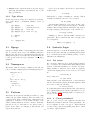
Currently C-code can be loaded from source files (.c,
.cpp) or object files (.o, .a, .so). When loading from object files, it’s necessary to also include a header (.h, .hpp).
For example:
1. We wish to reuse existing libraries without modification
(e.g. Gnu Scientific Library, FFTW, etc).
c_bar =
(foreign("bar", ["bar.h", "bar.a"])
:: Int -> Int)
2. We wish to add new stream sources and sinks — for
network communication, disk access and so on — without modifying the WaveScript compiler itself. Also, we
frequently want to add support for new hardware datasources (sensors).
Of course, you may want to import many functions from
the same file or library. WaveScript uses a very simple rule.
If a file has already been imported once, repeated imports
are suppressed. (This goes for source and object files.) Also,
if you try to import multiple files with the same basename
(e.g. “bar.o” and “bar.so”) the behavior is currently undefined.
There are three WaveScript primitives used to interface with foreign code. The foreign primitive registers a single C function with WaveScript. Alternatively,
foreign source imports a stream of values from foreign
code. It does this by providing a C function that can be
called to add a single tuple to the stream. Thus we can call
from WaveScript into C and from C into WaveScript. The
third primitive is inline C. It allows WaveScript to generate arbitrary C code at compile time which is then linked
into the final stream query. We can of course call into the C
code we generate from WaveScript (or it can call into us).
3.1
3.2
Foreign functions
The basic foreign function primitive is called as follows:
“foreign(function-name, file-list)”. Like any other
primitive function, foreign can be used anywhere within a
WaveScript program. It returns a WaveScript function representing the corresponding C function of the given name.
The only restriction is that any call to the foreign primitive must have a type annotation. The type annotation lets
WaveScript type-check the program, and tells the WaveScript compiler how to convert (if necessary) WaveScript
values into C-values when the foreign function is called.
The second argument is a list of dependencies—files that
must be compiled/linked into the query for the foreign function to be available. For example, the following would import a function “foo” from “foo.c”.
c foo ::
Int -> Int = foreign("foo", ["foo.c"])
13
Foreign Sources
A call to register a foreign source has the same form as
for a foreign function: “foreign source(function-name,
file-list)”. However, in this case the function-name
is the name of the function being exported. The call to
foreign source will return a stream of incoming values. It
must be annotated with a type of the form Stream T , where
T is a type that supports marshaling from C code.
We call the function exported to C an entrypoint. When
called from C, it will take a single argument, convert it to
the WaveScript representation, and fire off a tuple as one
element of the input stream. The return behavior of this
entrypoint is determined by the scheduling policy employed
by that particular WaveScope backend. For example, it may
follow the tuple through a depth-first traversal of the stream
graph, returning only when there is no further processing.
Or the entrypoint may return immediately, merely enqueuing the tuple for later processing. The entrypoint returns an
integer error code, which is zero if the WaveScope process is
in a healthy state at the time the call completes. Note that
a zero return-code does not guarantee that an error will not
be encountered in the time between the call completion and
the next invocation of the entrypoint.
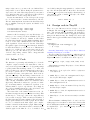
Currently, using multiple foreign sources is supported
(i.e. multiple entrypoints into WaveScript). However, if