1
Introduction
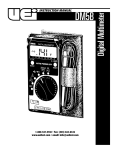
The DM200 ElectroMate™ will perform everyday basic electrical tests easily
and economically. Connect the test leads, turn the DM200 on, set the function switch to the proper setting and you are ready to take AC/DC volt,
c o n t i n u i tyor resistant measurements.
Features include
• 600 Volts AC and DC
• Continuity
• Resistance to 200 ohms
• Manual ranging
• 3-1/2” digit, 2000 count display
• Protective rubber boot
• UL and CE listed CAT II
• Read the safety precautions associated with the equipment being
tested and seek assistance or advice when performing
unfamiliar tasks.
• Keep your fingers away from the test lead metal probe contacts
and bus-bars when making measurements. Always grip the
instrument and test-leads behind the hand guards (molded into
the probes).
• In the event of electrical shock, ALWAYS bring the victim to
the emergency room for evaluation, regardless of the victim’s
apparent recovery. Electrical shock can cause an unstable heart
rhythm that may need medical attention.
International Symbols
Safety Notes
Before using this meter, read all safety information carefully. In
this manual the word "WARNING" is used to indicate conditions
or actions that may pose physical hazards to the user. The word
"CAUTION" is used to indicate conditions or actions that may
damage this instrument.
WARNING!
Exceeding the specified limits of this meter is dangerous and can
expose the user to serious or possibly fatal injury.
• DO NOT attempt to measure any voltage that exceeds 600 volts
with this meter - UEi offers numerous alternatives for measuring
high voltage and current
• Voltages above 60 volts DC or 25 volts AC may constitute a
serious shock hazard
• DO NOT attempt to use this meter if either the meter or the test
leads have been damaged. Send unit in for repair by a qualified
repair facility
• Test leads must be fully inserted prior to taking measurements
• Always turn off power to a circuit (or assembly) under test before
cutting, unsoldering or breaking the current path. Even small
amounts of current can be dangerous
• Always disconnect the live test lead before disconnecting the
common test lead from a circuit
• When measuring high voltage, disconnect the power source before
making test lead connections. Connect the test leads to the meter
first then to the circuit under test. Reapply power
• If any of the following indications occur during testing, turn
off the power source to the circuit under test:
• Arcing
• Flame
• Smoke
• Extreme Heat
• Smell of Burning Materials
• Discoloration or Melting of Components
DM200-MAN
Operating Instructions
WARNING!
Electric shock, instrument damage, or equipment damage, may result if
input voltages exceed 600 volts DC or AC RMS. Do not attempt to take
any unknown voltage measurement that may be in excess of 600 volts
DC or AC RMS.
DC/AC Voltage Measurement
1. Connect the black test lead to the terminal marked “COM” and
the red test lead to the terminal marked “V
Ω“.
2. Set the rotary switch to the desired function (DC V or AC V).
3. Select the desired range. The safest practice is to set the range to
exceed the suspected value of the supplied voltage. If the value is
u n k n own, start at the highest range and reduce that setting until the
s cale provides an acceptable reading. Touch the probes to the circuit
under test and read the display.
NOTE: If the input voltage exceeds the selected range the indicator will
display the overload “ .“, indicating that a higher range must be
selected. If a negative DC voltage is being measured the “
“
symbol will appear on the left side of the display.
P. 1