1
Evropský sociální fond. Praha & EU: Investujeme do vaší budoucnosti.
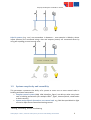
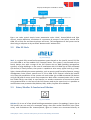
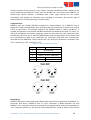
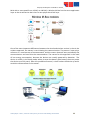
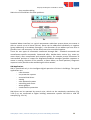
Fig. 3.2.5.4: Multipoint-to-point communication (51)
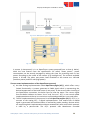
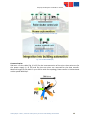
Fig. 3.2.5.5: Multi-point to point Opentherm communication (52)
A master (a thermostat) is in an OpenTherm system powered from a slave (a boiler).
With the new feature from the specification 3.0 called “Smart power”, power
consumption can be smartly managed by asking the slave for providing more or less
power according to the needs of the master (e.g. backlight on). The minimal available
power is 35 mW. The other two power levels available to the master are: 136 mW
(medium power) and 255 mW (high power).
There are two implementations of the OpenTherm protocol:
a) An older analog implementation called OpenTherm/light (OT/-), which offers a very
limited functionality. A master generates a PWM signal which is representing the
desired temperature of the boiler water (a set point). In the case of short circuiting of
the OpenTherm connection, the boiler stars to heat the water. The current signal
from the boiler indicates its status: “error” and “no error”. OT/- is not a much usable
implementation and due to its restrictions and limited possibilities is not used often.
b) The full implementation of the protocol is called OpenTherm/plus (OT/+). OT/+ is, in
contrast to the analog OT/-, a digital implementation. That means that no PWM
signal is generated and communication is realized by packet sending. Devices which
are supporting both implementations detect automatically after reset which protocol
is used by a partner-side. The OT/+ protocol uses Manchester encoded
Ondřej Nývlt - Buses, Protocols and Systems for Home and Building Automation
36