1
2.20 Deadlock (or Deadly Embrace)
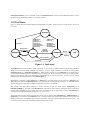
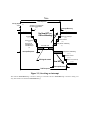
A deadlock, also called adeadly embrace, is a situation in which two tasks are each unknowingly waiting for resources
held by each other. If task T1 has exclusive access to resource R1 and task T2 has exclusive access to resource R2, then
if T1 needs exclusive access to R2 and T2 needs exclusive access to R1, neither task can continue. They are
deadlocked. The simplest way to avoid a deadlock is for tasks to:
a) acquire all resources before proceeding,
b) acquire the resources in the same order, and
c) release the resources in the reverse order.
Most kernels allow you to specify a timeout when ac quiring a semaphore. This feature allows a deadlock to be broken.
If the semaphore is not available withing a certain amount of time, the task requesting the resource will resume
execution. Some form of error code must be returned to the task to notify it that a timeout has occurred. A return error
code prevents the task from thinking it has obtained to the resource. Deadlocks generally occur in large multitasking
systems and are not generally encountered in embedded systems.
2.21 Synchronization
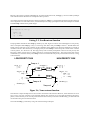
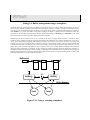
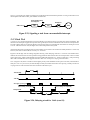
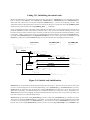
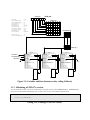
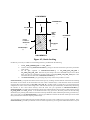
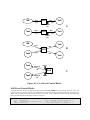
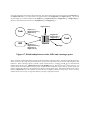
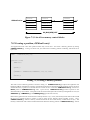
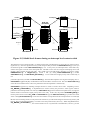
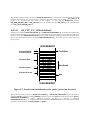
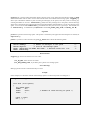
A task can be synchronized with an ISR, or another task when no data is being exchanged, by using a semaphore as
shown in Figure 2-12. Note that, in this case, the semaphore is drawn as a flag, to indicate that it is used to signal the
occurrence of an event (rather than to ensure mutual exclusion, in which case it would be drawn as a key). When used
as a synchronization mechanism, the semaphore is initialized to 0. Using a semaphore for this type of synchronization
is using what is called a unilateral rendezvous. A task initiates an I/O operation and then waits for the semaphore.
When the I/O operation is complete, an ISR (or another task) signals the semaphore and the task is resumed.
ISR
POST
PEND
TASK
TASK
POST
PEND
TASK
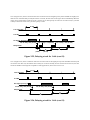
Figure 2-12, Synchronizing tasks and ISRs.
If the kernel supports counting semaphores, the semaphore would accumulate events that have not yet been processed.
Note that more than one task can be waiting for the event to occur. In this case, the kernel could signal the occurrence
of the event either to:
a) the highest priority task waiting for the event to occur, or
b) the first task waiting for the event.
Depending on the application, more than one ISR or task could signal the occurrence of the event.