1
The Double-layer Master-Slave Model :
A Hybrid Approach to Parallel Programming for
Multicore Clusters
User’s Manual for the HPCVL DMSM Library
Gang Liu and Hartmut L. Schmider
High Performance Computing Virtual Laboratory, Queen’s University,
Kingston, Ontario, Canada K7L 3N6
Version 3.1
December 8, 2011
Abstract
This manual explains the structure and usage of a library that implements the Double-layer
Master-Slave Model , a flexible and generally applicable model for parallel programming
that can be deployed across clusters with multicore nodes. The model is based on a two-tier
structure:
• The Message-Passing Interface (MPI) is used to distribute work-groups across a cluster, based on a simple Master-Slave approach.
• Locally, on each cluster node, OpenMP compiler directives are used to work through
the work items in a group based on a dynamic “All Slaves” model.
Several variations of this basic structure were implemented in a library in Fortran and
C. In this manual, we discuss the user interfaces for these libraries and for the necessary
user-supplied functions. We also outline the capabilities of the model and its limitations.
Contents
1 Introduction: The Double-layer Master-Slave Model
1.1 Parallel Programming on Multicore Clusters . . . . . .
1.2 Master-Slave and All-Slave Models . . . . . . . . . . .
1.3 The Double-layer Master-Slave Model (DMSM) . . . .
1.4 The Structure of this Manual . . . . . . . . . . . . . .
2 The
2.1
2.2
2.3
2.4
DMSM Library
Overview . . . . . .
Naming Convention
Nine Variations . .
Three Special Cases
.
.
.
.
.
.
.
.
.
.
.
.
.
.
.
.
.
.
.
.
.
.
.
.
.
.
.
.
.
.
.
.
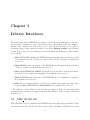
3 Library Interfaces
3.1 DMSM INITIALIZE . . . . . . . .
3.2 DMSM WORKING . . . . . . . . . .
3.3 DMSM JOB DISTRIBUTION CHECKUP
3.4 DMSM FINALIZE . . . . . . . . . .
3.5 DMSM ALL . . . . . . . . . . . . .
3.6 DO THE JOB . . . . . . . . . . . .
3.7 The C interfaces . . . . . . . . .
.
.
.
.
.
.
.
.
.
.
.
.
. . .
. . .
. .
. . .
. . .
. . .
. . .
.
.
.
.
.
.
.
.
.
.
.
.
.
.
.
.
.
.
.
.
.
.
.
.
.
.
.
.
.
.
.
.
.
.
.
.
.
.
.
.
.
.
.
.
.
.
.
.
.
.
.
.
.
.
.
.
.
.
.
.
.
.
.
.
.
.
.
.
.
.
.
.
.
.
.
.
.
.
.
.
.
.
.
.
.
.
.
.
.
.
.
.
.
.
.
.
.
.
.
.
.
.
.
.
.
.
.
.
.
.
.
.
.
.
.
.
.
.
.
.
.
.
.
.
.
.
.
.
.
.
.
.
.
.
.
.
.
.
.
.
.
.
.
.
.
.
.
.
.
.
.
.
.
.
.
.
.
.
.
.
.
.
.
.
.
.
.
.
.
.
.
.
.
.
.
.
.
.
.
.
.
.
.
.
.
.
.
.
.
.
.
.
.
.
.
.
.
.
.
.
.
.
.
.
.
.
.
.
.
.
.
.
.
.
.
.
.
.
.
.
.
.
.
.
.
.
.
.
.
.
.
.
.
.
.
.
.
.
.
.
.
.
.
.
.
.
.
.
.
.
.
.
.
2
2
3
4
5
.
.
.
.
6
6
6
7
8
.
.
.
.
.
.
.
9
9
10
11
11
12
12
13
4 Job Group Preparation (JOB GROUP PREPARATION)
14
5 Result Collection (RESULT COLLECTION)
16
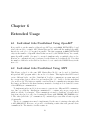
6 Extended Usage
6.1 Individual Jobs Parallelized Using OpenMP . . . . . . . . . . . . . . . . .
6.2 Individual Jobs Parallelized Using MPI . . . . . . . . . . . . . . . . . . .
18
18
18
7 Technical issues
7.1 Hardware and Software Requirements . . . . . . . . . . . . . . . . . . . . .
7.2 Library Components & Installation . . . . . . . . . . . . . . . . . . . . . .
21
21
21
1
Chapter 1
Introduction: The Double-layer
Master-Slave Model
1.1
Parallel Programming on Multicore Clusters
Modern clusters usually consist of nodes with multiple CPU’s or cores. In addition, recent
core architectures support multiple threads being concurrently executed on a single core
(hardware multi- or hyper-threading). The standard approach to exploit parallelism on a
cluster is by use of the Message-Passing Interface MPI. This requires the communication
between independent “heavy-weight” processes that are deployed across the nodes in a
distributed-memory fashion. While it is possible to run multiple independent MPI processes
on a single multicore cluster node, it may not be the most efficient use of resources. This
is particularly true for multithreaded cores which exhibit a high degree of resource sharing
between threads, and are therefore prone to run into bottlenecks, particularly connected
to communication resources.
A more appropriate approach to use multicore and multi-threaded nodes is through
the use of thread libraries such as Pthread or compiler directives such as OpenMP. The
resulting multithreaded programs do not require communication resources and use shared
memory for information exchange between “light-weight” processes instead. As a result,
resource-bottlenecks are much less likely. Unfortunately, due to their dependence on the
shared-memory architecture of the computer, such programs cannot be deployed across a
cluster.
It therefore appears that the ideal approach for programming for a multicore, multithreaded cluster, is a hybrid one: combining MPI to deploy processes across the cluster
to the individual nodes, with OpenMP parallelization of each process “intranode” to make
efficient use of the multicore and/or multi-thread structure of the hardware.
The main complicating issue with this approach is the lack of thread safety of most
MPI libraries. This means in practice that communication resources cannot be accessed
through MPI functions by more than one thread per process at a time, because internal
communication buffers and other variables are not protected against race conditions, and
2
are not forced to be consistent for all threads. In other words, the message envelope in
MPI is not thread-specific. As a result, the onus is on the programmer to make sure that
MPI and therefore the internode-communication subsystem are consistently only seeing
only one thread per rank and that all information that is communicated is made available
to all threads at a time when they need it.
The simplest approach to achieve this is to completely separate MPI communication
from those parts of the individual processes that are executed in a multithreaded fashion.
In other words, all MPI communication happens in the serial regions of the code, and at
the time when internode-communication happens, only one thread (preferably the “master
thread”) is active on either end. In many cases, this approach is sufficient to obtain
smoothly running and well-scaling code, and at least one of the models we discuss in this
manual follows this scheme. It is arguably the safest way to write a hybrid program.
However, in some cases, there is a need to go beyond this approach. If communication is required to obtain information from another node while working through portions
of the code that are OpenMP multi-threaded, there is no alternative but to specifically
protect communication calls and to use shared data structures to pass information. This
complicates issues considerably, as not only do we have to deal with race conditions on the
communication resources, but also on all data structures that are involved. Most of the
models discussed here are of this type. We have made an effort to keep the complexities of
this approach away from the user, but an understanding of the issues is still helpfull when
using our library.
1.2
Master-Slave and All-Slave Models
One of the basic principles of parallel programming is the avoidance of workload imbalances.
If computing tasks are distributed among a number of independent processes, care has to
be taken that the allocation of the tasks is not done too statically if there is a chance that
tasks differ substantially in their execution times. If this rule is not followed, some of the
processes will spend too much time waiting to obtain further work, with the corresponding
“hit” on execution time and therefore scaling.
If the computational burden associated with each of the tasks is heterogeneous and
unpredictable, a dynamic schedule of the tasks to the processes needs to be adopted. For
distributed-memory systems, this often takes the form of a “Master-Slave Model”. In this
model, one process - the Master - is dedicated to work distribution, while the others - the
Slaves - work on individual tasks. Once a Slave has completed a task, it sends a signal to the
Master and obtains a new one. If the communication times for signalling the Master and
supplying Slaves with new tasks are small compared with task execution, this model stands
to avoid workload imbalances and scale well in the limit of a large number of tasks. When
used with a large number of processes, the dedication of one process to “management” is
deemed an acceptable price for the resulting scalability. On a distributed-memory cluster,
the Master process usually is necessary to insure that no tasks are performed more than
once or skipped, as well as to supply the nodes with the necessary information to perform
3
the tasks. Of course, the independence of the tasks is a precondition for this model to
work.
On a shared-memory system such as a multicore node or an SMP server, it is usually not
necessary to dedicate a specific processor for the Master tasks. This is because the sharedmemory structure of the machine makes all necessary information for task execution readily
available, and the role of the Master can be played by a simple protected counter variable.
Each process that has run out of work accesses this variable and supplies itself with the next
task. We call this an “All-Slaves Model”. This model is mostly used on shared-memory
systems, where it combines the advantages of the Master-Slave model with the additional
bonus of the participation of all available processes in the workload execution.
In this manual, we are discussing a combination of these two approaches in an
MPI /OpenMP hybrid framework. This is called the Double-layer Master-Slave Model .
1.3
The Double-layer Master-Slave Model (DMSM)
It is easy to see that an MPI implementation of the “Master-Slave Model” can readily be
expanded to a hybrid model if each of the tasks is further divided into sub-tasks which are
then executed in an OpenMP parallel fashion. In practice, it is easier to combine multiple
tasks into “workload packages” and distribute these packages across nodes using an MPI
master-slave approach. Each of the tasks in the package is then internally distributed on
each node via an “All-Slaves Model”.
1. On a cluster, one node (usually the one running the process with rank 0) is chosen as
the master node where thread 0 is dedicated to be the Master. All other nodes are
used as Slaves. Communication between them is done via MPI calls.
2. In the beginning, each Slave signals to the Master that it is idle, and the Master sends
out instructions and data to all Slaves establishing their workload. This workload
consists of many smaller tasks that are handled internally by the Slave nodes.
3. Any Slave node works through such a workload package without any further communication to the Master node. Once the workload is executed, a signal is sent to the
Master requesting another package. This is executed in the same manner until a stop
signal is received, at which point execution ends.
4. The Master continues to serve any requests for new packages until all the available
work is distributed. Then a stop signal is passed to the Slaves. During this process,
the Master insures that no package is distributed more than once or skipped.
Step 3. in the above Master-Slave scheme - the workload execution on the nodes - is in
itself done through OpenMP:
1. Once a new workload package is received on a Slave node, a task counter is reset, and
multiple OpenMP threads begin to work on the package.
4
2. Each process (thread) assigns itself to a given task in the package and moves the task
counter forward to avoid double execution or skipping.
3. The task counter has to be protected by placing updates into a critical region or by
use of locks.
4. Once all tasks in a package are executed (or at least assigned), a single thread communicates with the Master for a new package.
The last point on this level establishes a distinction between different variations of
the model. A more robust implementation waits until all tasks in a package have been
performed completely before communicating with the Master for a new package outside of
the OpenMP parallel region. A more flexible version of the code obtains a new package
from the Master as soon as the first thread in the OpenMP set runs out of tasks, even if
others in the set are still working on tasks from the old package. This has to be done from
inside the OpenMP parallel region and therefore needs careful protection.
1.4
The Structure of this Manual
This manual is meant as a User’s Guide for the DMSM library.
• The present Chapter 1 serves as a general introduction and explains the working of
the Double-layer Master Slave model.
• The next Chapter 2 outlines the different variations of the model as implemented in
the DMSM library.
• Chapter 3 focusses on the user interfaces necessary to run the Double-layer MasterSlave Model in the simple case where work-related data are available on the nodes,
and results do not have to be collected from the nodes by the library.
• Chapter 4 deals with cases where work-related data are supplied to the nodes dynamically by the library.
• Chapter 5 discusses cases where computed results are collected dynamically from the
nodes by the library.
• Chapter 6 deals with extended usage of the Double-layer Master-Slave Model library
where individual jobs are executed in parallel. item Chapter 7 addresses technical
issues, such as installation, compilation, and availability of the library.
Each of the chapters is divided into sections.
5
Chapter 2
The DMSM Library
The library documented in this manual was developed by Gang Liu at HPCVL in 2011
to enable the deployment of a large number of independent computing tasks with unpredictable execution times across a cluster with multithreaded multicore nodes. At present,
the library is implemented in Fortran 90 and C.
The current version of the library is 3.1.
2.1
Overview
• Nine variations of the Double-layer Master-Slave Model are implemented. See below
(Section 2.3) for details.
• In the simplest case, where data required for all tasks already reside on the slave
nodes, and results are either directly written by the Slaves or sent to the Master after
completion of all tasks, the user only supplies a simple job routine (DO_THE_JOB)
(Chapter 3).
• In a more complex situation where task-related data are sent along to the Slaves
whenever a new task package is requested, the user needs to supply an additional job
group preparation routine (JOB_GROUP_PREPARATION) (Chapter 4).
• In the most general case that involves the collection of results from a previous package whenever a new one is issued, the user supplis a data collection routine as well
(RESULT_COLLECTION) (Chapter 5).
• Each individual job may still be run in parallel using either OpenMP or MPI (Chapter
6).
2.2
Naming Convention
All library routines, internal variables and constants, modules used by the library, and files
generated are named with a prefix DMSM_. It is best not to use this prefix for user routines
6
etc. to avoid conflicts and overlaps.
2.3
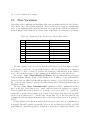
Nine Variations
Depending on the complexity and flexibility of the basic algorithm, the Double-layer MasterSlave Model can be used in nine variations. These are labeled by an integer variable that
serves as an argument in the standard function call to the library. Whenever applicable,
the main thread on the Master node always serves as the Master to distribute job packages.
Table 2.1: Variations of the Double-layer Master-Slave Model
Arg
11
12
13
21
22
23
31
32
33
Other threads on Master
none
pre-allocated
dynamic
none
pre-allocated
dynamic
none
pre-allocated
dynamic
Slave Communication
serial
serial
serial
parallel 0
parallel 0
parallel 0
parallel any
parallel any
parallel any
The first column of the above table indicates the integer label that must be passed
to the library to select the corresponding variation of the model. This label is computed
according to l = 10m + s where m describes the behaviour of the threads on the ”master
node”, and s indicates nature of the communication with threads on the slave nodes.
The second column “Other threads on Master” indicates what task are performed
by the non-master threads - if any - on the Master node. To make good use of the available
resources, they can either work through packages according to a pre-allocated static schedule, or dynamically obtain job packages from the Master and work through them using an
All-Slaves scheme.
The last column “Slave Communication” explains how MPI communication takes
place on the side of the Slave nodes. “serial” indicates that work packages are obtained
before a parallel thread-set is invoked, i.e. from the serial region of the code. “parallel 0”
means that a specific thread (number 0 ) obtains new packages from inside the OpenMP
parallel region when needed. “parallel any” means that any of the slave threads can
communicate with the Master from inside the parallel region when a new work package is
needed.
Clearly, Variation 11 is the most static but also the most “safe” since no communication
from inside OpenMP parallel regions takes place at all, and therefore OpenMP and MPI
parallelism are completely separated. Variation 33 is the most complex and flexible, and
7
therefore is most suitable to avoid load imbalances. Anytime a slave thread detects that no
further work items are left unallocated, it obtains another work package from the Master.
In addition, threads on the Master node work on their own work package to make optimal
use of the computing resources.
2.4
Three Special Cases
Specific values for the number of MPI processes and the number of threads per process in
the Double-layer Master-Slave Model lead to simpler models.
• If both the number of MPI processes and the number of threads per process is 1, the
workload is executed in serial. It is best to choose the number of jobs per group to
be 1 as well in this case.
• Otherwise, if only the number of MPI processes is 1, the library performs a singlelayer “all slaves” model that is implemented entirely with OpenMP.
• If only the number of threads per MPI process is chosen to be 1, then no OpenMP
parallelism is used and the system defaults to a “master-slaves” model. Jobs are
distributed in job groups and the processed serially. If a standard “master-slaves”
model is desired, the number of jobs per group needs to be set to 1. Note that it is
also possible to incorporate a pre-existing parallel program (using either OpenMP or
MPI ) into the job execution routine to perform each individual job. In this case,
many such parallel jobs can be executed simultaneously. This ”extended usage” of
the model will be discussed further in Chapter 6.
8
Chapter 3
Library Interfaces
The central part of the DMSM library consists of 4 basic interfaces that must be called in a
fixed sequence. This may be done by the user directly, or through an additional “wrapper”
interface that calls the basic four in the correct order. In the following, we are going to
discuss the usage of these interfaces with a focus on the Fortran version. An additional
section (3.7) is devoted to the differences between Fortran and C interfaces. The routines
are as follows:
• DMSM_INITIALIZE initializes the DMSM library and requires the specification of the
basic framework for the Double-layer Master-Slave Model . Its usage is explained in
section 3.1.
• DMSM_WORKING is the core routine of the DMSM library. It requires the specification
of the job routines and is explained in section 3.2.
• DMSM_JOB_DISTRIBUTION_CHECKUP checks the proper execution of the work distribution and does not require any arguments. It is explained in section 3.3.
• DMSM_FINALIZE finalizes the usage of the DMSM library. No arguments are required.
It is explained in section 3.4
• DMSM_ALL is a wrapper interface for the above routines and requires the same arguments as DMSM_INITIALIZE and DMSM_WORKING. It is explained in section 3.5.
In addition to these interfaces, the user has to supply at least one subroutine that
encapsulates the execution of a single work task. The interface of that routine is discussed
in section 3.6.
3.1
DMSM INITIALIZE
This subroutine is used to initialize the DMSM library and requires the specification of the
basic framework for the Double-layer Master-Slave Model . It must be called first before any
9
other DMSM interfaces are used. MPI must be initialized first through a call to MPI_INIT
before calling this routine. The routine has the following interface:
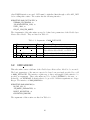
SUBROUTINE DMSM_INITIALIZE( &
THREADS_PER_PROCESS, &
JOB_DISTRIBUTION_PLAN, &
TOTAL_JOBS, &
NUM_OF_JOBS_PER_GROUP)
The 4 arguments of the subroutine are used to define basic parameters of the Double-layer
Master-Slave Model . They are listed in Table 3.1.
Table 3.1: Arguments of DMSM INITIALIZE
1
2
3
4
3.2
Name
Type Function/Purpose
THREADS PER PROCESS
integer Requested number of threads per process
JOB DISTRIBUTION PLAN integer Specification of the variation of the Doublelayer Master-Slave Model , see Table 2.1
TOTAL JOBS
integer Total number of jobs to be performed
NUM OF JOBS PER GROUP integer Number of jobs contained in each job group
DMSM WORKING
This subroutine causes a full run of the Double-layer Master-Slave Model to be executed.
The basic parameters of the run are expected to have been previously specified by a call
to DMSM_INITIALIZE. The interface requires up to three user-supplied subroutines to be
specified as arguments. These subroutines need be declared EXTERNAL by the user, or –
preferably – an INTERFACE declaration has to be provided. All their arguments are of type
integer. The interface of DMSM_WORKING is:
SUBROUTINE DMSM_WORKING( &
DO_THE_JOB, &
JOB_GROUP_PREPARATION, &
RESULT_COLLECTION, &
COLLECTION_ENABLED)
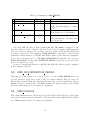
The arguments of this routine are listed in Table 3.2.
10
Table 3.2: Arguments of DMSM WORKING
Name
Type
Args
1 DO THE JOB
subroutine 1
2 JOB GROUP PREPARATION subroutine 4
3 RESULT COLLECTION
subroutine 2
4 COLLECTION ENABLED
logical
n/a
Function/Purpose
Executes a single job
Communicates initial data for a job
group from the master to a slave
node.
Communicates available results
from a slave node to the master.
If true, results are collected dynamically throughout, otherwise only
once at the end.
Note that while the first of these routines (DO_THE_JOB) must be supplied by the
user, the other two can be “skipped” if the nodes need not be supplied with supporting
data before the processing of a job package, and if no result collection inside the library
is required, respectively. The interface of DMSM_WORKING is overloaded, so that the first
argument is always meant to be DO_THE_JOB. If the routine is called with two arguments,
the second one is supposed to be JOB_GROUP_PREPARATION. If with three, the second is
RESULT_COLLECTION, and the third COLLECTION_ENABLED. If all four are specified they
have to be in the above order.
Section 3.6 discusses the function of DO_THE_JOB, while the other two will be explained
in later chapters (4 and 5).
3.3
DMSM JOB DISTRIBUTION CHECKUP
The purpose of this routine is to check if all jobs of a run of DMSM_WORKING have been
properly executed. It produces a list of all jobs together with the MPI processes and
threads that executed them and writes this list and other detailed information, such as
timings, about job execution into a file DMSM_journal.txt that is written to the working
directory on the master node. It requires no arguments.
3.4
DMSM FINALIZE
This routine finalizes the use of the Double-layer Master-Slave Model library by deallocating
arrays and releasing resources. It should be called after all jobs have finished and no further
use of DMSM routines is made. It requires no arguments.
11
3.5
DMSM ALL
The routine DMSM_ALL is a wrapper that makes consecutive calls to all 4 previously discussed routines: DMSM_INITIALIZE, DMSM_WORKING, DMSM_CHECKING, and DMSM_FINALIZE.
The arguments of DMSM_ALL are the combination of the ones of DMSM_INITIALIZE and
DMSM_WORKING, i.e. this routine has the following interface:
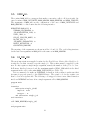
SUBROUTINE DMSM_ALL( &
THREADS_PER_PROCESS, &
JOB_DISTRIBUTION_PLAN, &
TOTAL_JOBS, &
NUM_OF_JOBS_PER_GROUP, &
DO_THE_JOB, &
JOB_GROUP_PREPARATION, &
RESULT_COLLECTION, &
COLLECTION_ENABLED)
The meaning of the arguments are shown in tables 3.1 and 3.2. The overloading structure
for the last four arguments in DMSM_ALL is the same as in DMSM_WORKING.
3.6
DO THE JOB
The most important user-supplied routine for the Double-layer Master-Slave Model is obviously the one that executes a specific single job. This routine must be supplied by the
user. It only requires a single integer argument, namely the number of the job to be done.
In Fortran, this lies between 1 and the maximum number TOTAL_JOBS which is the third
argument in the call to subroutine DMSM_INITIALIZE (see Table 3.1).
It is recommended to make an INTERFACE declaration of the routine to make sure that
its name is properly passed to the DMSM library. The actual code for the routine can
then be done in a separate file. The following code snippet declares a user defined function
inside an INTERFACE and uses it in a single-argument call to DMSM_WORKING.
program main
...
interface
subroutine single_job(m)
implicit none
integer :: m
end subroutine single_job
end interface
...
call DMSM_WORKING(single_job)
...
end program main
12
This routine is repeatedly called by all work threads in the framework of the Doublelayer Master-Slave Model from inside a parallel region if applicable. It should therefore be
programmed in a threadsafe manner, meaning that different jobs should not write data into
the same shared location. Specifically, the use of external shared data structures such as
common blocks, modules, or global variables, should be done with great caution, as should
output into shared files.
3.7
The C interfaces
The interfaces of the C version of the DMSM routines discussed above are almost identical to
the ones in Fortran. The one for the initialization routine is:
void DMSM_Initialize( \
int threads_per_process, \
int job_distribution_plan, \
int total_jobs, \
int num_of_jobs_per_group)
The meaning of the arguments is the same as in Fortran. The function is of type void, i.e.
it does not return a value. For the “working routine” the interface is:
void DMSM_Working( \
void (*do_the_job)(int), \
void (*job_group_preparation)(int,int,int,int), \
void (*result_collection)(int,int), \
int collection_enabled)
Since C does not support overloading of functions, this interface requires four arguments
even if job preparation and/or result collection is not required. In those cases, the corresponding arguments may be replaced by NULL. The argument collection_enabled is
of type int. If it is 1 results are collected dynamically throughout, if it is 0 they are
collected only once at the end. If result_collection is specified as NULL, i.e. not used
collection_enabled is ignored. All specified functions are of type void, i.e. no return
value. They need to be prototyped, for instance:
void single_job (int);
...
main (){
...
DMSM_Working(single_job,NULL,NULL,0);
...
}
for the simple case where only a job execution function single_job is defined and used as
an arument in DMSM_Working. As the only argument, single_job receives a job number
ranging from 0 to total_jobs-1.
13
Chapter 4
Job Group Preparation
(JOB GROUP PREPARATION)
In many cases all necessary data to do the jobs in the Double-layer Master-Slave Model
can be distributed among the nodes before the execution of the model starts. In this case
the communication of the initial data for a job group or package is not necessary and the
JOB_GROUP_PREPARATION argument of DMSM_WORKING can be skipped in Fortran or NULL in
C. In some cases it is necessary to supply the job data dynamically at the time when a new
job package is issued by the master. In this case the user can supply such a routine with 4
integer input arguments:
interface
subroutine my_job_preparation(first_job,last_job,call_rank,dest_rank)
integer :: first_job,last_job,call_rank,dest_rank
end my_job_preparation
end interface
The first two arguments first_job and last_job define the first and last job number in
the group of jobs that is being prepared. The third argument is the rank of the calling
MPI process, which can be 0 (if the routine is called by the Master) or a positive integer
(if it is called by a slave node). The last argument is the rank number of the slave node
that is being supplied with job group data.
The routine is called by the DMSM library when a new job group is assigned to an MPI
process. The details of the implementation of this routine are left to the user. Usually,
the routine will contain at least one set of point-to-point MPI communication calls, i.e. an
MPI_SEND call for the case when it is called by the Master, and an MPI_RECV call for when
it is called by a slave node. It is recommended to use blocking MPI calls for this to avoid
possible race conditions. In cases where job group data need to be initialized inside the
Master node, the communication of the data can be replaced by a simple copy from one
data structure to another.
14
The interface for the job group preparation function in C is virtually identical to the one
in Fortran:
void my_job_preparation(\
int first_job,int last_job,int call_rank,int dest_rank)
In many cases, a job preparation routine communicates job related data from the Master
into a temporary data structure on the slave. This information is over-written every time
a new job group is requested. This implies a race condition in those cases where the new
job data are requested by a single thread inside the OMP parallel region of a slave process.
This is because new data are requested whenever the communicating thread runs out of
work, at a time when other threads might still be doing work that requires job related data
from the previous job group. To avoid this race condition, the DMSM library provides
a pair of lock routines that protect access to job related data until they are not needed
anymore. The first of these routines is:
DMSM_WAIT_FOR_INITIAL_LOCKS
void DMSM_Wait_For_Initial_Locks()
in Fortran and C, respectively. This routine should be called inside the job group
preparation routine before updating job related data for a slave process. This
will cause the job preparation routine to halt until it is safe to update these data. The
signal that this is the case comes from call to the second of the lock routines:
DMSM_UNSET_AN_INITIAL_LOCK
void DMSM_Unset_An_Initial_Lock()
This routine should be called in the job routine after the point where the specific
job related data have been copied to local data structures and can therefore be
safely overwritten. When all threads on an MPI process that are still doing work have
called this routine, the thread that is waiting after a call to DMSM_WAIT_FOR_INITIAL_LOCKS
can proceed to update data for a new job group. All other work (lock declaration, initialization, setting, and deleting) is done by the library.
15
Chapter 5
Result Collection (RESULT COLLECTION)
Sometimes, the results of jobs that have been executed by the slave nodes need to be
communicated back dynamically to the master node. This should be done “in bulk” after
some jobs have finished to avoid interference between multiple active threads on multiple
slave nodes. In such a case, the user can supply a routine that collects all available results
and sends them to the Master. This routine needs to have two integer arguments:
interface
subroutine my_result_collection(call_rank,source_rank)
integer :: call_rank,source_rank
end my_result_collection
end interface
As with the job group preparation, the interface for the data collection function in C is
virtually identical to the one in Fortran:
void my_result_collection(\
int call_rank,int source_rank)
The first argument is the rank of the calling MPI process, which can be 0 (if the routine
is called by the Master) or a positive integer (if it is called by a slave node). The second
argument is the rank number of the slave node that is returning result data. If the value
of collection_enabled (the fourth argument of a DMSM_WORKING call) is equal to 1 the
result collection routine is called whenever a new job group is assigned, if it is equal to
0 it is called only once when all jobs are done. The details of the implementation of this
routine are left to the user.
In many cases, a result collection routine communicates result data from a temporary
data structure on the slave process to the master. If both call_rank and source_rank are
0 (i.e. both are on the Master), results from a temporary data structure should be copied
to the final result structure. Otherwise, the slave sends information about the amount of
16
result data to the master, followed by the data themselves. A specific signal (such as a zero)
is suggested to indicate “currently no results”. Once the results are communicated, the
temporary structure is usually “emptied” to avoid the same results being sent repeatedly.
Inside the library, the result collection routine is called only from a critical region to protect
the final result structure on the Master. If this data structure is updated only by this routine
the structure is safe.
If the temporary data structure for results is shared, one thread may send it to the
Master and update it, while another has new results and writes them into the structure.
To avoid this race condition, the DMSM library provides another pair of lock routines that
protect the temporary job result data while they are being communicated and reset. These
routines are:
CALL DMSM_SET_NODE_RESULT_LOCK
void DMSM_Set_Node_Result_Lock()
and
CALL DMSM_UNSET_NODE_RESULT_LOCK
void DMSM_Unset_Node_Result_Lock();
in Fortran and C, respectively. The first routine should be called inside the job
result collection routine before communicating and resetting the temporary
data structure that contains results, as well as in the job routine before updating
that structure. The second routine should be called after communication/reset
or after an update, respectively.
17
Chapter 6
Extended Usage
6.1
Individual Jobs Parallelized Using OpenMP
It is possible to set the number of threads per MPI process in DMSM_INITIALIZE to 1 and
reduce the model to a simple MPI Master-Slave model, while still use multiple OpenMP
threads for each job to be executed in parallel. The first argument in DMSM_INITIALIZE
only sets the number of OpenMP threads that are used by the DMSM library. As a result,
many OpenMP parallel jobs may be executed simultaneously on multiple slave nodes.
However, no computations can be performed on the Master node in this model. Note that
the number of threads on the Slave nodes has to be set outside the DMSM library in the
user code.
6.2
Individual Jobs Parallelized Using MPI
This library, reduced to the pure MPI Master-Slave Model, can be used to distribute
independent MPI program runs to the nodes of a cluster. This implies that MPI is used
on two different levels: one (the “distribution” level) to communicate program runs and
the corresponding data to the nodes, and another (the “job” level) to execute individual
jobs on the nodes. The latter are usually considerably more communication intensive than
the former, and therefore the shared-memory structure of a single node is desirable because
of fast SHM-layer communication.
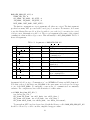
To implement such a model, it is necessary to generate two different MPI communicators. One - we call it the “distribution communicator” - contains only one process per node
which we call the “local master”. This communicator is used to distribute jobs and related
data from a head node to all job nodes using the library with THREADS_PER_PROCESS set to
1. The other (called the “job communicator”) contains all processes that execute a specific
job internally.
The above communicators may be implemented by the user, for instance through calls
to MPI_COMM_SPLIT. However, we provide a facilitating routine that will generate these
communicators. The interface for this routine is:
18
DMSM_GEN_COMM_MPI_ALL( &
PROCS_PER_JOB, &
ALL_COMM, ALL_RANK, ALL_SIZE, &
JOB_COMM, JOB_RANK, JOB_SIZE, &
DIST_COMM, DIST_RANK, DIST_SIZE )
The first two arguments are input arguments, all others are output. The first argument
specifies how many MPI processes will be used per job execution. For instance, if we want
to use the Master-Slave model on 10 nodes with 8 cores each for job execution for a total
of 80 processes, this number would be 8. The second argument is the name of the original
communicator that includes all processes. This will usually be MPI_COMM_WORLD. Table 6.1
shows all arguments.
Table 6.1: Arguments of DMSM GEN COMM ALL
1
2
3
Name
Type
In/Out
PROCS PER JOB Integer
In
ALL COMM
Communicator In
ALL RANK
Integer
Out
4
5
6
ALL SIZE
JOB COMM
JOB RANK
Integer
Out
Communicator Out
Integer
Out
7
8
9
JOB SIZE
DIST COMM
DIST RANK
Integer
Out
Communicator Out
Integer
Out
10 DIST SIZE
Integer
Out
Explanation
MPI processes per job execution
Global communicator
Rank of calling process in global
communicator
Size of global communicator
Job (local) communicator
Rank of calling process in job communicator
Size of job communicator
Distribution communicator
Rank of calling process in distribution communicator
Size of distribution communicator
Arguments labeled as type “Communicator” are INTEGER in Fortran and MPI_Comm in C.
Note that each node has their own JOB_COMM of the same name and each process belongs
to one of the DIST_COMMs. No ambiguity occurs as the job communicators are mutually
exclusive. For completeness, here is the C interface for this routine:
void DMSM_Gen_Comm_MPI_All( \
int Procs_Per_Job,\
MPI_Comm All_Comm, int *All_Rank, int *All\_Size,\
MPI_Comm *Job_Comm, int *Job_Rank, int *Job_Size,\
MPI_Comm *Dist_Comm, int *Dist_Rank, int *Dist_Processes);
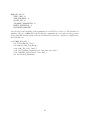
To run such an MPI based two-layered model with the library, a call to DMSM_GEN_COMM_MPI_ALL
should be followed by a call to another, simplified wrapper routine:
19
DMSM_MPI_ALL( &
TOTAL_JOBS, &
JOBS_PER_GROUP, &
DO_THE_JOB, &
JOB_GROUP_PREPARATION, &
RESULT_COLLECTION, &
COLLECTION_ENABLED)
were the types and meaning of the arguments are as in Tables 3.1 and 3.2. The interface is
similar to the one of DMSM_ALL, but the first two arguments are not reuired as they pertain
to the OpenMP all-slaves part of the model which is not used here. Again for completeness,
the C interface is:
void DMSM_MPI_All( \
int Total_Num_Of_Jobs,\
int Num_Of_Jobs_Per_Group,\
void (*Do_The_Job) (int),\
void (*Job_Group_Preparation) (int,int,int,int),\
void (*Result_Collection) (int,int),\
int Collection_Enabled);
20
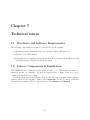
Chapter 7
Technical issues
7.1
Hardware and Software Requirements
The following components are required to use the library successfully:
• Operating system: Preferably Unix based (Solaris, Linux, AIX, Irix, etc.)
• Standard tools: MPI library.
• Fortran 90 and C compilers, preferably native to the operating system. However, the
cross-platform gnu compilers should work as well.
7.2
Library Components & Installation
The DMSM library is distributed in the form of source code. This archive can easily be
extracted via the tar command. All files are expanded into a single directory to avoid
complicated installation procedures.
For the Fortran version of the library, there is only one component that includes all subroutines, functions, and modules. This is called dmsm.f90. For the C version, additional
header files are required. The C components are called dmsm.c and dmsm.h.
21