1
Market Central, Inc.
2. Introduction
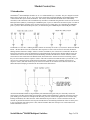
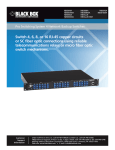
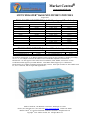
SwitchMaster® R6100 Multiport Switches are 1U 19” rackmountable layer 1 switches. They are designed to switch
RJ45 copper circuits or ST, SC, FC, or LC fiber optic connections using high reliability telecommunications relays
or micro mirror fiber optic switch mechanisms. The various connections thru the R6100 can be individually
controlled, or all connections can be simultaneously controlled. The R6100 Gang Switches can be used as Network
Backup Switches (NBS) by connecting the COMMON ports (C ports) to either their associated A ports or to their B
ports. The R6100 Gang Switches can be used for Network Access Control (NAC) by connecting the COMMON
ports (C ports) to their associated B ports (ON), or disconnecting the COMMON ports from the B ports (OFF).
The R6100 8 to 1 and 16 to 1 Sharing Switches connect one and only one of the 8 (or 16) Device Ports to the Shared
B Port. All other Device Ports are connected to their respective A Ports. If the A Ports are not used, the R6100
Sharing Switches function as simple “selector” switches such that any one of the devices connected to the Device
Ports can be selected to access the shared device on the Shared Port B, and all of the unselected Device Ports are
unconnected. If the A Ports are utilized, the R6100 Sharing Switches still function as selector switches with the
selected Device Port connected to the Shared Port B, but instead of the “unselected” Device Ports being “open”,
they are each connected to their respective A Ports. This can be useful in environments where you want all of your
devices to be connected to their normal network connections (each Device Port is normally connected to its
respective A Port), and when needed, any one of the Device Ports can be connected to a shared resource on the
Shared Port B, thus helping to maximize the investment in the shared device.
All of the R6100 RJ45 models use high reliability telecommunications grade relays to electrically connect the
selected ports. The fiber optic models use proprietary optical switch mechanisms to optically connect the selected
ports. Both types of switches are transparent to data rates, protocols, formats and signal levels. For models using
latching mechanisms, the connection state will be maintained if power fails or is removed and the switch will
continue to pass data between the selected ports. Models that use non-latching mechanisms will revert to the port C
to port A connection state when power is lost, and will remain in that state when power is restored until a new
switch command is received.
SwitchMaster® R6100 Multiport Switches
Page 3 of 30