1
Introduction
In the writing this guide, it is my intention to teach young and old students, along with hobbyists in
electronics, the various circuits and methods commonly used in micro-controlled data acquisition
and control systems. I will provide to you not only schematics, but also some theory of operation,
formulas, and design thoughts behind the circuitry, so that you can expound further this information
for your applications.
This guide also presents to you how to use a numerical menu command structure to your advantage,
like the one used in the AndroiDAQ firmware code, and how using this simple menu structure for
multi-core micro-controllers allows you to control parallel processing in ways other popular modules
can not, due to their linear single core processing methods. These simple menu commands simplify
USB, Bluetooth, and Wi-Fi communications with a micro-controller due to their brevity, saving both
bandwidth and time for more important communications like data gathering.
The Ultimate AndroiDAQ Guide not only describes how to setup, modify, and use your AndroiDAQ
module with the AndroiDAQ DEMO application for Android, but it also teaches you how to do these
things with the many other programming languages like LabVIEW, Java, and Python.
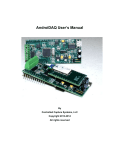
The AndroiDAQ module is very small, fully programmable, and very powerful multi-core singleboard micro-controller platform that is used for electronics prototyping and data acquisition.
Its eight processors can operate simultaneously, either independently or cooperatively, sharing
common resources through a central hub. The developer has full control over how and when each
processor is employed; there is no compiler-driven or operating system-driven splitting of tasks
among the multiple processors. A shared system clock keeps each processor on the same time
reference, allowing for true deterministic timing and synchronization.
AndroiDAQ is very design flexible with a plethora of uses for interfacing software languages to
the outside world. AndroiDAQ can be used for robotics, process monitoring and control systems,
smart peripherals, and anything else your imagination can dream up. This module is compatible
with Android, LabVIEW, JAVA, Python, and most other programming languages. This module was
designed to help innovative makers portable device driven and operated products a reality.
Each I/O pin, or channel, can be configured to be a digital input, which reads if the input signal line
is high or low. The logic threshold for digital input operation is ½ VDD or 1.65-volts DC at 3.3-volts
VDD. The I/O pins can also be configured as pulse counters to measure the input signal’s frequency.
Further, the I/O pins can be configured as digital outputs, where a digital low output is zero volts
and a digital high output is VDD or 3.3-volts DC. Lastly, any of the 16 I/O pins can be configured
as a pulsed output channel that can have a set desired frequency and duty cycle for pulse width
modulated signals. Here, a desired frequency and desired duty cycle that you want on each channel
to have is sent to the desired I/O channels. This input frequency and duty cycle is then synthesized