1
3
Replacing video input or video output cards
To add a video output or video input card, do the following:
Disconnect all power supplies before servicing.
1. Power down the KTD-HDS bay and, if necessary, remove the blank panel from where the new card is
to be installed.
2. Slide the card into the cage using the plastic guide rails until the connector is seated. Do not force the
card into the cage. If it does not plug in easily, try adjusting the card until the connector seats and goes
in with minimum force.
Note:
The video input and output cards look very similar. If you get them confused, please note that the video input
cards have a chip mounted in the center of the card, just beside the BNC panel connector; the video output
card does not.
3. Install the BNC module and tighten the two screws.
Note:
The BNC modules are different for video input and video output cards. The back of a BNC module for video
input has terminated BNC connections and resistors showing; the output does not. Refer to BNC panel on
page 9 for more information on BNC panels.
Fiber transmittal and reception
The optional single mode fiber modules on the KTD-HDS allow video data to be transmitted and received
using fiber. This allows for consolidation of your video cables because a single fiber can carry up to eight
video signals.
To use fiber, there must be a transmitter on one end of the cable, and a receiver on the other end. There is a
receiver card (KTD-HDS-RCV), and four transmitter cards (KTD-HDS-ST, KTD-HDS-STL, KTD-HDSSTH, KTD-HDS-STLH). For more information on the optional fiber modules, see Table 1. Additionally, the
cards operate with GE-IFS external components.
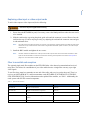
Table 1.
Optional fiber modules
Model no.
Description
Wavelength (nm)
KTD-HDS-ST
Single mode transmit
1310 nm
KTD-HDS-STL
Single mode transmit, long reach
1550 nm
KTD-HDS-STH
Single mode transmit, high power
1310 nm
KTD-HDS-STLH
Single mode transmit, long reach and high
power
1550 nm
KTD-HDS-RCV
Receiver
1310 nm