1
Programming Sections: 5.6 Communicator Programming PWS Sect6
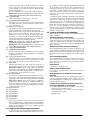
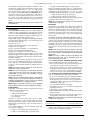
[301] - First Telephone Number
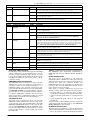
You can assign keypads to work on either a single partition, or on all partitions (Global operation). See Section 2
‘Keypad Assignment’.
Each partition can be programmed to report using a different account number.
Some of the Programmable Output options are also selectable by partition see Section 5 ‘Programmable Outputs’.
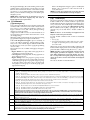
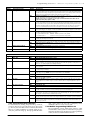
Partition 1-8 Enabled/Disabled Section [201]
Partition 1 Zone Assignments Sections [202] to [209]
Partition 2 Zone Assignments Sections [210] to [217]
Partition 3 Zone Assignments Sections [218] to [225]
Partition 4 Zone Assignments Sections [226] to [233]
Partition 5 Zone Assignments Sections [234] to [241]
Partition 6 Zone Assignments Sections [242] to [249]
Partition 7 Zone Assignments Sections [250] to [257]
Partition 8 Zone Assignments Sections [258] to [265]
These 8-bit toggle sections determine which partitions
each individual zone is assigned to. If a zone is enabled
on any partition, it will be supervised via the panel’s EOL
supervision, and will operate according to the zone type
programmed. If a zone is not assigned to any partition, it
will not be supervised and all activity on the zone will be
ignored by the panel.
[302] - Second Telephone Number
[303] - Third Telephone Number
NOTE: There is a static delay of 2 seconds before any
additional dial tone search in a phone number.
NOTE: The panel will not attempt to communicate, if
no phone number is programmed. This applies to
phone numbers 1, 2 and 3.
[304] - Call Waiting Cancel Dialing String
This is a 6-digit Hex entry that is used to disable Call
Waiting on a Call Waiting-equipped phone line. This is
typically *70 in most areas. Dialing this string before a
phone number will disable Call Waiting for the duration
of the call. If this section is programmed (not FF), and Section 382, Option 4 is ON, the panel will dial this string in
place of the first digit of the phone number (Sections
[301]-[303]). This only applies to the first attempt that is
made to each phone number.
NOTE: If not all 6 digits are required they should be
filled with Hex F.
All 6 digits of this section need to be programmed in
order for any changes to be accepted.
Communicator - Account Codes
The System Account Code will be used by the panel
when communicating System events (e.g. Low Battery,
Test Transmission). This account code can be up to six
digits in length for the SIA Communications format. Only
the SIA reporting format supports six-digit account
codes. All other formats will use the first four digits of the
account code.
NOTE: If the communicator is programmed for the SIA
reporting format, the system will use this account code
for all partitions.
There are eight Partition Identifier Codes (or account
codes) programmable, one for each partition. The account
code is used by central station to determine which panel
is calling.
If you have programmed the system for more than one
partition, you must program an account code for each
active partition. The panel will report to the central station by partition. For example, if an alarm occurs on a
zone assigned to partition 1 the panel will report using
partition 1 account code.
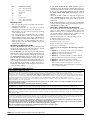
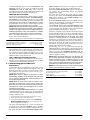
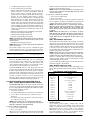
[310] - System Account Code
This is the account code used by the panel when communicating System events (e.g., Low Battery, Test Transmission).
This account code can be up to six digits in length for the
SIA Communications format.
Only SIA supports 6-digit account codes. If the last two
digits of the account code are FF, the panel will only use
the first four digits. All other formats will use the first
four digits of the account code.
The call directions that use this account code are System
Maintenance (Troubles, Zone Faults, etc.) and System Test
Transmissions.
NOTE: SIA will use this account code for all partitions
and system events. System events will be identified by
Nri0, with partitions 1-8 using Nri1-8.
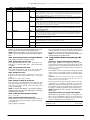
[311]-[317] - Partition 1-8 Account Codes
These account codes are used by the panel when communicating events for partitions 1-8 when using formats
other than SIA.
NOTE: All partition account codes are 4 digits in
length. Valid entries are 0000-FFFE.
5.6 Communicator Programming PWS Sect6
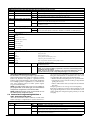
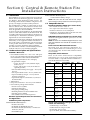
[301]-[304] Communicator - Telephone Numbers
The panel can call 3 different telephone numbers for communication to a central station. The 1stTelephone Number is the primary number, the 2nd Telephone Number is
the secondary number and the 3rd Telephone Number
will back up the 1st telephone number if enabled.
NOTE: The 3rd Telephone Number will NOT back up
the 2nd Telephone Number.
If Alternate Dial is enabled the panel will alternate
between the 1st and 3rd telephone numbers when
attempting to call the central station. If disabled the panel
will only attempt to call the 3rd telephone number after
failing to communicate on the 1st telephone number.
NOTE: For Alternate Dial to work properly the 3rd
telephone Number must be both enabled and programmed.
Telephone numbers can be up to 32 digits which will
allow you to add special digits if required. To program
the telephone number enter numbers 0 - 9 as required.
To communicate events over a LAN or WAN network
using the T-Link module, program the desired phone
number with DCAA. This allows the panel to send events
to the T-Link module in the SIA format via the PC-Link
connection.
Pressing [#] in these sections from an LED keypad will
exit and delete the rest of the phone number. Pressing [#]
in these sections from an LCD keypad will exit and save
the entire phone number up to the first Hex F.
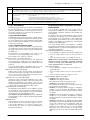
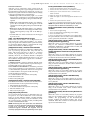
The following is a list of Hex digits which can also be programmed and the functions they perform:
Hex (A) -not used
Hex (B) -simulates the [*] key on a tone telephone
Hex (C) -simulates the [#] key on a tone telephone
Hex (D) -forces the panel to search for dial tone
Hex (E) -forces the panel to pause for 2 seconds
Hex (F) -end of telephone number marker
3rd Telephone Number Enable . . . . . . . . . Section [380], Option [5]
Alternate Dial. . . . . . . . . . . . . . . . . . . . . . Section [380], Option [6]
Downloading Options . . . . . . . . . . . . . . . . . . . . . (Section 7: PWS)
31