1
AWEA WindPower 2006
Software Tools for Distributed Wind
Introduction
The UWIG Distributed Wind Impacts Project has produced a suite of software tools, available to
project members, at http://www.uwig.org/distwind/default.htm. These tools focus on mediumscale wind turbine integration on distribution feeders, where medium-scale is roughly defined as
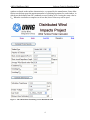
500 kW or greater. The first screening tool is the Flicker Calculator. For that, you only need to
know the number and type of wind turbines proposed, and the location where they would be
installed. The Flicker Calculator requires no special expertise, and minimal data requirements.
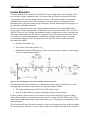
At the next level, the Feeder Simulator provides more detailed assessment of the potential for
voltage regulation problems, excessive tap changer and capacitor switching operations, misoperation of overcurrent protection, etc. Although the system model has been simplified for the
Feeder Simulator, the topics addressed are still fairly complicated. The user needs to be familiar
with voltage regulation and overcurrent protection practices on distribution feeders. The data
requirements are comparable to those for a distribution software package such as WindMil,
CYMDIST, Synergee Electric, DistriView, PSS/Adept, etc.
In cases where the utility will own the wind project, or wishes to assist the developer, the
Economic Screening application may be helpful. The user should be familiar with standard
engineering economics or financial techniques. The Economic Screener is customized for aspects
unique to wind, such as the Production Tax Credit, Clean Renewable Energy Bonds, and
estimates of the wind turbine capacity factor.
Sponsors
The Utility Wind Integration Group (UWIG) has over 90 organizational members. Those
funding the Distributed Wind Impacts Project specifically include:
•
Alaska Energy Authority
•
Alaska Village Electric Cooperative
•
APPA DEED Program
•
California Energy Commission
•
Edison Electric Institute
•
Electric Power Research Institute
•
Hawaiian Electric Company
•
Kotzebue Electric Association
•
Long Island Power Authority
•
Nebraska Public Power District
•
NRECA Cooperative Research Network (CRN)
•
Tennessee Valley Authority
Thus, many small utilities already have access to the software tools through their membership
in the American Public Power Association DEED program, or the National Rural Electric
Cooperative Association CRN. Other parties can gain access to the tools by joining UWIG; at the
2