1
1
Introduction
The measuring and control instrument VMF 2000, in combination with either
one or two transducers, is used for acquiring thickness.
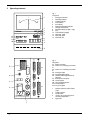
Measuring values or calculated results are output as exact numerical values on a
seven-digit display and, in addition, as scale values on a dial-type indicator.
This results in optimum read-off possibilities for all sorts of application:
For reading off measuring values, the numerical display is favorable,
for recognizing trends and reversing points, the analogue indicator is ideally
suited.
This instrument features a great variety of measuring and evaluation possibilities. They reach from the simple indication of the directly acquired value,
over sum and differential measurements with two transducers to the statistical
evaluation of complete measurement series including mean value, standard
deviation and range. In addition to the standard measuring range with a resolution of 0.1 µm, there is a fine measuring range with the high resolution of
0.01 µm.
Tolerances can be set and precisely monitored. The built-in pilot lamps which
arrange the test pieces into the groups "Accept", "Rework", and "Reject" are
used for the visual indication. The corresponding information on the test piece
can also be transferred via the interfaces to external instruments.
The VMF 2000 features a variety of inputs and outputs which can be connected directly to a stored program control (PLC). Printers and host computers
can be connected via two serial interfaces. Host computers can not only receive data sent by the VMF 2000, they can also control many of its functions.
Control units, recorders, indicating instruments, etc. can be connected to three
analogue outputs the parameters of which can be set independently from each
other, thus enabling the instrument's complete integration into the production
process.
This instrument also features numerous auxiliary functions, e.g. symmetry and
adjusting the sensitivity of the transducer. The function "blanking out disturbances" with its adjustable parameters can be used for largely suppressing interferences on the measuring signal.
Naturally, not all instrument functions will be used to the same extent. Therefore, you can tailor the user interface to suit your special demands. The possible evaluations can be restricted to the indication of the actually necessary results. If for some special application a not directly accessible function is required, the function in question may be assigned to a function key. The function can now be called up at any time by simply pressing this key.
In spite of its many functions, the VMF 2000 is easy to operate, such that even
non-specialists and temporary users can work with this instrument without any
difficulties.
3