1
the middle. This causes the chip to
draw lots of current and burn itself out.
I've always had a bit of trouble with
the labeling. I like "+5 V" and "GND."
CMOS is so versatile they say instead
"Vdd" (drain) and Vss (the chip's substrate). Hook power to Vdd and
ground to Vss.
Using CMOS in the clock circuit is
nice since you can use a 9 V battery instead of waiting for a power supply to
arrive in the mail. (Or you could tap a
line off your computer's power supply.)
The Clock
The clock circuit works by charging
the capacitor until the voltage at the
input inverts, which causes the
capacitor to be discharged until the
cycle repeats. The frequency of oscillation can be roughly estimated with the
RC time constant.
This is a measure of how long it
takes current through a resistor to
create a certain voltage across a
capacitor. It takes about 3· RCs to get
within 10% of the supply voltage, but
the CMOS threshold is passed during
the first RC, so one RC is a good estimate of the period. (Just take the
value of R and multiply by the value of
C. For example, R = 1 megohm and C =
1 microfarad gives an RC of 1 second.
Be careful with the multipliers.)
Connecting A Counter
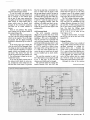
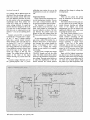
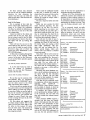
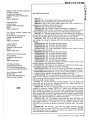
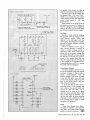
As a final example, connect the output of the oscillator to the 4017 counter
as shown in Figure 3. This is called a
decade counter / divider with 10
decoded outputs. This means it counts
to ten and then starts over, and only
one of its ten outputs is high at anyone
time. In the circuit shown, only one
LED will be off at a time.
A circuit like this is useful for sequencing events. If, for example, you
were using a one-second clock and
wanted to: start the VCR, wait 4
seconds for it to come up to speed,
start the camera panning .motor, then
turn on three lights in sequence, a circuit like this could be your controller
(although in many applications it'd be
more sensible just to throw a whole
computer at the problem).
Finale
I hope these thoughts have filled a
few gaps or scattered a few cobwebs.
Next issue, we'll push further into the
depths of computer electronics. • • •
MICRO CORNUCOPIA, #35, April-May 1987
75