1
Controls - cont’d
photocopy again and again…or possibly a VHS
dub of a dub. The effect is highly-dependent on
source footage, but usually causes some blooming
of mid- and highlights.
Smear –When Distortion is present (see the
Modulation section), it is fed back into the re-processing loop. The effect gets especially interesting
when there are subtle, varying amounts of distortion at medium to high Decay Amount values.
Modulation
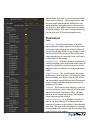
Distortion Method – There are several modes of
distortion that can be assigned to each field independently.
Shift translates the entire ‘field’ (as defined by your
E and O settings) to the right, that can be used to
simulate symptoms like transmission delay or field
dominance reversal.
Linear applies linearly-varying amounts of shift
from the top of the screen to the bottom of the
screen, introducing a diagonal error through the
‘field’.
Noisy mode is very random, such that each scanline is translated left-right by erratic and changing
values.
Sawtooth mode applies a sawtooth-wave to vary
the amount of left-right shifting of ‘scanline’ content.
Wave mode is similar to Sawtooth, except that
the waveform creates a more rounded or curved
displacement .
Horiz. Adj. – Controls the extent of left-right
modulation, as defined by the mode above. High
values here combined with high Influence result
in the greatest distortion. Note: when a scanline is
distorted and shifted ‘outside’ the screen area, the
result is that scanline becomes black in the area
left behind by the movement of the ‘scanline’.
Influence – Influence affects the Horizonal shift®
ing as defined above, but depends on the Distortion Mode. At zero, there will be no shifting at all.
Low Influence values mean the modulation effect
will be subtle, even if the Horizontal Adjustment
values are high. In some of these modes, you can
think of Influence as the ‘Coarse’ value control with
Horizontal Adjustment being the ‘Fine’ control.
In Shift Distortion mode, Influence amplifies the
Horizontal Adjustment value, so a low value here
counteracts Horizontal Adjustment value, while a
high value exaggerates it. Similarly in Linear Distortion mode, Influence adjusts the ‘slope’ of the
diagonal stretching by interacting with the Horizontal Adjustment value. Also, in Noisy Distortion
mode, Influence tends to exaggerate the horizontal shifting by complementing the Horizontal
Adjustment value. In Wave and Sawtooth Distortion modes, Influence controls the modulation of
the waves.
Comb Filter Level – In signal processing, a comb
filter is typically employed to combine a visual
signal with a delayed version of itself to maximize
perceived image quality through the construction of the two versions of the image while the
destructive interference caused by the combining
of the two tend to “smooth” out some details that
aren’t always deemed visually desirable. The effect
of the comb filters in Interference are controlled
by this value. To maximize the horizontal scanline
look, try to run one field’s comb filter at max value
(20) and the other field at minimum (0).
Skew
This effect takes its name from the control on
many professional video tape recorders from distant memory which would affect the tensioning of
the ribbon of tape that wraps around the playback
heads. Altering the skew control during playback
of video would cause various undesirable artifacts
including image shearing, visual noise (or what a