1
A. Nagy, Prof. J. Rohacs
and mini actuators, cost sensitive solutions
of new avionics, etc.,
• measuring the aerodynamic characteristics
of
the
canopies,
developing
the
aerodynamics models and their estimation,
• developing and testing
the UAS
subsystems,
• investigation and
parameter and state
identification of the paraglider motion
models studying the system of motion
equations, mathematical modeling and
solving the models that required for
developing the automatic control of
paragliders.
Of course, these goals define not only the
system elements, sensors, actuators, but the
required accuracy for measurement:
• positioning system (like GPS) with accuracy
0.3 m for navigation purposes,
• attitude, heading and roll measurement with
accuracy less then 2 degrees,
• cameras for image processing (for image
detection and recognition) with accuracy
0.005 s (s – distance to the detected object,
obstacle),
• communication system (data link)
• system monitoring (engine rotational speed,
fuel consumption, speed (at least determined
from the positioning measurement),
monitoring telemetry and monitoring system
(communication system)
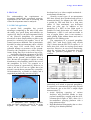
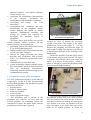
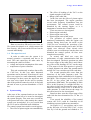
Fig. 4. The very first test of the PPG UAV
developed on the department
The frame of the platform is made of steel,
because we have to provide the necessary
weight of the trike. The weight of the whole
platform has to be in the range 75 - 105 kg,
because the paraglider used has this range of
total weight in flight. The material used allowed
to manufacture the frame in the workshop of the
Department.
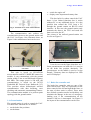
Brake line actuators (left and right) consist
of an actuator and its control circuit. On Figure
5 the brake line actuator can be seen on the test
bench. It is able to develop forces of 400 N,
which is enough to control the paraglider brake
lines in normal flight conditions.
3.2. General description of the test platform
The UAV platform developed by us has take-off
weight up to 110 kg. It is fully developed and
built on the department. The mechanical system
consists of as follows:
• propulsion unit
• frame (3 wheeled trike)
• brake line actuators
• avionics block
• canopy (paraglider wing)
The propulsion unit is consist of the
paramotor type Solo210, the fuel tank, the
wooden propeller, the exhausting system, the
transmission system, the starter motor and the
propeller protection frame (Figure 4).
Fig. 5. Brake line actuator on test bench
The brake line actuators are critical units of
the platform, so they have to be robust and have
fail- safe features. One of the fail safe features is
how these modules can manage the total power
lost. If there is no power on actuators at all, the
force developed on the brake lines can set the
brake to its default position, in which the
4