1
Satellite-Based Augmentation System
Chapter 3
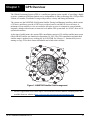
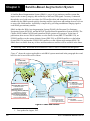
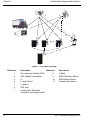
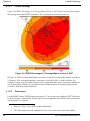
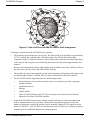
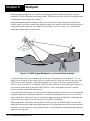
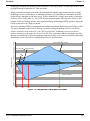
SBAS is made up of a series of Reference Stations, Master Stations, Ground Uplink Stations and Geostationary Satellites (GEOs), see Figure 7, The SBAS Concept on Page 22. The Reference Stations,
which are geographically distributed, pick up GPS satellite data and route it to the Master Stations
where wide area corrections are generated. These corrections are sent to the Ground Uplink Stations
which up-link them to the GEOs for re-transmission on the GPS L1 frequency. These GEOs transmit
signals which carry accuracy and integrity messages, and which also provide additional ranging
signals for added availability, continuity and accuracy. These GEO signals are available over a wide
area and can be received and processed by NovAtel receivers with appropriate firmware. GPS user
receivers are thus able to receive SBAS data in-band and use not only differential corrections, but also
integrity, residual errors and ionospheric information for each monitored satellite.
The signal broadcast via the SBAS GEOs to the SBAS users is designed to minimize modifications to
standard GPS receivers. As such, the GPS L1 frequency (1575.42 MHz) is used, together with GPStype modulation, for example, a Coarse/Acquisition (C/A) pseudorandom (PRN) code. In addition,
the code phase timing is maintained close to GPS Time to provide a ranging capability.
The primary functions of SBAS include:
• data collection
• determining ionospheric corrections
• determining satellite orbits
• determining satellite clock corrections
• determining satellite integrity
• independent data verification
• SBAS message broadcast and ranging
• system operations & maintenance
3.1
SBAS Receiver
All OEMV models, many OEM4 and several SSII models of NovAtel receivers are equipped with
SBAS capability. The ability to incorporate the SBAS corrections into the position is available in
these models.
SBAS data can be output in log format and can incorporate these corrections to generate differentialquality position solutions. Standard SBAS data messages are analyzed based on RTCA standards for
GPS/WAAS airborne equipment. Please refer to your SUPERSTAR II Firmware Reference Manual or
OEMV Firmware Reference Manual for details on SBAS commands and logs.
An SBAS-capable receiver permits anyone within the area of coverage to take advantage of its
benefits with no subscription fee.
GPS+ Reference Manual Rev 0I
21