1
5.2
Check and Reflect
Key Concept Review
1. In your own words, state Newton’s second law.
2. An applied force Fapp acting on an object of
constant mass causes the object to accelerate.
Sketch graphs to show the relationship
between a and Fapp when friction is
(a) present, and
(b) absent.
3. Sketch a graph to show the relationship
between the magnitude of acceleration and
mass for constant net force.
4. Explain why vehicles with more powerful
engines are able to accelerate faster.
5. Pick a sports or other situation that involves
Newton’s second law, and explain how
Newton’s second law applies to that situation.
6. Summarize concepts and ideas associated with
Newton’s second law using a graphic organizer
of your choice. Make sure that the concepts
and ideas are clearly presented and are linked
appropriately.
Connect Your Understanding
9. A piece of lead on a table, initially at rest,
has a force of 195 N [right] exerted on it. If
the force of friction is 155 N and the resultant
acceleration is 2.5 m/s2 [right], determine the
mass of the piece of lead.
10. A student applies a force of 125 N [left] on a
12.5-kg block of wood, which is initially at
rest. Another student also applies a force of
32 N [left] on the block. If the block accelerates
at 3.7 m/s2 [left], calculate the frictional force
involved with this motion.
11. Two boxes, A and B, are touching each other
and are at rest on a horizontal, frictionless
surface. Box A has a mass of 25 kg and box B a
mass of 15 kg. A person applies a force of 30 N
[right] on box A which, in turn, pushes on box B.
Calculate the acceleration of the boxes.
12. A 2.9-kg bucket is lifted upward with a force
of 46 N against the force of gravity. Calculate its
upward acceleration, ignoring all frictional forces.
13. A 78-kg parachutist, in the first few seconds
of her jump, accelerates at a rate of 7.4 m/s2
[down]. Calculate the force she experiences
due to air resistance.
7. A dolphin experiences a force of 320 N [up]
when it jumps out of the water. The
acceleration of the dolphin is 2.6 m/s2 [up].
(a) Calculate the mass of the dolphin.
(b) What would be the acceleration of the
dolphin if it had the same strength but half
the mass?
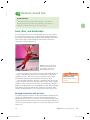
14. Many hockey players like to practice with a
heavy practice puck.
(a) State two advantages that practicing with
a weighted practice puck would provide to
a hockey player.
(b) How would the acceleration of a regular
puck compare to that of a weighted puck if
hit with the same force?
8. An ice hut used for winter fishing is at rest
on a level patch of snow. The mass of the hut
is 80 kg. A wind exerts a horizontal force of
205 N [E] on the hut, and causes it to accelerate.
While in motion, the magnitude of the force of
friction acting on the hut is 196 N [W].
(a) Draw a free-body diagram of the hut.
(b) What is the acceleration of the hut?
15. Consider a spacecraft whose engines cause it to
accelerate at 5.0 m/s2.
(a) What would be the spacecraft’s acceleration
at a later time if half its fuel has been used up?
(b) What assumptions have you made in order
to answer (a)?
If the ice hut now accelerates at 0.95 m/s2 [E],
calculate
(c) the net force acting on the hut, and
(d) the force applied by the wind if the force
of friction remains at 196 N.
Reflection
16. How did your understanding of the relationships
among net force, mass, and acceleration change
after working through this section?
For more questions, go to
138
Unit B Forces
05-PHYSICS-11SE-Ch05.indd 138
PHYSICS• SOURCE
©P
7/23/10 11:37:19 AM