1
This paper has two core objectives: to refine a well-known set of template models for agent-based modeling, and to offer a new reference implementation. In pursuing these goals, we address issues of design,
flexibility, and ease of use that are relevant to the choice of an agent-based modeling platform.
The use of agent-based models (ABMs) has been growing rapidly in many fields, including evolutionary
biology, ecology, economics, epidemiology, game theory, political science, and sociology. Popular ABM
platforms include NetLogo (http://ccl.northwestern.edu/netlogo/), Swarm and Java Swarm (http:
//www.swarm.org), Repast (http://repast.sourceforge.net), and MASON (http://www.cs.gmu.edu/
%7Eeclab/projects/mason/). Each of these platforms has benefits and limitations that have been explored
in the literature (Tobias and Hofmann, 2004; Railsback et al., 2006). The most popular of these platforms
remains NetLogo, which is renowned for its combination good graphical capabilities, reasonable flexibility,
and excellent of ease of use. Railsback et al. (2006) also judge NetLogo to be the most professional platform
in terms of appearance and documentation. The most common complaint against NetLogo is its failure to
adopt an open source license, which some researchers view as a crucial component of scientific ABM research.
Railsback et al. (2006) discuss a collection of sixteen template models, which they designed as tools to
introduce and explore agent-based modeling (ABM) platforms. (Railsback et al. (2005) provide the full
model specifications.) The template models are intended to be “ridiculously simplified”. They illustrate
general modeling considerations required by many different real-world applications and do not constitute an
attempt to implement a specific real-world application. These template models have already proved their
usefulness. They are used in teaching and are chosen as a point of reference for introductory presentations of
new ABM platforms. Nevertheless, in this paper we propose to remove certain ambiguities, tighten certain
specifications, remove from the specification some implementation details, highlight additional learning goals,
and draw a clearer distinction between general programming goals and goals focused on the visual display
of information.
Railsback et al. (2005) provide reference implementations of the template models for a few popular
platforms. The template-model reference implementations are intended to be “simple and intuitive” rather
than clever or fast. As might be expected, the reference implementations clarify the intent of certain parts
of the specifications and highlight some of their limitations. The simplest and least verbose are the NetLogo
reference implementations. Robertson (2005) notes that, as an ABM platform, NetLogo excels at ease of use
and compactness of representation. This makes the NetLogo reference implementations particularly relevant
as a point of comparison for other ABM platforms.
In this paper we provide new reference implementations. The reference implementations use the Python
programming language. After modest initial start-up costs, our Python implementations of the template
models prove simple, readable, and short. That is, they are useful as reference implementations. We show
how use of a simple gridworld module allows for Python implementations that usually approach and often
exceed the simplicity of NetLogo, while providing improved readability and power. Following the intent of
the original reference implementations, our code emphasizes readability and ease of use (rather than speed or
generality). We also suggest a few advantages and disadvantages of using Python as an ABM platform. Since
NetLogo consistently receives high marks on these criteria, we take it as our primary point of comparison.
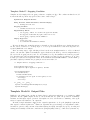
Template Model 1: Spatial Movement of Agents
The first template model provides a basic introduction to ABM platforms. The core programming goal is to
implement the random movement of agents in a simple two-dimensional space. That is, we must implement
a specified behavior for a base agent type that is spatially situated.
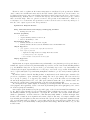
The background needed to attempt the first template model is platform dependent, but generally it
requires a modest introduction to programming on the chosen ABM platform. Required skills include the
use of basic built-in functions, definition and use of new functions, some understanding of variable scope
(local vs. global), use of a looping construct, iteration over a collection (of agents), and simple randomization
using built-in facilities.1 With this background, we can attempt the specification of the first template model.
2