1
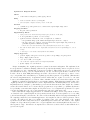
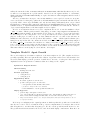
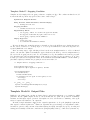
Specification: Template Model 1
World
• a 100 x 100 toroidal grid of possible agent positions
Setup
• create an iterable collection of 100 agents
• give each agent a unique, random position on the grid
Iteration
• each time step, each agent moves to a random, unoccupied neighboring location
Stopping Condition
• Not part of the specification.
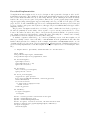
Supplementary Detail
• agent positions are characterized by integer pairs (locations on the grid)
• no two agents share a position, not even initially
• agent movement is constrained to a Moore neighborhood of radius 4
– an agent must change position unless all neighboring locations are occupied
– the new position is a “random” selection from the unoccupied neighboring locations (no
particular algorithm or PRNG is specified)
– the move action must terminate, even if all neighboring locations are occupied
• the order in which agents move is unspecified, but agents must move sequentially (i.e., one at
a time)
• a “time step” is one iteration through the model schedule
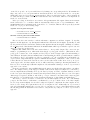
Display Suggestions
• position: display each agent on screen at a position corresponding to its grid position
• shape: display agents as circles
• color: use a red fill color for agents
• size: make sure adjacent agents are easily distinguishable
• update: display once each iteration
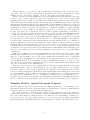
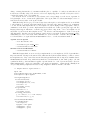
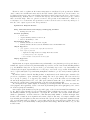
Despite its simplicity, the original specification contained some minor ambiguities. The emphasized text
in our specification constitutes clarifying additions. We specify that the initial positions of agents are chosen
randomly subject to the constraint that locations are not shared. This addition is not very consequential
(and matches the NetLogo reference implementation). We also add that agents should be members of an
iterable collection. Most ABM platforms support iterable collections for each agent type, so this too is not
very consequential. More substantively, we explicitly specify that agents move sequentially. (This matches
the reference implementations.) Sequential movement ensures that two agents do not move to the same
location, and as Kahn (2007) notes, violation of this constraint can affect outcomes in later template models.
Finally, we explicitly specify that the move action must terminate. While this is the natural reading of the
original specification, it conflicts with the reference implementations.2 As Kahn (2007) notes, the reference
implementations use a simple loop that makes repeated random draws from the entire neighborhood until a
vacant cell is found. If there are no vacant cells, the program never escapes this loop. (Admittedly, this is a
low probability event in the first template model.) However we do not augment the specification to require
a specific algorithm, since the ease of any particular approach can be platform specific.
It is notable that the display suggestions have no essential relationship to the model specification. In fact,
one drawback of the original template model specifications is the lack of a clean separation of core modeling
goals and visual display considerations. We cannot address this fully without diverging substantially from
the original specifications, but a natural supplement to the template models is a cleaner separation of these
concerns. We will provide this on a template by template basis. One other drawback or the original
specification is the unnecessary narrowness of original interpretive framework. The authors of the original
template model specifications presumed an ecological emphasis and somewhat light-heartedly referred to
their agents as “bugs”. Our interest encompasses the social sciences, and we therefore stick with the more
generic term ‘agents’.
3