1
SH3000 MicroBuddy™
SYSTEM MANAGEMENT
Since the clock is only active for the last 1 or 2 ms of
the reset interval, when VDD has already been valid for
some time, energy savings are realized and the startup
of the whole system is made easier. Commonly used
reset approach forces the processor to turn the oscillator
on and to run at full speed (thus consuming full power)
during the critical time when (possibly depleted) battery
is trying to raise VDD to an acceptable level. In contrast,
the SH3000 allows the power source to charge the
bypass capacitors and raise the level of VDD with little
additional load. Only when power has stabilized is the
target micro permitted to start expending energy.
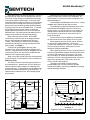
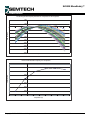
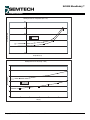
When a brownout event occurs, the SH3000
continues to provide the clock to the target processor,
but at a reduced frequency between 500 kHz and
1.0MHz. After a delay of 2 ms this clock is stopped,
automatically lowering the energy consumption of the
whole system, see Figure 2.
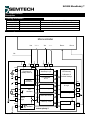
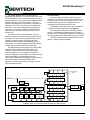
A Noise Filter (see Figure 1) prevents reset
activations from noise and small power glitches on the
VDD line. A typical behavior is shown in Figure 3 for the
VDD level just above VBO and various amplitudes and
durations of the negative-going spikes.
When VDD is falling, both reset lines are guaranteed
to activate within 5 µs from the time VBO is crossed over.
Watchdog Timer
The second circuit for supervising the processor is
the watchdog timer. Whereas the low VDD / Brownout
Detector monitors supply voltage, the watchdog timer
monitors behavior. It is based on a programmable timer
that must be restarted periodically by the host micro. If
software fails to restart the timer, the watchdog resets
the processor.
Restarting the timer takes considerable processing,
making it unlikely that it would occur accidentally, as
might happen for a simple pin-strobe configuration of a
typical watchdog IC.
The watchdog is disabled after reset occurs. It stays
disabled until initialized by the host processor.
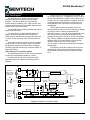
The initialization requires the watchdog clock mode
to be selected (see Figure 1) and the 7-bit time-out
value to be set. As soon as the time-out is written, the
watchdog begins operations and can not be stopped;
also, the time-out value and or clock source can no
longer be changed.
The two clock sources available for the watchdog
are the internal 32 kHz clock and the CLKOUT signal.
When operating from the 32 kHz source, the timeout interval is programmable from 7.8125 ms to
1 second with resolution of 7.8125 ms. Internal 32 kHz
clock is running all the time, therefore the time-out
duration is fixed and predictable.
When operating from the CLKOUT signal the time-out
interval is programmable between 256 and 32768 cycles
of CLKOUT with resolution of 256 cycles. The actual
time-out duration is variable and depends both on the
frequency of CLKOUT signal and the amount of time the
target micro spends in the STOP mode, when the
CLKOUT signal is also stopped.
These two clock modes, together with the
programmable time-out value, allow the SH3000
exceptional flexibility, previously unattainable by existing
discrete watchdog solutions.
12ms minimum
VBO + VHYST
1V
6ms
Duration, µs
3-5ms
Amplitude
VDD
Duration
10
VBO
RST
Undefined
5
Guaranteed reset
NRST
1ms
CLKOUT
Normal
FOUT
2ms
Guaranteed NO reset
2ms
0
0.05 0.1 0.15 0.2 0.25 0.3 0.35 0.4 0.45 0.5
Reduced FOUT
0.5-1.0 MHz
Am plitude, V
Figure 2. Operations of low VDD / Brownout Detector
Copyright ©2003-2005 Semtech Corporation
Figure 3. Response to negative voltage spikes
6
V1.15
www.semtech.com