1
Valgrind Documentation
Release 3.2.0 7 June 2006
Copyright © 2000-2006 AUTHORS
Permission is granted to copy, distribute and/or modify this document under the terms of the GNU Free Documentation
License, Version 1.2 or any later version published by the Free Software Foundation; with no Invariant Sections, with
no Front-Cover Texts, and with no Back-Cover Texts. A copy of the license is included in the section entitled The
GNU Free Documentation License.
Valgrind Documentation
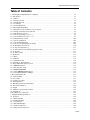
Table of Contents
The Valgrind Quick Start Guide . . . . . . . . . . . . . . . . . . . . . . . . . . . . . . . . . . . . . . . . . . . . . . . . . . . . . . . . . . . . . . . . . . . . 3
Valgrind User Manual . . . . . . . . . . . . . . . . . . . . . . . . . . . . . . . . . . . . . . . . . . . . . . . . . . . . . . . . . . . . . . . . . . . . . . . . . . . . 4
Valgrind FAQ . . . . . . . . . . . . . . . . . . . . . . . . . . . . . . . . . . . . . . . . . . . . . . . . . . . . . . . . . . . . . . . . . . . . . . . . . . . . . . . . . . . 80
Valgrind Technical Documentation . . . . . . . . . . . . . . . . . . . . . . . . . . . . . . . . . . . . . . . . . . . . . . . . . . . . . . . . . . . . . . . . 88
Valgrind Distribution Documents . . . . . . . . . . . . . . . . . . . . . . . . . . . . . . . . . . . . . . . . . . . . . . . . . . . . . . . . . . . . . . . . 144
GNU Licenses . . . . . . . . . . . . . . . . . . . . . . . . . . . . . . . . . . . . . . . . . . . . . . . . . . . . . . . . . . . . . . . . . . . . . . . . . . . . . . . . . 193
2
The Valgrind Quick Start Guide
Release 3.2.0 7 June 2006
Copyright © 2000-2006 Valgrind Developers
Email: [email protected]
The Valgrind Quick Start Guide
Table of Contents
The Valgrind Quick Start Guide . . . . . . . . . . . . . . . . . . . . . . . . . . . . . . . . . . . . . . . . . . . . . . . . . . . . . . . . . . . . . . . . . . . .
1. Introduction . . . . . . . . . . . . . . . . . . . . . . . . . . . . . . . . . . . . . . . . . . . . . . . . . . . . . . . . . . . . . . . . . . . . . . . . . . . . . . . . . . .
2. Preparing your program . . . . . . . . . . . . . . . . . . . . . . . . . . . . . . . . . . . . . . . . . . . . . . . . . . . . . . . . . . . . . . . . . . . . . . . .
3. Running your program under Memcheck . . . . . . . . . . . . . . . . . . . . . . . . . . . . . . . . . . . . . . . . . . . . . . . . . . . . . . . . .
4. Interpreting Memcheck’s output . . . . . . . . . . . . . . . . . . . . . . . . . . . . . . . . . . . . . . . . . . . . . . . . . . . . . . . . . . . . . . . . .
5. Caveats . . . . . . . . . . . . . . . . . . . . . . . . . . . . . . . . . . . . . . . . . . . . . . . . . . . . . . . . . . . . . . . . . . . . . . . . . . . . . . . . . . . . . . .
6. More information . . . . . . . . . . . . . . . . . . . . . . . . . . . . . . . . . . . . . . . . . . . . . . . . . . . . . . . . . . . . . . . . . . . . . . . . . . . . . .
1
1
1
1
1
3
3
iv
The Valgrind Quick Start Guide
The Valgrind Quick Start Guide
1. Introduction
The Valgrind distribution has multiple tools. The most popular is the memory checking tool (called Memcheck)
which can detect many common memory errors such as:
• touching memory you shouldn’t (eg. overrunning heap block boundaries);
• using values before they have been initialized;
• incorrect freeing of memory, such as double-freeing heap blocks;
• memory leaks.
What follows is the minimum information you need to start detecting memory errors in your program with Memcheck.
Note that this guide applies to Valgrind version 2.4.0 and later; some of the information is not quite right for earlier
versions.
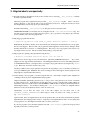
2. Preparing your program
Compile your program with -g to include debugging information so that Memcheck’s error messages include exact
line numbers. Using -O0 is also a good idea, if you can tolerate the slowdown. With -O1 line numbers in error
messages can be inaccurate, although generally speaking Memchecking code compiled at -O1 works fairly well. Use
of -O2 and above is not recommended as Memcheck occasionally reports uninitialised-value errors which don’t really
exist.
3. Running your program under Memcheck
If you normally run your program like this:
myprog arg1 arg2
Use this command line:
valgrind --leak-check=yes myprog arg1 arg2
Memcheck is the default tool. The --leak-check option turns on the detailed memory leak detector.
Your program will run much slower (eg. 20 to 30 times) than normal, and use a lot more memory. Memcheck will
issue messages about memory errors and leaks that it detects.
4. Interpreting Memcheck’s output
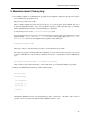
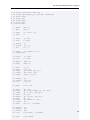
Here’s an example C program with a memory error and a memory leak.
1
The Valgrind Quick Start Guide
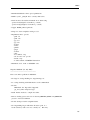
#include <stdlib.h>
void f(void)
{
int* x = malloc(10 * sizeof(int));
x[10] = 0;
// problem 1: heap block overrun
}
// problem 2: memory leak -- x not freed
int main(void)
{
f();
return 0;
}
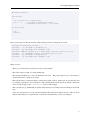
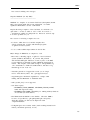
Most error messages look like the following, which describes problem 1, the heap block overrun:
==19182== Invalid write of size 4
==19182==
at 0x804838F: f (example.c:6)
==19182==
by 0x80483AB: main (example.c:11)
==19182== Address 0x1BA45050 is 0 bytes after a block of size 40 alloc’d
==19182==
at 0x1B8FF5CD: malloc (vg_replace_malloc.c:130)
==19182==
by 0x8048385: f (example.c:5)
==19182==
by 0x80483AB: main (example.c:11)
Things to notice:
• There is a lot of information in each error message; read it carefully.
• The 19182 is the process ID; it’s usually unimportant.
• The first line ("Invalid write...") tells you what kind of error it is. Here, the program wrote to some memory it
should not have due to a heap block overrun.
• Below the first line is a stack trace telling you where the problem occurred. Stack traces can get quite large, and
be confusing, especially if you are using the C++ STL. Reading them from the bottom up can help. If the stack
trace is not big enough, use the --num-callers option to make it bigger.
• The code addresses (eg. 0x804838F) are usually unimportant, but occasionally crucial for tracking down weirder
bugs.
• Some error messages have a second component which describes the memory address involved. This one shows
that the written memory is just past the end of a block allocated with malloc() on line 5 of example.c.
2
The Valgrind Quick Start Guide
It’s worth fixing errors in the order they are reported, as later errors can be caused by earlier errors.
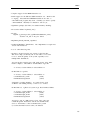
Memory leak messages look like this:
==19182== 40 bytes in 1 blocks are definitely lost in loss record 1 of 1
==19182==
at 0x1B8FF5CD: malloc (vg_replace_malloc.c:130)
==19182==
by 0x8048385: f (a.c:5)
==19182==
by 0x80483AB: main (a.c:11)
The stack trace tells you where the leaked memory was allocated. Memcheck cannot tell you why the memory leaked,
unfortunately. (Ignore the "vg_replace_malloc.c", that’s an implementation detail.)
There are several kinds of leaks; the two most important categories are:
• "definitely lost": your program is leaking memory -- fix it!
• "probably lost": your program is leaking memory, unless you’re doing funny things with pointers (such as moving
them to point to the middle of a heap block).
If you don’t understand an error message, please consult Explanation of error messages from Memcheck in the
Valgrind User Manual which has examples of all the error messages Memcheck produces.
5. Caveats
Memcheck is not perfect; it occasionally produces false positives, and there are mechanisms for suppressing these
(see Suppressing errors in the Valgrind User Manual). However, it is typically right 99% of the time, so you should be
wary of ignoring its error messages. After all, you wouldn’t ignore warning messages produced by a compiler, right?
The suppression mechanism is also useful if Memcheck is reporting errors in library code that you cannot change; the
default suppression set hides a lot of these, but you may come across more.
Memcheck also cannot detect every memory error your program has. For example, it can’t detect if you overrun the
bounds of an array that is allocated statically or on the stack. But it should detect every error that could crash your
program (eg. cause a segmentation fault).
6. More information
Please consult the Valgrind FAQ and the Valgrind User Manual, which have much more information. Note that the
other tools in the Valgrind distribution can be invoked with the --tool option.
3
Valgrind User Manual
Release 3.2.0 7 June 2006
Copyright © 2000-2006 Valgrind Developers
Email: [email protected]
Valgrind User Manual
Table of Contents
1. Introduction . . . . . . . . . . . . . . . . . . . . . . . . . . . . . . . . . . . . . . . . . . . . . . . . . . . . . . . . . . . . . . . . . . . . . . . . . . . . . . . . . . . 7
1.1. An Overview of Valgrind . . . . . . . . . . . . . . . . . . . . . . . . . . . . . . . . . . . . . . . . . . . . . . . . . . . . . . . . . . . . . . . . . . . . . . 7
1.2. How to navigate this manual . . . . . . . . . . . . . . . . . . . . . . . . . . . . . . . . . . . . . . . . . . . . . . . . . . . . . . . . . . . . . . . . . . . 8
2. Using and understanding the Valgrind core . . . . . . . . . . . . . . . . . . . . . . . . . . . . . . . . . . . . . . . . . . . . . . . . . . . . . . . 9
2.1. What Valgrind does with your program . . . . . . . . . . . . . . . . . . . . . . . . . . . . . . . . . . . . . . . . . . . . . . . . . . . . . . . . . 9
2.2. Getting started . . . . . . . . . . . . . . . . . . . . . . . . . . . . . . . . . . . . . . . . . . . . . . . . . . . . . . . . . . . . . . . . . . . . . . . . . . . . . . . 9
2.3. The Commentary . . . . . . . . . . . . . . . . . . . . . . . . . . . . . . . . . . . . . . . . . . . . . . . . . . . . . . . . . . . . . . . . . . . . . . . . . . . 10
2.4. Reporting of errors . . . . . . . . . . . . . . . . . . . . . . . . . . . . . . . . . . . . . . . . . . . . . . . . . . . . . . . . . . . . . . . . . . . . . . . . . . 12
2.5. Suppressing errors . . . . . . . . . . . . . . . . . . . . . . . . . . . . . . . . . . . . . . . . . . . . . . . . . . . . . . . . . . . . . . . . . . . . . . . . . . 12
2.6. Command-line flags for the Valgrind core . . . . . . . . . . . . . . . . . . . . . . . . . . . . . . . . . . . . . . . . . . . . . . . . . . . . . . 14
2.6.1. Tool-selection option . . . . . . . . . . . . . . . . . . . . . . . . . . . . . . . . . . . . . . . . . . . . . . . . . . . . . . . . . . . . . . . . . . . . . . 15
2.6.2. Basic Options . . . . . . . . . . . . . . . . . . . . . . . . . . . . . . . . . . . . . . . . . . . . . . . . . . . . . . . . . . . . . . . . . . . . . . . . . . . . . 15
2.6.3. Error-related options . . . . . . . . . . . . . . . . . . . . . . . . . . . . . . . . . . . . . . . . . . . . . . . . . . . . . . . . . . . . . . . . . . . . . . . 16
2.6.4. malloc()-related Options . . . . . . . . . . . . . . . . . . . . . . . . . . . . . . . . . . . . . . . . . . . . . . . . . . . . . . . . . . . . . . . . 19
2.6.5. Uncommon Options . . . . . . . . . . . . . . . . . . . . . . . . . . . . . . . . . . . . . . . . . . . . . . . . . . . . . . . . . . . . . . . . . . . . . . . 19
2.6.6. Debugging Valgrind Options . . . . . . . . . . . . . . . . . . . . . . . . . . . . . . . . . . . . . . . . . . . . . . . . . . . . . . . . . . . . . . . . 21
2.6.7. Setting default Options . . . . . . . . . . . . . . . . . . . . . . . . . . . . . . . . . . . . . . . . . . . . . . . . . . . . . . . . . . . . . . . . . . . . . 21
2.7. The Client Request mechanism . . . . . . . . . . . . . . . . . . . . . . . . . . . . . . . . . . . . . . . . . . . . . . . . . . . . . . . . . . . . . . . 21
2.8. Support for Threads . . . . . . . . . . . . . . . . . . . . . . . . . . . . . . . . . . . . . . . . . . . . . . . . . . . . . . . . . . . . . . . . . . . . . . . . . 23
2.9. Handling of Signals . . . . . . . . . . . . . . . . . . . . . . . . . . . . . . . . . . . . . . . . . . . . . . . . . . . . . . . . . . . . . . . . . . . . . . . . . 24
2.10. Function wrapping . . . . . . . . . . . . . . . . . . . . . . . . . . . . . . . . . . . . . . . . . . . . . . . . . . . . . . . . . . . . . . . . . . . . . . . . . 24
2.10.1. A Simple Example . . . . . . . . . . . . . . . . . . . . . . . . . . . . . . . . . . . . . . . . . . . . . . . . . . . . . . . . . . . . . . . . . . . . . . . 24
2.10.2. Wrapping Specifications . . . . . . . . . . . . . . . . . . . . . . . . . . . . . . . . . . . . . . . . . . . . . . . . . . . . . . . . . . . . . . . . . . 25
2.10.3. Wrapping Semantics . . . . . . . . . . . . . . . . . . . . . . . . . . . . . . . . . . . . . . . . . . . . . . . . . . . . . . . . . . . . . . . . . . . . . . 26
2.10.4. Debugging . . . . . . . . . . . . . . . . . . . . . . . . . . . . . . . . . . . . . . . . . . . . . . . . . . . . . . . . . . . . . . . . . . . . . . . . . . . . . . 27
2.10.5. Limitations - control flow . . . . . . . . . . . . . . . . . . . . . . . . . . . . . . . . . . . . . . . . . . . . . . . . . . . . . . . . . . . . . . . . . 27
2.10.6. Limitations - original function signatures . . . . . . . . . . . . . . . . . . . . . . . . . . . . . . . . . . . . . . . . . . . . . . . . . . . 28
2.10.7. Examples . . . . . . . . . . . . . . . . . . . . . . . . . . . . . . . . . . . . . . . . . . . . . . . . . . . . . . . . . . . . . . . . . . . . . . . . . . . . . . . . 28
2.11. Building and Installing . . . . . . . . . . . . . . . . . . . . . . . . . . . . . . . . . . . . . . . . . . . . . . . . . . . . . . . . . . . . . . . . . . . . . 28
2.12. If You Have Problems . . . . . . . . . . . . . . . . . . . . . . . . . . . . . . . . . . . . . . . . . . . . . . . . . . . . . . . . . . . . . . . . . . . . . . 29
2.13. Limitations . . . . . . . . . . . . . . . . . . . . . . . . . . . . . . . . . . . . . . . . . . . . . . . . . . . . . . . . . . . . . . . . . . . . . . . . . . . . . . . . 30
2.14. An Example Run . . . . . . . . . . . . . . . . . . . . . . . . . . . . . . . . . . . . . . . . . . . . . . . . . . . . . . . . . . . . . . . . . . . . . . . . . . 32
2.15. Warning Messages You Might See . . . . . . . . . . . . . . . . . . . . . . . . . . . . . . . . . . . . . . . . . . . . . . . . . . . . . . . . . . . 33
2.16. Debugging MPI Parallel Programs with Valgrind . . . . . . . . . . . . . . . . . . . . . . . . . . . . . . . . . . . . . . . . . . . . . . 34
2.16.1. Building and installing the wrappers . . . . . . . . . . . . . . . . . . . . . . . . . . . . . . . . . . . . . . . . . . . . . . . . . . . . . . . . 34
2.16.2. Getting started . . . . . . . . . . . . . . . . . . . . . . . . . . . . . . . . . . . . . . . . . . . . . . . . . . . . . . . . . . . . . . . . . . . . . . . . . . . 35
2.16.3. Controlling the wrapper library . . . . . . . . . . . . . . . . . . . . . . . . . . . . . . . . . . . . . . . . . . . . . . . . . . . . . . . . . . . . 35
2.16.4. Abilities and limitations . . . . . . . . . . . . . . . . . . . . . . . . . . . . . . . . . . . . . . . . . . . . . . . . . . . . . . . . . . . . . . . . . . . 36
2.16.5. Writing new wrappers . . . . . . . . . . . . . . . . . . . . . . . . . . . . . . . . . . . . . . . . . . . . . . . . . . . . . . . . . . . . . . . . . . . . 37
2.16.6. What to expect when using the wrappers . . . . . . . . . . . . . . . . . . . . . . . . . . . . . . . . . . . . . . . . . . . . . . . . . . . . 37
3. Memcheck: a heavyweight memory checker . . . . . . . . . . . . . . . . . . . . . . . . . . . . . . . . . . . . . . . . . . . . . . . . . . . . . 39
3.1. Kinds of bugs that Memcheck can find . . . . . . . . . . . . . . . . . . . . . . . . . . . . . . . . . . . . . . . . . . . . . . . . . . . . . . . . 39
3.2. Command-line flags specific to Memcheck . . . . . . . . . . . . . . . . . . . . . . . . . . . . . . . . . . . . . . . . . . . . . . . . . . . . . 39
3.3. Explanation of error messages from Memcheck . . . . . . . . . . . . . . . . . . . . . . . . . . . . . . . . . . . . . . . . . . . . . . . . 41
3.3.1. Illegal read / Illegal write errors . . . . . . . . . . . . . . . . . . . . . . . . . . . . . . . . . . . . . . . . . . . . . . . . . . . . . . . . . . . . . 41
3.3.2. Use of uninitialised values . . . . . . . . . . . . . . . . . . . . . . . . . . . . . . . . . . . . . . . . . . . . . . . . . . . . . . . . . . . . . . . . . . 41
3.3.3. Illegal frees . . . . . . . . . . . . . . . . . . . . . . . . . . . . . . . . . . . . . . . . . . . . . . . . . . . . . . . . . . . . . . . . . . . . . . . . . . . . . . . 42
3.3.4. When a block is freed with an inappropriate deallocation function . . . . . . . . . . . . . . . . . . . . . . . . . . . . . . 42
3.3.5. Passing system call parameters with inadequate read/write permissions . . . . . . . . . . . . . . . . . . . . . . . . . . 43
3.3.6. Overlapping source and destination blocks . . . . . . . . . . . . . . . . . . . . . . . . . . . . . . . . . . . . . . . . . . . . . . . . . . . 44
3.3.7. Memory leak detection . . . . . . . . . . . . . . . . . . . . . . . . . . . . . . . . . . . . . . . . . . . . . . . . . . . . . . . . . . . . . . . . . . . . . 45
3.4. Writing suppression files . . . . . . . . . . . . . . . . . . . . . . . . . . . . . . . . . . . . . . . . . . . . . . . . . . . . . . . . . . . . . . . . . . . . . 46
v
Valgrind User Manual
3.5. Details of Memcheck’s checking machinery . . . . . . . . . . . . . . . . . . . . . . . . . . . . . . . . . . . . . . . . . . . . . . . . . . . .
3.5.1. Valid-value (V) bits . . . . . . . . . . . . . . . . . . . . . . . . . . . . . . . . . . . . . . . . . . . . . . . . . . . . . . . . . . . . . . . . . . . . . . . .
3.5.2. Valid-address (A) bits . . . . . . . . . . . . . . . . . . . . . . . . . . . . . . . . . . . . . . . . . . . . . . . . . . . . . . . . . . . . . . . . . . . . . .
3.5.3. Putting it all together . . . . . . . . . . . . . . . . . . . . . . . . . . . . . . . . . . . . . . . . . . . . . . . . . . . . . . . . . . . . . . . . . . . . . .
3.6. Client Requests . . . . . . . . . . . . . . . . . . . . . . . . . . . . . . . . . . . . . . . . . . . . . . . . . . . . . . . . . . . . . . . . . . . . . . . . . . . . .
4. Cachegrind: a cache profiler . . . . . . . . . . . . . . . . . . . . . . . . . . . . . . . . . . . . . . . . . . . . . . . . . . . . . . . . . . . . . . . . . . .
4.1. Cache profiling . . . . . . . . . . . . . . . . . . . . . . . . . . . . . . . . . . . . . . . . . . . . . . . . . . . . . . . . . . . . . . . . . . . . . . . . . . . . .
4.1.1. Overview . . . . . . . . . . . . . . . . . . . . . . . . . . . . . . . . . . . . . . . . . . . . . . . . . . . . . . . . . . . . . . . . . . . . . . . . . . . . . . . . .
4.1.2. Cache simulation specifics . . . . . . . . . . . . . . . . . . . . . . . . . . . . . . . . . . . . . . . . . . . . . . . . . . . . . . . . . . . . . . . . . .
4.2. Profiling programs . . . . . . . . . . . . . . . . . . . . . . . . . . . . . . . . . . . . . . . . . . . . . . . . . . . . . . . . . . . . . . . . . . . . . . . . . .
4.2.1. Output file . . . . . . . . . . . . . . . . . . . . . . . . . . . . . . . . . . . . . . . . . . . . . . . . . . . . . . . . . . . . . . . . . . . . . . . . . . . . . . . .
4.2.2. Cachegrind options . . . . . . . . . . . . . . . . . . . . . . . . . . . . . . . . . . . . . . . . . . . . . . . . . . . . . . . . . . . . . . . . . . . . . . . .
4.2.3. Annotating C/C++ programs . . . . . . . . . . . . . . . . . . . . . . . . . . . . . . . . . . . . . . . . . . . . . . . . . . . . . . . . . . . . . . . .
4.2.4. Annotating assembler programs . . . . . . . . . . . . . . . . . . . . . . . . . . . . . . . . . . . . . . . . . . . . . . . . . . . . . . . . . . . . .
4.3. cg_annotate options . . . . . . . . . . . . . . . . . . . . . . . . . . . . . . . . . . . . . . . . . . . . . . . . . . . . . . . . . . . . . . . . . . . . .
4.3.1. Warnings . . . . . . . . . . . . . . . . . . . . . . . . . . . . . . . . . . . . . . . . . . . . . . . . . . . . . . . . . . . . . . . . . . . . . . . . . . . . . . . . .
4.3.2. Things to watch out for . . . . . . . . . . . . . . . . . . . . . . . . . . . . . . . . . . . . . . . . . . . . . . . . . . . . . . . . . . . . . . . . . . . .
4.3.3. Accuracy . . . . . . . . . . . . . . . . . . . . . . . . . . . . . . . . . . . . . . . . . . . . . . . . . . . . . . . . . . . . . . . . . . . . . . . . . . . . . . . . .
4.3.4. Todo . . . . . . . . . . . . . . . . . . . . . . . . . . . . . . . . . . . . . . . . . . . . . . . . . . . . . . . . . . . . . . . . . . . . . . . . . . . . . . . . . . . . .
5. Callgrind: a heavyweight profiler . . . . . . . . . . . . . . . . . . . . . . . . . . . . . . . . . . . . . . . . . . . . . . . . . . . . . . . . . . . . . . .
5.1. Overview . . . . . . . . . . . . . . . . . . . . . . . . . . . . . . . . . . . . . . . . . . . . . . . . . . . . . . . . . . . . . . . . . . . . . . . . . . . . . . . . . .
5.2. Purpose . . . . . . . . . . . . . . . . . . . . . . . . . . . . . . . . . . . . . . . . . . . . . . . . . . . . . . . . . . . . . . . . . . . . . . . . . . . . . . . . . . . .
5.2.1. Profiling as part of Application Development . . . . . . . . . . . . . . . . . . . . . . . . . . . . . . . . . . . . . . . . . . . . . . . . .
5.2.2. Profiling Tools . . . . . . . . . . . . . . . . . . . . . . . . . . . . . . . . . . . . . . . . . . . . . . . . . . . . . . . . . . . . . . . . . . . . . . . . . . . .
5.3. Usage . . . . . . . . . . . . . . . . . . . . . . . . . . . . . . . . . . . . . . . . . . . . . . . . . . . . . . . . . . . . . . . . . . . . . . . . . . . . . . . . . . . . . .
5.3.1. Basics . . . . . . . . . . . . . . . . . . . . . . . . . . . . . . . . . . . . . . . . . . . . . . . . . . . . . . . . . . . . . . . . . . . . . . . . . . . . . . . . . . . .
5.3.2. Multiple profiling dumps from one program run . . . . . . . . . . . . . . . . . . . . . . . . . . . . . . . . . . . . . . . . . . . . . .
5.3.3. Limiting the range of collected events . . . . . . . . . . . . . . . . . . . . . . . . . . . . . . . . . . . . . . . . . . . . . . . . . . . . . . .
5.3.4. Avoiding cycles . . . . . . . . . . . . . . . . . . . . . . . . . . . . . . . . . . . . . . . . . . . . . . . . . . . . . . . . . . . . . . . . . . . . . . . . . . .
5.4. Command line option reference . . . . . . . . . . . . . . . . . . . . . . . . . . . . . . . . . . . . . . . . . . . . . . . . . . . . . . . . . . . . . . .
5.4.1. Miscellaneous options . . . . . . . . . . . . . . . . . . . . . . . . . . . . . . . . . . . . . . . . . . . . . . . . . . . . . . . . . . . . . . . . . . . . .
5.4.2. Dump creation options . . . . . . . . . . . . . . . . . . . . . . . . . . . . . . . . . . . . . . . . . . . . . . . . . . . . . . . . . . . . . . . . . . . . .
5.4.3. Activity options . . . . . . . . . . . . . . . . . . . . . . . . . . . . . . . . . . . . . . . . . . . . . . . . . . . . . . . . . . . . . . . . . . . . . . . . . . .
5.4.4. Data collection options . . . . . . . . . . . . . . . . . . . . . . . . . . . . . . . . . . . . . . . . . . . . . . . . . . . . . . . . . . . . . . . . . . . . .
5.4.5. Cost entity separation options . . . . . . . . . . . . . . . . . . . . . . . . . . . . . . . . . . . . . . . . . . . . . . . . . . . . . . . . . . . . . . .
5.4.6. Cache simulation options . . . . . . . . . . . . . . . . . . . . . . . . . . . . . . . . . . . . . . . . . . . . . . . . . . . . . . . . . . . . . . . . . . .
6. Massif: a heap profiler . . . . . . . . . . . . . . . . . . . . . . . . . . . . . . . . . . . . . . . . . . . . . . . . . . . . . . . . . . . . . . . . . . . . . . . .
6.1. Heap profiling . . . . . . . . . . . . . . . . . . . . . . . . . . . . . . . . . . . . . . . . . . . . . . . . . . . . . . . . . . . . . . . . . . . . . . . . . . . . . .
6.1.1. Why Use a Heap Profiler? . . . . . . . . . . . . . . . . . . . . . . . . . . . . . . . . . . . . . . . . . . . . . . . . . . . . . . . . . . . . . . . . .
6.2. Using Massif . . . . . . . . . . . . . . . . . . . . . . . . . . . . . . . . . . . . . . . . . . . . . . . . . . . . . . . . . . . . . . . . . . . . . . . . . . . . . . .
6.2.1. Overview . . . . . . . . . . . . . . . . . . . . . . . . . . . . . . . . . . . . . . . . . . . . . . . . . . . . . . . . . . . . . . . . . . . . . . . . . . . . . . . . .
6.2.2. Basic Results of Profiling . . . . . . . . . . . . . . . . . . . . . . . . . . . . . . . . . . . . . . . . . . . . . . . . . . . . . . . . . . . . . . . . . .
6.2.3. Spacetime Graphs . . . . . . . . . . . . . . . . . . . . . . . . . . . . . . . . . . . . . . . . . . . . . . . . . . . . . . . . . . . . . . . . . . . . . . . . .
6.3. Details of Heap Allocations . . . . . . . . . . . . . . . . . . . . . . . . . . . . . . . . . . . . . . . . . . . . . . . . . . . . . . . . . . . . . . . . . .
6.3.1. Accuracy . . . . . . . . . . . . . . . . . . . . . . . . . . . . . . . . . . . . . . . . . . . . . . . . . . . . . . . . . . . . . . . . . . . . . . . . . . . . . . . . .
6.4. Massif Options . . . . . . . . . . . . . . . . . . . . . . . . . . . . . . . . . . . . . . . . . . . . . . . . . . . . . . . . . . . . . . . . . . . . . . . . . . . . .
7. Helgrind: a data-race detector . . . . . . . . . . . . . . . . . . . . . . . . . . . . . . . . . . . . . . . . . . . . . . . . . . . . . . . . . . . . . . . . . .
7.1. Data Races . . . . . . . . . . . . . . . . . . . . . . . . . . . . . . . . . . . . . . . . . . . . . . . . . . . . . . . . . . . . . . . . . . . . . . . . . . . . . . . . .
7.2. What Helgrind Does . . . . . . . . . . . . . . . . . . . . . . . . . . . . . . . . . . . . . . . . . . . . . . . . . . . . . . . . . . . . . . . . . . . . . . . . .
7.3. Helgrind Options . . . . . . . . . . . . . . . . . . . . . . . . . . . . . . . . . . . . . . . . . . . . . . . . . . . . . . . . . . . . . . . . . . . . . . . . . . . .
8. Nulgrind: the "null" tool . . . . . . . . . . . . . . . . . . . . . . . . . . . . . . . . . . . . . . . . . . . . . . . . . . . . . . . . . . . . . . . . . . . . . . .
9. Lackey: a simple profiler and memory tracer . . . . . . . . . . . . . . . . . . . . . . . . . . . . . . . . . . . . . . . . . . . . . . . . . . . . .
9.1. Overview . . . . . . . . . . . . . . . . . . . . . . . . . . . . . . . . . . . . . . . . . . . . . . . . . . . . . . . . . . . . . . . . . . . . . . . . . . . . . . . . . .
9.2. Lackey Options . . . . . . . . . . . . . . . . . . . . . . . . . . . . . . . . . . . . . . . . . . . . . . . . . . . . . . . . . . . . . . . . . . . . . . . . . . . . .
46
46
48
49
50
51
51
51
52
53
53
54
54
59
59
60
61
62
62
63
63
63
63
63
64
64
64
66
66
67
67
67
68
68
69
70
71
71
71
71
72
72
73
74
75
75
77
77
77
77
78
79
79
79
vi
1. Introduction
1.1. An Overview of Valgrind
Valgrind is a suite of simulation-based debugging and profiling tools for programs running on Linux (x86, amd64 and
ppc32). The system consists of a core, which provides a synthetic CPU in software, and a series of tools, each of
which performs some kind of debugging, profiling, or similar task. The architecture is modular, so that new tools can
be created easily and without disturbing the existing structure.
A number of useful tools are supplied as standard. In summary, these are:
1. Memcheck detects memory-management problems in your programs. All reads and writes of memory are
checked, and calls to malloc/new/free/delete are intercepted. As a result, Memcheck can detect the following
problems:
• Use of uninitialised memory
• Reading/writing memory after it has been free’d
• Reading/writing off the end of malloc’d blocks
• Reading/writing inappropriate areas on the stack
• Memory leaks -- where pointers to malloc’d blocks are lost forever
• Mismatched use of malloc/new/new [] vs free/delete/delete []
• Overlapping src and dst pointers in memcpy() and related functions
Problems like these can be difficult to find by other means, often lying undetected for long periods, then causing
occasional, difficult-to-diagnose crashes.
2. Cachegrind is a cache profiler. It performs detailed simulation of the I1, D1 and L2 caches in your CPU and so
can accurately pinpoint the sources of cache misses in your code. If you desire, it will show the number of cache
misses, memory references and instructions accruing to each line of source code, with per-function, per-module
and whole-program summaries. If you ask really nicely it will even show counts for each individual machine
instruction.
On x86 and AMD64, Cachegrind auto-detects your machine’s cache configuration using the CPUID instruction,
and so needs no further configuration info, in most cases.
Cachegrind is nicely complemented by Josef Weidendorfer’s amazing KCacheGrind visualisation tool
(http://kcachegrind.sourceforge.net), a KDE application which presents these profiling results in a graphical and
easier-to-understand form.
7
Introduction
3. Helgrind finds data races in multithreaded programs. Helgrind looks for memory locations which are accessed
by more than one (POSIX p-)thread, but for which no consistently used (pthread_mutex_)lock can be found.
Such locations are indicative of missing synchronisation between threads, and could cause hard-to-find timingdependent problems.
Helgrind ("Hell’s Gate", in Norse mythology) implements the so-called "Eraser" data-race-detection algorithm,
along with various refinements (thread-segment lifetimes) which reduce the number of false errors it reports. It
is as yet somewhat of an experimental tool, so your feedback is especially welcomed here.
Helgrind has been hacked on extensively by Jeremy Fitzhardinge, and we have him to thank for getting it to a
releasable state.
NOTE: Helgrind is, unfortunately, not available in Valgrind 3.1.X, as a result of threading changes that happened
in the 2.4.0 release. We hope to reinstate its functionality in a future 3.2.0 release.
A couple of minor tools (Lackey and Nulgrind) are also supplied. These aren’t particularly useful -- they exist to
illustrate how to create simple tools and to help the valgrind developers in various ways. Nulgrind is the null tool
-- it adds no instrumentation. Lackey is a simple example tool which counts instructions, memory accesses, and the
number of integer and floating point operations your program does.
Valgrind is closely tied to details of the CPU and operating system, and to a lesser extent, the compiler and basic
C libraries. Nonetheless, as of version 3.1.0 it supports several platforms: x86/Linux (mature), AMD64/Linux
(maturing), and PPC32/Linux (immature but works well). Valgrind uses the standard Unix ./configure, make,
make install mechanism, and we have attempted to ensure that it works on machines with kernel 2.4 or 2.6 and
glibc 2.2.X--2.3.X.
Valgrind is licensed under the The GNU General Public License, version 2. The valgrind/*.h headers that
you may wish to include in your code (eg. valgrind.h, memcheck.h) are distributed under a BSD-style license,
so you may include them in your code without worrying about license conflicts. Some of the PThreads test cases,
pth_*.c, are taken from "Pthreads Programming" by Bradford Nichols, Dick Buttlar & Jacqueline Proulx Farrell,
ISBN 1-56592-115-1, published by O’Reilly & Associates, Inc.
1.2. How to navigate this manual
The Valgrind distribution consists of the Valgrind core, upon which are built Valgrind tools, which do different kinds
of debugging and profiling. This manual is structured similarly.
First, we describe the Valgrind core, how to use it, and the flags it supports. Then, each tool has its own chapter in
this manual. You only need to read the documentation for the core and for the tool(s) you actually use, although you
may find it helpful to be at least a little bit familar with what all tools do. If you’re new to all this, you probably want
to run the Memcheck tool. If you want to write a new tool, read Writing a New Valgrind Tool.
Be aware that the core understands some command line flags, and the tools have their own flags which they know
about. This means there is no central place describing all the flags that are accepted -- you have to read the flags
documentation both for Valgrind’s core and for the tool you want to use.
8
2. Using and understanding the
Valgrind core
This section describes the Valgrind core services, flags and behaviours. That means it is relevant regardless of what
particular tool you are using. A point of terminology: most references to "valgrind" in the rest of this section (Section
2) refer to the Valgrind core services.
2.1. What Valgrind does with your program
Valgrind is designed to be as non-intrusive as possible. It works directly with existing executables. You don’t need to
recompile, relink, or otherwise modify, the program to be checked.
Simply put valgrind --tool=tool_name at the start of the command line normally used to run the program.
For example, if want to run the command ls -l using the heavyweight memory-checking tool Memcheck, issue the
command:
valgrind --tool=memcheck ls -l
(Memcheck is the default, so if you want to use it you can actually omit the --tool flag.
Regardless of which tool is in use, Valgrind takes control of your program before it starts. Debugging information is
read from the executable and associated libraries, so that error messages and other outputs can be phrased in terms of
source code locations (if that is appropriate).
Your program is then run on a synthetic CPU provided by the Valgrind core. As new code is executed for the first
time, the core hands the code to the selected tool. The tool adds its own instrumentation code to this and hands the
result back to the core, which coordinates the continued execution of this instrumented code.
The amount of instrumentation code added varies widely between tools. At one end of the scale, Memcheck adds
code to check every memory access and every value computed, increasing the size of the code at least 12 times, and
making it run 25-50 times slower than natively. At the other end of the spectrum, the ultra-trivial "none" tool (a.k.a.
Nulgrind) adds no instrumentation at all and causes in total "only" about a 4 times slowdown.
Valgrind simulates every single instruction your program executes. Because of this, the active tool checks, or profiles,
not only the code in your application but also in all supporting dynamically-linked (.so-format) libraries, including
the GNU C library, the X client libraries, Qt, if you work with KDE, and so on.
If you’re using one of the error-detection tools, Valgrind will often detect errors in libraries, for example the GNU C or
X11 libraries, which you have to use. You might not be interested in these errors, since you probably have no control
over that code. Therefore, Valgrind allows you to selectively suppress errors, by recording them in a suppressions file
which is read when Valgrind starts up. The build mechanism attempts to select suppressions which give reasonable
behaviour for the libc and XFree86 versions detected on your machine. To make it easier to write suppressions, you
can use the --gen-suppressions=yes option which tells Valgrind to print out a suppression for each error that
appears, which you can then copy into a suppressions file.
Different error-checking tools report different kinds of errors. The suppression mechanism therefore allows you to say
which tool or tool(s) each suppression applies to.
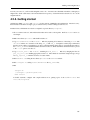
2.2. Getting started
9
Using and understanding the Valgrind core
First off, consider whether it might be beneficial to recompile your application and supporting libraries with debugging
info enabled (the -g flag). Without debugging info, the best Valgrind tools will be able to do is guess which function
a particular piece of code belongs to, which makes both error messages and profiling output nearly useless. With -g,
you’ll hopefully get messages which point directly to the relevant source code lines.
Another flag you might like to consider, if you are working with C++, is -fno-inline. That makes it easier to see
the function-call chain, which can help reduce confusion when navigating around large C++ apps. For whatever it’s
worth, debugging OpenOffice.org with Memcheck is a bit easier when using this flag. You don’t have to do this, but
doing so helps Valgrind produce more accurate and less confusing error reports. Chances are you’re set up like this
already, if you intended to debug your program with GNU gdb, or some other debugger.
This paragraph applies only if you plan to use Memcheck: On rare occasions, optimisation levels at -O2 and above
have been observed to generate code which fools Memcheck into wrongly reporting uninitialised value errors. We
have looked in detail into fixing this, and unfortunately the result is that doing so would give a further significant
slowdown in what is already a slow tool. So the best solution is to turn off optimisation altogether. Since this often
makes things unmanagably slow, a plausible compromise is to use -O. This gets you the majority of the benefits of
higher optimisation levels whilst keeping relatively small the chances of false complaints from Memcheck. All other
tools (as far as we know) are unaffected by optimisation level.
Valgrind understands both the older "stabs" debugging format, used by gcc versions prior to 3.1, and the newer
DWARF2 format used by gcc 3.1 and later. We continue to refine and debug our debug-info readers, although
the majority of effort will naturally enough go into the newer DWARF2 reader.
When you’re ready to roll, just run your application as you would normally, but place valgrind
--tool=tool_name in front of your usual command-line invocation.
Note that you should run the real
(machine-code) executable here. If your application is started by, for example, a shell or perl script, you’ll need to
modify it to invoke Valgrind on the real executables. Running such scripts directly under Valgrind will result in you
getting error reports pertaining to /bin/sh, /usr/bin/perl, or whatever interpreter you’re using. This may not
be what you want and can be confusing. You can force the issue by giving the flag --trace-children=yes, but
confusion is still likely.
2.3. The Commentary
Valgrind tools write a commentary, a stream of text, detailing error reports and other significant events. All lines in
the commentary have following form:
==12345== some-message-from-Valgrind
The 12345 is the process ID. This scheme makes it easy to distinguish program output from Valgrind commentary,
and also easy to differentiate commentaries from different processes which have become merged together, for whatever
reason.
By default, Valgrind tools write only essential messages to the commentary, so as to avoid flooding you with
information of secondary importance. If you want more information about what is happening, re-run, passing the -v
flag to Valgrind. A second -v gives yet more detail.
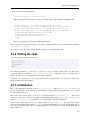
You can direct the commentary to three different places:
10
Using and understanding the Valgrind core
1. The default: send it to a file descriptor, which is by default 2 (stderr). So, if you give the core no options, it will
write commentary to the standard error stream. If you want to send it to some other file descriptor, for example
number 9, you can specify --log-fd=9.
This is the simplest and most common arrangement, but can cause problems when valgrinding entire trees of
processes which expect specific file descriptors, particularly stdin/stdout/stderr, to be available for their own use.
2. A less intrusive option is to write the commentary to a file, which you specify by --log-file=filename.
Note carefully that the commentary is not written to the file you specify, but instead to one called
filename.12345, if for example the pid of the traced process is 12345.
This is helpful when valgrinding a whole tree of processes at once, since it means that each process writes to its own logfile, rather than
the result being jumbled up in one big logfile. If filename.12345 already exists, then it will name new files
filename.12345.1 and so on.
If you want to specify precisely the file name to use, without the trailing .12345 part, you can instead use
--log-file-exactly=filename.
You can also use the --log-file-qualifier=<VAR> option to modify the filename via according to the
environment variable VAR. This is rarely needed, but very useful in certain circumstances (eg. when running
MPI programs). In this case, the trailing .12345 part is replaced by the contents of $VAR. The idea is that
you specify a variable which will be set differently for each process in the job, for example BPROC_RANK or
whatever is applicable in your MPI setup.
3. The least intrusive option is to send the commentary to a network socket. The socket is specified as an IP address
and port number pair, like this: --log-socket=192.168.0.1:12345 if you want to send the output to
host IP 192.168.0.1 port 12345 (I have no idea if 12345 is a port of pre-existing significance). You can also omit
the port number: --log-socket=192.168.0.1, in which case a default port of 1500 is used. This default
is defined by the constant VG_CLO_DEFAULT_LOGPORT in the sources.
Note, unfortunately, that you have to use an IP address here, rather than a hostname.
Writing to a network socket is pretty useless if you don’t have something listening at the other end. We provide
a simple listener program, valgrind-listener, which accepts connections on the specified port and copies
whatever it is sent to stdout. Probably someone will tell us this is a horrible security risk. It seems likely that
people will write more sophisticated listeners in the fullness of time.
valgrind-listener can accept simultaneous connections from up to 50 valgrinded processes. In front of each line
of output it prints the current number of active connections in round brackets.
valgrind-listener accepts two command-line flags:
• -e or --exit-at-zero: when the number of connected processes falls back to zero, exit. Without this,
it will run forever, that is, until you send it Control-C.
• portnumber: changes the port it listens on from the default (1500). The specified port must be in the range
1024 to 65535. The same restriction applies to port numbers specified by a --log-socket to Valgrind
itself.
If a valgrinded process fails to connect to a listener, for whatever reason (the listener isn’t running, invalid or
unreachable host or port, etc), Valgrind switches back to writing the commentary to stderr. The same goes for
any process which loses an established connection to a listener. In other words, killing the listener doesn’t kill
the processes sending data to it.
11
Using and understanding the Valgrind core
Here is an important point about the relationship between the commentary and profiling output from tools. The
commentary contains a mix of messages from the Valgrind core and the selected tool. If the tool reports errors, it will
report them to the commentary. However, if the tool does profiling, the profile data will be written to a file of some
kind, depending on the tool, and independent of what --log-* options are in force. The commentary is intended
to be a low-bandwidth, human-readable channel. Profiling data, on the other hand, is usually voluminous and not
meaningful without further processing, which is why we have chosen this arrangement.
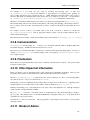
2.4. Reporting of errors
When one of the error-checking tools (Memcheck, Helgrind) detects something bad happening in the program, an
error message is written to the commentary. For example:
==25832== Invalid read of size 4
==25832==
at 0x8048724: BandMatrix::ReSize(int, int, int) (bogon.cpp:45)
==25832==
by 0x80487AF: main (bogon.cpp:66)
==25832== Address 0xBFFFF74C is not stack’d, malloc’d or free’d
This message says that the program did an illegal 4-byte read of address 0xBFFFF74C, which, as far as Memcheck
can tell, is not a valid stack address, nor corresponds to any currently malloc’d or free’d blocks. The read is happening
at line 45 of bogon.cpp, called from line 66 of the same file, etc.
For errors associated with an identified
malloc’d/free’d block, for example reading free’d memory, Valgrind reports not only the location where the error
happened, but also where the associated block was malloc’d/free’d.
Valgrind remembers all error reports. When an error is detected, it is compared against old reports, to see if it is a
duplicate. If so, the error is noted, but no further commentary is emitted. This avoids you being swamped with
bazillions of duplicate error reports.
If you want to know how many times each error occurred, run with the -v option. When execution finishes, all the
reports are printed out, along with, and sorted by, their occurrence counts. This makes it easy to see which errors have
occurred most frequently.
Errors are reported before the associated operation actually happens. If you’re using a tool (Memcheck) which does
address checking, and your program attempts to read from address zero, the tool will emit a message to this effect, and
the program will then duly die with a segmentation fault.
In general, you should try and fix errors in the order that they are reported. Not doing so can be confusing. For
example, a program which copies uninitialised values to several memory locations, and later uses them, will generate
several error messages, when run on Memcheck. The first such error message may well give the most direct clue to
the root cause of the problem.
The process of detecting duplicate errors is quite an expensive one and can become a significant performance overhead
if your program generates huge quantities of errors. To avoid serious problems, Valgrind will simply stop collecting
errors after 1000 different errors have been seen, or 10000000 errors in total have been seen. In this situation you
might as well stop your program and fix it, because Valgrind won’t tell you anything else useful after this. Note that
the 1000/10000000 limits apply after suppressed errors are removed. These limits are defined in m_errormgr.c
and can be increased if necessary.
To avoid this cutoff you can use the --error-limit=no flag. Then Valgrind will always show errors, regardless
of how many there are. Use this flag carefully, since it may have a bad effect on performance.
2.5. Suppressing errors
12
Using and understanding the Valgrind core
The error-checking tools detect numerous problems in the base libraries, such as the GNU C library, and the XFree86
client libraries, which come pre-installed on your GNU/Linux system. You can’t easily fix these, but you don’t want
to see these errors (and yes, there are many!) So Valgrind reads a list of errors to suppress at startup. A default
suppression file is cooked up by the ./configure script when the system is built.
You can modify and add to the suppressions file at your leisure, or, better, write your own. Multiple suppression files
are allowed. This is useful if part of your project contains errors you can’t or don’t want to fix, yet you don’t want to
continuously be reminded of them.
Note: By far the easiest way to add suppressions is to use the --gen-suppressions=yes flag described in
Command-line flags for the Valgrind core.
Each error to be suppressed is described very specifically, to minimise the possibility that a suppression-directive
inadvertantly suppresses a bunch of similar errors which you did want to see. The suppression mechanism is designed
to allow precise yet flexible specification of errors to suppress.
If you use the -v flag, at the end of execution, Valgrind prints out one line for each used suppression, giving its name
and the number of times it got used. Here’s the suppressions used by a run of valgrind --tool=memcheck
ls l:
--27579-- supp: 1 socketcall.connect(serv_addr)/__libc_connect/__nscd_getgrgid_r
--27579-- supp: 1 socketcall.connect(serv_addr)/__libc_connect/__nscd_getpwuid_r
--27579-- supp: 6 strrchr/_dl_map_object_from_fd/_dl_map_object
Multiple suppressions files are allowed. By default, Valgrind uses $PREFIX/lib/valgrind/default.supp.
You can ask to add suppressions from another file, by specifying --suppressions=/path/to/file.supp.
If you want to understand more about suppressions, look at an existing suppressions file whilst reading the following
documentation. The file glibc-2.2.supp, in the source distribution, provides some good examples.
Each suppression has the following components:
• First line: its name. This merely gives a handy name to the suppression, by which it is referred to in the summary
of used suppressions printed out when a program finishes. It’s not important what the name is; any identifying
string will do.
• Second line: name of the tool(s) that the suppression is for (if more than one, comma-separated), and the name of
the suppression itself, separated by a colon (Nb: no spaces are allowed), eg:
tool_name1,tool_name2:suppression_name
Recall that Valgrind is a modular system, in which different instrumentation tools can observe your program
whilst it is running. Since different tools detect different kinds of errors, it is necessary to say which tool(s) the
suppression is meaningful to.
Tools will complain, at startup, if a tool does not understand any suppression directed to it.
Tools ignore
suppressions which are not directed to them. As a result, it is quite practical to put suppressions for all tools
into the same suppression file.
Valgrind’s core can detect certain PThreads API errors, for which this line reads:
core:PThread
13
Using and understanding the Valgrind core
• Next line: a small number of suppression types have extra information after the second line (eg. the Param
suppression for Memcheck)
• Remaining lines: This is the calling context for the error -- the chain of function calls that led to it. There can be
up to four of these lines.
Locations may be either names of shared objects/executables or wildcards matching function names. They begin
obj: and fun: respectively. Function and object names to match against may use the wildcard characters *
and ?.
Important note: C++ function names must be mangled. If you are writing suppressions by hand, use the
--demangle=no option to get the mangled names in your error messages.
• Finally, the entire suppression must be between curly braces. Each brace must be the first character on its own line.
A suppression only suppresses an error when the error matches all the details in the suppression. Here’s an example:
{
__gconv_transform_ascii_internal/__mbrtowc/mbtowc
Memcheck:Value4
fun:__gconv_transform_ascii_internal
fun:__mbr*toc
fun:mbtowc
}
What it means is: for Memcheck only, suppress a use-of-uninitialised-value error, when
is 4, when it occurs in the function __gconv_transform_ascii_internal, when
from any function of name matching __mbr*toc, when that is called from mbtowc.
ply under any other circumstances.
The string by which this suppression is identified
__gconv_transform_ascii_internal/__mbrtowc/mbtowc.
the data size
that is called
It doesn’t apto the user is
(See Writing suppression files for more details on the specifics of Memcheck’s suppression kinds.)
Another example, again for the Memcheck tool:
{
libX11.so.6.2/libX11.so.6.2/libXaw.so.7.0
Memcheck:Value4
obj:/usr/X11R6/lib/libX11.so.6.2
obj:/usr/X11R6/lib/libX11.so.6.2
obj:/usr/X11R6/lib/libXaw.so.7.0
}
Suppress any size 4 uninitialised-value error which occurs anywhere in libX11.so.6.2, when called from
anywhere in the same library, when called from anywhere in libXaw.so.7.0. The inexact specification of
locations is regrettable, but is about all you can hope for, given that the X11 libraries shipped with Red Hat 7.2 have
had their symbol tables removed.
Note: since the above two examples did not make it clear, you can freely mix the obj: and fun: styles of description
within a single suppression record.
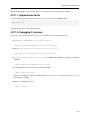
2.6. Command-line flags for the Valgrind core
14
Using and understanding the Valgrind core
As mentioned above, Valgrind’s core accepts a common set of flags. The tools also accept tool-specific flags, which
are documented seperately for each tool.
You invoke Valgrind like this:
valgrind [valgrind-options] your-prog [your-prog-options]
Valgrind’s default settings succeed in giving reasonable behaviour in most cases. We group the available options by
rough categories.
2.6.1. Tool-selection option
The single most important option.
• --tool=<name> [default=memcheck]
Run the Valgrind tool called name, e.g. Memcheck, Cachegrind, etc.
2.6.2. Basic Options
These options work with all tools.
-h --help
Show help for all options, both for the core and for the selected tool.
--help-debug
Same as --help, but also lists debugging options which usually are only of use to Valgrind’s developers.
--version
Show the version number of the Valgrind core. Tools can have their own version numbers. There is a scheme in place
to ensure that tools only execute when the core version is one they are known to work with. This was done to minimise
the chances of strange problems arising from tool-vs-core version incompatibilities.
-q --quiet
Run silently, and only print error messages. Useful if you are running regression tests or have some other automated
test machinery.
-v --verbose
Be more verbose. Gives extra information on various aspects of your program, such as: the shared objects loaded, the
suppressions used, the progress of the instrumentation and execution engines, and warnings about unusual behaviour.
Repeating the flag increases the verbosity level.
-d
Emit information for debugging Valgrind itself. This is usually only of interest to the Valgrind developers. Repeating
the flag produces more detailed output. If you want to send us a bug report, a log of the output generated by -v -v
-d -d will make your report more useful.
--tool=<toolname> [default: memcheck]
Run the Valgrind tool called toolname, e.g. Memcheck, Addrcheck, Cachegrind, etc.
15
Using and understanding the Valgrind core
--trace-children=<yes|no> [default: no]
When enabled, Valgrind will trace into child processes. This can be confusing and isn’t usually what you want, so it
is disabled by default.
--track-fds=<yes|no> [default: no]
When enabled, Valgrind will print out a list of open file descriptors on exit. Along with each file descriptor is printed
a stack backtrace of where the file was opened and any details relating to the file descriptor such as the file name or
socket details.
--time-stamp=<yes|no> [default: no]
When enabled, each message is preceded with an indication of the elapsed wallclock time since startup, expressed as
days, hours, minutes, seconds and milliseconds.
--log-fd=<number> [default: 2, stderr]
Specifies that Valgrind should send all of its messages to the specified file descriptor. The default, 2, is the standard
error channel (stderr). Note that this may interfere with the client’s own use of stderr, as Valgrind’s output will be
interleaved with any output that the client sends to stderr.
--log-file=<filename>
Specifies that Valgrind should send all of its messages to the specified file. In fact, the file name used is created by
concatenating the text filename, "." and the process ID, (ie. <filename>.<pid>), so as to create a file per process.
The specified file name may not be the empty string.
--log-file-exactly=<filename>
Just like --log-file, but the suffix ".pid" is not added.
using this option the log file may get all messed up.
If you trace multiple processes with Valgrind when
--log-file-qualifier=<VAR>
When used in conjunction with --log-file, causes the log file name to be qualified using the contents of the
environment variable $VAR. This is useful when running MPI programs. For further details, see Section 2.3 "The
Commentary" in the manual.
--log-socket=<ip-address:port-number>
Specifies that Valgrind should send all of its messages to the specified port at the specified IP address. The port
may be omitted, in which case port 1500 is used. If a connection cannot be made to the specified socket, Valgrind
falls back to writing output to the standard error (stderr). This option is intended to be used in conjunction with the
valgrind-listener program. For further details, see Section 2.3 "The Commentary" in the manual.
2.6.3. Error-related options
These options are used by all tools that can report errors, e.g. Memcheck, but not Cachegrind.
--xml=<yes|no> [default: no]
When enabled, output will be in XML format. This is aimed at making life easier for tools that consume Valgrind’s
output as input, such as GUI front ends. Currently this option only works with Memcheck.
--xml-user-comment=<string>
Embeds an extra user comment string at the start of the XML output. Only works when --xml=yes is specified;
ignored otherwise.
16
Using and understanding the Valgrind core
--demangle=<yes|no> [default: yes]
Enable/disable automatic demangling (decoding) of C++ names. Enabled by default. When enabled, Valgrind will
attempt to translate encoded C++ names back to something approaching the original. The demangler handles symbols
mangled by g++ versions 2.X, 3.X and 4.X.
An important fact about demangling is that function names mentioned in suppressions files should be in their mangled
form. Valgrind does not demangle function names when searching for applicable suppressions, because to do otherwise
would make suppressions file contents dependent on the state of Valgrind’s demangling machinery, and would also be
slow and pointless.
--num-callers=<number> [default: 12]
By default, Valgrind shows twelve levels of function call names to help you identify program locations. You can
change that number with this option. This can help in determining the program’s location in deeply-nested call
chains. Note that errors are commoned up using only the top four function locations (the place in the current function,
and that of its three immediate callers). So this doesn’t affect the total number of errors reported.
The maximum value for this is 50. Note that higher settings will make Valgrind run a bit more slowly and take a bit
more memory, but can be useful when working with programs with deeply-nested call chains.
--error-limit=<yes|no> [default: yes]
When enabled, Valgrind stops reporting errors after 10,000,000 in total, or 1,000 different ones, have been seen. This
is to stop the error tracking machinery from becoming a huge performance overhead in programs with many errors.
--error-exitcode=<number> [default: 0]
Specifies an alternative exit code to return if Valgrind reported any errors in the run. When set to the default value
(zero), the return value from Valgrind will always be the return value of the process being simulated. When set to a
nonzero value, that value is returned instead, if Valgrind detects any errors. This is useful for using Valgrind as part
of an automated test suite, since it makes it easy to detect test cases for which Valgrind has reported errors, just by
inspecting return codes.
--show-below-main=<yes|no> [default: no]
By default, stack traces for errors do not show any functions that appear beneath main() (or similar functions such
as glibc’s __libc_start_main(), if main() is not present in the stack trace); most of the time it’s uninteresting
C library stuff. If this option is enabled, those entries below main() will be shown.
--suppressions=<filename> [default: $PREFIX/lib/valgrind/default.supp]
Specifies an extra file from which to read descriptions of errors to suppress. You may use as many extra suppressions
files as you like.
17
Using and understanding the Valgrind core
--gen-suppressions=<yes|no|all> [default: no]
When set to yes, Valgrind will pause after every error shown and print the line:
---- Print suppression ? --- [Return/N/n/Y/y/C/c] ---The prompt’s behaviour is the same as for the --db-attach option (see below).
If you choose to, Valgrind will print out a suppression for this error. You can then cut and paste it into a suppression
file if you don’t want to hear about the error in the future.
When set to all, Valgrind will print a suppression for every reported error, without querying the user.
This option is particularly useful with C++ programs, as it prints out the suppressions with mangled names, as required.
Note that the suppressions printed are as specific as possible. You may want to common up similar ones, eg. by
adding wildcards to function names. Also, sometimes two different errors are suppressed by the same suppression,
in which case Valgrind will output the suppression more than once, but you only need to have one copy in your
suppression file (but having more than one won’t cause problems). Also, the suppression name is given as <insert
a suppression name here>; the name doesn’t really matter, it’s only used with the -v option which prints out
all used suppression records.
--db-attach=<yes|no> [default: no]
When enabled, Valgrind will pause after every error shown and print the line:
---- Attach to debugger ? --- [Return/N/n/Y/y/C/c] ---Pressing Ret, or N Ret or n Ret, causes Valgrind not to start a debugger for this error.
Pressing Y Ret or y Ret causes Valgrind to start a debugger for the program at this point. When you have finished
with the debugger, quit from it, and the program will continue. Trying to continue from inside the debugger doesn’t
work.
C Ret or c Ret causes Valgrind not to start a debugger, and not to ask again.
Note: --db-attach=yes conflicts with --trace-children=yes. You can’t use them together. Valgrind
refuses to start up in this situation.
May 2002: this is a historical relic which could be easily fixed if it gets in your way. Mail us and complain if this is a
problem for you.
Nov 2002: if you’re sending output to a logfile or to a network socket, I guess this option doesn’t make any sense.
Caveat emptor.
--db-command=<command> [default: gdb -nw %f %p]
Specify the debugger to use with the --db-attach command. The default debugger is gdb. This option is a template
that is expanded by Valgrind at runtime. %f is replaced with the executable’s file name and %p is replaced by the
process ID of the executable.
This specifies how Valgrind will invoke the debugger. By default it will use whatever GDB is detected at build time,
which is usually /usr/bin/gdb. Using this command, you can specify some alternative command to invoke the
debugger you want to use.
The command string given can include one or instances of the %p and %f expansions. Each instance of %p expands to
the PID of the process to be debugged and each instance of %f expands to the path to the executable for the process to
be debugged.
18
Using and understanding the Valgrind core
--input-fd=<number> [default: 0, stdin]
When using --db-attach=yes and --gen-suppressions=yes, Valgrind will stop so as to read keyboard
input from you, when each error occurs. By default it reads from the standard input (stdin), which is problematic for
programs which close stdin. This option allows you to specify an alternative file descriptor from which to read input.
--max-stackframe=<number> [default: 2000000]
The maximum size of a stack frame - if the stack pointer moves by more than this amount then Valgrind will assume
that the program is switching to a different stack.
You may need to use this option if your program has large stack-allocated arrays. Valgrind keeps track of your
program’s stack pointer.
If it changes by more than the threshold amount, Valgrind assumes your program is
switching to a different stack, and Memcheck behaves differently than it would for a stack pointer change smaller
than the threshold. Usually this heuristic works well. However, if your program allocates large structures on the
stack, this heuristic will be fooled, and Memcheck will subsequently report large numbers of invalid stack accesses.
This option allows you to change the threshold to a different value.
You should only consider use of this flag if Valgrind’s debug output directs you to do so. In that case it will tell you
the new threshold you should specify.
In general, allocating large structures on the stack is a bad idea, because (1) you can easily run out of stack space,
especially on systems with limited memory or which expect to support large numbers of threads each with a small
stack, and (2) because the error checking performed by Memcheck is more effective for heap-allocated data than for
stack-allocated data. If you have to use this flag, you may wish to consider rewriting your code to allocate on the heap
rather than on the stack.
2.6.4. malloc()-related Options
For tools that use their own version of malloc() (e.g. Memcheck and Massif), the following options apply.
--alignment=<number> [default: 8]
By default Valgrind’s malloc(), realloc(), etc, return 8-byte aligned addresses. This is standard for most
processors. However, some programs might assume that malloc() et al return 16-byte or more aligned memory.
The supplied value must be between 8 and 4096 inclusive, and must be a power of two.
2.6.5. Uncommon Options
These options apply to all tools, as they affect certain obscure workings of the Valgrind core. Most people won’t need
to use these.
19
Using and understanding the Valgrind core
--run-libc-freeres=<yes|no> [default: yes]
The GNU C library (libc.so), which is used by all programs, may allocate memory for its own uses. Usually it
doesn’t bother to free that memory when the program ends - there would be no point, since the Linux kernel reclaims
all process resources when a process exits anyway, so it would just slow things down.
The glibc authors realised that this behaviour causes leak checkers, such as Valgrind, to falsely report leaks in glibc,
when a leak check is done at exit.
In order to avoid this, they provided a routine called __libc_freeres
specifically to make glibc release all memory it has allocated. Memcheck therefore tries to run __libc_freeres
at exit.
Unfortunately, in some versions of glibc, __libc_freeres is sufficiently buggy to cause segmentation faults. This
is particularly noticeable on Red Hat 7.1. So this flag is provided in order to inhibit the run of __libc_freeres.
If your program seems to run fine on Valgrind, but segfaults at exit, you may find that --run-libc-freeres=no
fixes that, although at the cost of possibly falsely reporting space leaks in libc.so.
--sim-hints=hint1,hint2,...
Pass miscellaneous hints to Valgrind which slightly modify the simulated behaviour in nonstandard or dangerous ways,
possibly to help the simulation of strange features. By default no hints are enabled. Use with caution! Currently
known hints are:
• lax-ioctls:
Be very lax about ioctl handling; the only assumption is that the size is correct. Doesn’t
require the full buffer to be initialized when writing. Without this, using some device drivers with a large number
of strange ioctl commands becomes very tiresome.
• enable-inner:
Enable some special magic needed when the program being run is itself Valgrind.
--kernel-variant=variant1,variant2,...
Handle system calls and ioctls arising from minor variants of the default kernel for this platform. This is useful for
running on hacked kernels or with kernel modules which support nonstandard ioctls, for example. Use with caution.
If you don’t understand what this option does then you almost certainly don’t need it. Currently known variants are:
• bproc:
Support the sys_broc system call on x86. This is for running on BProc, which is a minor variant of
standard Linux which is sometimes used for building clusters.
--show-emwarns=<yes|no> [default: no]
When enabled, Valgrind will emit warnings about its CPU emulation in certain cases.
interesting.
These are usually not
20
Using and understanding the Valgrind core
--smc-check=<none|stack|all> [default: stack]
This option controls Valgrind’s detection of self-modifying code. Valgrind can do no detection, detect self-modifying
code on the stack, or detect self-modifying code anywhere. Note that the default option will catch the vast majority
of cases, as far as we know. Running with all will slow Valgrind down greatly (but running with none will rarely
speed things up, since very little code gets put on the stack for most programs).
2.6.6. Debugging Valgrind Options
There are also some options for debugging Valgrind itself. You shouldn’t need to use them in the normal run of
things. If you wish to see the list, use the --help-debug option.
2.6.7. Setting default Options
Note that Valgrind also reads options from three places:
1. The file ~/.valgrindrc
2. The environment variable $VALGRIND_OPTS
3. The file ./.valgrindrc
These are processed in the given order, before the command-line options. Options processed later override those
processed earlier; for example, options in ./.valgrindrc will take precedence over those in ~/.valgrindrc.
The first two are particularly useful for setting the default tool to use.
Any tool-specific options put in $VALGRIND_OPTS or the .valgrindrc files should be prefixed with the tool
name and a colon. For example, if you want Memcheck to always do leak checking, you can put the following entry
in ~/.valgrindrc:
--memcheck:leak-check=yes
This will be ignored if any tool other than Memcheck is run. Without the memcheck: part, this will cause problems
if you select other tools that don’t understand --leak-check=yes.
2.7. The Client Request mechanism
Valgrind has a trapdoor mechanism via which the client program can pass all manner of requests and queries to
Valgrind and the current tool. Internally, this is used extensively to make malloc, free, etc, work, although you don’t
see that.
For your convenience, a subset of these so-called client requests is provided to allow you to tell Valgrind facts about
the behaviour of your program, and also to make queries. In particular, your program can tell Valgrind about changes
in memory range permissions that Valgrind would not otherwise know about, and so allows clients to get Valgrind to
do arbitrary custom checks.
Clients need to include a header file to make this work. Which header file depends on which client requests you use.
Some client requests are handled by the core, and are defined in the header file valgrind/valgrind.h. Toolspecific header files are named after the tool, e.g. valgrind/memcheck.h. All header files can be found in the
include/valgrind directory of wherever Valgrind was installed.
21
Using and understanding the Valgrind core
The macros in these header files have the magical property that they generate code in-line which Valgrind can spot.
However, the code does nothing when not run on Valgrind, so you are not forced to run your program under Valgrind
just because you use the macros in this file. Also, you are not required to link your program with any extra supporting
libraries.
The code left in your binary has negligible performance impact: on x86, amd64 and ppc32, the overhead is 6 simple
integer instructions and is probably undetectable except in tight loops. However, if you really wish to compile out the
client requests, you can compile with -DNVALGRIND (analogous to -DNDEBUG’s effect on assert()).
You are encouraged to copy the valgrind/*.h headers into your project’s include directory, so your program
doesn’t have a compile-time dependency on Valgrind being installed. The Valgrind headers, unlike most of the rest
of the code, are under a BSD-style license so you may include them without worrying about license incompatibility.
Here is a brief description of the macros available in valgrind.h, which work with more than one tool (see the
tool-specific documentation for explanations of the tool-specific macros).
RUNNING_ON_VALGRIND:
returns 1 if running on Valgrind, 0 if running on the real CPU. If you are running Valgrind on itself, it will return the
number of layers of Valgrind emulation we’re running on.
VALGRIND_DISCARD_TRANSLATIONS:
discard translations of code in the specified address range. Useful if you are debugging a JITter or some other dynamic
code generation system. After this call, attempts to execute code in the invalidated address range will cause Valgrind
to make new translations of that code, which is probably the semantics you want. Note that code invalidations are
expensive because finding all the relevant translations quickly is very difficult. So try not to call it often. Note that
you can be clever about this: you only need to call it when an area which previously contained code is overwritten with
new code. You can choose to write code into fresh memory, and just call this occasionally to discard large chunks of
old code all at once.
Alternatively, for transparent self-modifying-code support, use--smc-check=all.
VALGRIND_COUNT_ERRORS:
returns the number of errors found so far by Valgrind. Can be useful in test harness code when combined with
the --log-fd=-1 option; this runs Valgrind silently, but the client program can detect when errors occur. Only
useful for tools that report errors, e.g. it’s useful for Memcheck, but for Cachegrind it will always return zero because
Cachegrind doesn’t report errors.
VALGRIND_MALLOCLIKE_BLOCK:
If your program manages its own memory instead of using the standard malloc() / new / new[], tools that track
information about heap blocks will not do nearly as good a job. For example, Memcheck won’t detect nearly as
many errors, and the error messages won’t be as informative. To improve this situation, use this macro just after your
custom allocator allocates some new memory. See the comments in valgrind.h for information on how to use it.
VALGRIND_FREELIKE_BLOCK:
This should be used in conjunction with VALGRIND_MALLOCLIKE_BLOCK. Again, see memcheck/memcheck.h
for information on how to use it.
VALGRIND_CREATE_MEMPOOL:
This is similar to VALGRIND_MALLOCLIKE_BLOCK, but is tailored towards code that uses memory pools. See the
comments in valgrind.h for information on how to use it.
VALGRIND_DESTROY_MEMPOOL:
This should be used in conjunction with VALGRIND_CREATE_MEMPOOL Again, see the comments in valgrind.h
for information on how to use it.
22
Using and understanding the Valgrind core
VALGRIND_MEMPOOL_ALLOC:
This should be used in conjunction with VALGRIND_CREATE_MEMPOOL Again, see the comments in valgrind.h
for information on how to use it.
VALGRIND_MEMPOOL_FREE:
This should be used in conjunction with VALGRIND_CREATE_MEMPOOL Again, see the comments in valgrind.h
for information on how to use it.
VALGRIND_NON_SIMD_CALL[0123]:
executes a function of 0, 1, 2 or 3 args in the client program on the real CPU, not the virtual CPU that Valgrind
normally runs code on. These are used in various ways internally to Valgrind. They might be useful to client
programs.
Warning: Only use these if you really know what you are doing.
VALGRIND_PRINTF(format, ...):
printf a message to the log file when running under Valgrind. Nothing is output if not running under Valgrind. Returns
the number of characters output.
VALGRIND_PRINTF_BACKTRACE(format, ...):
printf a message to the log file along with a stack backtrace when running under Valgrind. Nothing is output if not
running under Valgrind. Returns the number of characters output.
VALGRIND_STACK_REGISTER(start, end):
Register a new stack. Informs Valgrind that the memory range between start and end is a unique stack. Returns a
stack identifier that can be used with other VALGRIND_STACK_* calls.
Valgrind will use this information to determine if a change to the stack pointer is an item pushed onto the stack or a
change over to a new stack. Use this if you’re using a user-level thread package and are noticing spurious errors from
Valgrind about uninitialized memory reads.
VALGRIND_STACK_DEREGISTER(id):
Deregister a previously registered stack. Informs Valgrind that previously registered memory range with stack id id
is no longer a stack.
VALGRIND_STACK_CHANGE(id, start, end):
Change a previously registered stack. Informs Valgrind that the previously registerer stack with stack id id has
changed it’s start and end values. Use this if your user-level thread package implements stack growth.
Note that valgrind.h is included by all the tool-specific header files (such as memcheck.h), so you don’t need to
include it in your client if you include a tool-specific header.
2.8. Support for Threads
Valgrind supports programs which use POSIX pthreads. Getting this to work was technically challenging but it all
works well enough for significant threaded applications to work.
The main thing to point out is that although Valgrind works with the built-in threads system (eg. NPTL or
LinuxThreads), it serialises execution so that only one thread is running at a time. This approach avoids the horrible
implementation problems of implementing a truly multiprocessor version of Valgrind, but it does mean that threaded
apps run only on one CPU, even if you have a multiprocessor machine.
Valgrind schedules your program’s threads in a round-robin fashion, with all threads having equal priority. It switches
threads every 50000 basic blocks (on x86, typically around 300000 instructions), which means you’ll get a much finer
23
Using and understanding the Valgrind core
interleaving of thread executions than when run natively. This in itself may cause your program to behave differently
if you have some kind of concurrency, critical race, locking, or similar, bugs.
Your program will use the native libpthread, but not all of its facilities will work. In particular, synchonisation
of processes via shared-memory segments will not work. This relies on special atomic instruction sequences which
Valgrind does not emulate in a way which works between processes. Unfortunately there’s no way for Valgrind to
warn when this is happening, and such calls will mostly work; it’s only when there’s a race that it will fail.
Valgrind also supports direct use of the clone() system call, futex() and so on. clone() is supported where
either everything is shared (a thread) or nothing is shared (fork-like); partial sharing will fail. Again, any use of
atomic instruction sequences in shared memory between processes will not work reliably.
2.9. Handling of Signals
Valgrind has a fairly complete signal implementation. It should be able to cope with any valid use of signals.
If you’re using signals in clever ways (for example, catching SIGSEGV, modifying page state and restarting the instruction), you’re probably relying on precise exceptions.
In this case, you will need to use
--vex-iropt-precise-memory-exns=yes.
If your program dies as a result of a fatal core-dumping signal, Valgrind will generate its own core file
(vgcore.NNNNN) containing your program’s state.
You may use this core file for post-mortem debugging
with gdb or similar. (Note: it will not generate a core if your core dump size limit is 0.) At the time of writing the
core dumps do not include all the floating point register information.
If Valgrind itself crashes (hopefully not) the operating system will create a core dump in the usual way.
2.10. Function wrapping
Valgrind versions 3.2.0 and above and can do function wrapping on all supported targets. In function wrapping, calls
to some specified function are intercepted and rerouted to a different, user-supplied function. This can do whatever
it likes, typically examining the arguments, calling onwards to the original, and possibly examining the result. Any
number of different functions may be wrapped.
Function wrapping is useful for instrumenting an API in some way. For example, wrapping functions in the POSIX
pthreads API makes it possible to notify Valgrind of thread status changes, and wrapping functions in the MPI
(message-passing) API allows notifying Valgrind of memory status changes associated with message arrival/departure.
Such information is usually passed to Valgrind by using client requests in the wrapper functions, although that is not
of relevance here.
2.10.1. A Simple Example
Supposing we want to wrap some function
int foo ( int x, int y ) { return x + y; }
A wrapper is a function of identical type, but with a special name which identifies it as the wrapper for foo. Wrappers
need to include supporting macros from valgrind.h. Here is a simple wrapper which prints the arguments and
return value:
24
Using and understanding the Valgrind core
#include <stdio.h>
#include "valgrind.h"
int I_WRAP_SONAME_FNNAME_ZU(NONE,foo)( int x, int y )
{
int
result;
OrigFn fn;
VALGRIND_GET_ORIG_FN(fn);
printf("foo’s wrapper: args %d %d\n", x, y);
CALL_FN_W_WW(result, fn, x,y);
printf("foo’s wrapper: result %d\n", result);
return result;
}
To become active, the wrapper merely needs to be present in a text section somewhere in the same process’ address
space as the function it wraps, and for its ELF symbol name to be visible to Valgrind. In practice, this means either
compiling to a .o and linking it in, or compiling to a .so and LD_PRELOADing it in. The latter is more convenient
in that it doesn’t require relinking.
All wrappers have approximately the above form. There are three crucial macros:
I_WRAP_SONAME_FNNAME_ZU: this generates the real name of the wrapper. This is an encoded name which
Valgrind notices when reading symbol table information. What it says is: I am the wrapper for any function named
foo which is found in an ELF shared object with an empty ("NONE") soname field. The specification mechanism is
powerful in that wildcards are allowed for both sonames and function names. The fine details are discussed below.
VALGRIND_GET_ORIG_FN: once in the the wrapper, the first priority is to get hold of the address of the original
(and any other supporting information needed). This is stored in a value of opaque type OrigFn. The information is
acquired using VALGRIND_GET_ORIG_FN. It is crucial to make this macro call before calling any other wrapped
function in the same thread.
CALL_FN_W_WW: eventually we will want to call the function being wrapped. Calling it directly does not work,
since that just gets us back to the wrapper and tends to kill the program in short order by stack overflow. Instead, the
result lvalue, OrigFn and arguments are handed to one of a family of macros of the form CALL_FN_*. These cause
Valgrind to call the original and avoid recursion back to the wrapper.
2.10.2. Wrapping Specifications
This scheme has the advantage of being self-contained. A library of wrappers can be compiled to object code in the
normal way, and does not rely on an external script telling Valgrind which wrappers pertain to which originals.
Each wrapper has a name which, in the most general case says: I am the wrapper for any function whose name matches
FNPATT and whose ELF "soname" matches SOPATT. Both FNPATT and SOPATT may contain wildcards (asterisks)
and other characters (spaces, dots, @, etc) which are not generally regarded as valid C identifier names.
This flexibility is needed to write robust wrappers for POSIX pthread functions, where typically we are not completely
sure of either the function name or the soname, or alternatively we want to wrap a whole bunch of functions at once.
For example, pthread_create in GNU libpthread is usually a versioned symbol - one whose name ends in, eg,
@GLIBC_2.3. Hence we are not sure what its real name is. We also want to cover any soname of the form
libpthread.so*. So the header of the wrapper will be
25
Using and understanding the Valgrind core
int I_WRAP_SONAME_FNNAME_ZZ(libpthreadZdsoZd0,pthreadZucreateZAZa)
( ... formals ... )
{ ... body ... }
In order to write unusual characters as valid C function names, a Z-encoding scheme is used.
literally, except that a capital Z acts as an escape character, with the following encoding:
Za
Zp
Zc
Zd
Zu
Zh
Zs
ZA
ZZ
encodes
Names are written
*
+
:
.
_
(space)
@
Z
Hence libpthreadZdsoZd0 is an encoding of the soname libpthread.so.0 and pthreadZucreateZAZa
is an encoding of the function name pthread_create@*.
The macro I_WRAP_SONAME_FNNAME_ZZ constructs a wrapper name in which both the soname (first component)
and function name (second component) are Z-encoded. Encoding the function name can be tiresome and is often
unnecessary, so a second macro, I_WRAP_SONAME_FNNAME_ZU, can be used instead. The _ZU variant is also
useful for writing wrappers for C++ functions, in which the function name is usually already mangled using some
other convention in which Z plays an important role; having to encode a second time quickly becomes confusing.
Since the function name field may contain wildcards, it can be anything, including just *. The same is true for
the soname. However, some ELF objects - specifically, main executables - do not have sonames.
Any object
lacking a soname is treated as if its soname was NONE, which is why the original example above had a name
I_WRAP_SONAME_FNNAME_ZU(NONE,foo).
2.10.3. Wrapping Semantics
The ability for a wrapper to replace an infinite family of functions is powerful but brings complications in situations
where ELF objects appear and disappear (are dlopen’d and dlclose’d) on the fly. Valgrind tries to maintain sensible
behaviour in such situations.
For example, suppose a process has dlopened (an ELF object with soname) object1.so, which contains
function1. It starts to use function1 immediately.
After a while it dlopens wrappers.so, which contains a wrapper for function1 in (soname) object1.so. All
subsequent calls to function1 are rerouted to the wrapper.
If wrappers.so is later dlclose’d, calls to function1 are naturally routed back to the original.
Alternatively, if object1.so is dlclose’d but wrappers.so remains, then the wrapper exported by wrapper.so
becomes inactive, since there is no way to get to it - there is no original to call any more. However, Valgrind
remembers that the wrapper is still present. If object1.so is eventually dlopen’d again, the wrapper will become
active again.
26
Using and understanding the Valgrind core
In short, valgrind inspects all code loading/unloading events to ensure that the set of currently active wrappers remains
consistent.
A second possible problem is that of conflicting wrappers. It is easily possible to load two or more wrappers, both of
which claim to be wrappers for some third function. In such cases Valgrind will complain about conflicting wrappers
when the second one appears, and will honour only the first one.
2.10.4. Debugging
Figuring out what’s going on given the dynamic nature of wrapping can be difficult. The --trace-redir=yes
flag makes this possible by showing the complete state of the redirection subsystem after every mmap/munmap event
affecting code (text).
There are two central concepts:
• A "redirection specification" is a binding of a (soname pattern, fnname pattern) pair to a code address. These
bindings are created by writing functions with names made with the I_WRAP_SONAME_FNNAME_{ZZ,_ZU}
macros.
• An "active redirection" is code-address to code-address binding currently in effect.
The state of the wrapping-and-redirection subsystem comprises a set of specifications and a set of active bindings.
The specifications are acquired/discarded by watching all mmap/munmap events on code (text) sections. The active
binding set is (conceptually) recomputed from the specifications, and all known symbol names, following any change
to the specification set.
--trace-redir=yes shows the contents of both sets following any such event.
-v prints a line of text each time an active specification is used for the first time.
Hence for maximum debugging effectiveness you will need to use both flags.
One final comment. The function-wrapping facility is closely tied to Valgrind’s ability to replace (redirect) specified
functions, for example to redirect calls to malloc to its own implementation. Indeed, a replacement function can be
regarded as a wrapper function which does not call the original. However, to make the implementation more robust,
the two kinds of interception (wrapping vs replacement) are treated differently.
--trace-redir=yes shows specifications and bindings for both replacement and wrapper functions.
differentiate the two, replacement bindings are printed using R-> whereas wraps are printed using W->.
To
2.10.5. Limitations - control flow
For the most part, the function wrapping implementation is robust. The only important caveat is: in a wrapper, get hold
of the OrigFn information using VALGRIND_GET_ORIG_FN before calling any other wrapped function. Once you
have the OrigFn, arbitrary intercalling, recursion between, and longjumping out of wrappers should work correctly.
There is never any interaction between wrapped functions and merely replaced functions (eg malloc), so you can
call malloc etc safely from within wrappers.
The above comments are true for {x86,amd64,ppc32}-linux. On ppc64-linux function wrapping is more fragile due to
the (arguably poorly designed) ppc64-linux ABI. This mandates the use of a shadow stack which tracks entries/exits of
both wrapper and replacement functions. This gives two limitations: firstly, longjumping out of wrappers will rapidly
lead to disaster, since the shadow stack will not get correctly cleared. Secondly, since the shadow stack has finite size,
recursion between wrapper/replacement functions is only possible to a limited depth, beyond which Valgrind has to
abort the run. This depth is currently 16 calls.
27
Using and understanding the Valgrind core
For all platforms ({x86,amd64,ppc32,ppc64}-linux) all the above comments apply on a per-thread basis. In other
words, wrapping is thread-safe: each thread must individually observe the above restrictions, but there is no need for
any kind of inter-thread cooperation.
2.10.6. Limitations - original function signatures
As shown in the above example, to call the original you must use a macro of the form CALL_FN_*. For technical
reasons it is impossible to create a single macro to deal with all argument types and numbers, so a family of macros
covering the most common cases is supplied. In what follows, ’W’ denotes a machine-word-typed value (a pointer or
a C long), and ’v’ denotes C’s void type. The currently available macros are:
CALL_FN_v_v
CALL_FN_W_v
-- call an original of type void fn ( void )
-- call an original of type long fn ( void )
CALL_FN_v_W
CALL_FN_W_W
-- void fn ( long )
-- long fn ( long )
CALL_FN_v_WW
CALL_FN_W_WW
-- void fn ( long, long )
-- long fn ( long, long )
CALL_FN_v_WWW
CALL_FN_W_WWW
-- void fn ( long, long, long )
-- long fn ( long, long, long )
CALL_FN_W_WWWW
-- long fn ( long, long, long, long )
CALL_FN_W_5W
-- long fn ( long, long, long, long, long )
CALL_FN_W_6W
-- long fn ( long, long, long, long, long, long )
and so on, up to
CALL_FN_W_12W
The set of supported types can be expanded as needed. It is regrettable that this limitation exists. Function
wrapping has proven difficult to implement, with a certain apparently unavoidable level of ickyness. After several
implementation attempts, the present arrangement appears to be the least-worst tradeoff. At least it works reliably in
the presence of dynamic linking and dynamic code loading/unloading.
You should not attempt to wrap a function of one type signature with a wrapper of a different type signature. Such
trickery will surely lead to crashes or strange behaviour. This is not of course a limitation of the function wrapping
implementation, merely a reflection of the fact that it gives you sweeping powers to shoot yourself in the foot if you
are not careful. Imagine the instant havoc you could wreak by writing a wrapper which matched any function name
in any soname - in effect, one which claimed to be a wrapper for all functions in the process.
2.10.7. Examples
In the source tree, memcheck/tests/wrap[1-8].c provide a series of examples, ranging from very simple to
quite advanced.
auxprogs/libmpiwrap.c is an example of wrapping a big, complex API (the MPI-2 interface). This file defines
almost 300 different wrappers.
2.11. Building and Installing
28
Using and understanding the Valgrind core
We use the standard Unix ./configure, make, make install mechanism, and we have attempted to ensure
that it works on machines with kernel 2.4 or 2.6 and glibc 2.2.X or 2.3.X. You may then want to run the regression
tests with make regtest.
There are five options (in addition to the usual --prefix= which affect how Valgrind is built:
• --enable-inner
This builds Valgrind with some special magic hacks which make it possible to run it on a standard build of Valgrind
(what the developers call "self-hosting"). Ordinarily you should not use this flag as various kinds of safety checks
are disabled.
• --enable-tls
TLS (Thread Local Storage) is a relatively new mechanism which requires compiler, linker and kernel support.
Valgrind tries to automatically test if TLS is supported and if so enables this option. Sometimes it cannot test for
TLS, so this option allows you to override the automatic test.
• --with-vex=
Specifies the path to the underlying VEX dynamic-translation library. By default this is taken to be in the VEX
directory off the root of the source tree.
• --enable-only64bit
--enable-only32bit
On 64-bit platforms (amd64-linux, ppc64-linux), Valgrind is by default built in such a way that both 32-bit and
64-bit executables can be run. Sometimes this cleverness is a problem for a variety of reasons. These two flags
allow for single-target builds in this situation. If you issue both, the configure script will complain. Note they are
ignored on 32-bit-only platforms (x86-linux, ppc32-linux).
The configure script tests the version of the X server currently indicated by the current $DISPLAY. This is a
known bug. The intention was to detect the version of the current XFree86 client libraries, so that correct suppressions
could be selected for them, but instead the test checks the server version. This is just plain wrong.
If you are building a binary package of Valgrind for distribution, please read README_PACKAGERS Readme
Packagers. It contains some important information.
Apart from that, there’s not much excitement here. Let us know if you have build problems.
2.12. If You Have Problems
Contact us at http://www.valgrind.org/.
See Limitations for the known limitations of Valgrind, and for a list of programs which are known not to work on it.
All parts of the system make heavy use of assertions and internal self-checks. They are permanently enabled, and we
have no plans to disable them. If one of them breaks, please mail us!
If you get an assertion failure on the expression blockSane(ch) in VG_(free)() in m_mallocfree.c, this
may have happened because your program wrote off the end of a malloc’d block, or before its beginning. Valgrind
hopefully will have emitted a proper message to that effect before dying in this way. This is a known problem which
we should fix.
29
Using and understanding the Valgrind core
Read the Valgrind FAQ for more advice about common problems, crashes, etc.
2.13. Limitations
The following list of limitations seems long. However, most programs actually work fine.
Valgrind will run Linux ELF binaries, on a kernel 2.4.X or 2.6.X system, on the x86, amd64, ppc32 and ppc64
architectures, subject to the following constraints:
• On x86 and amd64, there is no support for 3DNow! instructions. If the translator encounters these, Valgrind
will generate a SIGILL when the instruction is executed. Apart from that, on x86 and amd64, essentially all
instructions are supported, up to and including SSE2. Version 3.1.0 includes limited support for SSE3 on x86.
This could be improved if necessary.
On ppc32 and ppc64, almost all integer, floating point and Altivec instructions are supported. Specifically:
integer and FP insns that are mandatory for PowerPC, the "General-purpose optional" group (fsqrt, fsqrts, stfiwx),
the "Graphics optional" group (fre, fres, frsqrte, frsqrtes), and the Altivec (also known as VMX) SIMD instruction
set, are supported.
• Atomic instruction sequences are not properly supported, in the sense that their atomicity is not preserved. This
will affect any use of synchronization via memory shared between processes. They will appear to work, but fail
sporadically.
• If your program does its own memory management, rather than using malloc/new/free/delete, it should still work,
but Valgrind’s error checking won’t be so effective. If you describe your program’s memory management scheme
using "client requests" (see The Client Request mechanism), Memcheck can do better. Nevertheless, using
malloc/new and free/delete is still the best approach.
• Valgrind’s signal simulation is not as robust as it could be. Basic POSIX-compliant sigaction and sigprocmask
functionality is supplied, but it’s conceivable that things could go badly awry if you do weird things with signals.
Workaround: don’t. Programs that do non-POSIX signal tricks are in any case inherently unportable, so should
be avoided if possible.
• Machine instructions, and system calls, have been implemented on demand. So it’s possible, although unlikely,
that a program will fall over with a message to that effect. If this happens, please report ALL the details printed
out, so we can try and implement the missing feature.
• Memory consumption of your program is majorly increased whilst running under Valgrind. This is due to the large
amount of administrative information maintained behind the scenes. Another cause is that Valgrind dynamically
translates the original executable. Translated, instrumented code is 12-18 times larger than the original so you can
easily end up with 50+ MB of translations when running (eg) a web browser.
• Valgrind can handle dynamically-generated code just fine. If you regenerate code over the top of old code (ie.
at the same memory addresses), if the code is on the stack Valgrind will realise the code has changed, and work
correctly. This is necessary to handle the trampolines GCC uses to implemented nested functions. If you
regenerate code somewhere other than the stack, you will need to use the --smc-check=all flag, and Valgrind
will run more slowly than normal.
30
Using and understanding the Valgrind core
• As of version 3.0.0, Valgrind has the following limitations in its implementation of x86/AMD64 floating point
relative to IEEE754.
Precision: There is no support for 80 bit arithmetic. Internally, Valgrind represents all such "long double" numbers
in 64 bits, and so there may be some differences in results. Whether or not this is critical remains to be seen.
Note, the x86/amd64 fldt/fstpt instructions (read/write 80-bit numbers) are correctly simulated, using conversions
to/from 64 bits, so that in-memory images of 80-bit numbers look correct if anyone wants to see.
The impression observed from many FP regression tests is that the accuracy differences aren’t significant.
Generally speaking, if a program relies on 80-bit precision, there may be difficulties porting it to non x86/amd64
platforms which only support 64-bit FP precision. Even on x86/amd64, the program may get different results
depending on whether it is compiled to use SSE2 instructions (64-bits only), or x87 instructions (80-bit). The net
effect is to make FP programs behave as if they had been run on a machine with 64-bit IEEE floats, for example
PowerPC. On amd64 FP arithmetic is done by default on SSE2, so amd64 looks more like PowerPC than x86
from an FP perspective, and there are far fewer noticable accuracy differences than with x86.
Rounding: Valgrind does observe the 4 IEEE-mandated rounding modes (to nearest, to +infinity, to -infinity,
to zero) for the following conversions: float to integer, integer to float where there is a possibility of loss of
precision, and float-to-float rounding. For all other FP operations, only the IEEE default mode (round to nearest)
is supported.
Numeric exceptions in FP code: IEEE754 defines five types of numeric exception that can happen: invalid
operation (sqrt of negative number, etc), division by zero, overflow, underflow, inexact (loss of precision).
For each exception, two courses of action are defined by 754: either (1) a user-defined exception handler may be
called, or (2) a default action is defined, which "fixes things up" and allows the computation to proceed without
throwing an exception.
Currently Valgrind only supports the default fixup actions. Again, feedback on the importance of exception support
would be appreciated.
When Valgrind detects that the program is trying to exceed any of these limitations (setting exception handlers,
rounding mode, or precision control), it can print a message giving a traceback of where this has happened, and
continue execution. This behaviour used to be the default, but the messages are annoying and so showing them is
now optional. Use --show-emwarns=yes to see them.
The above limitations define precisely the IEEE754 ’default’ behaviour: default fixup on all exceptions, round-tonearest operations, and 64-bit precision.
• As of version 3.0.0, Valgrind has the following limitations in its implementation of x86/AMD64 SSE2 FP
arithmetic, relative to IEEE754.
Essentially the same: no exceptions, and limited observance of rounding mode. Also, SSE2 has control bits which
make it treat denormalised numbers as zero (DAZ) and a related action, flush denormals to zero (FTZ). Both of
these cause SSE2 arithmetic to be less accurate than IEEE requires. Valgrind detects, ignores, and can warn about,
attempts to enable either mode.
31
Using and understanding the Valgrind core
• As of version 3.2.0, Valgrind has the following limitations in its implementation of PPC32 and PPC64 floating
point arithmetic, relative to IEEE754.
Scalar (non-Altivec): Valgrind provides a bit-exact emulation of all floating point instructions, except for "fre" and
"fres", which are done more precisely than required by the PowerPC architecture specification. All floating point
operations observe the current rounding mode.
However, fpscr[FPRF] is not set after each operation. That could be done but would give measurable performance
overheads, and so far no need for it has been found.
As on x86/AMD64, IEEE754 exceptions are not supported: all floating point exceptions are handled using the
default IEEE fixup actions. Valgrind detects, ignores, and can warn about, attempts to unmask the 5 IEEE FP
exception kinds by writing to the floating-point status and control register (fpscr).
Vector (Altivec, VMX): essentially as with x86/AMD64 SSE/SSE2: no exceptions, and limited observance of
rounding mode. For Altivec, FP arithmetic is done in IEEE/Java mode, which is more accurate than the Linux
default setting. "More accurate" means that denormals are handled properly, rather than simply being flushed to
zero.
Programs which are known not to work are:
• emacs starts up but immediately concludes it is out of memory and aborts. It may be that Memcheck does not
provide a good enough emulation of the mallinfo function. Emacs works fine if you build it to use the standard
malloc/free routines.
2.14. An Example Run
This is the log for a run of a small program using Memcheck The program is in fact correct, and the reported error is
as the result of a potentially serious code generation bug in GNU g++ (snapshot 20010527).
32
Using and understanding the Valgrind core
sewardj@phoenix:~/newmat10$
~/Valgrind-6/valgrind -v ./bogon
==25832== Valgrind 0.10, a memory error detector for x86 RedHat 7.1.
==25832== Copyright (C) 2000-2001, and GNU GPL’d, by Julian Seward.
==25832== Startup, with flags:
==25832== --suppressions=/home/sewardj/Valgrind/redhat71.supp
==25832== reading syms from /lib/ld-linux.so.2
==25832== reading syms from /lib/libc.so.6
==25832== reading syms from /mnt/pima/jrs/Inst/lib/libgcc_s.so.0
==25832== reading syms from /lib/libm.so.6
==25832== reading syms from /mnt/pima/jrs/Inst/lib/libstdc++.so.3
==25832== reading syms from /home/sewardj/Valgrind/valgrind.so
==25832== reading syms from /proc/self/exe
==25832==
==25832== Invalid read of size 4
==25832==
at 0x8048724: _ZN10BandMatrix6ReSizeEiii (bogon.cpp:45)
==25832==
by 0x80487AF: main (bogon.cpp:66)
==25832== Address 0xBFFFF74C is not stack’d, malloc’d or free’d
==25832==
==25832== ERROR SUMMARY: 1 errors from 1 contexts (suppressed: 0 from 0)
==25832== malloc/free: in use at exit: 0 bytes in 0 blocks.
==25832== malloc/free: 0 allocs, 0 frees, 0 bytes allocated.
==25832== For a detailed leak analysis, rerun with: --leak-check=yes
==25832==
==25832== exiting, did 1881 basic blocks, 0 misses.
==25832== 223 translations, 3626 bytes in, 56801 bytes out.
The GCC folks fixed this about a week before gcc-3.0 shipped.
2.15. Warning Messages You Might See
Most of these only appear if you run in verbose mode (enabled by -v):
• More than 100 errors detected.
but in less detail than before.
Subsequent errors will still be recorded,
After 100 different errors have been shown, Valgrind becomes more conservative about collecting them. It then
requires only the program counters in the top two stack frames to match when deciding whether or not two errors
are really the same one. Prior to this point, the PCs in the top four frames are required to match. This hack has
the effect of slowing down the appearance of new errors after the first 100. The 100 constant can be changed by
recompiling Valgrind.
• More than 1000 errors detected.
error counts may be inaccurate.
I’m not reporting any more.
Go fix your program!
Final
After 1000 different errors have been detected, Valgrind ignores any more. It seems unlikely that collecting even
more different ones would be of practical help to anybody, and it avoids the danger that Valgrind spends more
and more of its time comparing new errors against an ever-growing collection. As above, the 1000 number is a
compile-time constant.
33
Using and understanding the Valgrind core
• Warning:
client switching stacks?
Valgrind spotted such a large change in the stack pointer, %esp, that it guesses the client is switching to a different
stack. At this point it makes a kludgey guess where the base of the new stack is, and sets memory permissions
accordingly. You may get many bogus error messages following this, if Valgrind guesses wrong. At the moment
"large change" is defined as a change of more that 2000000 in the value of the %esp (stack pointer) register.
• Warning:
client attempted to close Valgrind’s logfile fd <number>
Valgrind doesn’t allow the client to close the logfile, because you’d never see any diagnostic information after that
point. If you see this message, you may want to use the --log-fd=<number> option to specify a different
logfile file-descriptor number.
• Warning:
noted but unhandled ioctl <number>
Valgrind observed a call to one of the vast family of ioctl system calls, but did not modify its memory status
info (because I have not yet got round to it). The call will still have gone through, but you may get spurious errors
after this as a result of the non-update of the memory info.
• Warning:
set address range perms:
large range <number>
Diagnostic message, mostly for benefit of the Valgrind developers, to do with memory permissions.
2.16. Debugging MPI Parallel Programs with
Valgrind
Valgrind supports debugging of distributed-memory applications which use the MPI message passing standard.
This support consists of a library of wrapper functions for the PMPI_* interface. When incorporated into the
application’s address space, either by direct linking or by LD_PRELOAD, the wrappers intercept calls to PMPI_Send,
PMPI_Recv, etc. They then use client requests to inform Valgrind of memory state changes caused by the function
being wrapped. This reduces the number of false positives that Memcheck otherwise typically reports for MPI
applications.
The wrappers also take the opportunity to carefully check size and definedness of buffers passed as arguments to MPI
functions, hence detecting errors such as passing undefined data to PMPI_Send, or receiving data into a buffer which
is too small.
Unlike most of the rest of Valgrind, the wrapper library is subject to a BSD-style license, so you can link it into any
code base you like. See the top of auxprogs/libmpiwrap.c for details.
2.16.1. Building and installing the wrappers
The wrapper library will be built automatically if possible. Valgrind’s configure script will look for a suitable mpicc
to build it with. This must be the same mpicc you use to build the MPI application you want to debug. By
default, Valgrind tries mpicc, but you can specify a different one by using the configure-time flag --with-mpicc=.
Currently the wrappers are only buildable with mpiccs which are based on GNU gcc or Intel’s icc.
Check that the configure script prints a line like this:
checking for usable MPI2-compliant mpicc and mpi.h... yes, mpicc
34
Using and understanding the Valgrind core
If it says ...
no, your mpicc has failed to compile and link a test MPI2 program.
If the configure test succeeds, continue in the usual way with make and make install.
should then contain libmpiwrap.so.
The final install tree
Compile up a test MPI program (eg, MPI hello-world) and try this:
LD_PRELOAD=$prefix/lib/valgrind/<platform>/libmpiwrap.so
mpirun [args] $prefix/bin/valgrind ./hello
\
You should see something similar to the following
valgrind MPI wrappers 31901: Active for pid 31901
valgrind MPI wrappers 31901: Try MPIWRAP_DEBUG=help for possible options
repeated for every process in the group. If you do not see these, there is an build/installation problem of some kind.
The MPI functions to be wrapped are assumed to be in an ELF shared object with soname matching libmpi.so*.
This is known to be correct at least for Open MPI and Quadrics MPI, and can easily be changed if required.
2.16.2. Getting started
Compile your MPI application as usual, taking care to link it using the same mpicc that your Valgrind build was
configured with.
Use the following basic scheme to run your application on Valgrind with the wrappers engaged:
MPIWRAP_DEBUG=[wrapper-args]
\
LD_PRELOAD=$prefix/lib/valgrind/<platform>/libmpiwrap.so
mpirun [mpirun-args]
\
$prefix/bin/valgrind [valgrind-args]
\
[application] [app-args]
\
As an alternative to LD_PRELOADing libmpiwrap.so, you can simply link it to your application if desired. This
should not disturb native behaviour of your application in any way.
2.16.3. Controlling the wrapper library
Environment variable MPIWRAP_DEBUG is consulted at startup. The default behaviour is to print a starting banner
valgrind MPI wrappers 16386: Active for pid 16386
valgrind MPI wrappers 16386: Try MPIWRAP_DEBUG=help for possible options
and then be relatively quiet.
You can give a list of comma-separated options in MPIWRAP_DEBUG. These are
35
Using and understanding the Valgrind core
• verbose: show entries/exits of all wrappers. Also show extra debugging info, such as the status of outstanding
MPI_Requests resulting from uncompleted MPI_Irecvs.
• quiet: opposite of verbose, only print anything when the wrappers want to report a detected programming
error, or in case of catastrophic failure of the wrappers.
• warn: by default, functions which lack proper wrappers are not commented on, just silently ignored. This causes
a warning to be printed for each unwrapped function used, up to a maximum of three warnings per function.
• strict: print an error message and abort the program if a function lacking a wrapper is used.
If you want to use Valgrind’s XML output facility (--xml=yes), you should pass quiet in MPIWRAP_DEBUG so
as to get rid of any extraneous printing from the wrappers.
2.16.4. Abilities and limitations
2.16.4.1. Functions
All MPI2 functions except MPI_Wtick, MPI_Wtime and MPI_Pcontrol have wrappers.
The first two
are not wrapped because they return a double, and Valgrind’s function-wrap mechanism cannot handle that
(it could easily enough be extended to).
MPI_Pcontrol cannot be wrapped as it has variable arity: int
MPI_Pcontrol(const int level, ...)
Most functions are wrapped with a default wrapper which does nothing except complain or abort if it is called,
depending on settings in MPIWRAP_DEBUG listed above. The following functions have "real", do-something-useful
wrappers:
PMPI_Send PMPI_Bsend PMPI_Ssend PMPI_Rsend
PMPI_Recv PMPI_Get_count
PMPI_Isend PMPI_Ibsend PMPI_Issend PMPI_Irsend
PMPI_Irecv
PMPI_Wait PMPI_Waitall
PMPI_Test PMPI_Testall
PMPI_Iprobe PMPI_Probe
PMPI_Cancel
PMPI_Sendrecv
PMPI_Type_commit PMPI_Type_free
PMPI_Bcast PMPI_Gather PMPI_Scatter PMPI_Alltoall
PMPI_Reduce PMPI_Allreduce PMPI_Op_create
PMPI_Comm_create PMPI_Comm_dup PMPI_Comm_free PMPI_Comm_rank PMPI_Comm_size
PMPI_Error_string
PMPI_Init PMPI_Initialized PMPI_Finalize
36
Using and understanding the Valgrind core
A few functions such as PMPI_Address are listed as HAS_NO_WRAPPER. They have no wrapper at all as there is
nothing worth checking, and giving a no-op wrapper would reduce performance for no reason.
Note that the wrapper library itself can itself generate large numbers of calls to the MPI implementation, especially when walking complex types.
The most common functions called are PMPI_Extent,
PMPI_Type_get_envelope, PMPI_Type_get_contents, and PMPI_Type_free.
2.16.4.2. Types
MPI-1.1 structured types are supported, and walked exactly.
The currently supported combinMPI_COMBINER_NAMED,
MPI_COMBINER_CONTIGUOUS,
MPI_COMBINER_VECTOR,
ers
are
MPI_COMBINER_HVECTOR MPI_COMBINER_INDEXED, MPI_COMBINER_HINDEXED and MPI_COMBINER_STRUCT.
This should cover all MPI-1.1 types. The mechanism (function walk_type) should extend easily to cover MPI2
combiners.
MPI defines some named structured types (MPI_FLOAT_INT, MPI_DOUBLE_INT, MPI_LONG_INT, MPI_2INT,
MPI_SHORT_INT, MPI_LONG_DOUBLE_INT) which are pairs of some basic type and a C int. Unfortunately the
MPI specification makes it impossible to look inside these types and see where the fields are. Therefore these
wrappers assume the types are laid out as struct { float val; int loc; } (for MPI_FLOAT_INT), etc,
and act accordingly. This appears to be correct at least for Open MPI 1.0.2 and for Quadrics MPI.
If strict is an option specified in MPIWRAP_DEBUG, the application will abort if an unhandled type is encountered.
Otherwise, the application will print a warning message and continue.
Some effort is made to mark/check memory ranges corresponding to arrays of values in a single pass. This is
important for performance since asking Valgrind to mark/check any range, no matter how small, carries quite a large
constant cost. This optimisation is applied to arrays of primitive types (double, float, int, long, long long,
short, char, and long double on platforms where sizeof(long double) == 8). For arrays of all other
types, the wrappers handle each element individually and so there can be a very large performance cost.
2.16.5. Writing new wrappers
For the most part the wrappers are straightforward. The only significant complexity arises with nonblocking receives.
The issue is that MPI_Irecv states the recv buffer and returns immediately, giving a handle (MPI_Request)
for the transaction. Later the user will have to poll for completion with MPI_Wait etc, and when the transaction
completes successfully, the wrappers have to paint the recv buffer. But the recv buffer details are not presented to
MPI_Wait -- only the handle is. The library therefore maintains a shadow table which associates uncompleted
MPI_Requests with the corresponding buffer address/count/type. When an operation completes, the table is
searched for the associated address/count/type info, and memory is marked accordingly.
Access to the table is guarded by a (POSIX pthreads) lock, so as to make the library thread-safe.
The table is allocated with malloc and never freed, so it will show up in leak checks.
Writing new wrappers should be fairly easy. The source file is auxprogs/libmpiwrap.c. If possible, find an
existing wrapper for a function of similar behaviour to the one you want to wrap, and use it as a starting point. The
wrappers are organised in sections in the same order as the MPI 1.1 spec, to aid navigation. When adding a wrapper,
remember to comment out the definition of the default wrapper in the long list of defaults at the bottom of the file (do
not remove it, just comment it out).
2.16.6. What to expect when using the wrappers
37
Using and understanding the Valgrind core
The wrappers should reduce Memcheck’s false-error rate on MPI applications. Because the wrapping is done at the
MPI interface, there will still potentially be a large number of errors reported in the MPI implementation below the
interface. The best you can do is try to suppress them.
You may also find that the input-side (buffer length/definedness) checks find errors in your MPI use, for example
passing too short a buffer to MPI_Recv.
Functions which are not wrapped may increase the false error rate. A possible approach is to run with MPI_DEBUG
containing warn. This will show you functions which lack proper wrappers but which are nevertheless used. You
can then write wrappers for them.
38
3. Memcheck: a heavyweight memory
checker
To use this tool, you may specify --tool=memcheck on the Valgrind command line. You don’t have to, though,
since Memcheck is the default tool.
3.1. Kinds of bugs that Memcheck can find
Memcheck is Valgrind’s heavyweight memory checking tool. All reads and writes of memory are checked, and calls
to malloc/new/free/delete are intercepted. As a result, Memcheck can detect the following problems:
• Use of uninitialised memory
• Reading/writing memory after it has been free’d
• Reading/writing off the end of malloc’d blocks
• Reading/writing inappropriate areas on the stack
• Memory leaks - where pointers to malloc’d blocks are lost forever
• Mismatched use of malloc/new/new [] vs free/delete/delete []
• Overlapping src and dst pointers in memcpy() and related functions
3.2. Command-line flags specific to Memcheck
--leak-check=<no|summary|yes|full> [default: summary]
When enabled, search for memory leaks when the client program finishes. A memory leak means a malloc’d block,
which has not yet been free’d, but to which no pointer can be found. Such a block can never be free’d by the program,
since no pointer to it exists. If set to summary, it says how many leaks occurred. If set to full or yes, it gives
details of each individual leak.
--show-reachable=<yes|no> [default: no]
When disabled, the memory leak detector only shows blocks for which it cannot find a pointer to at all, or it can only
find a pointer to the middle of. These blocks are prime candidates for memory leaks. When enabled, the leak detector
also reports on blocks which it could find a pointer to. Your program could, at least in principle, have freed such
blocks before exit. Contrast this to blocks for which no pointer, or only an interior pointer could be found: they are
more likely to indicate memory leaks, because you do not actually have a pointer to the start of the block which you
can hand to free, even if you wanted to.
39
Memcheck: a heavyweight memory checker
--leak-resolution=<low|med|high> [default: low]
When doing leak checking, determines how willing memcheck is to consider different backtraces to be the same.
When set to low, only the first two entries need match. When med, four entries have to match. When high, all
entries need to match.
For hardcore leak debugging, you probably want to use --leak-resolution=high together with
--num-callers=40 or some such large number. Note however that this can give an overwhelming amount of
information, which is why the defaults are 4 callers and low-resolution matching.
Note that the --leak-resolution= setting does not affect memcheck’s ability to find leaks. It only changes
how the results are presented.
--freelist-vol=<number> [default: 5000000]
When the client program releases memory using free (in C) or delete (C++), that memory is not immediately made
available for re-allocation. Instead, it is marked inaccessible and placed in a queue of freed blocks. The purpose is to
defer as long as possible the point at which freed-up memory comes back into circulation. This increases the chance
that memcheck will be able to detect invalid accesses to blocks for some significant period of time after they have
been freed.
This flag specifies the maximum total size, in bytes, of the blocks in the queue. The default value is five million bytes.
Increasing this increases the total amount of memory used by memcheck but may detect invalid uses of freed blocks
which would otherwise go undetected.
--workaround-gcc296-bugs=<yes|no> [default: no]
When enabled, assume that reads and writes some small distance below the stack pointer are due to bugs in gcc 2.96,
and does not report them. The "small distance" is 256 bytes by default. Note that gcc 2.96 is the default compiler on
some older Linux distributions (RedHat 7.X) and so you may need to use this flag. Do not use it if you do not have
to, as it can cause real errors to be overlooked. A better alternative is to use a more recent gcc/g++ in which this bug
is fixed.
--partial-loads-ok=<yes|no> [default: no]
Controls how memcheck handles word-sized, word-aligned loads from addresses for which some bytes are addressible and others are not. When yes, such loads do not elicit an address error. Instead, the loaded V bytes corresponding to the illegal addresses indicate Undefined, and those corresponding to legal addresses are loaded from shadow
memory, as usual.
When no, loads from partially invalid addresses are treated the same as loads from completely invalid addresses: an
illegal-address error is issued, and the resulting V bytes indicate valid data.
Note that code that behaves in this way is in violation of the the ISO C/C++ standards, and should be considered
broken. If at all possible, such code should be fixed. This flag should be used only as a last resort.
40
Memcheck: a heavyweight memory checker
--undef-value-errors=<yes|no> [default: yes]
Controls whether memcheck detects dangerous uses of undefined value errors. When yes, Memcheck behaves like
Addrcheck, a lightweight memory-checking tool that used to be part of Valgrind, which didn’t detect undefined value
errors. Use this option if you don’t like seeing undefined value errors.
3.3. Explanation of error messages from
Memcheck
Despite considerable sophistication under the hood, Memcheck can only really detect two kinds of errors: use of
illegal addresses, and use of undefined values. Nevertheless, this is enough to help you discover all sorts of memorymanagement nasties in your code. This section presents a quick summary of what error messages mean. The precise
behaviour of the error-checking machinery is described in Details of Memcheck’s checking machinery.
3.3.1. Illegal read / Illegal write errors
For example:
Invalid read of size 4
at 0x40F6BBCC: (within /usr/lib/libpng.so.2.1.0.9)
by 0x40F6B804: (within /usr/lib/libpng.so.2.1.0.9)
by 0x40B07FF4: read_png_image__FP8QImageIO (kernel/qpngio.cpp:326)
by 0x40AC751B: QImageIO::read() (kernel/qimage.cpp:3621)
Address 0xBFFFF0E0 is not stack’d, malloc’d or free’d
This happens when your program reads or writes memory at a place which Memcheck reckons it shouldn’t. In
this example, the program did a 4-byte read at address 0xBFFFF0E0, somewhere within the system-supplied library
libpng.so.2.1.0.9, which was called from somewhere else in the same library, called from line 326 of qpngio.cpp,
and so on.
Memcheck tries to establish what the illegal address might relate to, since that’s often useful. So, if it points into a
block of memory which has already been freed, you’ll be informed of this, and also where the block was free’d at.
Likewise, if it should turn out to be just off the end of a malloc’d block, a common result of off-by-one-errors in array
subscripting, you’ll be informed of this fact, and also where the block was malloc’d.
In this example, Memcheck can’t identify the address. Actually the address is on the stack, but, for some reason, this
is not a valid stack address -- it is below the stack pointer and that isn’t allowed. In this particular case it’s probably
caused by gcc generating invalid code, a known bug in some ancient versions of gcc.
Note that Memcheck only tells you that your program is about to access memory at an illegal address. It can’t stop the
access from happening. So, if your program makes an access which normally would result in a segmentation fault,
you program will still suffer the same fate -- but you will get a message from Memcheck immediately prior to this. In
this particular example, reading junk on the stack is non-fatal, and the program stays alive.
3.3.2. Use of uninitialised values
For example:
41
Memcheck: a heavyweight memory checker
Conditional jump or move depends on uninitialised value(s)
at 0x402DFA94: _IO_vfprintf (_itoa.h:49)
by 0x402E8476: _IO_printf (printf.c:36)
by 0x8048472: main (tests/manuel1.c:8)
An uninitialised-value use error is reported when your program uses a value which hasn’t been initialised -- in other
words, is undefined. Here, the undefined value is used somewhere inside the printf() machinery of the C library. This
error was reported when running the following small program:
int main()
{
int x;
printf ("x = %d\n", x);
}
It is important to understand that your program can copy around junk (uninitialised) data as much as it likes.
Memcheck observes this and keeps track of the data, but does not complain. A complaint is issued only when
your program attempts to make use of uninitialised data. In this example, x is uninitialised. Memcheck observes the
value being passed to _IO_printf and thence to _IO_vfprintf, but makes no comment. However, _IO_vfprintf
has to examine the value of x so it can turn it into the corresponding ASCII string, and it is at this point that Memcheck
complains.
Sources of uninitialised data tend to be:
• Local variables in procedures which have not been initialised, as in the example above.
• The contents of malloc’d blocks, before you write something there. In C++, the new operator is a wrapper round
malloc, so if you create an object with new, its fields will be uninitialised until you (or the constructor) fill them in,
which is only Right and Proper.
3.3.3. Illegal frees
For example:
Invalid free()
at 0x4004FFDF: free (vg_clientmalloc.c:577)
by 0x80484C7: main (tests/doublefree.c:10)
Address 0x3807F7B4 is 0 bytes inside a block of size 177 free’d
at 0x4004FFDF: free (vg_clientmalloc.c:577)
by 0x80484C7: main (tests/doublefree.c:10)
Memcheck keeps track of the blocks allocated by your program with malloc/new, so it can know exactly whether or
not the argument to free/delete is legitimate or not. Here, this test program has freed the same block twice. As with
the illegal read/write errors, Memcheck attempts to make sense of the address free’d. If, as here, the address is one
which has previously been freed, you wil be told that -- making duplicate frees of the same block easy to spot.
42
Memcheck: a heavyweight memory checker
3.3.4. When a block is freed with an inappropriate
deallocation function
In the following example, a block allocated with new[] has wrongly been deallocated with free:
Mismatched free() / delete / delete []
at 0x40043249: free (vg_clientfuncs.c:171)
by 0x4102BB4E: QGArray::~QGArray(void) (tools/qgarray.cpp:149)
by 0x4C261C41: PptDoc::~PptDoc(void) (include/qmemarray.h:60)
by 0x4C261F0E: PptXml::~PptXml(void) (pptxml.cc:44)
Address 0x4BB292A8 is 0 bytes inside a block of size 64 alloc’d
at 0x4004318C: __builtin_vec_new (vg_clientfuncs.c:152)
by 0x4C21BC15: KLaola::readSBStream(int) const (klaola.cc:314)
by 0x4C21C155: KLaola::stream(KLaola::OLENode const *) (klaola.cc:416)
by 0x4C21788F: OLEFilter::convert(QCString const &) (olefilter.cc:272)
In C++ it’s important to deallocate memory in a way compatible with how it was allocated. The deal is:
• If allocated with malloc, calloc, realloc, valloc or memalign, you must deallocate with free.
• If allocated with new[], you must deallocate with delete[].
• If allocated with new, you must deallocate with delete.
The worst thing is that on Linux apparently it doesn’t matter if you do muddle these up, and it all seems to work ok,
but the same program may then crash on a different platform, Solaris for example. So it’s best to fix it properly.
According to the KDE folks "it’s amazing how many C++ programmers don’t know this".
Pascal Massimino adds the following clarification: delete[] must be used for objects allocated by new[] because
the compiler stores the size of the array and the pointer-to-member to the destructor of the array’s content just before
the pointer actually returned. This implies a variable-sized overhead in what’s returned by new or new[].
3.3.5. Passing system call parameters with inadequate
read/write permissions
Memcheck checks all parameters to system calls:
• It checks all the direct parameters themselves.
• Also, if a system call needs to read from a buffer provided by your program, Memcheck checks that the entire
buffer is addressible and has valid data, ie, it is readable.
• Also, if the system call needs to write to a user-supplied buffer, Memcheck checks that the buffer is addressible.
43
Memcheck: a heavyweight memory checker
After the system call, Memcheck updates its tracked information to precisely reflect any changes in memory
permissions caused by the system call.
Here’s an example of two system calls with invalid parameters:
#include <stdlib.h>
#include <unistd.h>
int main( void )
{
char* arr = malloc(10);
int* arr2 = malloc(sizeof(int));
write( 1 /* stdout */, arr, 10 );
exit(arr2[0]);
}
You get these complaints ...
Syscall param write(buf) points to uninitialised byte(s)
at 0x25A48723: __write_nocancel (in /lib/tls/libc-2.3.3.so)
by 0x259AFAD3: __libc_start_main (in /lib/tls/libc-2.3.3.so)
by 0x8048348: (within /auto/homes/njn25/grind/head4/a.out)
Address 0x25AB8028 is 0 bytes inside a block of size 10 alloc’d
at 0x259852B0: malloc (vg_replace_malloc.c:130)
by 0x80483F1: main (a.c:5)
Syscall param exit(error_code) contains uninitialised byte(s)
at 0x25A21B44: __GI__exit (in /lib/tls/libc-2.3.3.so)
by 0x8048426: main (a.c:8)
... because the program has (a) tried to write uninitialised junk from the malloc’d block to the standard output, and
(b) passed an uninitialised value to exit. Note that the first error refers to the memory pointed to by buf (not buf
itself), but the second error refers to the argument error_code itself.
3.3.6. Overlapping source and destination blocks
The following C library functions copy some data from one memory block to another (or something similar):
memcpy(), strcpy(), strncpy(), strcat(), strncat(). The blocks pointed to by their src and dst
pointers aren’t allowed to overlap. Memcheck checks for this.
For example:
==27492== Source and destination overlap in memcpy(0xbffff294, 0xbffff280, 21)
==27492==
at 0x40026CDC: memcpy (mc_replace_strmem.c:71)
==27492==
by 0x804865A: main (overlap.c:40)
==27492==
You don’t want the two blocks to overlap because one of them could get partially trashed by the copying.
44
Memcheck: a heavyweight memory checker
You might think that Memcheck is being overly pedantic reporting this in the case where dst is less than src.
For example, the obvious way to implement memcpy() is by copying from the first byte to the last. However,
the optimisation guides of some architectures recommend copying from the last byte down to the first. Also, some
implementations of memcpy() zero dst before copying, because zeroing the destination’s cache line(s) can improve
performance.
The moral of the story is: if you want to write truly portable code, don’t make any assumptions about the language
implementation.
3.3.7. Memory leak detection
Memcheck keeps track of all memory blocks issued in response to calls to malloc/calloc/realloc/new. So when the
program exits, it knows which blocks have not been freed.
If --leak-check is set appropriately, for each remaining block, Memcheck scans the entire address space of the
process, looking for pointers to the block. Each block fits into one of the three following categories.
• Still reachable: A pointer to the start of the block is found. This usually indicates programming sloppiness.
Since the block is still pointed at, the programmer could, at least in principle, free it before program exit.
Because these are very common and arguably not a problem, Memcheck won’t report such blocks unless
--show-reachable=yes is specified.
• Possibly lost, or "dubious": A pointer to the interior of the block is found. The pointer might originally have
pointed to the start and have been moved along, or it might be entirely unrelated. Memcheck deems such a block
as "dubious", because it’s unclear whether or not a pointer to it still exists.
• Definitely lost, or "leaked": The worst outcome is that no pointer to the block can be found. The block is classified
as "leaked", because the programmer could not possibly have freed it at program exit, since no pointer to it exists.
This is likely a symptom of having lost the pointer at some earlier point in the program.
For each block mentioned, Memcheck will also tell you where the block was allocated. It cannot tell you how or why
the pointer to a leaked block has been lost; you have to work that out for yourself. In general, you should attempt to
ensure your programs do not have any leaked or dubious blocks at exit.
For example:
8 bytes in 1 blocks are definitely lost in loss record 1 of 14
at 0x........: malloc (vg_replace_malloc.c:...)
by 0x........: mk (leak-tree.c:11)
by 0x........: main (leak-tree.c:39)
88 (8 direct, 80 indirect) bytes in 1 blocks are definitely lost
in loss record 13 of 14
at 0x........: malloc (vg_replace_malloc.c:...)
by 0x........: mk (leak-tree.c:11)
by 0x........: main (leak-tree.c:25)
The first message describes a simple case of a single 8 byte block that has been definitely lost. The second case
mentions both "direct" and "indirect" leaks. The distinction is that a direct leak is a block which has no pointers to it.
An indirect leak is a block which is only pointed to by other leaked blocks. Both kinds of leak are bad.
45
Memcheck: a heavyweight memory checker
The precise area of memory in which Memcheck searches for pointers is: all naturally-aligned machine-word-sized
words for which all A bits indicate addressibility and all V bits indicated that the stored value is actually valid.
3.4. Writing suppression files
The basic suppression format is described in Suppressing errors.
The suppression (2nd) line should have the form:
Memcheck:suppression_type
The Memcheck suppression types are as follows:
• Value1, Value2, Value4, Value8, Value16, meaning an uninitialised-value error when using a value of 1,
2, 4, 8 or 16 bytes.
• Or: Cond (or its old name, Value0), meaning use of an uninitialised CPU condition code.
• Or: Addr1, Addr2, Addr4, Addr8, Addr16, meaning an invalid address during a memory access of 1, 2, 4, 8
or 16 bytes respectively.
• Or: Param, meaning an invalid system call parameter error.
• Or: Free, meaning an invalid or mismatching free.
• Or: Overlap, meaning a src / dst overlap in memcpy() or a similar function.
• Or: Leak, meaning a memory leak.
The extra information line: for Param errors, is the name of the offending system call parameter. No other error kinds
have this extra line.
The first line of the calling context: for Value and Addr errors, it is either the name of the function in which the error
occurred, or, failing that, the full path of the .so file or executable containing the error location. For Free errors, is
the name of the function doing the freeing (eg, free, __builtin_vec_delete, etc). For Overlap errors, is the
name of the function with the overlapping arguments (eg. memcpy(), strcpy(), etc).
Lastly, there’s the rest of the calling context.
3.5. Details of Memcheck’s checking machinery
Read this section if you want to know, in detail, exactly what and how Memcheck is checking.
3.5.1. Valid-value (V) bits
It is simplest to think of Memcheck implementing a synthetic CPU which is identical to a real CPU, except for one
crucial detail. Every bit (literally) of data processed, stored and handled by the real CPU has, in the synthetic CPU, an
associated "valid-value" bit, which says whether or not the accompanying bit has a legitimate value. In the discussions
which follow, this bit is referred to as the V (valid-value) bit.
Each byte in the system therefore has a 8 V bits which follow it wherever it goes. For example, when the CPU loads a
word-size item (4 bytes) from memory, it also loads the corresponding 32 V bits from a bitmap which stores the V bits
46
Memcheck: a heavyweight memory checker
for the process’ entire address space. If the CPU should later write the whole or some part of that value to memory at
a different address, the relevant V bits will be stored back in the V-bit bitmap.
In short, each bit in the system has an associated V bit, which follows it around everywhere, even inside the CPU.
Yes, all the CPU’s registers (integer, floating point, vector and condition registers) have their own V bit vectors.
Copying values around does not cause Memcheck to check for, or report on, errors. However, when a value is
used in a way which might conceivably affect the outcome of your program’s computation, the associated V bits are
immediately checked. If any of these indicate that the value is undefined, an error is reported.
Here’s an (admittedly nonsensical) example:
int i, j;
int a[10], b[10];
for ( i = 0; i < 10; i++ ) {
j = a[i];
b[i] = j;
}
Memcheck emits no complaints about this, since it merely copies uninitialised values from a[] into b[], and doesn’t
use them in any way. However, if the loop is changed to:
for ( i = 0; i < 10; i++ ) {
j += a[i];
}
if ( j == 77 )
printf("hello there\n");
then Valgrind will complain, at the if, that the condition depends on uninitialised values. Note that it doesn’t
complain at the j += a[i];, since at that point the undefinedness is not "observable". It’s only when a decision
has to be made as to whether or not to do the printf -- an observable action of your program -- that Memcheck
complains.
Most low level operations, such as adds, cause Memcheck to use the V bits for the operands to calculate the V bits for
the result. Even if the result is partially or wholly undefined, it does not complain.
Checks on definedness only occur in three places: when a value is used to generate a memory address, when control
flow decision needs to be made, and when a system call is detected, Valgrind checks definedness of parameters as
required.
If a check should detect undefinedness, an error message is issued. The resulting value is subsequently regarded as
well-defined. To do otherwise would give long chains of error messages. In effect, we say that undefined values are
non-infectious.
This sounds overcomplicated. Why not just check all reads from memory, and complain if an undefined value is
loaded into a CPU register? Well, that doesn’t work well, because perfectly legitimate C programs routinely copy
uninitialised values around in memory, and we don’t want endless complaints about that. Here’s the canonical
example. Consider a struct like this:
47
Memcheck: a heavyweight memory checker
struct S { int x; char c; };
struct S s1, s2;
s1.x = 42;
s1.c = ’z’;
s2 = s1;
The question to ask is: how large is struct S, in bytes? An int is 4 bytes and a char one byte, so perhaps a
struct S occupies 5 bytes? Wrong. All (non-toy) compilers we know of will round the size of struct S up to
a whole number of words, in this case 8 bytes. Not doing this forces compilers to generate truly appalling code for
subscripting arrays of struct S’s.
So s1 occupies 8 bytes, yet only 5 of them will be initialised. For the assignment s2 = s1, gcc generates code to
copy all 8 bytes wholesale into s2 without regard for their meaning. If Memcheck simply checked values as they
came out of memory, it would yelp every time a structure assignment like this happened. So the more complicated
semantics described above is necessary. This allows gcc to copy s1 into s2 any way it likes, and a warning will
only be emitted if the uninitialised values are later used.
3.5.2. Valid-address (A) bits
Notice that the previous subsection describes how the validity of values is established and maintained without having
to say whether the program does or does not have the right to access any particular memory location. We now consider
the latter issue.
As described above, every bit in memory or in the CPU has an associated valid-value (V) bit. In addition, all bytes
in memory, but not in the CPU, have an associated valid-address (A) bit. This indicates whether or not the program
can legitimately read or write that location. It does not give any indication of the validity or the data at that location
-- that’s the job of the V bits -- only whether or not the location may be accessed.
Every time your program reads or writes memory, Memcheck checks the A bits associated with the address. If any of
them indicate an invalid address, an error is emitted. Note that the reads and writes themselves do not change the A
bits, only consult them.
So how do the A bits get set/cleared? Like this:
• When the program starts, all the global data areas are marked as accessible.
• When the program does malloc/new, the A bits for exactly the area allocated, and not a byte more, are marked as
accessible. Upon freeing the area the A bits are changed to indicate inaccessibility.
• When the stack pointer register (SP) moves up or down, A bits are set. The rule is that the area from SP up to
the base of the stack is marked as accessible, and below SP is inaccessible. (If that sounds illogical, bear in mind
that the stack grows down, not up, on almost all Unix systems, including GNU/Linux.) Tracking SP like this has
the useful side-effect that the section of stack used by a function for local variables etc is automatically marked
accessible on function entry and inaccessible on exit.
• When doing system calls, A bits are changed appropriately. For example, mmap() magically makes files appear in
the process’ address space, so the A bits must be updated if mmap() succeeds.
• Optionally, your program can tell Valgrind about such changes explicitly, using the client request mechanism
described above.
48
Memcheck: a heavyweight memory checker
3.5.3. Putting it all together
Memcheck’s checking machinery can be summarised as follows:
• Each byte in memory has 8 associated V (valid-value) bits, saying whether or not the byte has a defined value, and
a single A (valid-address) bit, saying whether or not the program currently has the right to read/write that address.
• When memory is read or written, the relevant A bits are consulted. If they indicate an invalid address, Valgrind
emits an Invalid read or Invalid write error.
• When memory is read into the CPU’s registers, the relevant V bits are fetched from memory and stored in the
simulated CPU. They are not consulted.
• When a register is written out to memory, the V bits for that register are written back to memory too.
• When values in CPU registers are used to generate a memory address, or to determine the outcome of a conditional
branch, the V bits for those values are checked, and an error emitted if any of them are undefined.
• When values in CPU registers are used for any other purpose, Valgrind computes the V bits for the result, but does
not check them.
• One the V bits for a value in the CPU have been checked, they are then set to indicate validity. This avoids long
chains of errors.
• When values are loaded from memory, valgrind checks the A bits for that location and issues an illegal-address
warning if needed. In that case, the V bits loaded are forced to indicate Valid, despite the location being invalid.
This apparently strange choice reduces the amount of confusing information presented to the user. It avoids the
unpleasant phenomenon in which memory is read from a place which is both unaddressible and contains invalid
values, and, as a result, you get not only an invalid-address (read/write) error, but also a potentially large set of
uninitialised-value errors, one for every time the value is used.
There is a hazy boundary case to do with multi-byte loads from addresses which are partially valid and partially
invalid. See details of the flag --partial-loads-ok for details.
Memcheck intercepts calls to malloc, calloc, realloc, valloc, memalign, free, new, new[], delete and delete[].
behaviour you get is:
The
• malloc/new/new[]: the returned memory is marked as addressible but not having valid values. This means you
have to write on it before you can read it.
• calloc: returned memory is marked both addressible and valid, since calloc() clears the area to zero.
• realloc: if the new size is larger than the old, the new section is addressible but invalid, as with malloc.
• If the new size is smaller, the dropped-off section is marked as unaddressible.
pointer previously issued to you by malloc/calloc/realloc.
You may only pass to realloc a
• free/delete/delete[]: you may only pass to these functions a pointer previously issued to you by the corresponding
allocation function. Otherwise, Valgrind complains. If the pointer is indeed valid, Valgrind marks the entire
area it points at as unaddressible, and places the block in the freed-blocks-queue. The aim is to defer as long as
possible reallocation of this block. Until that happens, all attempts to access it will elicit an invalid-address error,
as you would hope.
49
Memcheck: a heavyweight memory checker
3.6. Client Requests
The following client requests are defined in memcheck.h. See memcheck.h for exact details of their arguments.
• VALGRIND_MAKE_MEM_NOACCESS, VALGRIND_MAKE_MEM_UNDEFINED and VALGRIND_MAKE_MEM_DEFINED.
These mark address ranges as completely inaccessible, accessible but containing undefined data, and accessible
and containing defined data, respectively. Subsequent errors may have their faulting addresses described in terms
of these blocks. Returns a "block handle". Returns zero when not run on Valgrind.
• VALGRIND_MAKE_MEM_DEFINED_IF_ADDRESSABLE. This is just like VALGRIND_MAKE_MEM_DEFINED
but only affects those bytes that are already addressable.
• VALGRIND_DISCARD: At some point you may want Valgrind to stop reporting errors in terms of the blocks
defined by the previous three macros. To do this, the above macros return a small-integer "block handle". You
can pass this block handle to VALGRIND_DISCARD. After doing so, Valgrind will no longer be able to relate
addressing errors to the user-defined block associated with the handle. The permissions settings associated with
the handle remain in place; this just affects how errors are reported, not whether they are reported. Returns 1 for
an invalid handle and 0 for a valid handle (although passing invalid handles is harmless). Always returns 0 when
not run on Valgrind.
• VALGRIND_CHECK_MEM_IS_ADDRESSABLE and VALGRIND_CHECK_MEM_IS_DEFINED: check immediately whether or not the given address range has the relevant property, and if not, print an error message. Also,
for the convenience of the client, returns zero if the relevant property holds; otherwise, the returned value is the
address of the first byte for which the property is not true. Always returns 0 when not run on Valgrind.
• VALGRIND_CHECK_VALUE_IS_DEFINED: a quick and easy way to find out whether Valgrind thinks a
particular value (lvalue, to be precise) is addressable and defined. Prints an error message if not. Returns
no value.
• VALGRIND_DO_LEAK_CHECK: run the memory leak detector right now. Returns no value. I guess this could
be used to incrementally check for leaks between arbitrary places in the program’s execution. Warning: not
properly tested!
• VALGRIND_COUNT_LEAKS: fills in the four arguments with the number of bytes of memory found by the
previous leak check to be leaked, dubious, reachable and suppressed. Again, useful in test harness code, after
calling VALGRIND_DO_LEAK_CHECK.
• VALGRIND_GET_VBITS and VALGRIND_SET_VBITS: allow you to get and set the V (validity) bits for an
address range. You should probably only set V bits that you have got with VALGRIND_GET_VBITS. Only for
those who really know what they are doing.
50
4. Cachegrind: a cache profiler
Detailed technical documentation on how Cachegrind works is available in How Cachegrind works. If you only want
to know how to use it, this is the page you need to read.
4.1. Cache profiling
To use this tool, you must specify --tool=cachegrind on the Valgrind command line.
Cachegrind is a tool for doing cache simulations and annotating your source line-by-line with the number of cache
misses. In particular, it records:
• L1 instruction cache reads and misses;
• L1 data cache reads and read misses, writes and write misses;
• L2 unified cache reads and read misses, writes and writes misses.
On a modern machine, an L1 miss will typically cost around 10 cycles, and an L2 miss can cost as much as 200 cycles.
Detailed cache profiling can be very useful for improving the performance of your program.
Also, since one instruction cache read is performed per instruction executed, you can find out how many instructions
are executed per line, which can be useful for traditional profiling and test coverage.
Any feedback, bug-fixes, suggestions, etc, welcome.
4.1.1. Overview
First off, as for normal Valgrind use, you probably want to compile with debugging info (the -g flag). But by contrast
with normal Valgrind use, you probably do want to turn optimisation on, since you should profile your program as it
will be normally run.
The two steps are:
1. Run your program with valgrind --tool=cachegrind in front of the normal command line invocation.
When the program finishes, Cachegrind will print summary cache statistics. It also collects line-by-line
information in a file cachegrind.out.pid, where pid is the program’s process id.
This step should be done every time you want to collect information about a new program, a changed program,
or about the same program with different input.
2. Generate a function-by-function summary, and possibly annotate source files, using the supplied cg_annotate
program. Source files to annotate can be specified manually, or manually on the command line, or "interesting"
source files can be annotated automatically with the --auto=yes option. You can annotate C/C++ files or
assembly language files equally easily.
This step can be performed as many times as you like for each Step 2. You may want to do multiple annotations
showing different information each time.
51
Cachegrind: a cache profiler
The steps are described in detail in the following sections.
4.1.2. Cache simulation specifics
Cachegrind uses a simulation for a machine with a split L1 cache and a unified L2 cache. This configuration is used
for all (modern) x86-based machines we are aware of. Old Cyrix CPUs had a unified I and D L1 cache, but they are
ancient history now.
The more specific characteristics of the simulation are as follows.
• Write-allocate: when a write miss occurs, the block written to is brought into the D1 cache. Most modern caches
have this property.
• Bit-selection hash function: the line(s) in the cache to which a memory block maps is chosen by the middle bits
M--(M+N-1) of the byte address, where:
• line size = 2^M bytes
• (cache size / line size) = 2^N bytes
• Inclusive L2 cache: the L2 cache replicates all the entries of the L1 cache. This is standard on Pentium chips, but
AMD Athlons use an exclusive L2 cache that only holds blocks evicted from L1. Ditto AMD Durons and most
modern VIAs.
The cache configuration simulated (cache size, associativity and line size) is determined automagically using the
CPUID instruction. If you have an old machine that (a) doesn’t support the CPUID instruction, or (b) supports
it in an early incarnation that doesn’t give any cache information, then Cachegrind will fall back to using a default
configuration (that of a model 3/4 Athlon). Cachegrind will tell you if this happens. You can manually specify one,
two or all three levels (I1/D1/L2) of the cache from the command line using the --I1, --D1 and --L2 options.
Other noteworthy behaviour:
• References that straddle two cache lines are treated as follows:
• If both blocks hit --> counted as one hit
• If one block hits, the other misses --> counted as one miss.
• If both blocks miss --> counted as one miss (not two)
• Instructions that modify a memory location (eg. inc and dec) are counted as doing just a read, ie. a single data
reference. This may seem strange, but since the write can never cause a miss (the read guarantees the block is in
the cache) it’s not very interesting.
Thus it measures not the number of times the data cache is accessed, but the number of times a data cache miss
could occur.
52
Cachegrind: a cache profiler
If you are interested in simulating a cache with different properties, it is not particularly hard to write your own cache
simulator, or to modify the existing ones in vg_cachesim_I1.c, vg_cachesim_D1.c, vg_cachesim_L2.c
and vg_cachesim_gen.c. We’d be interested to hear from anyone who does.
4.2. Profiling programs
To gather cache profiling information about the program ls -l, invoke Cachegrind like this:
valgrind --tool=cachegrind ls -l
The program will execute (slowly). Upon completion, summary statistics that look like this will be printed:
==31751==
==31751==
==31751==
==31751==
==31751==
==31751==
==31751==
==31751==
==31751==
==31751==
==31751==
==31751==
==31751==
==31751==
I refs:
27,742,716
I1 misses:
276
L2 misses:
275
I1 miss rate:
0.0%
L2i miss rate:
0.0%
D refs:
15,430,290 (10,955,517 rd + 4,474,773 wr)
D1 misses:
41,185 (
21,905 rd +
19,280 wr)
L2 misses:
23,085 (
3,987 rd +
19,098 wr)
D1 miss rate:
0.2% (
0.1% +
0.4%)
L2d miss rate:
0.1% (
0.0% +
0.4%)
L2 misses:
L2 miss rate:
23,360 (
0.0% (
4,262 rd +
0.0% +
19,098 wr)
0.4%)
Cache accesses for instruction fetches are summarised first, giving the number of fetches made (this is the number of
instructions executed, which can be useful to know in its own right), the number of I1 misses, and the number of L2
instruction (L2i) misses.
Cache accesses for data follow. The information is similar to that of the instruction fetches, except that the values are
also shown split between reads and writes (note each row’s rd and wr values add up to the row’s total).
Combined instruction and data figures for the L2 cache follow that.
4.2.1. Output file
As well as printing summary information, Cachegrind also writes line-by-line cache profiling information to a file
named cachegrind.out.pid. This file is human-readable, but is best interpreted by the accompanying program
cg_annotate, described in the next section.
Things to note about the cachegrind.out.pid file:
• It is written every time Cachegrind is run, and will overwrite any existing cachegrind.out.pid in the current
directory (but that won’t happen very often because it takes some time for process ids to be recycled).
• It can be huge: ls -l generates a file of about 350KB. Browsing a few files and web pages with a Konqueror
built with full debugging information generates a file of around 15 MB.
53
Cachegrind: a cache profiler
The .pid suffix on the output file name serves two purposes. Firstly, it means you don’t have to rename old
log files that you don’t want to overwrite. Secondly, and more importantly, it allows correct profiling with the
--trace-children=yes option of programs that spawn child processes.
4.2.2. Cachegrind options
Manually specifies the I1/D1/L2 cache configuration, where size and line_size are measured in bytes.
three items must be comma-separated, but with no spaces, eg:
The
valgrind --tool=cachegrind --I1=65535,2,64
You can specify one, two or three of the I1/D1/L2 caches. Any level not manually specified will be simulated using
the configuration found in the normal way (via the CPUID instruction for automagic cache configuration, or failing
that, via defaults).
Cache-simulation specific options are:
--I1=<size>,<associativity>,<line size>
Specify the size, associativity and line size of the level 1 instruction cache.
--D1=<size>,<associativity>,<line size>
Specify the size, associativity and line size of the level 1 data cache.
--L2=<size>,<associativity>,<line size>
Specify the size, associativity and line size of the level 2 cache.
4.2.3. Annotating C/C++ programs
Before using cg_annotate, it is worth widening your window to be at least 120-characters wide if possible, as the
output lines can be quite long.
To get a function-by-function summary, run cg_annotate --pid in a directory containing a
cachegrind.out.pid file.
The --pid is required so that cg_annotate knows which log file to use
when several are present.
The output looks like this:
54
Cachegrind: a cache profiler
-------------------------------------------------------------------------------I1 cache:
65536 B, 64 B, 2-way associative
D1 cache:
65536 B, 64 B, 2-way associative
L2 cache:
262144 B, 64 B, 8-way associative
Command:
concord vg_to_ucode.c
Events recorded:
Ir I1mr I2mr Dr D1mr D2mr Dw D1mw D2mw
Events shown:
Ir I1mr I2mr Dr D1mr D2mr Dw D1mw D2mw
Event sort order:
Ir I1mr I2mr Dr D1mr D2mr Dw D1mw D2mw
Threshold:
99%
Chosen for annotation:
Auto-annotation:
on
-------------------------------------------------------------------------------Ir
I1mr I2mr Dr
D1mr D2mr Dw
D1mw D2mw
-------------------------------------------------------------------------------27,742,716 276 275 10,955,517 21,905 3,987 4,474,773 19,280 19,098 PROGRAM TOTALS
-------------------------------------------------------------------------------Ir
I1mr I2mr Dr
D1mr D2mr Dw
D1mw D2mw
file:function
-------------------------------------------------------------------------------8,821,482
5
5,222,023
4
2,649,248
2
2,521,927
2
2,242,740
2
1,496,937
4
897,991 51
598,068
1
5
4
2
2
2
4
51
1
2,242,702 1,621
73 1,794,230
0
0 getc.c:_IO_getc
2,276,334
16
12 875,959
1
1 concord.c:get_word
1,344,810 7,326 1,385
.
.
. vg_main.c:strcmp
591,215
0
0 179,398
0
0 concord.c:hash
1,046,612 568
22 448,548
0
0 ctype.c:tolower
630,874 9,000 1,400 279,388
0
0 concord.c:insert
897,831
95
30
62
1
1 ???:???
299,034
0
0 149,517
0
0 ../sysdeps/generic/lockfile.c:__flo
598,068
0
0
299,034
0
0
598,024
4
4
213,580
35
16
446,587
1
1
215,973 2,167
430
341,760
2
2
128,160
0
0
320,782
4
4
150,711
276
298,998
149,518
149,518
95,983
1
0
0
4
1
0
0
4
106,785
149,516
149,516
38,031
0
0
0
0
0
0
0
0
64,071
1
1 concord.c:create
1
0
0 ???:tolower@@GLIBC_2.0
1
0
0 ???:fgetc@@GLIBC_2.0
34,409 3,152 3,150 concord.c:new_word_node
85,440
0
0
42,720
0
0
21,360
0
149,517
0
149,506
0
0 ../sysdeps/generic/lockfile.c:__fun
0 vg_clientmalloc.c:malloc
129,948 14,057 13,957 concord.c:add_existing
128,160
56,027
0
0 vg_clientmalloc.c:vg_trap_here_WRAP
53
53 concord.c:init_hash_table
0
0 vg_clientmalloc.c:vg_bogus_epilogue
55
Cachegrind: a cache profiler
First up is a summary of the annotation options:
• I1 cache, D1 cache, L2 cache: cache configuration. So you know the configuration with which these results were
obtained.
• Command: the command line invocation of the program under examination.
• Events recorded: event abbreviations are:
• Ir : I cache reads (ie. instructions executed)
• I1mr: I1 cache read misses
• I2mr: L2 cache instruction read misses
• Dr : D cache reads (ie. memory reads)
• D1mr: D1 cache read misses
• D2mr: L2 cache data read misses
• Dw : D cache writes (ie. memory writes)
• D1mw: D1 cache write misses
• D2mw: L2 cache data write misses
Note that D1 total accesses is given by D1mr + D1mw, and that L2 total accesses is given by I2mr + D2mr +
D2mw.
• Events shown: the events shown (a subset of events gathered). This can be adjusted with the --show option.
• Event sort order: the sort order in which functions are shown. For example, in this case the functions are sorted
from highest Ir counts to lowest. If two functions have identical Ir counts, they will then be sorted by I1mr
counts, and so on. This order can be adjusted with the --sort option.
Note that this dictates the order the functions appear. It is not the order in which the columns appear; that is
dictated by the "events shown" line (and can be changed with the --show option).
• Threshold: cg_annotate by default omits functions that cause very low numbers of misses to avoid drowning
you in information. In this case, cg_annotate shows summaries the functions that account for 99% of the Ir
counts; Ir is chosen as the threshold event since it is the primary sort event. The threshold can be adjusted with
the --threshold option.
• Chosen for annotation: names of files specified manually for annotation; in this case none.
• Auto-annotation: whether auto-annotation was requested via the --auto=yes option. In this case no.
56
Cachegrind: a cache profiler
Then follows summary statistics for the whole program. These are similar to the summary provided when running
valgrind --tool=cachegrind.
Then follows function-by-function statistics. Each function is identified by a file_name:function_name pair. If
a column contains only a dot it means the function never performs that event (eg. the third row shows that strcmp()
contains no instructions that write to memory). The name ??? is used if the the file name and/or function name could
not be determined from debugging information. If most of the entries have the form ???:??? the program probably
wasn’t compiled with -g. If any code was invalidated (either due to self-modifying code or unloading of shared
objects) its counts are aggregated into a single cost centre written as (discarded):(discarded).
It is worth noting that functions will come from three types of source files:
1. From the profiled program (concord.c in this example).
2. From libraries (eg. getc.c)
3. From Valgrind’s implementation of some libc functions (eg.
vg_clientmalloc.c:malloc).
These are recognisable because the filename begins with vg_, and is probably one of vg_main.c,
vg_clientmalloc.c or vg_mylibc.c.
There are two ways to annotate source files -- by choosing them manually, or with the --auto=yes option. To
do it manually, just specify the filenames as arguments to cg_annotate. For example, the output from running
cg_annotate concord.c for our example produces the same output as above followed by an annotated version
of concord.c, a section of which looks like:
57
Cachegrind: a cache profiler
--------------------------------------------------------------------------------- User-annotated source: concord.c
-------------------------------------------------------------------------------Ir
I1mr I2mr Dr
D1mr D2mr Dw
D1mw
D2mw
[snip]
.
.
.
.
.
.
.
.
. void init_hash_table(char *file_name, Word_N
3
.
.
1
.
5
1
.
.
0
.
0
1
.
.
0
.
0
.
.
.
.
.
.
.
.
.
.
.
.
.
.
.
.
.
.
1
.
.
1
.
3
0
.
.
1
.
0
0 {
.
.
1
.
0
.
4,991
3,988
.
.
6
2
.
.
.
0
0
1
1
.
.
0
.
.
0
0
.
0
.
.
.
998
1,994
0
0
.
.
.
.
.
.
1
0
0
997
53
52
table[i] = NULL;
.
.
.
.
.
.
/* Open file, check it. */
4
0
0
file_ptr = fopen(file_name, "r");
0
.
1
1
1
.
.
.
.
.
.
.
.
.
.
.
.
165,062
1
1 73,360
.
.
.
146,712
.
4
4
3
.
0
0
0
1
.
0 73,356
.
0
0
0
data = (Word_Info *) create(sizeof(Word_In
.
.
.
1,995
0
0
0
.
0
FILE *file_ptr;
Word_Info *data;
int line = 1, i;
.
1
1
2
.
0
0
0
0
for (i = 0; i < TABLE_SIZE; i++)
.
.
.
.
0
.
.
.
.
.
.
0 91,700
.
.
.
0
0
0
0 73,356
0
0
.
0
0
0
.
.
.
0
.
2
2
.
.
0
0
.
.
0
0
. }
if (!(file_ptr)) {
fprintf(stderr, "Couldn’t open ’%s’.\n"
exit(EXIT_FAILURE);
}
while ((line = get_word(data, line, f
insert(data->;word, data->line, ta
free(data);
fclose(file_ptr);
(Although column widths are automatically minimised, a wide terminal is clearly useful.)
Each source file is clearly marked (User-annotated source) as having been chosen manually for annotation.
If the file was found in one of the directories specified with the -I / --include option, the directory and file are
both given.
Each line is annotated with its event counts. Events not applicable for a line are represented by a ‘.’; this is useful for
distinguishing between an event which cannot happen, and one which can but did not.
Sometimes only a small section of a source file is executed. To minimise uninteresting output, Cachegrind only shows
annotated lines and lines within a small distance of annotated lines. Gaps are marked with the line numbers so you
know which part of a file the shown code comes from, eg:
58
Cachegrind: a cache profiler
(figures and code for line 704)
-- line 704 ----------------------------------------- line 878 ---------------------------------------(figures and code for line 878)
The amount of context to show around annotated lines is controlled by the --context option.
To get automatic annotation, run cg_annotate --auto=yes. cg_annotate will automatically annotate every
source file it can find that is mentioned in the function-by-function summary. Therefore, the files chosen for
auto-annotation are affected by the --sort and --threshold options.
Each source file is clearly marked
(Auto-annotated source) as being chosen automatically. Any files that could not be found are mentioned
at the end of the output, eg:
-----------------------------------------------------------------The following files chosen for auto-annotation could not be found:
-----------------------------------------------------------------getc.c
ctype.c
../sysdeps/generic/lockfile.c
This is quite common for library files, since libraries are usually compiled with debugging information, but the source
files are often not present on a system. If a file is chosen for annotation both manually and automatically, it is marked
as User-annotated source. Use the -I / --include option to tell Valgrind where to look for source files
if the filenames found from the debugging information aren’t specific enough.
Beware that cg_annotate can take some time to digest large cachegrind.out.pid files, e.g. 30 seconds or more.
Also beware that auto-annotation can produce a lot of output if your program is large!
4.2.4. Annotating assembler programs
Valgrind can annotate assembler programs too, or annotate the assembler generated for your C program. Sometimes
this is useful for understanding what is really happening when an interesting line of C code is translated into multiple
instructions.
To do this, you just need to assemble your .s files with assembler-level debug information. gcc doesn’t do this, but
you can use the GNU assembler with the --gstabs option to generate object files with this information, eg:
as --gstabs foo.s
You can then profile and annotate source files in the same way as for C/C++ programs.
4.3. cg_annotate options
• --pid
Indicates which cachegrind.out.pid file to read. Not actually an option -- it is required.
59
Cachegrind: a cache profiler
• -h, --help
-v, --version
Help and version, as usual.
• --sort=A,B,C [default: order in cachegrind.out.pid]
Specifies the events upon which the sorting of the function-by-function entries will be based. Useful if you want
to concentrate on eg. I cache misses (--sort=I1mr,I2mr), or D cache misses (--sort=D1mr,D2mr), or
L2 misses (--sort=D2mr,I2mr).
• --show=A,B,C [default: all, using order in cachegrind.out.pid]
Specifies which events to show (and the column order).
cachegrind.out.pid file (and use the order in the file).
Default is to use all present in the
• --threshold=X [default: 99%]
Sets the threshold for the function-by-function summary. Functions are shown that account for more than X% of
the primary sort event. If auto-annotating, also affects which files are annotated.
Note: thresholds can be set for more than one of the events by appending any events for the --sort option with
a colon and a number (no spaces, though). E.g. if you want to see the functions that cover 99% of L2 read misses
and 99% of L2 write misses, use this option:
--sort=D2mr:99,D2mw:99
• --auto=no [default]
--auto=yes
When enabled, automatically annotates every file that is mentioned in the function-by-function summary that can
be found. Also gives a list of those that couldn’t be found.
• --context=N [default: 8]
Print N lines of context before and after each annotated line. Avoids printing large sections of source files that
were not executed. Use a large number (eg. 10,000) to show all source lines.
• -I<dir>, --include=<dir> [default: empty string]
Adds a directory to the list in which to search for files. Multiple -I/--include options can be given to add multiple
directories.
4.3.1. Warnings
There are a couple of situations in which cg_annotate issues warnings.
• If a source file is more recent than the cachegrind.out.pid file. This is because the information in
cachegrind.out.pid is only recorded with line numbers, so if the line numbers change at all in the source
(eg. lines added, deleted, swapped), any annotations will be incorrect.
• If information is recorded about line numbers past the end of a file. This can be caused by the above problem, ie.
shortening the source file while using an old cachegrind.out.pid file. If this happens, the figures for the
bogus lines are printed anyway (clearly marked as bogus) in case they are important.
60
Cachegrind: a cache profiler
4.3.2. Things to watch out for
Some odd things that can occur during annotation:
• If annotating at the assembler level, you might see something like this:
1
1
2
.
1
1
0
0
0
.
0
0
0
0
0
.
0
0
.
.
0
.
.
.
.
.
0
.
.
.
.
.
0
.
.
.
.
1
1
.
.
1
.
0
0
.
.
0
.
0
0
.
.
0
leal -12(%ebp),%eax
movl %eax,84(%ebx)
movl $1,-20(%ebp)
.align 4,0x90
movl $.LnrB,%eax
movl %eax,-16(%ebp)
How can the third instruction be executed twice when the others are executed only once? As it turns out, it isn’t.
Here’s a dump of the executable, using objdump -d:
8048f25:
8048f28:
8048f2b:
8048f32:
8048f34:
8048f39:
8d
89
c7
89
b8
89
45
43
45
f6
08
45
f4
lea
0xfffffff4(%ebp),%eax
54
mov
%eax,0x54(%ebx)
ec 01 00 00 00
movl $0x1,0xffffffec(%ebp)
mov
%esi,%esi
8b 07 08
mov
$0x8078b08,%eax
f0
mov
%eax,0xfffffff0(%ebp)
Notice the extra mov %esi,%esi instruction. Where did this come from? The GNU assembler inserted
it to serve as the two bytes of padding needed to align the movl $.LnrB,%eax instruction on a four-byte
boundary, but pretended it didn’t exist when adding debug information. Thus when Valgrind reads the debug
info it thinks that the movl $0x1,0xffffffec(%ebp) instruction covers the address range 0x8048f2b-0x804833 by itself, and attributes the counts for the mov %esi,%esi to it.
• Inlined functions can cause strange results in the function-by-function summary. If a function inline_me()
is defined in foo.h and inlined in the functions f1(), f2() and f3() in bar.c, there will not be a
foo.h:inline_me() function entry. Instead, there will be separate function entries for each inlining site,
ie. foo.h:f1(), foo.h:f2() and foo.h:f3(). To find the total counts for foo.h:inline_me(), add
up the counts from each entry.
The reason for this is that although the debug info output by gcc indicates the switch from bar.c to foo.h, it
doesn’t indicate the name of the function in foo.h, so Valgrind keeps using the old one.
• Sometimes, the same filename might be represented with a relative name and with an absolute name in different
parts of the debug info, eg: /home/user/proj/proj.h and ../proj.h. In this case, if you use autoannotation, the file will be annotated twice with the counts split between the two.
• Files with more than 65,535 lines cause difficulties for the stabs debug info reader. This is because the line
number in the struct nlist defined in a.out.h under Linux is only a 16-bit value. Valgrind can handle
some files with more than 65,535 lines correctly by making some guesses to identify line number overflows. But
some cases are beyond it, in which case you’ll get a warning message explaining that annotations for the file might
be incorrect.
• If you compile some files with -g and some without, some events that take place in a file without debug info could
be attributed to the last line of a file with debug info (whichever one gets placed before the non-debug-info file in
the executable).
61
Cachegrind: a cache profiler
This list looks long, but these cases should be fairly rare.
Note: stabs is not an easy format to read. If you come across bizarre annotations that look like might be caused by
a bug in the stabs reader, please let us know.
4.3.3. Accuracy
Valgrind’s cache profiling has a number of shortcomings:
• It doesn’t account for kernel activity -- the effect of system calls on the cache contents is ignored.
• It doesn’t account for other process activity (although this is probably desirable when considering a single
program).
• It doesn’t account for virtual-to-physical address mappings; hence the entire simulation is not a true representation
of what’s happening in the cache.
• It doesn’t account for cache misses not visible at the instruction level, eg. those arising from TLB misses, or
speculative execution.
• Valgrind will schedule threads differently from how they would be when running natively. This could warp the
results for threaded programs.
• The x86/amd64 instructions bts, btr and btc will incorrectly be counted as doing a data read if both the
arguments are registers, eg:
btsl %eax, %edx
This should only happen rarely.
• x86/amd64 FPU instructions with data sizes of 28 and 108 bytes (e.g. fsave) are treated as though they only
access 16 bytes. These instructions seem to be rare so hopefully this won’t affect accuracy much.
Another thing worth nothing is that results are very sensitive. Changing the size of the valgrind.so file, the size
of the program being profiled, or even the length of its name can perturb the results. Variations will be small, but
don’t expect perfectly repeatable results if your program changes at all.
While these factors mean you shouldn’t trust the results to be super-accurate, hopefully they should be close enough
to be useful.
4.3.4. Todo
• Program start-up/shut-down calls a lot of functions that aren’t interesting and just complicate the output. Would
be nice to exclude these somehow.
62
5. Callgrind: a heavyweight profiler
5.1. Overview
Callgrind is a Valgrind tool for profiling programs. The collected data consists of the number of instructions executed
on a run, their relationship to source lines, and call relationship among functions together with call counts. Optionally,
a cache simulator (similar to cachegrind) can produce further information about the memory access behavior of the
application.
The profile data is written out to a file at program termination. For presentation of the data, and interactive control of
the profiling, two command line tools are provided:
callgrind_annotate
This command reads in the profile data, and prints a sorted lists of functions, optionally with annotation.
For graphical visualization of the data, check out KCachegrind.
callgrind_control
This command enables you to interactively observe and control the status of currently running applications, without
stopping the application. You can get statistics information, the current stack trace, and request zeroing of counters,
and dumping of profiles data.
To use Callgrind, you must specify --tool=callgrind on the Valgrind command line or use the supplied script
callgrind.
Callgrind’s cache simulation is based on the Cachegrind tool of the Valgrind package.
Read Cachegrind’s
documentation first; this page describes the features supported in addition to Cachegrind’s features.
5.2. Purpose
5.2.1. Profiling as part of Application Development
With application development, a common step is to improve runtime performance. To not waste time on optimizing
functions which are rarely used, one needs to know in which parts of the program most of the time is spent.
This is done with a technique called profiling. The program is run under control of a profiling tool, which gives the
time distribution of executed functions in the run. After examination of the program’s profile, it should be clear if and
where optimization is useful. Afterwards, one should verify any runtime changes by another profile run.
5.2.2. Profiling Tools
Most widely known is the GCC profiling tool GProf: one needs to compile an application with the compiler option
-pg. Running the program generates a file gmon.out, which can be transformed into human readable form with
the command line tool gprof. A disadvantage here is the the need to recompile everything, and also the need to
statically link the executable.
Another profiling tool is Cachegrind, part of Valgrind. It uses the processor emulation of Valgrind to run the
executable, and catches all memory accesses, which are used to drive a cache simulator. The program does not need
to be recompiled, it can use shared libraries and plugins, and the profile measurement doesn’t influence the memory
access behaviour. The trace includes the number of instruction/data memory accesses and 1st/2nd level cache misses,
63
Callgrind: a heavyweight profiler
and relates it to source lines and functions of the run program.
processor emulation, around 50 times slower.
A disadvantage is the slowdown involved in the
Cachegrind can only deliver a flat profile. There is no call relationship among the functions of an application stored.
Thus, inclusive costs, i.e. costs of a function including the cost of all functions called from there, cannot be calculated.
Callgrind extends Cachegrind by including call relationship and exact event counts spent while doing a call.
Because Callgrind (and Cachegrind) is based on simulation, the slowdown due to processing the synthetic runtime
events does not influence the results. See Usage for more details on the possibilities.
5.3. Usage
5.3.1. Basics
To start a profile run for a program, execute:
callgrind [callgrind options] your-program [program options]
While the simulation is running, you can observe execution with
callgrind_control -b
This will print out a current backtrace. To annotate the backtrace with event counts, run
callgrind_control -e -b
After program termination, a profile data file named callgrind.out.pid is generated with pid being the process
ID of the execution of this profile run.
The data file contains information about the calls made in the program among the functions executed, together with
events of type Instruction Read Accesses (Ir).
If you are additionally interested in measuring the cache behaviour of your program, use Callgrind with the option
--simulate-cache=yes. This will further slow down the run approximately by a factor of 2.
If the program section you want to profile is somewhere in the middle of the run, it is beneficial to fast forward to this
section without any profiling at all, and switch it on later. This is achieved by using --instr-atstart=no and
interactively use callgrind_control -i on before the interesting code section is about to be executed.
If you want to be able to see assembler annotation, specify --dump-instr=yes. This will produce profile data
at instruction granularity. Note that the resulting profile data can only be viewed with KCachegrind. For assembler
annotation, it also is interesting to see more details of the control flow inside of functions, ie. (conditional) jumps.
This will be collected by further specifying --collect-jumps==yes.
5.3.2. Multiple profiling dumps from one program run
Often, you aren’t interested in time characteristics of a full program run, but only of a small part of it (e.g. execution
of one algorithm). If there are multiple algorithms or one algorithm running with different input data, it’s even useful
to get different profile information for multiple parts of one program run.
Profile data files have names of the form
64
Callgrind: a heavyweight profiler
callgrind.out.pid.part-threadID
where pid is the PID of the running program, part is a number incremented on each dump (".part" is skipped for the
dump at program termination), and threadID is a thread identification ("-threadID" is only used if you request dumps
of individual threads with --separate-threads=yes).
There are different ways to generate multiple profile dumps while a program is running under Callgrind’s supervision.
Nevertheless, all methods trigger the same action, which is "dump all profile information since the last dump or
program start, and zero cost counters afterwards". To allow for zeroing cost counters without dumping, there is a
second action "zero all cost counters now". The different methods are:
• Dump on program termination. This method is the standard way and doesn’t need any special action from your
side.
• Spontaneous, interactive dumping. Use
callgrind_control -d [hint [PID/Name]]
to request the dumping of profile information of the supervised application with PID or Name. hint is an arbitrary
string you can optionally specify to later be able to distinguish profile dumps. The control program will not
terminate before the dump is completely written. Note that the application must be actively running for detection
of the dump command. So, for a GUI application, resize the window or for a server send a request.
If you are using KCachegrind for browsing of profile information, you can use the toolbar button Force dump.
This will request a dump and trigger a reload after the dump is written.
• Periodic dumping after execution of a specified number of basic blocks. For this, use the command line option
--dump-every-bb=count.
• Dumping at enter/leave of all functions whose name starts with funcprefix.
Use the option
--dump-before=funcprefix and --dump-after=funcprefix. To zero cost counters before
entering a function, use --zero-before=funcprefix. The prefix method for specifying function names
was choosen to ease the use with C++: you don’t have to specify full signatures.
You can specify these options multiple times for different function prefixes.
• Program controlled dumping. Put
#include <valgrind/callgrind.h>
into your source and add CALLGRIND_DUMP_STATS; when you want a dump to happen.
CALLGRIND_ZERO_STATS; to only zero cost centers.
Use
In Valgrind terminology, this method is called "Client requests". The given macros generate a special instruction
pattern with no effect at all (i.e. a NOP). When run under Valgrind, the CPU simulation engine detects the special
instruction pattern and triggers special actions like the ones described above.
65
Callgrind: a heavyweight profiler
If you are running a multi-threaded application and specify the command line option --separate-threads=yes,
every thread will be profiled on its own and will create its own profile dump. Thus, the last two methods will only
generate one dump of the currently running thread. With the other methods, you will get multiple dumps (one for each
thread) on a dump request.
5.3.3. Limiting the range of collected events
For aggregating events (function enter/leave, instruction execution, memory access) into event numbers, first, the
events must be recognizable by Callgrind, and second, the collection state must be switched on.
Event collection is only possible if instrumentation for program code is switched on. This is the default, but for
faster execution (identical to valgrind --tool=none), it can be switched off until the program reaches a state
in which you want to start collecting profiling data. Callgrind can start without instrumentation by specifying option
--instr-atstart=no. Instrumentation can be switched on interactively with
callgrind_control -i on
and off by specifying "off" instead of "on". Furthermore, instrumentation state can be programatically changed with
the macros CALLGRIND_START_INSTRUMENTATION; and CALLGRIND_STOP_INSTRUMENTATION;.
In addition to enabling instrumentation, you must also enable event collection for the parts of your program you are
interested in. By default, event collection is enabled everywhere. You can limit collection to specific function(s)
by using --toggle-collect=funcprefix. This will toggle the collection state on entering and leaving the
specified functions. When this option is in effect, the default collection state at program start is "off". Only events
happening while running inside of functions starting with funcprefix will be collected. Recursive calls of functions
with funcprefix do not trigger any action.
It is important to note that with instrumentation switched off, the cache simulator cannot see any memory access
events, and thus, any simulated cache state will be frozen and wrong without instrumentation. Therefore, to get useful
cache events (hits/misses) after switching on instrumentation, the cache first must warm up, probably leading to many
cold misses which would not have happened in reality. If you do not want to see these, start event collection a few
million instructions after you have switched on instrumentation
.
5.3.4. Avoiding cycles
Each group of functions with any two of them happening to have a call chain from one to the other, is called a cycle.
For example, with A calling B, B calling C, and C calling A, the three functions A,B,C build up one cycle.
If a call chain goes multiple times around inside of a cycle, with profiling, you can not distinguish event counts coming
from the first round or the second. Thus, it makes no sense to attach any inclusive cost to a call among functions inside
of one cycle. If "A > B" appears multiple times in a call chain, you have no way to partition the one big sum of
all appearances of "A > B". Thus, for profile data presentation, all functions of a cycle are seen as one big virtual
function.
Unfortunately, if you have an application using some callback mechanism (like any GUI program), or even with normal
polymorphism (as in OO languages like C++), it’s quite possible to get large cycles. As it is often impossible to say
anything about performance behaviour inside of cycles, it is useful to introduce some mechanisms to avoid cycles in
call graphs. This is done by treating the same function in different ways, depending on the current execution context,
either by giving them different names, or by ignoring calls to functions.
There is an option to ignore calls to a function with --fn-skip=funcprefix. E.g., you usually do not want to
see the trampoline functions in the PLT sections for calls to functions in shared libraries. You can see the difference
66
Callgrind: a heavyweight profiler
if you profile with --skip-plt=no. If a call is ignored, cost events happening will be attached to the enclosing
function.
If you have a recursive function, you can distinguish the first 10 recursion levels by specifying
--fn-recursion10=funcprefix. Or for all functions with --fn-recursion=10, but this will give
you much bigger profile data files. In the profile data, you will see the recursion levels of "func" as the different
functions with names "func", "func’2", "func’3" and so on.
If you have call chains "A > B > C" and "A > C > B" in your program, you usually get a "false" cycle "B <> C". Use
--fn-caller2=B --fn-caller2=C, and functions "B" and "C" will be treated as different functions depending
on the direct caller. Using the apostrophe for appending this "context" to the function name, you get "A > B’A >
C’B" and "A > C’A > B’C", and there will be no cycle. Use --fn-caller=3 to get a 2-caller dependency for all
functions. Note that doing this will increase the size of profile data files.
5.4. Command line option reference
In the following, options are grouped into classes, in same order as the output as callgrind --help.
5.4.1. Miscellaneous options
--help
Show summary of options. This is a short version of this manual section.
--version
Show version of callgrind.
5.4.2. Dump creation options
These options influence the name and format of the profile data files.
--base=<prefix> [default: callgrind.out]
Specify the base name for the dump file names. To distinguish different profile runs of the same application, .<pid>
is appended to the base dump file name with <pid> being the process ID of the profile run (with multiple dumps
happening, the file name is modified further; see below).
This option is especially usefull if your application changes its working directory. Usually, the dump file is generated
in the current working directory of the application at program termination. By giving an absolute path with the base
specification, you can force a fixed directory for the dump files.
--dump-instr=<no|yes> [default: no]
This specifies that event counting should be performed at per-instruction granularity. This allows for assembler code
annotation, but currently the results can only be shown with KCachegrind.
--dump-line=<no|yes> [default: yes]
This specifies that event counting should be performed at source line granularity. This allows source annotation for
sources which are compiled with debug information ("-g").
67
Callgrind: a heavyweight profiler
--compress-strings=<no|yes> [default: yes]
This option influences the output format of the profile data. It specifies whether strings (file and function names)
should be identified by numbers. This shrinks the file size, but makes it more difficult for humans to read (which is
not recommand either way).
However, this currently has to be switched off if the files are to be read by callgrind_annotate!
--compress-pos=<no|yes> [default: yes]
This option influences the output format of the profile data. It specifies whether numerical positions are always
specified as absolute values or are allowed to be relative to previous numbers. This shrinks the file size,
However, this currently has to be switched off if the files are to be read by callgrind_annotate!
--combine-dumps=<no|yes> [default: no]
When multiple profile data parts are to be generated, these parts are appended to the same output file if this option is
set to "yes". Not recommand.
5.4.3. Activity options
These options specify when actions relating to event counts are to be executed.
callgrind_control.
For interactive control use
--dump-every-bb=<count> [default: 0, never]
Dump profile data every <count> basic blocks. Whether a dump is needed is only checked when Valgrinds internal
scheduler is run. Therefore, the minimum setting useful is about 100000. The count is a 64-bit value to make long
dump periods possible.
--dump-before=<prefix>
Dump when entering a function starting with <prefix>
--zero-before=<prefix>
Zero all costs when entering a function starting with <prefix>
--dump-after=<prefix>
Dump when leaving a function starting with <prefix>
5.4.4. Data collection options
These options specify when events are to be aggregated into event counts. Also see Limiting range of event collection.
--instr-atstart=<yes|no> [default: yes]
Specify if you want Callgrind to start simulation and profiling from the beginning of the program. When set to
no, Callgrind will not be able to collect any information, including calls, but it will have at most a slowdown
of around 4, which is the minimum Valgrind overhead.
Instrumentation can be interactively switched on via
callgrind_control -i on.
Note that the resulting call graph will most probably not contain main, but will contain all the functions executed
after instrumentation was switched on. Instrumentation can also programatically switched on/off. See the Callgrind
include file <callgrind.h> for the macro you have to use in your source code.
For cache simulation, results will be less accurate when switching on instrumentation later in the program run, as the
simulator starts with an empty cache at that moment. Switch on event collection later to cope with this error.
68
Callgrind: a heavyweight profiler
--collect-atstart=<yes|no> [default: yes]
Specify whether event collection is switched on at beginning of the profile run.
To only look at parts of your program, you have two possibilities:
1. Zero event counters before entering the program part you want to profile, and dump the event counters to a file
after leaving that program part.
2. Switch on/off collection state as needed to only see event counters happening while inside of the program part
you want to profile.
The second option can be used if the program part you want to profile is called many times. Option 1, i.e. creating a
lot of dumps is not practical here.
Collection state can be toggled at entry and exit of a given function with the option --toggle-collect. If you use this
flag, collection state should be switched off at the beginning. Note that the specification of --toggle-collect
implicitly sets --collect-state=no.
Collection state can be toggled also by using a Valgrind Client Request in your application.
For this, include
valgrind/callgrind.h and specify the macro CALLGRIND_TOGGLE_COLLECT at the needed positions. This
only will have any effect if run under supervision of the Callgrind tool.
--toggle-collect=<prefix>
Toggle collection on entry/exit of a function whose name starts with <prefix>.
--collect-jumps=<no|yes> [default: no]
This specifies whether information for (conditional) jumps should be collected.
As above, callgrind_annotate
currently is not able to show you the data. You have to use KCachegrind to get jump arrows in the annotated
code.
5.4.5. Cost entity separation options
These options specify how event counts should be attributed to execution contexts. More specifically, they specify e.g.
if the recursion level or the call chain leading to a function should be accounted for, and whether the thread ID should
be remembered. Also see Avoiding cycles.
--separate-threads=<no|yes> [default: no]
This option specifies whether profile data should be generated separately for every thread. If yes, the file names get
"-threadID" appended.
--fn-recursion=<level> [default: 2]
Separate function recursions, maximal <level>. See Avoiding cycles.
--fn-caller=<callers> [default: 0]
Separate contexts by maximal <callers> functions in the call chain. See Avoiding cycles.
--skip-plt=<no|yes> [default:
Ignore calls to/from PLT sections.
yes]
69
Callgrind: a heavyweight profiler
--fn-skip=<function>
Ignore calls to/from a given function.
ignored, you will only see A > C.
E.g. if you have a call chain A > B > C, and you specify function B to be
This is very convenient to skip functions handling callback behaviour. E.g. for the SIGNAL/SLOT mechanism in QT,
you only want to see the function emitting a signal to call the slots connected to that signal. First, determine the real
call chain to see the functions needed to be skipped, then use this option.
--fn-group<number>=<function>
Put a function into a separate group. This influences the context name for cycle avoidance. All functions inside of such
a group are treated as being the same for context name building, which resembles the call chain leading to a context.
By specifying function groups with this option, you can shorten the context name, as functions in the same group will
not appear in sequence in the name.
--fn-recursion<number>=<function>
Separate <number> recursions for <function>. See Avoiding cycles.
--fn-caller<number>=<function>
Separate <number> callers for <function>. See Avoiding cycles.
5.4.6. Cache simulation options
--simulate-cache=<yes|no> [default: no]
Specify if you want to do full cache simulation. By default, only instruction read accesses will be profiled.
70
6. Massif: a heap profiler
To use this tool, you must specify --tool=massif on the Valgrind command line.
6.1. Heap profiling
Massif is a heap profiler, i.e. it measures how much heap memory programs use.
information about:
In particular, it can give you
• Heap blocks;
• Heap administration blocks;
• Stack sizes.
Heap profiling is useful to help you reduce the amount of memory your program uses. On modern machines with
virtual memory, this provides the following benefits:
• It can speed up your program -- a smaller program will interact better with your machine’s caches and avoid
paging.
• If your program uses lots of memory, it will reduce the chance that it exhausts your machine’s swap space.
Also, there are certain space leaks that aren’t detected by traditional leak-checkers, such as Memcheck’s. That’s
because the memory isn’t ever actually lost -- a pointer remains to it -- but it’s not in use. Programs that have leaks
like this can unnecessarily increase the amount of memory they are using over time.
6.1.1. Why Use a Heap Profiler?
Everybody knows how useful time profilers are for speeding up programs. They are particularly useful because
people are notoriously bad at predicting where are the bottlenecks in their programs.
But the story is different for heap profilers. Some programming languages, particularly lazy functional languages
like Haskell, have quite sophisticated heap profilers. But there are few tools as powerful for profiling C and C++
programs.
Why is this? Maybe it’s because C and C++ programmers must think that they know where the memory is being
allocated. After all, you can see all the calls to malloc() and new and new[], right? But, in a big program, do
you really know which heap allocations are being executed, how many times, and how large each allocation is? Can
you give even a vague estimate of the memory footprint for your program? Do you know this for all the libraries
your program uses? What about administration bytes required by the heap allocator to track heap blocks -- have you
thought about them? What about the stack? If you are unsure about any of these things, maybe you should think
about heap profiling.
Massif can tell you these things.
Or maybe it’s because it’s relatively easy to add basic heap profiling functionality into a program, to tell you how many
bytes you have allocated for certain objects, or similar. But this information might only be simple like total counts for
the whole program’s execution. What about space usage at different points in the program’s execution, for example?
And reimplementing heap profiling code for each project is a pain.
Massif can save you this effort.
71
Massif: a heap profiler
6.2. Using Massif
6.2.1. Overview
First off, as for normal Valgrind use, you probably want to compile with debugging info (the -g flag). But, as
opposed to Memcheck, you probably do want to turn optimisation on, since you should profile your program as it will
be normally run.
Then, run your program with valgrind --tool=massif in front of the normal command line invocation. When
the program finishes, Massif will print summary space statistics. It also creates a graph representing the program’s
heap usage in a file called massif.pid.ps, which can be read by any PostScript viewer, such as Ghostview.
It also puts detailed information about heap consumption in a file massif.pid.txt (text format) or
massif.pid.html (HTML format), where pid is the program’s process id.
6.2.2. Basic Results of Profiling
To gather heap profiling information about the program prog, type:
% valgrind --tool=massif prog
The program will execute (slowly). Upon completion, summary statistics that look like this will be printed:
==27519==
==27519==
==27519==
==27519==
Total spacetime: 2,258,106 ms.B
heap:
24.0%
heap admin:
2.2%
stack(s):
73.7%
All measurements are done in spacetime, i.e. space (in bytes) multiplied by time (in milliseconds). Note that because
Massif slows a program down a lot, the actual spacetime figure is fairly meaningless; it’s the relative values that are
interesting.
Which entries you see in the breakdown depends on the command line options given. The above example measures
all the possible parts of memory:
• Heap: number of words allocated on the heap, via malloc(), new and new[].
• Heap admin: each heap block allocated requires some administration data, which lets the allocator track certain
things about the block. It is easy to forget about this, and if your program allocates lots of small blocks, it can add
up. This value is an estimate of the space required for this administration data.
• Stack(s): the spacetime used by the programs’ stack(s). (Threaded programs can have multiple stacks.)
includes signal handler stacks.
This
72
Massif: a heap profiler
6.2.3. Spacetime Graphs
As well as printing summary information, Massif also creates a file representing a spacetime graph,
massif.pid.hp.
It will produce a file called massif.pid.ps, which can be viewed in a PostScript
viewer.
Massif uses a program called hp2ps to convert the raw data into the PostScript graph. It’s distributed with Massif,
but came originally from the Glasgow Haskell Compiler. You shouldn’t need to worry about this at all. However, if
the graph creation fails for any reason, Massif will tell you, and will leave behind a file named massif.pid.hp,
containing the raw heap profiling data.
Here’s an example graph:
The graph is broken into several bands. Most bands represent a single line of your program that does some heap
allocation; each such band represents all the allocations and deallocations done from that line. Up to twenty bands
are shown; less significant allocation sites are merged into "other" and/or "OTHER" bands. The accompanying
text/HTML file produced by Massif has more detail about these heap allocation bands. Then there are single bands
for the stack(s) and heap admin bytes.
Note: it’s the height of a band that’s important. Don’t let the ups and downs caused by other bands confuse you. For
example, the read_alias_file band in the example has the same height all the time it’s in existence.
The triangles on the x-axis show each point at which a memory census was taken. These aren’t necessarily evenly
spread; Massif only takes a census when memory is allocated or deallocated. The time on the x-axis is wallclock time,
73
Massif: a heap profiler
which is not ideal because you can get different graphs for different executions of the same program, due to random
OS delays. But it’s not too bad, and it becomes less of a problem the longer a program runs.
Massif takes censuses at an appropriate timescale; censuses take place less frequently as the program runs for longer.
There is no point having more than 100-200 censuses on a single graph.
The graphs give a good overview of where your program’s space use comes from, and how that varies over time. The
accompanying text/HTML file gives a lot more information about heap use.
6.3. Details of Heap Allocations
The text/HTML file contains information to help interpret the heap bands of the graph. It also contains a lot of extra
information about heap allocations that you don’t see in the graph.
Here’s part of the information that accompanies the above graph.
== 0 ===========================
Heap allocation functions accounted for 50.8% of measured spacetime
Called from:
• 22.1%: 0x401767D0: _nl_intern_locale_data (in /lib/i686/libc-2.3.2.so)
• 8.6%: 0x4017C393: read_alias_file (in /lib/i686/libc-2.3.2.so)
• ... ... (several entries omitted)
• and 6 other insignificant places
The first part shows the total spacetime due to heap allocations, and the places in the program where most memory
was allocated (Nb: if this program had been compiled with -g, actual line numbers would be given). These places are
sorted, from most significant to least, and correspond to the bands seen in the graph. Insignificant sites (accounting
for less than 0.5% of total spacetime) are omitted.
That alone can be useful, but often isn’t enough.
What if one of these functions was called from several
different places in the program?
Which one of these is responsible for most of the memory used?
For
_nl_intern_locale_data(), this question is answered by clicking on the 22.1% link, which takes us to the
following part of the file:
== 1 ===========================
Context accounted for 22.1% of measured spacetime
0x401767D0:
_nl_intern_locale_data (in /lib/i686/libc-2.3.2.so)
Called from:
• 22.1%: 0x40176F95: _nl_load_locale_from_archive (in /lib/i686/libc-2.3.2.so)
74
Massif: a heap profiler
At this level, we can see all the places from which _nl_load_locale_from_archive() was called such that
it allocated memory at 0x401767D0. (We can click on the top 22.1% link to go back to the parent entry.) At this
level, we have moved beyond the information presented in the graph. In this case, it is only called from one place.
We can again follow the link for more detail, moving to the following part of the file.
== 2 ===========================
Context accounted for 22.1% of measured spacetime
0x401767D0: _nl_intern_locale_data (in /lib/i686/libc-2.3.2.so)
_nl_load_locale_from_archive (in /lib/i686/libc-2.3.2.so)
0x40176F95:
Called from:
• 22.1%: 0x40176184: _nl_find_locale (in /lib/i686/libc-2.3.2.so)
In this way we can dig deeper into the call stack, to work out exactly what sequence of calls led to some memory
being allocated. At this point, with a call depth of 3, the information runs out (thus the address of the child entry,
0x40176184, isn’t a link). We could rerun the program with a greater --depth value if we wanted more information.
Sometimes you will get a code location like this:
30.8% : 0xFFFFFFFF: ???
The code address isn’t really 0xFFFFFFFF -- that’s impossible. This is what Massif does when it can’t work out what
the real code address is.
Massif produces this information in a plain text file by default, or HTML with the --format=html option. The
plain text version obviously doesn’t have the links, but a similar effect can be achieved by searching on the code
addresses. (In Vim, the ’*’ and ’#’ searches are ideal for this.)
6.3.1. Accuracy
The information should be pretty accurate. Some approximations made might cause some allocation contexts to be
attributed with less memory than they actually allocated, but the amounts should be miniscule.
The heap admin spacetime figure is an approximation, as described above.
accuracy, please let us know.
If anyone knows how to improve its
6.4. Massif Options
Massif-specific options are:
--heap=<yes|no> [default: yes]
When enabled, profile heap usage in detail. Without it, the massif.pid.txt or massif.pid.html will be
very short.
75
Massif: a heap profiler
--heap-admin=<number> [default: 8]
The number of admin bytes per block to use. This can only be an estimate of the average, since it may vary. The
allocator used by glibc requires somewhere between 4 to 15 bytes per block, depending on various factors. It also
requires admin space for freed blocks, although massif does not count this.
--stacks=<yes|no> [default: yes]
When enabled, include stack(s) in the profile. Threaded programs can have multiple stacks.
--depth=<number> [default: 3]
Depth of call chains to present in the detailed heap information. Increasing it will give more information, but
massif will run the program more slowly, using more memory, and produce a bigger massif.pid.txt or
massif.pid.hp file.
--alloc-fn=<name>
Specify a function that allocates memory. This is useful for functions that are wrappers to malloc(), which can fill
up the context information uselessly (and give very uninformative bands on the graph). Functions specified will be
ignored in contexts, i.e. treated as though they were malloc(). This option can be specified multiple times on the
command line, to name multiple functions.
--format=<text|html> [default: text]
Produce the detailed heap information in text or HTML format. The file suffix used will be either .txt or .html.
76
7. Helgrind: a data-race detector
To use this tool, you must specify --tool=helgrind on the Valgrind command line.
Note: Helgrind does not work in Valgrind 3.1.0. We hope to reinstate in version 3.2.0.
7.1. Data Races
Helgrind is a valgrind tool for detecting data races in C and C++ programs that use the Pthreads library.
It uses the Eraser algorithm described in:
Eraser: A Dynamic Data Race Detector for Multithreaded Programs
Stefan Savage, Michael Burrows, Greg Nelson, Patrick Sobalvarro and Thomas Anderson
ACM Transactions on Computer Systems, 15(4):391-411
November 1997.
We also incorporate significant improvements from this paper:
Runtime Checking of Multithreaded Applications with Visual Threads
Jerry J. Harrow, Jr.
Proceedings of the 7th International SPIN Workshop on Model Checking of Software
Stanford, California, USA
August 2000
LNCS 1885, pp331--342
K. Havelund, J. Penix, and W. Visser, editors.
7.2. What Helgrind Does
Basically what Helgrind does is to look for memory locations which are accessed by more than one thread. For each
such location, Helgrind records which of the program’s (pthread_mutex_)locks were held by the accessing thread at
the time of the access. The hope is to discover that there is indeed at least one lock which is used by all threads to
protect that location. If no such lock can be found, then there is (apparently) no consistent locking strategy being
applied for that location, and so a possible data race might result.
Helgrind also allows for "thread segment lifetimes". If the execution of two threads cannot overlap -- for example,
if your main thread waits on another thread with a pthread_join() operation -- they can both access the same
variable without holding a lock.
There’s a lot of other sophistication in Helgrind, aimed at reducing the number of false reports, and at producing useful
error reports. We hope to have more documentation one day ...
7.3. Helgrind Options
Helgrind-specific options are:
--private-stacks=<yes|no> [default:
Assume thread stacks are used privately.
no]
--show-last-access=<yes|some|no> [default:
Show location of last word access on error.
no]
77
8. Nulgrind: the "null" tool
A tool that does not very much at all
Nulgrind is the minimal tool for Valgrind. It does no initialisation or finalisation, and adds no instrumentation to the
program’s code. It is mainly of use for Valgrind’s developers for debugging and regression testing.
Nonetheless you can run programs with Nulgrind. They will run roughly 5 times more slowly than normal, for no
useful effect. Note that you need to use the option --tool=none to run Nulgrind (ie. not --tool=nulgrind).
78
9. Lackey: a simple profiler and
memory tracer
To use this tool, you must specify --tool=lackey on the Valgrind command line.
9.1. Overview
Lackey is a simple valgrind tool that does some basic program measurement.
It adds quite a lot of simple
instrumentation to the program’s code. It is primarily intended to be of use as an example tool.
It measures and reports various things.
1. When command line option --basic-counts=yes is specified, it prints the following statistics and information about the execution of the client program:
a. The number of calls to _dl_runtime_resolve(), the function in glibc’s dynamic linker that resolves
function references to shared objects.
You can change the name of the function tracekd with command line option --fnname=<name>.
b. The number of conditional branches encountered and the number and proportion of those taken.
c. The number of basic blocks entered and completed by the program. Note that due to optimisations done by
the JIT, this is not really an accurate value.
d. The number of guest (x86, amd64, ppc, etc.) instructions and IR statements executed.
RISC-like intermediate representation via which all instrumentation is done.
IR is Valgrind’s
e. Ratios between some of these counts.
f. The exit code of the client program.
2. When command line option --detailed-counts=yes is specified, a table is printed with counts of loads,
stores and ALU operations for various types of operands.
The types are identified by their IR name ("I1" ... "I128", "F32", "F64", and "V128").
3. When command line option --trace-mem=yes is specified, it prints out the size and address of almost every
load and store made by the program. See the comments at the top of the file lackey/lk_main.c for details
about the output format, how it works, and inaccuracies in the address trace.
Note that Lackey runs quite slowly, especially when --detailed-counts=yes is specified. It could be made to
run a lot faster by doing a slightly more sophisticated job of the instrumentation, but that would undermine its role as
a simple example tool. Hence we have chosen not to do so.
9.2. Lackey Options
Lackey-specific options are:
--fnname=<name> [default:
Count calls to <name>.
_dl_runtime_resolve()]
--detailed-counts=<no|yes> [default:
Count loads, stores and alu ops.
no]
79
Valgrind FAQ
Release 3.2.0 7 June 2006
Copyright © 2000-2006 Valgrind Developers
Email: [email protected]
Valgrind FAQ
Table of Contents
Valgrind Frequently Asked Questions
. . . . . . . . . . . . . . . . . . . . . . . . . . . . . . . . . . . . . . . . . . . . . . . . . . . . . . . . . . . . . 82
lxxxi
Valgrind Frequently Asked Questions
Valgrind Frequently Asked Questions
1. Background
1.1. How do you pronounce "Valgrind"?
The "Val" as in the world "value". The "grind" is pronounced with a short ’i’ -- ie. "grinned" (rhymes with
"tinned") rather than "grined" (rhymes with "find").
Don’t feel bad: almost everyone gets it wrong at first.
1.2. Where does the name "Valgrind" come from?
From Nordic mythology. Originally (before release) the project was named Heimdall, after the watchman of
the Nordic gods. He could "see a hundred miles by day or night, hear the grass growing, see the wool growing
on a sheep’s back" (etc). This would have been a great name, but it was already taken by a security package
"Heimdal".
Keeping with the Nordic theme, Valgrind was chosen. Valgrind is the name of the main entrance to Valhalla
(the Hall of the Chosen Slain in Asgard). Over this entrance there resides a wolf and over it there is the head
of a boar and on it perches a huge eagle, whose eyes can see to the far regions of the nine worlds. Only those
judged worthy by the guardians are allowed to pass through Valgrind. All others are refused entrance.
It’s not short for "value grinder", although that’s not a bad guess.
2. Compiling, installing and configuring
2.1. When I trying building Valgrind, ’make’ dies partway with an assertion failure, something like this:
% make: expand.c:489: allocated_variable_append:
Assertion ’current_variable_set_list->next != 0’ failed.
It’s probably a bug in ’make’. Some, but not all, instances of version 3.79.1 have this bug, see www.mailarchive.com/[email protected]/msg01658.html. Try upgrading to a more recent version of ’make’. Alternatively, we have heard that unsetting the CFLAGS environment variable avoids the problem.
2.2. When I try to build Valgrind, ’make’ fails with
/usr/bin/ld: cannot find -lc
collect2: ld returned 1 exit status
You need to install the glibc-static-devel package.
82
Valgrind Frequently Asked Questions
3. Valgrind aborts unexpectedly
3.1. Programs run OK on Valgrind, but at exit produce a bunch of errors involving __libc_freeres() and then
die with a segmentation fault.
When the program exits, Valgrind runs the procedure __libc_freeres() in glibc. This is a hook for
memory debuggers, so they can ask glibc to free up any memory it has used. Doing that is needed to ensure
that Valgrind doesn’t incorrectly report space leaks in glibc.
Problem is that running __libc_freeres() in older glibc versions causes this crash.
WORKAROUND FOR 1.1.X and later versions of Valgrind: use the --run-libc-freeres=no flag. You
may then get space leak reports for glibc-allocations (please _don’t_ report these to the glibc people, since they
are not real leaks), but at least the program runs.
3.2. My (buggy) program dies like this:
% valgrind: vg_malloc2.c:442 (bszW_to_pszW): Assertion ’pszW >= 0’ failed.
If Memcheck (the memory checker) shows any invalid reads, invalid writes and invalid frees in your program,
the above may happen. Reason is that your program may trash Valgrind’s low-level memory manager, which
then dies with the above assertion, or something like this. The cure is to fix your program so that it doesn’t do
any illegal memory accesses. The above failure will hopefully go away after that.
3.3. My program dies, printing a message like this along the way:
% disInstr: unhandled instruction bytes: 0x66 0xF 0x2E 0x5
Older versions did not support some x86 instructions, particularly SSE/SSE2 instructions.
Try a newer
Valgrind; we now support almost all instructions. If it still happens with newer versions, if the failing instruction
is an SSE/SSE2 instruction, you might be able to recompile your program without it by using the flag -march
to gcc. Either way, let us know and we’ll try to fix it.
Another possibility is that your program has a bug and erroneously jumps to a non-code address, in which case
you’ll get a SIGILL signal. Memcheck may issue a warning just before this happens, but they might not if the
jump happens to land in addressable memory.
3.4. I tried running a Java program (or another program that uses a just-in-time compiler) under Valgrind but
something went wrong. Does Valgrind handle such programs?
Valgrind can handle dynamically generated code, so long as none of the generated code is later overwritten
by other generated code. If this happens, though, things will go wrong as Valgrind will continue running its
translations of the old code (this is true on x86 and AMD64, on PPC32 there are explicit cache flush instructions
which Valgrind detects). You should try running with --smc-check=all in this case; Valgrind will run
much more slowly, but should detect the use of the out-of-date code.
Alternativaly, if you have the source code to the JIT compiler you can insert calls to the
VALGRIND_DISCARD_TRANSLATIONS client request to mark out-of-date code, saving you from using --smc-check=all.
Apart from this, in theory Valgrind can run any Java program just fine, even those that use JNI and are partially
implemented in other languages like C and C++. In practice, Java implementations tend to do nasty things that
most programs do not, and Valgrind sometimes falls over these corner cases.
If your Java programs do not run under Valgrind, even with --smc-check=all, please file a bug report and
hopefully we’ll be able to fix the problem.
83
Valgrind Frequently Asked Questions
4. Valgrind behaves unexpectedly
4.1. My program uses the C++ STL and string classes. Valgrind reports ’still reachable’ memory leaks involving
these classes at the exit of the program, but there should be none.
First of all: relax, it’s probably not a bug, but a feature. Many implementations of the C++ standard libraries use
their own memory pool allocators. Memory for quite a number of destructed objects is not immediately freed
and given back to the OS, but kept in the pool(s) for later re-use. The fact that the pools are not freed at the
exit() of the program cause Valgrind to report this memory as still reachable. The behaviour not to free pools
at the exit() could be called a bug of the library though.
Using gcc, you can force the STL to use malloc and to free memory as soon as possible by globally disabling
memory caching. Beware! Doing so will probably slow down your program, sometimes drastically.
• With gcc 2.91, 2.95, 3.0 and 3.1, compile all source using the STL with -D__USE_MALLOC. Beware! This
is removed from gcc starting with version 3.3.
• With gcc 3.2.2 and later, you should export the environment variable GLIBCPP_FORCE_NEW before
running your program.
• With gcc 3.4 and later, that variable has changed name to GLIBCXX_FORCE_NEW.
There are other ways to disable memory pooling: using the malloc_alloc template with your objects (not
portable, but should work for gcc) or even writing your own memory allocators. But all this goes beyond the
scope of this FAQ. Start by reading http://gcc.gnu.org/onlinedocs/libstdc++/ext/howto.html#3 if you absolutely
want to do that. But beware:
1. there are currently changes underway for gcc which are not totally reflected in the docs right now ("now"
== 26 Apr 03)
2. allocators belong to the more messy parts of the STL and people went to great lengths to make it portable
across platforms. Chances are good that your solution will work on your platform, but not on others.
4.2. The stack traces given by Memcheck (or another tool) aren’t helpful. How can I improve them?
If they’re not long enough, use --num-callers to make them longer.
If they’re not detailed enough, make sure you are compiling with -g to add debug information. And don’t strip
symbol tables (programs should be unstripped unless you run ’strip’ on them; some libraries ship stripped).
Also, for leak reports involving shared objects, if the shared object is unloaded before the program terminates,
Valgrind will discard the debug information and the error message will be full of ??? entries. The workaround
here is to avoid calling dlclose() on these shared objects.
Also, -fomit-frame-pointer and -fstack-check can make stack traces worse.
Some example sub-traces:
84
Valgrind Frequently Asked Questions
• With debug information and unstripped (best):
Invalid write of size 1
at 0x80483BF: really (malloc1.c:20)
by 0x8048370: main (malloc1.c:9)
• With no debug information, unstripped:
Invalid write of size 1
at 0x80483BF: really (in /auto/homes/njn25/grind/head5/a.out)
by 0x8048370: main (in /auto/homes/njn25/grind/head5/a.out)
• With no debug information, stripped:
Invalid write of size 1
at 0x80483BF: (within /auto/homes/njn25/grind/head5/a.out)
by 0x8048370: (within /auto/homes/njn25/grind/head5/a.out)
by 0x42015703: __libc_start_main (in /lib/tls/libc-2.3.2.so)
by 0x80482CC: (within /auto/homes/njn25/grind/head5/a.out)
• With debug information and -fomit-frame-pointer:
Invalid write of size 1
at 0x80483C4: really (malloc1.c:20)
by 0x42015703: __libc_start_main (in /lib/tls/libc-2.3.2.so)
by 0x80482CC: ??? (start.S:81)
• A leak error message involving an unloaded shared object:
84 bytes in 1 blocks are possibly lost in loss record 488 of 713
at 0x1B9036DA: operator new(unsigned) (vg_replace_malloc.c:132)
by 0x1DB63EEB: ???
by 0x1DB4B800: ???
by 0x1D65E007: ???
by 0x8049EE6: main (main.cpp:24)
4.3. The stack traces given by Memcheck (or another tool) seem to have the wrong function name in them. What’s
happening?
Occasionally Valgrind stack traces get the wrong function names.
This is caused by glibc using aliases
to effectively give one function two names. Most of the time Valgrind chooses a suitable name, but very
occasionally it gets it wrong. Examples we know of are printing ’bcmp’ instead of ’memcmp’, ’index’ instead
of ’strchr’, and ’rindex’ instead of ’strrchr’.
85
Valgrind Frequently Asked Questions
5. Memcheck doesn’t find my bug
5.1. I try running "valgrind --tool=memcheck my_program" and get Valgrind’s startup message, but I don’t get any
errors and I know my program has errors.
There are two possible causes of this.
First, by default, Valgrind only traces the top-level process. So if your program spawns children, they won’t
be traced by Valgrind by default. Also, if your program is started by a shell script, Perl script, or something
similar, Valgrind will trace the shell, or the Perl interpreter, or equivalent.
To trace child processes, use the --trace-children=yes option.
If you are tracing large trees of processes, it can be less disruptive to have the output sent over the network. Give
Valgrind the flag --log-socket=127.0.0.1:12345 (if you want logging output sent to port 12345
on localhost). You can use the valgrind-listener program to listen on that port:
valgrind-listener 12345
Obviously you have to start the listener process first. See the manual for more details.
Second, if your program is statically linked, most Valgrind tools won’t work as well, because they won’t be able
to replace certain functions, such as malloc(), with their own versions. A key indicator of this is if Memcheck
says:
All heap blocks were freed -- no leaks are possible
when you know your program calls malloc(). The workaround is to avoid statically linking your program.
5.2. Why doesn’t Memcheck find the array overruns in this program?
int static[5];
int main(void)
{
int stack[5];
static[5] = 0;
stack [5] = 0;
return 0;
}
Unfortunately, Memcheck doesn’t do bounds checking on static or stack arrays. We’d like to, but it’s just not
possible to do in a reasonable way that fits with how Memcheck works. Sorry.
86
Valgrind Frequently Asked Questions
6. Miscellaneous
6.1. I tried writing a suppression but it didn’t work. Can you write my suppression for me?
Yes! Use the --gen-suppressions=yes feature to spit out suppressions automatically for you. You can
then edit them if you like, eg. combining similar automatically generated suppressions using wildcards like
’*’.
If you really want to write suppressions by hand, read the manual carefully. Note particularly that C++ function
names must be _mangled_.
6.2. With Memcheck’s memory leak detector, what’s the difference between "definitely lost", "possibly lost", "still
reachable", and "suppressed"?
The details are in the Memcheck section of the user manual.
In short:
• "definitely lost" means your program is leaking memory -- fix it!
• "possibly lost" means your program is probably leaking memory, unless you’re doing funny things with
pointers.
• "still reachable" means your program is probably ok -- it didn’t free some memory it could have. This is
quite common and often reasonable. Don’t use --show-reachable=yes if you don’t want to see these
reports.
• "suppressed" means that a leak error has been suppressed. There are some suppressions in the default
suppression files. You can ignore suppressed errors.
7. How To Get Further Assistance
Please read all of this section before posting.
If you think an answer is incomplete or inaccurate, please e-mail [email protected].
Read the appropriate section(s) of the Valgrind Documentation.
Read the Distribution Documents.
Search the valgrind-users mailing list archives, using the group name gmane.comp.debugging.valgrind.
Only when you have tried all of these things and are still stuck, should you post to the valgrind-users mailing
list. In which case, please read the following carefully. Making a complete posting will greatly increase the
chances that an expert or fellow user reading it will have enough information and motivation to reply.
Make sure you give full details of the problem, including the full output of valgrind -v <your-prog>,
if applicable. Also which Linux distribution you’re using (Red Hat, Debian, etc) and its version number.
You are in little danger of making your posting too long unless you include large chunks of Valgrind’s
(unsuppressed) output, so err on the side of giving too much information.
Clearly written subject lines and message bodies are appreciated, too.
Finally, remember that, despite the fact that most of the community are very helpful and responsive to emailed
questions, you are probably requesting help from unpaid volunteers, so you have no guarantee of receiving an
answer.
87
Valgrind Technical Documentation
Release 3.2.0 7 June 2006
Copyright © 2000-2006 Valgrind Developers
Email: [email protected]
Valgrind Technical Documentation
Table of Contents
1. The Design and Implementation of Valgrind . . . . . . . . . . . . . . . . . . . . . . . . . . . . . . . . . . . . . . . . . . . . . . . . . . . . . 91
1.1. Introduction . . . . . . . . . . . . . . . . . . . . . . . . . . . . . . . . . . . . . . . . . . . . . . . . . . . . . . . . . . . . . . . . . . . . . . . . . . . . . . . . 91
1.1.1. History . . . . . . . . . . . . . . . . . . . . . . . . . . . . . . . . . . . . . . . . . . . . . . . . . . . . . . . . . . . . . . . . . . . . . . . . . . . . . . . . . . . 91
1.1.2. Design overview . . . . . . . . . . . . . . . . . . . . . . . . . . . . . . . . . . . . . . . . . . . . . . . . . . . . . . . . . . . . . . . . . . . . . . . . . . 91
1.1.3. Design decisions . . . . . . . . . . . . . . . . . . . . . . . . . . . . . . . . . . . . . . . . . . . . . . . . . . . . . . . . . . . . . . . . . . . . . . . . . . 93
1.1.4. Correctness . . . . . . . . . . . . . . . . . . . . . . . . . . . . . . . . . . . . . . . . . . . . . . . . . . . . . . . . . . . . . . . . . . . . . . . . . . . . . . . 93
1.1.5. Current limitations . . . . . . . . . . . . . . . . . . . . . . . . . . . . . . . . . . . . . . . . . . . . . . . . . . . . . . . . . . . . . . . . . . . . . . . . 95
1.2. The instrumenting JITter . . . . . . . . . . . . . . . . . . . . . . . . . . . . . . . . . . . . . . . . . . . . . . . . . . . . . . . . . . . . . . . . . . . . . 95
1.2.1. Run-time storage, and the use of host registers . . . . . . . . . . . . . . . . . . . . . . . . . . . . . . . . . . . . . . . . . . . . . . . . 95
1.2.2. Startup, shutdown, and system calls . . . . . . . . . . . . . . . . . . . . . . . . . . . . . . . . . . . . . . . . . . . . . . . . . . . . . . . . . 97
1.2.3. Introduction to UCode . . . . . . . . . . . . . . . . . . . . . . . . . . . . . . . . . . . . . . . . . . . . . . . . . . . . . . . . . . . . . . . . . . . . . 98
1.2.4. UCode operand tags: type Tag . . . . . . . . . . . . . . . . . . . . . . . . . . . . . . . . . . . . . . . . . . . . . . . . . . . . . . . . . . . . . 98
1.2.5. UCode instructions: type UInstr . . . . . . . . . . . . . . . . . . . . . . . . . . . . . . . . . . . . . . . . . . . . . . . . . . . . . . . . . . 99
1.2.6. Translation into UCode . . . . . . . . . . . . . . . . . . . . . . . . . . . . . . . . . . . . . . . . . . . . . . . . . . . . . . . . . . . . . . . . . . . 103
1.2.7. UCode optimisation . . . . . . . . . . . . . . . . . . . . . . . . . . . . . . . . . . . . . . . . . . . . . . . . . . . . . . . . . . . . . . . . . . . . . . 104
1.2.8. UCode instrumentation . . . . . . . . . . . . . . . . . . . . . . . . . . . . . . . . . . . . . . . . . . . . . . . . . . . . . . . . . . . . . . . . . . . 105
1.2.9. UCode post-instrumentation cleanup . . . . . . . . . . . . . . . . . . . . . . . . . . . . . . . . . . . . . . . . . . . . . . . . . . . . . . . 108
1.2.10. Translation from UCode . . . . . . . . . . . . . . . . . . . . . . . . . . . . . . . . . . . . . . . . . . . . . . . . . . . . . . . . . . . . . . . . . 110
1.2.11. Top-level dispatch loop . . . . . . . . . . . . . . . . . . . . . . . . . . . . . . . . . . . . . . . . . . . . . . . . . . . . . . . . . . . . . . . . . . 111
1.2.12. Lazy updates of the simulated program counter . . . . . . . . . . . . . . . . . . . . . . . . . . . . . . . . . . . . . . . . . . . . . 111
1.2.13. Signals . . . . . . . . . . . . . . . . . . . . . . . . . . . . . . . . . . . . . . . . . . . . . . . . . . . . . . . . . . . . . . . . . . . . . . . . . . . . . . . . . 111
1.2.14. To be written . . . . . . . . . . . . . . . . . . . . . . . . . . . . . . . . . . . . . . . . . . . . . . . . . . . . . . . . . . . . . . . . . . . . . . . . . . . 111
1.3. Extensions . . . . . . . . . . . . . . . . . . . . . . . . . . . . . . . . . . . . . . . . . . . . . . . . . . . . . . . . . . . . . . . . . . . . . . . . . . . . . . . . 112
1.3.1. Bugs . . . . . . . . . . . . . . . . . . . . . . . . . . . . . . . . . . . . . . . . . . . . . . . . . . . . . . . . . . . . . . . . . . . . . . . . . . . . . . . . . . . . 112
1.3.2. Threads . . . . . . . . . . . . . . . . . . . . . . . . . . . . . . . . . . . . . . . . . . . . . . . . . . . . . . . . . . . . . . . . . . . . . . . . . . . . . . . . . 112
1.3.3. Verification suite . . . . . . . . . . . . . . . . . . . . . . . . . . . . . . . . . . . . . . . . . . . . . . . . . . . . . . . . . . . . . . . . . . . . . . . . . 112
1.3.4. Porting to other platforms . . . . . . . . . . . . . . . . . . . . . . . . . . . . . . . . . . . . . . . . . . . . . . . . . . . . . . . . . . . . . . . . . 112
1.4. Easy stuff which ought to be done . . . . . . . . . . . . . . . . . . . . . . . . . . . . . . . . . . . . . . . . . . . . . . . . . . . . . . . . . . . 113
1.4.1. MMX Instructions . . . . . . . . . . . . . . . . . . . . . . . . . . . . . . . . . . . . . . . . . . . . . . . . . . . . . . . . . . . . . . . . . . . . . . . . 113
1.4.2. Fix stabs-info reader . . . . . . . . . . . . . . . . . . . . . . . . . . . . . . . . . . . . . . . . . . . . . . . . . . . . . . . . . . . . . . . . . . . . . . 113
1.4.3. BT/BTC/BTS/BTR . . . . . . . . . . . . . . . . . . . . . . . . . . . . . . . . . . . . . . . . . . . . . . . . . . . . . . . . . . . . . . . . . . . . . . . 113
1.4.4. Using PREFETCH Instructions . . . . . . . . . . . . . . . . . . . . . . . . . . . . . . . . . . . . . . . . . . . . . . . . . . . . . . . . . . . . 113
1.4.5. User-defined Permission Ranges . . . . . . . . . . . . . . . . . . . . . . . . . . . . . . . . . . . . . . . . . . . . . . . . . . . . . . . . . . . 114
2. How Cachegrind works . . . . . . . . . . . . . . . . . . . . . . . . . . . . . . . . . . . . . . . . . . . . . . . . . . . . . . . . . . . . . . . . . . . . . . . 117
2.1. Cache profiling . . . . . . . . . . . . . . . . . . . . . . . . . . . . . . . . . . . . . . . . . . . . . . . . . . . . . . . . . . . . . . . . . . . . . . . . . . . . 117
2.2. Cost centres . . . . . . . . . . . . . . . . . . . . . . . . . . . . . . . . . . . . . . . . . . . . . . . . . . . . . . . . . . . . . . . . . . . . . . . . . . . . . . . 117
2.3. Storing cost-centres . . . . . . . . . . . . . . . . . . . . . . . . . . . . . . . . . . . . . . . . . . . . . . . . . . . . . . . . . . . . . . . . . . . . . . . . 118
2.4. Instrumentation . . . . . . . . . . . . . . . . . . . . . . . . . . . . . . . . . . . . . . . . . . . . . . . . . . . . . . . . . . . . . . . . . . . . . . . . . . . . 119
2.5. Handling basic block retranslations . . . . . . . . . . . . . . . . . . . . . . . . . . . . . . . . . . . . . . . . . . . . . . . . . . . . . . . . . . 121
2.6. The cache simulation . . . . . . . . . . . . . . . . . . . . . . . . . . . . . . . . . . . . . . . . . . . . . . . . . . . . . . . . . . . . . . . . . . . . . . . 122
2.7. Output . . . . . . . . . . . . . . . . . . . . . . . . . . . . . . . . . . . . . . . . . . . . . . . . . . . . . . . . . . . . . . . . . . . . . . . . . . . . . . . . . . . . 122
2.8. Summary of performance features . . . . . . . . . . . . . . . . . . . . . . . . . . . . . . . . . . . . . . . . . . . . . . . . . . . . . . . . . . . 123
2.9. Annotation . . . . . . . . . . . . . . . . . . . . . . . . . . . . . . . . . . . . . . . . . . . . . . . . . . . . . . . . . . . . . . . . . . . . . . . . . . . . . . . . 123
2.10. Similar work, extensions . . . . . . . . . . . . . . . . . . . . . . . . . . . . . . . . . . . . . . . . . . . . . . . . . . . . . . . . . . . . . . . . . . . 123
3. Callgrind Format Specification . . . . . . . . . . . . . . . . . . . . . . . . . . . . . . . . . . . . . . . . . . . . . . . . . . . . . . . . . . . . . . . . 124
3.1. Overview . . . . . . . . . . . . . . . . . . . . . . . . . . . . . . . . . . . . . . . . . . . . . . . . . . . . . . . . . . . . . . . . . . . . . . . . . . . . . . . . . 124
3.1.1. Basic Structure . . . . . . . . . . . . . . . . . . . . . . . . . . . . . . . . . . . . . . . . . . . . . . . . . . . . . . . . . . . . . . . . . . . . . . . . . . . 124
3.1.2. Simple Example . . . . . . . . . . . . . . . . . . . . . . . . . . . . . . . . . . . . . . . . . . . . . . . . . . . . . . . . . . . . . . . . . . . . . . . . . 124
3.1.3. Associations . . . . . . . . . . . . . . . . . . . . . . . . . . . . . . . . . . . . . . . . . . . . . . . . . . . . . . . . . . . . . . . . . . . . . . . . . . . . . 124
3.1.4. Extended Example . . . . . . . . . . . . . . . . . . . . . . . . . . . . . . . . . . . . . . . . . . . . . . . . . . . . . . . . . . . . . . . . . . . . . . . 125
3.1.5. Name Compression . . . . . . . . . . . . . . . . . . . . . . . . . . . . . . . . . . . . . . . . . . . . . . . . . . . . . . . . . . . . . . . . . . . . . . . 126
3.1.6. Subposition Compression . . . . . . . . . . . . . . . . . . . . . . . . . . . . . . . . . . . . . . . . . . . . . . . . . . . . . . . . . . . . . . . . . 127
lxxxix
Valgrind Technical Documentation
3.1.7. Miscellaneous . . . . . . . . . . . . . . . . . . . . . . . . . . . . . . . . . . . . . . . . . . . . . . . . . . . . . . . . . . . . . . . . . . . . . . . . . . .
3.2. Reference . . . . . . . . . . . . . . . . . . . . . . . . . . . . . . . . . . . . . . . . . . . . . . . . . . . . . . . . . . . . . . . . . . . . . . . . . . . . . . . . .
3.2.1. Grammar . . . . . . . . . . . . . . . . . . . . . . . . . . . . . . . . . . . . . . . . . . . . . . . . . . . . . . . . . . . . . . . . . . . . . . . . . . . . . . . .
3.2.2. Description of Header Lines . . . . . . . . . . . . . . . . . . . . . . . . . . . . . . . . . . . . . . . . . . . . . . . . . . . . . . . . . . . . . . .
3.2.3. Description of Body Lines . . . . . . . . . . . . . . . . . . . . . . . . . . . . . . . . . . . . . . . . . . . . . . . . . . . . . . . . . . . . . . . .
4. Writing a New Valgrind Tool . . . . . . . . . . . . . . . . . . . . . . . . . . . . . . . . . . . . . . . . . . . . . . . . . . . . . . . . . . . . . . . . . .
4.1. Introduction . . . . . . . . . . . . . . . . . . . . . . . . . . . . . . . . . . . . . . . . . . . . . . . . . . . . . . . . . . . . . . . . . . . . . . . . . . . . . . .
4.1.1. Supervised Execution . . . . . . . . . . . . . . . . . . . . . . . . . . . . . . . . . . . . . . . . . . . . . . . . . . . . . . . . . . . . . . . . . . . . .
4.1.2. Tools . . . . . . . . . . . . . . . . . . . . . . . . . . . . . . . . . . . . . . . . . . . . . . . . . . . . . . . . . . . . . . . . . . . . . . . . . . . . . . . . . . .
4.1.3. Execution Spaces . . . . . . . . . . . . . . . . . . . . . . . . . . . . . . . . . . . . . . . . . . . . . . . . . . . . . . . . . . . . . . . . . . . . . . . . .
4.2. Writing a Tool . . . . . . . . . . . . . . . . . . . . . . . . . . . . . . . . . . . . . . . . . . . . . . . . . . . . . . . . . . . . . . . . . . . . . . . . . . . . .
4.2.1. Why write a tool? . . . . . . . . . . . . . . . . . . . . . . . . . . . . . . . . . . . . . . . . . . . . . . . . . . . . . . . . . . . . . . . . . . . . . . . .
4.2.2. Suggested tools . . . . . . . . . . . . . . . . . . . . . . . . . . . . . . . . . . . . . . . . . . . . . . . . . . . . . . . . . . . . . . . . . . . . . . . . . .
4.2.3. How tools work . . . . . . . . . . . . . . . . . . . . . . . . . . . . . . . . . . . . . . . . . . . . . . . . . . . . . . . . . . . . . . . . . . . . . . . . . .
4.2.4. Getting the code . . . . . . . . . . . . . . . . . . . . . . . . . . . . . . . . . . . . . . . . . . . . . . . . . . . . . . . . . . . . . . . . . . . . . . . . . .
4.2.5. Getting started . . . . . . . . . . . . . . . . . . . . . . . . . . . . . . . . . . . . . . . . . . . . . . . . . . . . . . . . . . . . . . . . . . . . . . . . . . .
4.2.6. Writing the code . . . . . . . . . . . . . . . . . . . . . . . . . . . . . . . . . . . . . . . . . . . . . . . . . . . . . . . . . . . . . . . . . . . . . . . . .
4.2.7. Initialisation . . . . . . . . . . . . . . . . . . . . . . . . . . . . . . . . . . . . . . . . . . . . . . . . . . . . . . . . . . . . . . . . . . . . . . . . . . . . .
4.2.8. Instrumentation . . . . . . . . . . . . . . . . . . . . . . . . . . . . . . . . . . . . . . . . . . . . . . . . . . . . . . . . . . . . . . . . . . . . . . . . . .
4.2.9. Finalisation . . . . . . . . . . . . . . . . . . . . . . . . . . . . . . . . . . . . . . . . . . . . . . . . . . . . . . . . . . . . . . . . . . . . . . . . . . . . . .
4.2.10. Other Important Information . . . . . . . . . . . . . . . . . . . . . . . . . . . . . . . . . . . . . . . . . . . . . . . . . . . . . . . . . . . . .
4.2.11. Words of Advice . . . . . . . . . . . . . . . . . . . . . . . . . . . . . . . . . . . . . . . . . . . . . . . . . . . . . . . . . . . . . . . . . . . . . . . .
4.3. Advanced Topics . . . . . . . . . . . . . . . . . . . . . . . . . . . . . . . . . . . . . . . . . . . . . . . . . . . . . . . . . . . . . . . . . . . . . . . . . . .
4.3.1. Suppressions . . . . . . . . . . . . . . . . . . . . . . . . . . . . . . . . . . . . . . . . . . . . . . . . . . . . . . . . . . . . . . . . . . . . . . . . . . . . .
4.3.2. Documentation . . . . . . . . . . . . . . . . . . . . . . . . . . . . . . . . . . . . . . . . . . . . . . . . . . . . . . . . . . . . . . . . . . . . . . . . . . .
4.3.3. Regression Tests . . . . . . . . . . . . . . . . . . . . . . . . . . . . . . . . . . . . . . . . . . . . . . . . . . . . . . . . . . . . . . . . . . . . . . . . .
4.3.4. Profiling . . . . . . . . . . . . . . . . . . . . . . . . . . . . . . . . . . . . . . . . . . . . . . . . . . . . . . . . . . . . . . . . . . . . . . . . . . . . . . . . .
4.3.5. Other Makefile Hackery . . . . . . . . . . . . . . . . . . . . . . . . . . . . . . . . . . . . . . . . . . . . . . . . . . . . . . . . . . . . . . . . . . .
4.3.6. Core/tool Interface Versions . . . . . . . . . . . . . . . . . . . . . . . . . . . . . . . . . . . . . . . . . . . . . . . . . . . . . . . . . . . . . . .
4.4. Final Words . . . . . . . . . . . . . . . . . . . . . . . . . . . . . . . . . . . . . . . . . . . . . . . . . . . . . . . . . . . . . . . . . . . . . . . . . . . . . . .
127
128
128
130
132
133
133
133
133
133
134
134
134
135
135
136
137
137
138
138
138
138
140
140
140
142
142
142
142
143
xc
1. The Design and Implementation of
Valgrind
Detailed technical notes for hackers, maintainers and the overlycurious
1.1. Introduction
This document contains a detailed, highly-technical description of the internals of Valgrind. This is not the user
manual; if you are an end-user of Valgrind, you do not want to read this. Conversely, if you really are a hacker-type
and want to know how it works, I assume that you have read the user manual thoroughly.
You may need to read this document several times, and carefully. Some important things, I only say once.
[Note: this document is now very old, and a lot of its contents are out of date, and misleading.]
1.1.1. History
Valgrind came into public view in late Feb 2002. However, it has been under contemplation for a very long time,
perhaps seriously for about five years. Somewhat over two years ago, I started working on the x86 code generator for
the Glasgow Haskell Compiler (http://www.haskell.org/ghc), gaining familiarity with x86 internals on the way. I then
did Cacheprof, gaining further x86 experience. Some time around Feb 2000 I started experimenting with a user-space
x86 interpreter for x86-Linux. This worked, but it was clear that a JIT-based scheme would be necessary to give
reasonable performance for Valgrind. Design work for the JITter started in earnest in Oct 2000, and by early 2001 I
had an x86-to-x86 dynamic translator which could run quite large programs. This translator was in a sense pointless,
since it did not do any instrumentation or checking.
Most of the rest of 2001 was taken up designing and implementing the instrumentation scheme. The main difficulty,
which consumed a lot of effort, was to design a scheme which did not generate large numbers of false uninitialisedvalue warnings. By late 2001 a satisfactory scheme had been arrived at, and I started to test it on ever-larger programs,
with an eventual eye to making it work well enough so that it was helpful to folks debugging the upcoming version 3
of KDE. I’ve used KDE since before version 1.0, and wanted to Valgrind to be an indirect contribution to the KDE 3
development effort. At the start of Feb 02 the kde-core-devel crew started using it, and gave a huge amount of helpful
feedback and patches in the space of three weeks. Snapshot 20020306 is the result.
In the best Unix tradition, or perhaps in the spirit of Fred Brooks’ depressing-but-completely-accurate epitaph "build
one to throw away; you will anyway", much of Valgrind is a second or third rendition of the initial idea. The
instrumentation machinery (vg_translate.c, vg_memory.c) and core CPU simulation (vg_to_ucode.c,
vg_from_ucode.c) have had three redesigns and rewrites; the register allocator, low-level memory manager
(vg_malloc2.c) and symbol table reader (vg_symtab2.c) are on the second rewrite. In a sense, this document
serves to record some of the knowledge gained as a result.
1.1.2. Design overview
Valgrind is compiled into a Linux shared object, valgrind.so, and also a dummy one, valgrinq.so, of which
more later. The valgrind shell script adds valgrind.so to the LD_PRELOAD list of extra libraries to be loaded
with any dynamically linked library. This is a standard trick, one which I assume the LD_PRELOAD mechanism was
developed to support.
valgrind.so is linked with the -z initfirst flag, which requests that its initialisation code is run before
that of any other object in the executable image. When this happens, valgrind gains control. The real CPU
91
The Design and Implementation of Valgrind
becomes "trapped" in valgrind.so and the translations it generates. The synthetic CPU provided by Valgrind
does, however, return from this initialisation function. So the normal startup actions, orchestrated by the dynamic
linker ld.so, continue as usual, except on the synthetic CPU, not the real one. Eventually main is run and returns,
and then the finalisation code of the shared objects is run, presumably in inverse order to which they were initialised.
Remember, this is still all happening on the simulated CPU. Eventually valgrind.so’s own finalisation code is
called. It spots this event, shuts down the simulated CPU, prints any error summaries and/or does leak detection, and
returns from the initialisation code on the real CPU. At this point, in effect the real and synthetic CPUs have merged
back into one, Valgrind has lost control of the program, and the program finally exit()s back to the kernel in the
usual way.
The normal course of activity, once Valgrind has started up, is as follows. Valgrind never runs any part of your program
(usually referred to as the "client"), not a single byte of it, directly. Instead it uses function VG_(translate) to
translate basic blocks (BBs, straight-line sequences of code) into instrumented translations, and those are run instead.
The translations are stored in the translation cache (TC), vg_tc, with the translation table (TT), vg_tt supplying
the original-to-translation code address mapping. Auxiliary array VG_(tt_fast) is used as a direct-map cache for
fast lookups in TT; it usually achieves a hit rate of around 98% and facilitates an orig-to-trans lookup in 4 x86 insns,
which is not bad.
Function VG_(dispatch) in vg_dispatch.S is the heart of the JIT dispatcher.
Once a translated code
address has been found, it is executed simply by an x86 call to the translation. At the end of the translation,
the next original code addr is loaded into %eax, and the translation then does a ret, taking it back to the
dispatch loop, with, interestingly, zero branch mispredictions. The address requested in %eax is looked up first
in VG_(tt_fast), and, if not found, by calling C helper VG_(search_transtab).
If there is still no
translation available, VG_(dispatch) exits back to the top-level C dispatcher VG_(toploop), which arranges
for VG_(translate) to make a new translation. All fairly unsurprising, really. There are various complexities
described below.
The translator, orchestrated by VG_(translate), is complicated but entirely self-contained. It is described in
great detail in subsequent sections. Translations are stored in TC, with TT tracking administrative information.
The translations are subject to an approximate LRU-based management scheme. With the current settings, the
TC can hold at most about 15MB of translations, and LRU passes prune it to about 13.5MB. Given that the origto-translation expansion ratio is about 13:1 to 14:1, this means TC holds translations for more or less a megabyte of
original code, which generally comes to about 70000 basic blocks for C++ compiled with optimisation on. Generating
new translations is expensive, so it is worth having a large TC to minimise the (capacity) miss rate.
The dispatcher, VG_(dispatch), receives hints from the translations which allow it to cheaply spot all control
transfers corresponding to x86 call and ret instructions. It has to do this in order to spot some special events:
• Calls to VG_(shutdown). This is Valgrind’s cue to exit. NOTE: actually this is done a different way; it should
be cleaned up.
• Returns of system call handlers, to the return address VG_(signalreturn_bogusRA). The signal simulator
needs to know when a signal handler is returning, so we spot jumps (returns) to this address.
• Calls to vg_trap_here. All malloc, free, etc calls that the client program makes are eventually routed to
a call to vg_trap_here, and Valgrind does its own special thing with these calls. In effect this provides a
trapdoor, by which Valgrind can intercept certain calls on the simulated CPU, run the call as it sees fit itself (on
the real CPU), and return the result to the simulated CPU, quite transparently to the client program.
92
The Design and Implementation of Valgrind
Valgrind intercepts the client’s malloc, free, etc, calls, so that it can store additional information. Each block
malloc’d by the client gives rise to a shadow block in which Valgrind stores the call stack at the time of the malloc
call. When the client calls free, Valgrind tries to find the shadow block corresponding to the address passed to
free, and emits an error message if none can be found. If it is found, the block is placed on the freed blocks
queue vg_freed_list, it is marked as inaccessible, and its shadow block now records the call stack at the time
of the free call. Keeping free’d blocks in this queue allows Valgrind to spot all (presumably invalid) accesses to
them. However, once the volume of blocks in the free queue exceeds VG_(clo_freelist_vol), blocks are
finally removed from the queue.
Keeping track of A and V bits (note: if you don’t know what these are, you haven’t read the user guide carefully
enough) for memory is done in vg_memory.c. This implements a sparse array structure which covers the entire
4G address space in a way which is reasonably fast and reasonably space efficient. The 4G address space is divided
up into 64K sections, each covering 64Kb of address space. Given a 32-bit address, the top 16 bits are used to select
one of the 65536 entries in VG_(primary_map). The resulting "secondary" (SecMap) holds A and V bits for the
64k of address space chunk corresponding to the lower 16 bits of the address.
1.1.3. Design decisions
Some design decisions were motivated by the need to make Valgrind debuggable. Imagine you are writing a CPU
simulator. It works fairly well. However, you run some large program, like Netscape, and after tens of millions of
instructions, it crashes. How can you figure out where in your simulator the bug is?
Valgrind’s answer is: cheat. Valgrind is designed so that it is possible to switch back to running the client program on
the real CPU at any point. Using the --stop-after= flag, you can ask Valgrind to run just some number of basic
blocks, and then run the rest of the way on the real CPU. If you are searching for a bug in the simulated CPU, you can
use this to do a binary search, which quickly leads you to the specific basic block which is causing the problem.
This is all very handy. It does constrain the design in certain unimportant ways. Firstly, the layout of memory, when
viewed from the client’s point of view, must be identical regardless of whether it is running on the real or simulated
CPU. This means that Valgrind can’t do pointer swizzling -- well, no great loss -- and it can’t run on the same stack as
the client -- again, no great loss. Valgrind operates on its own stack, VG_(stack), which it switches to at startup,
temporarily switching back to the client’s stack when doing system calls for the client.
Valgrind also receives signals on its own stack, VG_(sigstack), but for different gruesome reasons discussed
below.
This nice clean switch-back-to-the-real-CPU-whenever-you-like story is muddied by signals. Problem is that signals
arrive at arbitrary times and tend to slightly perturb the basic block count, with the result that you can get close to the
basic block causing a problem but can’t home in on it exactly. My kludgey hack is to define SIGNAL_SIMULATION
to 1 towards the bottom of vg_syscall_mem.c, so that signal handlers are run on the real CPU and don’t change
the BB counts.
A second hole in the switch-back-to-real-CPU story is that Valgrind’s way of delivering signals to the client is different
from that of the kernel. Specifically, the layout of the signal delivery frame, and the mechanism used to detect a
sighandler returning, are different. So you can’t expect to make the transition inside a sighandler and still have things
working, but in practice that’s not much of a restriction.
Valgrind’s implementation of malloc, free, etc, (in vg_clientmalloc.c, not the low-level stuff in
vg_malloc2.c) is somewhat complicated by the need to handle switching back at arbitrary points. It does work
tho.
1.1.4. Correctness
There’s only one of me, and I have a Real Life (tm) as well as hacking Valgrind [allegedly :-]. That means I don’t
have time to waste chasing endless bugs in Valgrind. My emphasis is therefore on doing everything as simply as
93
The Design and Implementation of Valgrind
possible, with correctness, stability and robustness being the number one priority, more important than performance
or functionality. As a result:
• The code is absolutely loaded with assertions, and these are permanently enabled. I have no plan to remove or
disable them later. Over the past couple of months, as valgrind has become more widely used, they have shown
their worth, pulling up various bugs which would otherwise have appeared as hard-to-find segmentation faults.
I am of the view that it’s acceptable to spend 5% of the total running time of your valgrindified program doing
assertion checks and other internal sanity checks.
• Aside from the assertions, valgrind contains various sets of internal sanity checks, which get run at varying
frequencies during normal operation. VG_(do_sanity_checks) runs every 1000 basic blocks, which means
500 to 2000 times/second for typical machines at present. It checks that Valgrind hasn’t overrun its private stack,
and does some simple checks on the memory permissions maps. Once every 25 calls it does some more extensive
checks on those maps. Etc, etc.
The following components also have sanity check code, which can be enabled to aid debugging:
• The low-level memory-manager (VG_(mallocSanityCheckArena)). This does a complete check of all
blocks and chains in an arena, which is very slow. Is not engaged by default.
• The symbol table reader(s): various checks to ensure uniqueness of mappings; see VG_(read_symbols)
for a start. Is permanently engaged.
• The A and V bit tracking stuff in vg_memory.c.
This can be compiled with cpp symbol
VG_DEBUG_MEMORY defined, which removes all the fast, optimised cases, and uses simple-but-slow
fallbacks instead. Not engaged by default.
• Ditto VG_DEBUG_LEAKCHECK.
• The JITter parses x86 basic blocks into sequences of UCode instructions. It then sanity checks each one with
VG_(saneUInstr) and sanity checks the sequence as a whole with VG_(saneUCodeBlock). This stuff
is engaged by default, and has caught some way-obscure bugs in the simulated CPU machinery in its time.
• The system call wrapper does VG_(first_and_last_secondaries_look_plausible) after every
syscall; this is known to pick up bugs in the syscall wrappers. Engaged by default.
• The main dispatch loop, in VG_(dispatch), checks that translations do not set %ebp to any value
different from VG_EBP_DISPATCH_CHECKED or & VG_(baseBlock). In effect this test is free, and
is permanently engaged.
• There are a couple of ifdefed-out consistency checks I inserted whilst debugging the new register allocater,
vg_do_register_allocation.
• I try to avoid techniques, algorithms, mechanisms, etc, for which I can supply neither a convincing argument that
they are correct, nor sanity-check code which might pick up bugs in my implementation. I don’t always succeed
in this, but I try. Basically the idea is: avoid techniques which are, in practice, unverifiable, in some sense. When
doing anything, always have in mind: "how can I verify that this is correct?"
Some more specific things are:
94
The Design and Implementation of Valgrind
• Valgrind runs in the same namespace as the client, at least from ld.so’s point of view, and it therefore absolutely
had better not export any symbol with a name which could clash with that of the client or any of its libraries.
Therefore, all globally visible symbols exported from valgrind.so are defined using the VG_ CPP macro. As
you’ll see from vg_constants.h, this appends some arbitrary prefix to the symbol, in order that it be, we hope,
globally unique. Currently the prefix is vgPlain_. For convenience there are also VGM_, VGP_ and VGOFF_.
All locally defined symbols are declared static and do not appear in the final shared object.
To check this, I periodically do nm valgrind.so | grep " T ", which shows you all the globally
exported text symbols. They should all have an approved prefix, except for those like malloc, free, etc,
which we deliberately want to shadow and take precedence over the same names exported from glibc.so, so
that valgrind can intercept those calls easily. Similarly, nm valgrind.so | grep " D " allows you to
find any rogue data-segment symbol names.
• Valgrind tries, and almost succeeds, in being completely independent of all other shared objects, in particular of
glibc.so. For example, we have our own low-level memory manager in vg_malloc2.c, which is a fairly
standard malloc/free scheme augmented with arenas, and vg_mylibc.c exports reimplementations of various
bits and pieces you’d normally get from the C library.
Why all the hassle? Because imagine the potential chaos of both the simulated and real CPUs executing in
glibc.so. It just seems simpler and cleaner to be completely self-contained, so that only the simulated CPU
visits glibc.so. In practice it’s not much hassle anyway. Also, valgrind starts up before glibc has a chance to
initialise itself, and who knows what difficulties that could lead to. Finally, glibc has definitions for some types,
specifically sigset_t, which conflict (are different from) the Linux kernel’s idea of same. When Valgrind
wants to fiddle around with signal stuff, it wants to use the kernel’s definitions, not glibc’s definitions. So it’s
simplest just to keep glibc out of the picture entirely.
To find out which glibc symbols are used by Valgrind, reinstate the link flags -nostdlib
-Wl,-no-undefined.
This causes linking to fail, but will tell you what you depend on.
I have
mostly, but not entirely, got rid of the glibc dependencies; what remains is, IMO, fairly harmless. AFAIK the
current dependencies are: memset, memcmp, stat, system, sbrk, setjmp and longjmp.
• Similarly, valgrind should not really import any headers other than the Linux kernel headers, since it knows
of no API other than the kernel interface to talk to. At the moment this is really not in a good state, and
vg_syscall_mem imports, via vg_unsafe.h, a significant number of C-library headers so as to know the
sizes of various structs passed across the kernel boundary. This is of course completely bogus, since there is no
guarantee that the C library’s definitions of these structs matches those of the kernel. I have started to sort this
out using vg_kerneliface.h, into which I had intended to copy all kernel definitions which valgrind could
need, but this has not gotten very far. At the moment it mostly contains definitions for sigset_t and struct
sigaction, since the kernel’s definition for these really does clash with glibc’s. I plan to use a vki_ prefix on
all these types and constants, to denote the fact that they pertain to Valgrind’s Kernel Interface.
Another advantage of having a vg_kerneliface.h file is that it makes it simpler to interface to a different
kernel. Once can, for example, easily imagine writing a new vg_kerneliface.h for FreeBSD, or x86
NetBSD.
1.1.5. Current limitations
Support for weird (non-POSIX) signal stuff is patchy. Does anybody care?
1.2. The instrumenting JITter
This really is the heart of the matter. We begin with various side issues.
95
The Design and Implementation of Valgrind
1.2.1. Run-time storage, and the use of host registers
Valgrind translates client (original) basic blocks into instrumented basic blocks, which live in the translation cache
TC, until either the client finishes or the translations are ejected from TC to make room for newer ones.
Since it generates x86 code in memory, Valgrind has complete control of the use of registers in the translations. Now
pay attention. I shall say this only once, and it is important you understand this. In what follows I will refer to
registers in the host (real) cpu using their standard names, %eax, %edi, etc. I refer to registers in the simulated
CPU by capitalising them: %EAX, %EDI, etc. These two sets of registers usually bear no direct relationship to each
other; there is no fixed mapping between them. This naming scheme is used fairly consistently in the comments in
the sources.
Host registers, once things are up and running, are used as follows:
• %esp, the real stack pointer, points somewhere in Valgrind’s private stack area, VG_(stack) or, transiently, into
its signal delivery stack, VG_(sigstack).
• %edi is used as a temporary in code generation; it is almost always dead, except when used for the Left value-tag
operations.
• %eax, %ebx, %ecx, %edx and %esi are available to Valgrind’s register allocator.
They are dead (carry
unimportant values) in between translations, and are live only in translations. The one exception to this is
%eax, which, as mentioned far above, has a special significance to the dispatch loop VG_(dispatch): when
a translation returns to the dispatch loop, %eax is expected to contain the original-code-address of the next
translation to run. The register allocator is so good at minimising spill code that using five regs and not having
to save/restore %edi actually gives better code than allocating to %edi as well, but then having to push/pop it
around special uses.
• %ebp points permanently at VG_(baseBlock).
Valgrind’s translations are position-independent, partly
because this is convenient, but also because translations get moved around in TC as part of the LRUing activity.
All static entities which need to be referred to from generated code, whether data or helper functions, are stored
starting at VG_(baseBlock) and are therefore reached by indexing from %ebp. There is but one exception,
which is that by placing the value VG_EBP_DISPATCH_CHECKED in %ebp just before a return to the dispatcher,
the dispatcher is informed that the next address to run, in %eax, requires special treatment.
• The real machine’s FPU state is pretty much unimportant, for reasons which will become obvious.
%eflags register.
Ditto its
The state of the simulated CPU is stored in memory, in VG_(baseBlock), which is a block of 200 words IIRC.
Recall that %ebp points permanently at the start of this block. Function vg_init_baseBlock decides what the
offsets of various entities in VG_(baseBlock) are to be, and allocates word offsets for them. The code generator
then emits %ebp relative addresses to get at those things. The sequence in which entities are allocated has been
carefully chosen so that the 32 most popular entities come first, because this means 8-bit offsets can be used in the
generated code.
If I was clever, I could make %ebp point 32 words along VG_(baseBlock), so that I’d have another 32 words
of short-form offsets available, but that’s just complicated, and it’s not important -- the first 32 words take 99% (or
whatever) of the traffic.
Currently, the sequence of stuff in VG_(baseBlock) is as follows:
• 9 words, holding the simulated integer registers, %EAX .. %EDI, and the simulated flags, %EFLAGS.
• Another 9 words, holding the V bit "shadows" for the above 9 regs.
96
The Design and Implementation of Valgrind
• The addresses of various helper routines called from generated code: VG_(helper_value_check4_fail),
VG_(helper_value_check0_fail), which register V-check failures, VG_(helperc_STOREV4),
VG_(helperc_STOREV1),
VG_(helperc_LOADV4),
VG_(helperc_LOADV1),
which do
stores and loads of V bits to/from the sparse array which keeps track of V bits in memory, and
VGM_(handle_esp_assignment), which messes with memory addressibility resulting from changes
in %ESP.
• The simulated %EIP.
• 24 spill words, for when the register allocator can’t make it work with 5 measly registers.
• Addresses of helpers VG_(helperc_STOREV2), VG_(helperc_LOADV2). These are here because 2-byte
loads and stores are relatively rare, so are placed above the magic 32-word offset boundary.
• For similar reasons, addresses of helper functions VGM_(fpu_write_check) and VGM_(fpu_read_check),
which handle the A/V maps testing and changes required by FPU writes/reads.
• Some other boring helper addresses: VG_(helper_value_check2_fail) and VG_(helper_value_check1_fail).
These are probably never emitted now, and should be removed.
• The entire state of the simulated FPU, which I believe to be 108 bytes long.
• Finally, the addresses of various other helper functions in vg_helpers.S, which deal with rare situations which
are tedious or difficult to generate code in-line for.
As a general rule, the simulated machine’s state lives permanently in memory at VG_(baseBlock). However, the
JITter does some optimisations which allow the simulated integer registers to be cached in real registers over multiple
simulated instructions within the same basic block. These are always flushed back into memory at the end of every
basic block, so that the in-memory state is up-to-date between basic blocks. (This flushing is implied by the statement
above that the real machine’s allocatable registers are dead in between simulated blocks).
1.2.2. Startup, shutdown, and system calls
Getting into of Valgrind (VG_(startup), called from valgrind.so’s initialisation section), really means
copying the real CPU’s state into VG_(baseBlock), and then installing our own stack pointer, etc, into the real
CPU, and then starting up the JITter. Exiting valgrind involves copying the simulated state back to the real state.
Unfortunately, there’s a complication at startup time. Problem is that at the point where we need to take a snapshot of
the real CPU’s state, the offsets in VG_(baseBlock) are not set up yet, because to do so would involve disrupting
the real machine’s state significantly. The way round this is to dump the real machine’s state into a temporary,
static block of memory, VG_(m_state_static). We can then set up the VG_(baseBlock) offsets at our
leisure, and copy into it from VG_(m_state_static) at some convenient later time. This copying is done by
VG_(copy_m_state_static_to_baseBlock).
On exit, the inverse transformation is (rather unnecessarily) used: stuff in VG_(baseBlock) is copied to
VG_(m_state_static), and the assembly stub then copies from VG_(m_state_static) into the real machine registers.
Doing system calls on behalf of the client (vg_syscall.S) is something of a half-way house. We have to make
the world look sufficiently like that which the client would normally have to make the syscall actually work properly,
but we can’t afford to lose control. So the trick is to copy all of the client’s state, except its program counter, into
the real CPU, do the system call, and copy the state back out. Note that the client’s state includes its stack pointer
register, so one effect of this partial restoration is to cause the system call to be run on the client’s stack, as it should
be.
97
The Design and Implementation of Valgrind
As ever there are complications. We have to save some of our own state somewhere when restoring the client’s state
into the CPU, so that we can keep going sensibly afterwards. In fact the only thing which is important is our own stack
pointer, but for paranoia reasons I save and restore our own FPU state as well, even though that’s probably pointless.
The complication on the above complication is, that for horrible reasons to do with signals, we may have to handle
a second client system call whilst the client is blocked inside some other system call (unbelievable!). That means
there’s two sets of places to dump Valgrind’s stack pointer and FPU state across the syscall, and we decide which to
use by consulting VG_(syscall_depth), which is in turn maintained by VG_(wrap_syscall).
1.2.3. Introduction to UCode
UCode lies at the heart of the x86-to-x86 JITter. The basic premise is that dealing the the x86 instruction set head-on
is just too darn complicated, so we do the traditional compiler-writer’s trick and translate it into a simpler, easier-todeal-with form.
In normal operation, translation proceeds through six stages, coordinated by VG_(translate):
1. Parsing of an x86 basic block into a sequence of UCode instructions (VG_(disBB)).
2. UCode optimisation (vg_improve), with the aim of caching simulated registers in real registers over multiple
simulated instructions, and removing redundant simulated %EFLAGS saving/restoring.
3. UCode instrumentation (vg_instrument), which adds value and address checking code.
4. Post-instrumentation cleanup (vg_cleanup), removing redundant value-check computations.
5. Register allocation (vg_do_register_allocation), which, note, is done on UCode.
6. Emission of final instrumented x86 code (VG_(emit_code)).
Notice how steps 2, 3, 4 and 5 are simple UCode-to-UCode transformation passes, all on straight-line blocks of
UCode (type UCodeBlock). Steps 2 and 4 are optimisation passes and can be disabled for debugging purposes,
with --optimise=no and --cleanup=no respectively.
Valgrind can also run in a no-instrumentation mode, given --instrument=no. This is useful for debugging the
JITter quickly without having to deal with the complexity of the instrumentation mechanism too. In this mode, steps
3 and 4 are omitted.
These flags combine, so that --instrument=no together with --optimise=no means only steps 1, 5 and 6 are
used. --single-step=yes causes each x86 instruction to be treated as a single basic block. The translations are
terrible but this is sometimes instructive.
The --stop-after=N flag switches back to the real CPU after N basic blocks. It also re-JITs the final basic
block executed and prints the debugging info resulting, so this gives you a way to get a quick snapshot of how a basic
block looks as it passes through the six stages mentioned above. If you want to see full information for every block
translated (probably not, but still ...) find, in VG_(translate), the lines
dis = True;
dis = debugging_translation;
and comment out the second line. This will spew out debugging junk faster than you can possibly imagine.
1.2.4. UCode operand tags: type Tag
98
The Design and Implementation of Valgrind
UCode is, more or less, a simple two-address RISC-like code. In keeping with the x86 AT&T assembly syntax,
generally speaking the first operand is the source operand, and the second is the destination operand, which is modified
when the uinstr is notionally executed.
UCode instructions have up to three operand fields, each of which has a corresponding Tag describing it. Possible
values for the tag are:
• NoValue: indicates that the field is not in use.
• Lit16: the field contains a 16-bit literal.
• Literal: the field denotes a 32-bit literal, whose value is stored in the lit32 field of the uinstr itself. Since
there is only one lit32 for the whole uinstr, only one operand field may contain this tag.
• SpillNo: the field contains a spill slot number, in the range 0 to 23 inclusive, denoting one of the spill slots
contained inside VG_(baseBlock). Such tags only exist after register allocation.
• RealReg: the field contains a number in the range 0 to 7 denoting an integer x86 ("real") register on the host.
The number is the Intel encoding for integer registers. Such tags only exist after register allocation.
• ArchReg: the field contains a number in the range 0 to 7 denoting an integer x86 register on the simulated CPU.
In reality this means a reference to one of the first 8 words of VG_(baseBlock). Such tags can exist at any
point in the translation process.
• Last, but not least, TempReg. The field contains the number of one of an infinite set of virtual (integer) registers.
TempRegs are used everywhere throughout the translation process; you can have as many as you want. The
register allocator maps as many as it can into RealRegs and turns the rest into SpillNos, so TempRegs should
not exist after the register allocation phase.
TempRegs are always 32 bits long, even if the data they hold is logically shorter. In that case the upper unused
bits are required, and, I think, generally assumed, to be zero. TempRegs holding V bits for quantities shorter than
32 bits are expected to have ones in the unused places, since a one denotes "undefined".
1.2.5. UCode instructions: type UInstr
UCode was carefully designed to make it possible to do register allocation on UCode and then translate the result into
x86 code without needing any extra registers ... well, that was the original plan, anyway. Things have gotten a little
more complicated since then. In what follows, UCode instructions are referred to as uinstrs, to distinguish them from
x86 instructions. Uinstrs of course have uopcodes which are (naturally) different from x86 opcodes.
A uinstr (type UInstr) contains various fields, not all of which are used by any one uopcode:
• Three 16-bit operand fields, val1, val2 and val3.
• Three tag fields, tag1, tag2 and tag3.
val1, val2 and val3 fields contain.
Each of these has a value of type Tag, and they describe what the
• A 32-bit literal field.
• Two FlagSets, specifying which x86 condition codes are read and written by the uinstr.
• An opcode byte, containing a value of type Opcode.
99
The Design and Implementation of Valgrind
• A size field, indicating the data transfer size (1/2/4/8/10) in cases where this makes sense, or zero otherwise.
• A condition-code field, which, for jumps, holds a value of type Condcode, indicating the condition which
applies. The encoding is as it is in the x86 insn stream, except we add a 17th value CondAlways to indicate an
unconditional transfer.
• Various 1-bit flags, indicating whether this insn pertains to an x86 CALL or RET instruction, whether a widening
is signed or not, etc.
UOpcodes (type Opcode) are divided into two groups: those necessary merely to express the functionality of the x86
code, and extra uopcodes needed to express the instrumentation. The former group contains:
• GET and PUT, which move values from the simulated CPU’s integer registers (ArchRegs) into TempRegs, and
back. GETF and PUTF do the corresponding thing for the simulated %EFLAGS. There are no corresponding insns
for the FPU register stack, since we don’t explicitly simulate its registers.
• LOAD and STORE, which, in RISC-like fashion, are the only uinstrs able to interact with memory.
• MOV and CMOV allow unconditional and conditional moves of values between TempRegs.
• ALU operations. Again in RISC-like fashion, these only operate on TempRegs (before reg-alloc) or RealRegs
(after reg-alloc). These are: ADD, ADC, AND, OR, XOR, SUB, SBB, SHL, SHR, SAR, ROL, ROR, RCL, RCR, NOT,
NEG, INC, DEC, BSWAP, CC2VAL and WIDEN. WIDEN does signed or unsigned value widening. CC2VAL is used
to convert condition codes into a value, zero or one. The rest are obvious.
To allow for more efficient code generation, we bend slightly the restriction at the start of the previous para: for
ADD, ADC, XOR, SUB and SBB, we allow the first (source) operand to also be an ArchReg, that is, one of the
simulated machine’s registers. Also, many of these ALU ops allow the source operand to be a literal. See
VG_(saneUInstr) for the final word on the allowable forms of uinstrs.
• LEA1 and LEA2 are not strictly necessary, but allow faciliate better translations. They record the fancy x86
addressing modes in a direct way, which allows those amodes to be emitted back into the final instruction stream
more or less verbatim.
• CALLM calls a machine-code helper, one of the methods whose address is stored at some VG_(baseBlock)
offset. PUSH and POP move values to/from TempReg to the real (Valgrind’s) stack, and CLEAR removes values
from the stack. CALLM_S and CALLM_E delimit the boundaries of call setups and clearings, for the benefit of the
instrumentation passes. Getting this right is critical, and so VG_(saneUCodeBlock) makes various checks on
the use of these uopcodes.
It is important to understand that these uopcodes have nothing to do with the x86 call, return, push or
pop instructions, and are not used to implement them.
Those guys turn into combinations of GET, PUT,
LOAD, STORE, ADD, SUB, and JMP. What these uopcodes support is calling of helper functions such as
VG_(helper_imul_32_64), which do stuff which is too difficult or tedious to emit inline.
• FPU, FPU_R and FPU_W. Valgrind doesn’t attempt to simulate the internal state of the FPU at all. Consequently
it only needs to be able to distinguish FPU ops which read and write memory from those that don’t, and for those
which do, it needs to know the effective address and data transfer size. This is made easier because the x86 FP
instruction encoding is very regular, basically consisting of 16 bits for a non-memory FPU insn and 11 (IIRC) bits
+ an address mode for a memory FPU insn. So our FPU uinstr carries the 16 bits in its val1 field. And FPU_R
and FPU_W carry 11 bits in that field, together with the identity of a TempReg or (later) RealReg which contains
the address.
• JIFZ is unique, in that it allows a control-flow transfer which is not deemed to end a basic block. It causes a
jump to a literal (original) address if the specified argument is zero.
100
The Design and Implementation of Valgrind
• Finally, INCEIP advances the simulated %EIP by the specified literal amount. This supports lazy %EIP updating,
as described below.
Stages 1 and 2 of the 6-stage translation process mentioned above deal purely with these uopcodes, and no others.
They are sufficient to express pretty much all the x86 32-bit protected-mode instruction set, at least everything
understood by a pre-MMX original Pentium (P54C).
Stages 3, 4, 5 and 6 also deal with the following extra "instrumentation" uopcodes. They are used to express all
the definedness-tracking and -checking machinery which valgrind does. In later sections we show how to create
checking code for each of the uopcodes above. Note that these instrumentation uopcodes, although some appearing
complicated, have been carefully chosen so that efficient x86 code can be generated for them. GNU superopt v2.5
did a great job helping out here. Anyways, the uopcodes are as follows:
• GETV and PUTV are analogues to GET and PUT above. They are identical except that they move the V bits for
the specified values back and forth to TempRegs, rather than moving the values themselves.
• Similarly, LOADV and STOREV read and write V bits from the synthesised shadow memory that Valgrind
maintains. In fact they do more than that, since they also do address-validity checks, and emit complaints if
the read/written addresses are unaddressible.
• TESTV, whose parameters are a TempReg and a size, tests the V bits in the TempReg, at the specified operation
size (0/1/2/4 byte) and emits an error if any of them indicate undefinedness. This is the only uopcode capable of
doing such tests.
• SETV, whose parameters are also TempReg and a size, makes the V bits in the TempReg indicated definedness,
at the specified operation size. This is usually used to generate the correct V bits for a literal value, which is of
course fully defined.
• GETVF and PUTVF are analogues to GETF and PUTF. They move the single V bit used to model definedness of
%EFLAGS between its home in VG_(baseBlock) and the specified TempReg.
• TAG1 denotes one of a family of unary operations on TempRegs containing V bits. Similarly, TAG2 denotes one
in a family of binary operations on V bits.
These 10 uopcodes are sufficient to express Valgrind’s entire definedness-checking semantics.
interesting magic is done by the TAG1 and TAG2 suboperations.
In fact most of the
First, however, I need to explain about V-vector operation sizes. There are 4 sizes: 1, 2 and 4, which operate on
groups of 8, 16 and 32 V bits at a time, supporting the usual 1, 2 and 4 byte x86 operations. However there is also the
mysterious size 0, which really means a single V bit. Single V bits are used in various circumstances; in particular,
the definedness of %EFLAGS is modelled with a single V bit. Now might be a good time to also point out that for V
bits, 1 means "undefined" and 0 means "defined". Similarly, for A bits, 1 means "invalid address" and 0 means "valid
address". This seems counterintuitive (and so it is), but testing against zero on x86s saves instructions compared to
testing against all 1s, because many ALU operations set the Z flag for free, so to speak.
With that in mind, the tag ops are:
101
The Design and Implementation of Valgrind
• (UNARY) Pessimising casts: VgT_PCast40, VgT_PCast20, VgT_PCast10, VgT_PCast01,
VgT_PCast02 and VgT_PCast04.
A "pessimising cast" takes a V-bit vector at one size, and creates
a new one at another size, pessimised in the sense that if any of the bits in the source vector indicate undefinedness,
then all the bits in the result indicate undefinedness. In this case the casts are all to or from a single V bit, so
for example VgT_PCast40 is a pessimising cast from 32 bits to 1, whereas VgT_PCast04 simply copies the
single source V bit into all 32 bit positions in the result. Surprisingly, these ops can all be implemented very
efficiently.
There are also the pessimising casts VgT_PCast14, from 8 bits to 32, VgT_PCast12, from 8 bits to 16, and
VgT_PCast11, from 8 bits to 8. This last one seems nonsensical, but in fact it isn’t a no-op because, as
mentioned above, any undefined (1) bits in the source infect the entire result.
• (UNARY) Propagating undefinedness upwards in a word: VgT_Left4, VgT_Left2 and VgT_Left1.
These are used to simulate the worst-case effects of carry propagation in adds and subtracts. They return a V
vector identical to the original, except that if the original contained any undefined bits, then it and all bits above it
are marked as undefined too. Hence the Left bit in the names.
• (UNARY) Signed and unsigned value widening: VgT_SWiden14, VgT_SWiden24, VgT_SWiden12,
VgT_ZWiden14, VgT_ZWiden24 and VgT_ZWiden12.
These mimic the definedness effects of standard signed and unsigned integer widening.
Unsigned widening creates zero bits in the new positions, so
VgT_ZWiden* accordingly park mark those parts of their argument as defined. Signed widening copies the
sign bit into the new positions, so VgT_SWiden* copies the definedness of the sign bit into the new positions.
Because 1 means undefined and 0 means defined, these operations can (fascinatingly) be done by the same operations which they mimic. Go figure.
• (BINARY) Undefined-if-either-Undefined,
Defined-if-either-Defined: VgT_UifU4,
VgT_UifU2,
VgT_UifU1, VgT_UifU0, VgT_DifD4, VgT_DifD2, VgT_DifD1.
These do simple bitwise operations on pairs of V-bit vectors, with UifU giving undefined if either arg bit is undefined, and DifD giving defined
if either arg bit is defined. Abstract interpretation junkies, if any make it this far, may like to think of them as
meets and joins (or is it joins and meets) in the definedness lattices.
• (BINARY; one value, one V bits) Generate argument improvement terms for AND and
OR. VgT_ImproveAND4_TQ, VgT_ImproveAND2_TQ, VgT_ImproveAND1_TQ, VgT_ImproveOR4_TQ,
VgT_ImproveOR2_TQ, VgT_ImproveOR1_TQ. These help out with AND and OR operations. AND and
OR have the inconvenient property that the definedness of the result depends on the actual values of the arguments
as well as their definedness. At the bit level:
1 AND undefined = undefined, but
0 AND undefined = 0, and
similarly
0 OR undefined = undefined, but
1 OR undefined = 1.
It turns out that gcc (quite legitimately) generates code which relies on this fact, so we have to model it properly
in order to avoid flooding users with spurious value errors. The ultimate definedness result of AND and OR
is calculated using UifU on the definedness of the arguments, but we also DifD in some "improvement" terms
which take into account the above phenomena.
ImproveAND takes as its first argument the actual value of an argument to AND (the T) and the definedness of
that argument (the Q), and returns a V-bit vector which is defined (0) for bits which have value 0 and are defined;
this, when DifD into the final result causes those bits to be defined even if the corresponding bit in the other
argument is undefined.
The ImproveOR ops do the dual thing for OR arguments. Note that XOR does not have this property that one
argument can make the other irrelevant, so there is no need for such complexity for XOR.
102
The Design and Implementation of Valgrind
That’s all the tag ops. If you stare at this long enough, and then run Valgrind and stare at the pre- and post-instrumented
ucode, it should be fairly obvious how the instrumentation machinery hangs together.
One point, if you do this: in order to make it easy to differentiate TempRegs carrying values from TempRegs carrying
V bit vectors, Valgrind prints the former as (for example) t28 and the latter as q28; the fact that they carry the same
number serves to indicate their relationship. This is purely for the convenience of the human reader; the register
allocator and code generator don’t regard them as different.
1.2.6. Translation into UCode
VG_(disBB) allocates a new UCodeBlock and then uses disInstr to translate x86 instructions one at a time into
UCode, dumping the result in the UCodeBlock. This goes on until a control-flow transfer instruction is encountered.
Despite the large size of vg_to_ucode.c, this translation is really very simple. Each x86 instruction is translated
entirely independently of its neighbours, merrily allocating new TempRegs as it goes. The idea is to have a simple
translator -- in reality, no more than a macro-expander -- and the -- resulting bad UCode translation is cleaned up by
the UCode optimisation phase which follows. To give you an idea of some x86 instructions and their translations (this
is a complete basic block, as Valgrind sees it):
0x40435A50: incl %edx
0: GETL
%EDX, t0
1: INCL
t0 (-wOSZAP)
2: PUTL
t0, %EDX
0x40435A51: movsbl (%edx),%eax
3: GETL
%EDX, t2
4: LDB
(t2), t2
5: WIDENL_Bs t2
6: PUTL
t2, %EAX
0x40435A54: testb $0x20, 1(%ecx,%eax,2)
7: GETL
%EAX, t6
8: GETL
%ECX, t8
9: LEA2L
1(t8,t6,2), t4
10: LDB
(t4), t10
11: MOVB
$0x20, t12
12: ANDB
t12, t10 (-wOSZACP)
13: INCEIPo $9
0x40435A59: jnz-8 0x40435A50
14: Jnzo
$0x40435A50 (-rOSZACP)
15: JMPo
$0x40435A5B
Notice how the block always ends with an unconditional jump to the next block. This is a bit unnecessary, but makes
many things simpler.
Most x86 instructions turn into sequences of GET, PUT, LEA1, LEA2, LOAD and STORE. Some complicated ones
however rely on calling helper bits of code in vg_helpers.S. The ucode instructions PUSH, POP, CALL, CALLM_S
and CALLM_E support this. The calling convention is somewhat ad-hoc and is not the C calling convention. The
helper routines must save all integer registers, and the flags, that they use. Args are passed on the stack underneath
the return address, as usual, and if result(s) are to be returned, it (they) are either placed in dummy arg slots created by
the ucode PUSH sequence, or just overwrite the incoming args.
103
The Design and Implementation of Valgrind
In order that the instrumentation mechanism can handle calls to these helpers, VG_(saneUCodeBlock) enforces
the following restrictions on calls to helpers:
• Each CALL uinstr must be bracketed by a preceding CALLM_S marker (dummy uinstr) and a trailing CALLM_E
marker. These markers are used by the instrumentation mechanism later to establish the boundaries of the PUSH,
POP and CLEAR sequences for the call.
• PUSH, POP and CLEAR may only appear inside sections bracketed by CALLM_S and CALLM_E, and nowhere
else.
• In any such bracketed section, no two PUSH insns may push the same TempReg. Dually, no two two POPs may
pop the same TempReg.
• Finally, although this is not checked, args should be removed from the stack with CLEAR, rather than POPs into
a TempReg which is not subsequently used. This is because the instrumentation mechanism assumes that all
values POPped from the stack are actually used.
Some of the translations may appear to have redundant TempReg-to-TempReg moves. This helps the next phase,
UCode optimisation, to generate better code.
1.2.7. UCode optimisation
UCode is then subjected to an improvement pass (vg_improve()), which blurs the boundaries between the
translations of the original x86 instructions. It’s pretty straightforward. Three transformations are done:
• Redundant GET elimination. Actually, more general than that -- eliminates redundant fetches of ArchRegs. In our
running example, uinstr 3 GETs %EDX into t2 despite the fact that, by looking at the previous uinstr, it is already
in t0. The GET is therefore removed, and t2 renamed to t0. Assuming t0 is allocated to a host register, it
means the simulated %EDX will exist in a host CPU register for more than one simulated x86 instruction, which
seems to me to be a highly desirable property.
There is some mucking around to do with subregisters; %AL vs %AH %AX vs %EAX etc. I can’t remember how it
works, but in general we are very conservative, and these tend to invalidate the caching.
• Redundant PUT elimination. This annuls PUTs of values back to simulated CPU registers if a later PUT would
overwrite the earlier PUT value, and there is no intervening reads of the simulated register (ArchReg).
As before, we are paranoid when faced with subregister references. Also, PUTs of %ESP are never annulled,
because it is vital the instrumenter always has an up-to-date %ESP value available, %ESP changes affect
addressibility of the memory around the simulated stack pointer.
The implication of the above paragraph is that the simulated machine’s registers are only lazily updated once the
above two optimisation phases have run, with the exception of %ESP. TempRegs go dead at the end of every
basic block, from which is is inferrable that any TempReg caching a simulated CPU reg is flushed (back into the
relevant VG_(baseBlock) slot) at the end of every basic block. The further implication is that the simulated
registers are only up-to-date at in between basic blocks, and not at arbitrary points inside basic blocks. And the
consequence of that is that we can only deliver signals to the client in between basic blocks. None of this seems
any problem in practice.
• Finally there is a simple def-use thing for condition codes. If an earlier uinstr writes the condition codes, and the
next uinsn along which actually cares about the condition codes writes the same or larger set of them, but does not
read any, the earlier uinsn is marked as not writing any condition codes. This saves a lot of redundant cond-code
saving and restoring.
104
The Design and Implementation of Valgrind
The effect of these transformations on our short block is rather unexciting, and shown below. On longer basic blocks
they can dramatically improve code quality.
at 3: delete GET, rename t2 to t0 in (4 .. 6)
at 7: delete GET, rename t6 to t0 in (8 .. 9)
at 1: annul flag write OSZAP due to later OSZACP
Improved code:
0: GETL
%EDX, t0
1: INCL
t0
2: PUTL
t0, %EDX
4: LDB
(t0), t0
5: WIDENL_Bs t0
6: PUTL
t0, %EAX
8: GETL
%ECX, t8
9: LEA2L
1(t8,t0,2), t4
10: LDB
(t4), t10
11: MOVB
$0x20, t12
12: ANDB
t12, t10 (-wOSZACP)
13: INCEIPo $9
14: Jnzo
$0x40435A50 (-rOSZACP)
15: JMPo
$0x40435A5B
1.2.8. UCode instrumentation
Once you understand the meaning of the instrumentation uinstrs, discussed in detail above, the instrumentation scheme
is fairly straightforward. Each uinstr is instrumented in isolation, and the instrumentation uinstrs are placed before
the original uinstr. Our running example continues below. I have placed a blank line after every original ucode, to
make it easier to see which instrumentation uinstrs correspond to which originals.
As mentioned somewhere above, TempRegs carrying values have names like t28, and each one has a shadow
carrying its V bits, with names like q28. This pairing aids in reading instrumented ucode.
One decision about all this is where to have "observation points", that is, where to check that V bits are valid. I use a
minimalistic scheme, only checking where a failure of validity could cause the original program to (seg)fault. So the
use of values as memory addresses causes a check, as do conditional jumps (these cause a check on the definedness of
the condition codes). And arguments PUSHed for helper calls are checked, hence the weird restrictions on help call
preambles described above.
Another decision is that once a value is tested, it is thereafter regarded as defined, so that we do not emit multiple
undefined-value errors for the same undefined value. That means that TESTV uinstrs are always followed by SETV
on the same (shadow) TempRegs. Most of these SETVs are redundant and are removed by the post-instrumentation
cleanup phase.
The instrumentation for calling helper functions deserves further comment. The definedness of results from a helper
is modelled using just one V bit. So, in short, we do pessimising casts of the definedness of all the args, down to
a single bit, and then UifU these bits together. So this single V bit will say "undefined" if any part of any arg is
undefined. This V bit is then pessimally cast back up to the result(s) sizes, as needed. If, by seeing that all the args are
got rid of with CLEAR and none with POP, Valgrind sees that the result of the call is not actually used, it immediately
examines the result V bit with a TESTV -- SETV pair. If it did not do this, there would be no observation point to
detect that the some of the args to the helper were undefined. Of course, if the helper’s results are indeed used, we
105
The Design and Implementation of Valgrind
don’t do this, since the result usage will presumably cause the result definedness to be checked at some suitable future
point.
In general Valgrind tries to track definedness on a bit-for-bit basis, but as the above para shows, for calls to helpers
we throw in the towel and approximate down to a single bit. This is because it’s too complex and difficult to track
bit-level definedness through complex ops such as integer multiply and divide, and in any case there is no reasonable
code fragments which attempt to (eg) multiply two partially-defined values and end up with something meaningful, so
there seems little point in modelling multiplies, divides, etc, in that level of detail.
Integer loads and stores are instrumented with firstly a test of the definedness of the address, followed by a LOADV
or STOREV respectively. These turn into calls to (for example) VG_(helperc_LOADV4). These helpers do two
things: they perform an address-valid check, and they load or store V bits from/to the relevant address in the (simulated
V-bit) memory.
FPU loads and stores are different. As above the definedness of the address is first tested. However, the helper
routine for FPU loads (VGM_(fpu_read_check)) emits an error if either the address is invalid or the referenced
area contains undefined values. It has to do this because we do not simulate the FPU at all, and so cannot track
definedness of values loaded into it from memory, so we have to check them as soon as they are loaded into the FPU,
ie, at this point. We notionally assume that everything in the FPU is defined.
It follows therefore that FPU writes first check the definedness of the address, then the validity of the address, and
finally mark the written bytes as well-defined.
If anyone is inspired to extend Valgrind to MMX/SSE insns, I suggest you use the same trick. It works provided that
the FPU/MMX unit is not used to merely as a conduit to copy partially undefined data from one place in memory to
another. Unfortunately the integer CPU is used like that (when copying C structs with holes, for example) and this is
the cause of much of the elaborateness of the instrumentation here described.
vg_instrument() in vg_translate.c actually does the instrumentation. There are comments explaining
how each uinstr is handled, so we do not repeat that here. As explained already, it is bit-accurate, except for calls to
helper functions. Unfortunately the x86 insns bt/bts/btc/btr are done by helper fns, so bit-level accuracy is lost
there. This should be fixed by doing them inline; it will probably require adding a couple new uinstrs. Also, left and
right rotates through the carry flag (x86 rcl and rcr) are approximated via a single V bit; so far this has not caused
anyone to complain. The non-carry rotates, rol and ror, are much more common and are done exactly. Re-visiting
the instrumentation for AND and OR, they seem rather verbose, and I wonder if it could be done more concisely now.
The lowercase o on many of the uopcodes in the running example indicates that the size field is zero, usually meaning
a single-bit operation.
Anyroads, the post-instrumented version of our running example looks like this:
106
The Design and Implementation of Valgrind
Instrumented code:
0: GETVL
%EDX, q0
1: GETL
%EDX, t0
2: TAG1o
3: INCL
q0 = Left4 ( q0 )
t0
4: PUTVL
5: PUTL
q0, %EDX
t0, %EDX
6:
7:
8:
9:
q0
q0
(t0), q0
(t0), t0
TESTVL
SETVL
LOADVB
LDB
10: TAG1o
q0 = SWiden14 ( q0 )
11: WIDENL_Bs t0
12: PUTVL
13: PUTL
q0, %EAX
t0, %EAX
14: GETVL
15: GETL
%ECX, q8
%ECX, t8
16:
17:
18:
19:
20:
MOVL
SHLL
TAG2o
TAG1o
LEA2L
q0, q4
$0x1, q4
q4 = UifU4 ( q8, q4 )
q4 = Left4 ( q4 )
1(t8,t0,2), t4
21:
22:
23:
24:
TESTVL
SETVL
LOADVB
LDB
q4
q4
(t4), q10
(t4), t10
25: SETVB
26: MOVB
q12
$0x20, t12
27:
28:
29:
30:
31:
32:
33:
34:
35:
36:
37:
q10, q14
q14 = ImproveAND1_TQ ( t10, q14 )
q10 = UifU1 ( q12, q10 )
q10 = DifD1 ( q14, q10 )
q12, q14
q14 = ImproveAND1_TQ ( t12, q14 )
q10 = DifD1 ( q14, q10 )
q10, q16
q16 = PCast10 ( q16 )
q16
t12, t10 (-wOSZACP)
MOVL
TAG2o
TAG2o
TAG2o
MOVL
TAG2o
TAG2o
MOVL
TAG1o
PUTVFo
ANDB
38: INCEIPo
39:
40:
41:
42:
GETVFo
TESTVo
SETVo
Jnzo
43: JMPo
$9
q18
q18
q18
$0x40435A50 (-rOSZACP)
$0x40435A5B
107
The Design and Implementation of Valgrind
1.2.9. UCode post-instrumentation cleanup
This pass, coordinated by vg_cleanup(), removes redundant definedness computation created by the simplistic instrumentation pass.
It consists of two passes, vg_propagate_definedness() followed by
vg_delete_redundant_SETVs.
vg_propagate_definedness() is a simple constant-propagation and constant-folding pass.
It tries to
determine which TempRegs containing V bits will always indicate "fully defined", and it propagates this information
as far as it can, and folds out as many operations as possible. For example, the instrumentation for an ADD of a
literal to a variable quantity will be reduced down so that the definedness of the result is simply the definedness of the
variable quantity, since the literal is by definition fully defined.
vg_delete_redundant_SETVs removes SETVs on shadow TempRegs for which the next action is a write. I
don’t think there’s anything else worth saying about this; it is simple. Read the sources for details.
So the cleaned-up running example looks like this. As above, I have inserted line breaks after every original (noninstrumentation) uinstr to aid readability. As with straightforward ucode optimisation, the results in this block
are undramatic because it is so short; longer blocks benefit more because they have more redundancy which gets
eliminated.
108
The Design and Implementation of Valgrind
at
at
at
at
at
at
at
29: delete UifU1 due to defd arg1
32: change ImproveAND1_TQ to MOV due to defd arg2
41: delete SETV
31: delete MOV
25: delete SETV
22: delete SETV
7: delete SETV
0: GETVL
1: GETL
%EDX, q0
%EDX, t0
2: TAG1o
3: INCL
q0 = Left4 ( q0 )
t0
4: PUTVL
5: PUTL
q0, %EDX
t0, %EDX
6: TESTVL
8: LOADVB
9: LDB
q0
(t0), q0
(t0), t0
10: TAG1o
q0 = SWiden14 ( q0 )
11: WIDENL_Bs t0
12: PUTVL
13: PUTL
q0, %EAX
t0, %EAX
14: GETVL
15: GETL
%ECX, q8
%ECX, t8
16:
17:
18:
19:
20:
q0, q4
$0x1, q4
q4 = UifU4 ( q8, q4 )
q4 = Left4 ( q4 )
1(t8,t0,2), t4
MOVL
SHLL
TAG2o
TAG1o
LEA2L
21: TESTVL
23: LOADVB
24: LDB
q4
(t4), q10
(t4), t10
26: MOVB
$0x20, t12
27:
28:
30:
32:
33:
34:
35:
36:
37:
MOVL
TAG2o
TAG2o
MOVL
TAG2o
MOVL
TAG1o
PUTVFo
ANDB
q10, q14
q14 = ImproveAND1_TQ ( t10, q14 )
q10 = DifD1 ( q14, q10 )
t12, q14
q10 = DifD1 ( q14, q10 )
q10, q16
q16 = PCast10 ( q16 )
q16
t12, t10 (-wOSZACP)
38:
39:
40:
42:
INCEIPo $9
GETVFo
q18
TESTVo
q18
Jnzo
$0x40435A50 (-rOSZACP)
43: JMPo
$0x40435A5B
109
The Design and Implementation of Valgrind
1.2.10. Translation from UCode
This is all very simple, even though vg_from_ucode.c is a big file. Position-independent x86 code is generated
into a dynamically allocated array emitted_code; this is doubled in size when it overflows. Eventually the array
is handed back to the caller of VG_(translate), who must copy the result into TC and TT, and free the array.
This file is structured into four layers of abstraction, which, thankfully, are glued back together with extensive
__inline__ directives. From the bottom upwards:
• Address-mode emitters, emit_amode_regmem_reg et al.
• Emitters for specific x86 instructions.
There are quite a lot of these, with names such as
emit_movv_offregmem_reg. The v suffix is Intel parlance for a 16/32 bit insn; there are also b
suffixes for 8 bit insns.
• The next level up are the synth_* functions, which synthesise possibly a sequence of raw x86 instructions to do
some simple task. Some of these are quite complex because they have to work around Intel’s silly restrictions on
subregister naming. See synth_nonshiftop_reg_reg for example.
• Finally, at the top of the heap, we have emitUInstr(), which emits code for a single uinstr.
Some comments:
• The hack for FPU instructions becomes apparent here. To do a FPU ucode instruction, we load the simulated FPU’s
state into from its VG_(baseBlock) into the real FPU using an x86 frstor insn, do the ucode FPU insn on
the real CPU, and write the updated FPU state back into VG_(baseBlock) using an fnsave instruction. This
is pretty brutal, but is simple and it works, and even seems tolerably efficient. There is no attempt to cache the
simulated FPU state in the real FPU over multiple back-to-back ucode FPU instructions.
FPU_R and FPU_W are also done this way, with the minor complication that we need to patch in some addressing
mode bits so the resulting insn knows the effective address to use. This is easy because of the regularity of the
x86 FPU instruction encodings.
• An analogous trick is done with ucode insns which claim, in their flags_r and flags_w fields, that they read
or write the simulated %EFLAGS. For such cases we first copy the simulated %EFLAGS into the real %eflags,
then do the insn, then, if the insn says it writes the flags, copy back to %EFLAGS. This is a bit expensive, which is
why the ucode optimisation pass goes to some effort to remove redundant flag-update annotations.
110
The Design and Implementation of Valgrind
And so ... that’s the end of the documentation for the instrumentating translator! It’s really not that complex, because
it’s composed as a sequence of simple(ish) self-contained transformations on straight-line blocks of code.
1.2.11. Top-level dispatch loop
Urk. In VG_(toploop). This is basically boring and unsurprising, not to mention fiddly and fragile. It needs to
be cleaned up.
The only perhaps surprise is that the whole thing is run on top of a setjmp-installed exception handler, because, supposing a translation got a segfault, we have to bail out of the Valgrind-supplied exception handler
VG_(oursignalhandler) and immediately start running the client’s segfault handler, if it has one. In particular we can’t finish the current basic block and then deliver the signal at some convenient future point, because
signals like SIGILL, SIGSEGV and SIGBUS mean that the faulting insn should not simply be re-tried. (I’m sure
there is a clearer way to explain this).
1.2.12. Lazy updates of the simulated program counter
Simulated %EIP is not updated after every simulated x86 insn as this was regarded as too expensive. Instead ucode
INCEIP insns move it along as and when necessary. Currently we don’t allow it to fall more than 4 bytes behind
reality (see VG_(disBB) for the way this works).
Note that %EIP is always brought up to date by the inner dispatch loop in VG_(dispatch), so that if the client
takes a fault we know at least which basic block this happened in.
1.2.13. Signals
Horrible, horrible. vg_signals.c. Basically, since we have to intercept all system calls anyway, we can see when
the client tries to install a signal handler. If it does so, we make a note of what the client asked to happen, and ask the
kernel to route the signal to our own signal handler, VG_(oursignalhandler). This simply notes the delivery
of signals, and returns.
Every 1000 basic blocks, we see if more signals have arrived. If so, VG_(deliver_signals) builds signal
delivery frames on the client’s stack, and allows their handlers to be run. Valgrind places in these signal delivery
frames a bogus return address, VG_(signalreturn_bogusRA), and checks all jumps to see if any jump to it.
If so, this is a sign that a signal handler is returning, and if so Valgrind removes the relevant signal frame from the
client’s stack, restores the from the signal frame the simulated state before the signal was delivered, and allows the
client to run onwards. We have to do it this way because some signal handlers never return, they just longjmp(),
which nukes the signal delivery frame.
The Linux kernel has a different but equally horrible hack for detecting signal handler returns. Discovering it is left
as an exercise for the reader.
1.2.14. To be written
The following is a list of as-yet-not-written stuff. Apologies.
1. The translation cache and translation table
2. Exceptions, creating new translations
3. Self-modifying code
111
The Design and Implementation of Valgrind
4. Errors, error contexts, error reporting, suppressions
5. Client malloc/free
6. Low-level memory management
7. A and V bitmaps
8. Symbol table management
9. Dealing with system calls
10. Namespace management
11. GDB attaching
12. Non-dependence on glibc or anything else
13. The leak detector
14. Performance problems
15. Continuous sanity checking
16. Tracing, or not tracing, child processes
17. Assembly glue for syscalls
1.3. Extensions
Some comments about Stuff To Do.
1.3.1. Bugs
Stephan Kulow and Marc Mutz report problems with kmail in KDE 3 CVS (RC2 ish) when run on Valgrind. Stephan
has it deadlocking; Marc has it looping at startup. I can’t repro either behaviour. Needs repro-ing and fixing.
1.3.2. Threads
Doing a good job of thread support strikes me as almost a research-level problem. The central issues are how to do
fast cheap locking of the VG_(primary_map) structure, whether or not accesses to the individual secondary maps
need locking, what race-condition issues result, and whether the already-nasty mess that is the signal simulator needs
further hackery.
I realise that threads are the most-frequently-requested feature, and I am thinking about it all. If you have guru-level
understanding of fast mutual exclusion mechanisms and race conditions, I would be interested in hearing from you.
1.3.3. Verification suite
Directory tests/ contains various ad-hoc tests for Valgrind.
However, there is no systematic verification or
regression suite, that, for example, exercises all the stuff in vg_memory.c, to ensure that illegal memory accesses
and undefined value uses are detected as they should be. It would be good to have such a suite.
1.3.4. Porting to other platforms
112
The Design and Implementation of Valgrind
It would be great if Valgrind was ported to FreeBSD and x86 NetBSD, and to x86 OpenBSD, if it’s possible (doesn’t
OpenBSD use a.out-style executables, not ELF ?)
The main difficulties, for an x86-ELF platform, seem to be:
• You’d need to rewrite the /proc/self/maps parser (vg_procselfmaps.c). Easy.
• You’d need to rewrite vg_syscall_mem.c, or, more specifically, provide one for your OS. This is tedious, but
you can implement syscalls on demand, and the Linux kernel interface is, for the most part, going to look very
similar to the *BSD interfaces, so it’s really a copy-paste-and-modify-on-demand job. As part of this, you’d need
to supply a new vg_kerneliface.h file.
• You’d also need to change the syscall wrappers for Valgrind’s internal use, in vg_mylibc.c.
All in all, I think a port to x86-ELF *BSDs is not really very difficult, and in some ways I would like to see it happen,
because that would force a more clear factoring of Valgrind into platform dependent and independent pieces. Not to
mention, *BSD folks also deserve to use Valgrind just as much as the Linux crew do.
1.4. Easy stuff which ought to be done
1.4.1. MMX Instructions
MMX insns should be supported, using the same trick as for FPU insns. If the MMX registers are not used to copy
uninitialised junk from one place to another in memory, this means we don’t have to actually simulate the internal
MMX unit state, so the FPU hack applies. This should be fairly easy.
1.4.2. Fix stabs-info reader
The machinery in vg_symtab2.c which reads "stabs" style debugging info is pretty weak. It usually correctly
translates simulated program counter values into line numbers and procedure names, but the file name is often
completely wrong. I think the logic used to parse "stabs" entries is weak. It should be fixed. The simplest
solution, IMO, is to copy either the logic or simply the code out of GNU binutils which does this; since GDB can
clearly get it right, binutils (or GDB?) must have code to do this somewhere.
1.4.3. BT/BTC/BTS/BTR
These are x86 instructions which test, complement, set, or reset, a single bit in a word. At the moment they are both
incorrectly implemented and incorrectly instrumented.
The incorrect instrumentation is due to use of helper functions. This means we lose bit-level definedness tracking,
which could wind up giving spurious uninitialised-value use errors. The Right Thing to do is to invent a couple of new
UOpcodes, I think GET_BIT and SET_BIT, which can be used to implement all 4 x86 insns, get rid of the helpers,
and give bit-accurate instrumentation rules for the two new UOpcodes.
I realised the other day that they are mis-implemented too. The x86 insns take a bit-index and a register or memory
location to access. For registers the bit index clearly can only be in the range zero to register-width minus 1,
and I assumed the same applied to memory locations too. But evidently not; for memory locations the index can
be arbitrary, and the processor will index arbitrarily into memory as a result. This too should be fixed. Sigh.
Presumably indexing outside the immediate word is not actually used by any programs yet tested on Valgrind, for
otherwise they (presumably) would simply not work at all. If you plan to hack on this, first check the Intel docs to
make sure my understanding is really correct.
113
The Design and Implementation of Valgrind
1.4.4. Using PREFETCH Instructions
Here’s a small but potentially interesting project for performance junkies. Experiments with valgrind’s code generator
and optimiser(s) suggest that reducing the number of instructions executed in the translations and mem-check helpers
gives disappointingly small performance improvements. Perhaps this is because performance of Valgrindified code
is limited by cache misses. After all, each read in the original program now gives rise to at least three reads, one
for the VG_(primary_map), one of the resulting secondary, and the original. Not to mention, the instrumented
translations are 13 to 14 times larger than the originals. All in all one would expect the memory system to be
hammered to hell and then some.
So here’s an idea.
following form:
An x86 insn involving a read from memory, after instrumentation, will turn into ucode of the
... calculate effective addr, into ta and qa ...
TESTVL qa
-- is the addr defined?
LOADV (ta), qloaded -- fetch V bits for the addr
LOAD (ta), tloaded -- do the original load
At the point where the LOADV is done, we know the actual address (ta) from which the real LOAD will be done. We
also know that the LOADV will take around 20 x86 insns to do. So it seems plausible that doing a prefetch of ta just
before the LOADV might just avoid a miss at the LOAD point, and that might be a significant performance win.
Prefetch insns are notoriously tempermental, more often than not making things worse rather than better, so this would
require considerable fiddling around. It’s complicated because Intels and AMDs have different prefetch insns with
different semantics, so that too needs to be taken into account. As a general rule, even placing the prefetches before
the LOADV insn is too near the LOAD; the ideal distance is apparently circa 200 CPU cycles. So it might be worth
having another analysis/transformation pass which pushes prefetches as far back as possible, hopefully immediately
after the effective address becomes available.
Doing too many prefetches is also bad because they soak up bus bandwidth / cpu resources, so some cleverness in
deciding which loads to prefetch and which to not might be helpful. One can imagine not prefetching client-stackrelative (%EBP or %ESP) accesses, since the stack in general tends to show good locality anyway.
There’s quite a lot of experimentation to do here, but I think it might make an interesting week’s work for someone.
As of 15-ish March 2002, I’ve started to experiment with this, using the AMD prefetch/prefetchw insns.
1.4.5. User-defined Permission Ranges
This is quite a large project -- perhaps a month’s hacking for a capable hacker to do a good job -- but it’s potentially
very interesting. The outcome would be that Valgrind could detect a whole class of bugs which it currently cannot.
The presentation falls into two pieces.
1.4.5.1. Part 1: User-defined Address-range Permission Setting
Valgrind intercepts the client’s malloc, free, etc calls, watches system calls, and watches the stack pointer move.
This is currently the only way it knows about which addresses are valid and which not. Sometimes the client program
knows extra information about its memory areas. For example, the client could at some point know that all elements
of an array are out-of-date. We would like to be able to convey to Valgrind this information that the array is now
addressable-but-uninitialised, so that Valgrind can then warn if elements are used before they get new values.
What I would like are some macros like this:
114
The Design and Implementation of Valgrind
VALGRIND_MAKE_NOACCESS(addr, len)
VALGRIND_MAKE_WRITABLE(addr, len)
VALGRIND_MAKE_READABLE(addr, len)
and also, to check that memory is addressible/initialised,
VALGRIND_CHECK_ADDRESSIBLE(addr, len)
VALGRIND_CHECK_INITIALISED(addr, len)
I then include in my sources a header defining these macros, rebuild my app, run under Valgrind, and get user-defined
checks.
Now here’s a neat trick. It’s a nuisance to have to re-link the app with some new library which implements the above
macros. So the idea is to define the macros so that the resulting executable is still completely stand-alone, and can be
run without Valgrind, in which case the macros do nothing, but when run on Valgrind, the Right Thing happens. How
to do this? The idea is for these macros to turn into a piece of inline assembly code, which (1) has no effect when run
on the real CPU, (2) is easily spotted by Valgrind’s JITter, and (3) no sane person would ever write, which is important
for avoiding false matches in (2). So here’s a suggestion:
VALGRIND_MAKE_NOACCESS(addr, len)
becomes (roughly speaking)
movl addr, %eax
movl len, %ebx
movl $1, %ecx -- 1 describes the action; MAKE_WRITABLE might be
-- 2, etc
rorl $13, %ecx
rorl $19, %ecx
rorl $11, %eax
rorl $21, %eax
The rotate sequences have no effect, and it’s unlikely they would appear for any other reason, but they define a unique
byte-sequence which the JITter can easily spot. Using the operand constraints section at the end of a gcc inlineassembly statement, we can tell gcc that the assembly fragment kills %eax, %ebx, %ecx and the condition codes,
so this fragment is made harmless when not running on Valgrind, runs quickly when not on Valgrind, and does not
require any other library support.
1.4.5.2. Part 2: Using it to detect Interference between Stack
Variables
Currently Valgrind cannot detect errors of the following form:
115
The Design and Implementation of Valgrind
void fooble ( void )
{
int a[10];
int b[10];
a[10] = 99;
}
Now imagine rewriting this as
void fooble ( void )
{
int spacer0;
int a[10];
int spacer1;
int b[10];
int spacer2;
VALGRIND_MAKE_NOACCESS(&spacer0, sizeof(int));
VALGRIND_MAKE_NOACCESS(&spacer1, sizeof(int));
VALGRIND_MAKE_NOACCESS(&spacer2, sizeof(int));
a[10] = 99;
}
Now the invalid write is certain to hit spacer0 or spacer1, so Valgrind will spot the error.
There are two complications.
1. The first is that we don’t want to annotate sources by hand, so the Right Thing to do is to write a C/C++
parser, annotator, prettyprinter which does this automatically, and run it on post-CPP’d C/C++ source. The
parser/prettyprinter is probably not as hard as it sounds; I would write it in Haskell, a powerful functional
language well suited to doing symbolic computation, with which I am intimately familar. There is already a
C parser written in Haskell by someone in the Haskell community, and that would probably be a good starting
point.
2. The second complication is how to get rid of these NOACCESS records inside Valgrind when the instrumented
function exits; after all, these refer to stack addresses and will make no sense whatever when some other function
happens to re-use the same stack address range, probably shortly afterwards. I think I would be inclined to define
a special stack-specific macro:
VALGRIND_MAKE_NOACCESS_STACK(addr, len)
which causes Valgrind to record the client’s %ESP at the time it is executed. Valgrind will then watch for changes
in %ESP and discard such records as soon as the protected area is uncovered by an increase in %ESP. I hesitate
with this scheme only because it is potentially expensive, if there are hundreds of such records, and considering
that changes in %ESP already require expensive messing with stack access permissions.
This is probably easier and more robust than for the instrumenter program to try and spot all exit points for the
procedure and place suitable deallocation annotations there. Plus C++ procedures can bomb out at any point if they
get an exception, so spotting return points at the source level just won’t work at all.
Although some work, it’s all eminently doable, and it would make Valgrind into an even-more-useful tool.
116
2. How Cachegrind works
2.1. Cache profiling
[Note: this document is now very old, and a lot of its contents are out of date, and misleading.]
Valgrind is a very nice platform for doing cache profiling and other kinds of simulation, because it converts horrible
x86 instructions into nice clean RISC-like UCode. For example, for cache profiling we are interested in instructions
that read and write memory; in UCode there are only four instructions that do this: LOAD, STORE, FPU_R and FPU_W.
By contrast, because of the x86 addressing modes, almost every instruction can read or write memory.
Most of the cache profiling machinery is in the file vg_cachesim.c.
These notes are a somewhat haphazard guide to how Valgrind’s cache profiling works.
2.2. Cost centres
Valgrind gathers cache profiling about every instruction executed, individually. Each instruction has a cost centre
associated with it. There are two kinds of cost centre: one for instructions that don’t reference memory (iCC), and
one for instructions that do (idCC):
typedef struct _CC {
ULong a;
ULong m1;
ULong m2;
} CC;
typedef struct _iCC {
/* word 1 */
UChar tag;
UChar instr_size;
/* words 2+ */
Addr instr_addr;
CC I;
} iCC;
typedef struct _idCC {
/* word 1 */
UChar tag;
UChar instr_size;
UChar data_size;
/* words 2+ */
Addr instr_addr;
CC I;
CC D;
} idCC;
Each CC has three fields a, m1, m2 for recording references, level 1 misses and level 2 misses. Each of these is a
64-bit ULong -- the numbers can get very large, ie. greater than 4.2 billion allowed by a 32-bit unsigned int.
117
How Cachegrind works
A iCC has one CC for instruction cache accesses. A idCC has two, one for instruction cache accesses, and one for
data cache accesses.
The iCC and dCC structs also store unchanging information about the instruction:
• An instruction-type identification tag (explained below)
• Instruction size
• Data reference size (idCC only)
• Instruction address
Note that data address is not one of the fields for idCC. This is because for many memory-referencing instructions
the data address can change each time it’s executed (eg. if it uses register-offset addressing). We have to give this item
to the cache simulation in a different way (see Instrumentation section below). Some memory-referencing instructions
do always reference the same address, but we don’t try to treat them specialy in order to keep things simple.
Also note that there is only room for recording info about one data cache access in an idCC. So what about instructions
that do a read then a write, such as:
inc %(esi)
In a write-allocate cache, as simulated by Valgrind, the write cannot miss, since it immediately follows the read which
will drag the block into the cache if it’s not already there. So the write access isn’t really interesting, and Valgrind
doesn’t record it. This means that Valgrind doesn’t measure memory references, but rather memory references that
could miss in the cache. This behaviour is the same as that used by the AMD Athlon hardware counters. It also has
the benefit of simplifying the implementation -- instructions that read and write memory can be treated like instructions
that read memory.
2.3. Storing cost-centres
Cost centres are stored in a way that makes them very cheap to lookup, which is important since one is looked up for
every original x86 instruction executed.
Valgrind does JIT translations at the basic block level, and cost centres are also setup and stored at the basic block
level. By doing things carefully, we store all the cost centres for a basic block in a contiguous array, and lookup
comes almost for free.
Consider this part of a basic block (for exposition purposes, pretend it’s an entire basic block):
movl $0x0,%eax
movl $0x99, -4(%ebp)
The translation to UCode looks like this:
118
How Cachegrind works
MOVL
$0x0, t20
PUTL
t20, %EAX
INCEIPo $5
LEA1L
-4(t4), t14
MOVL
$0x99, t18
STL
t18, (t14)
INCEIPo $7
The first step is to allocate the cost centres. This requires a preliminary pass to count how many x86 instructions were
in the basic block, and their types (and thus sizes). UCode translations for single x86 instructions are delimited by the
INCEIPo instruction, the argument of which gives the byte size of the instruction (note that lazy INCEIP updating is
turned off to allow this).
We can tell if an x86 instruction references memory by looking for LDL and STL UCode instructions, and thus what
kind of cost centre is required. From this we can determine how many cost centres we need for the basic block, and
their sizes. We can then allocate them in a single array.
Consider the example code above. After the preliminary pass, we know we need two cost centres, one iCC and one
dCC. So we allocate an array to store these which looks like this:
|(uninit)|
|(uninit)|
|(uninit)|
|(uninit)|
|(uninit)|
|(uninit)|
|(uninit)|
tag
(1 byte)
instr_size (1 bytes)
(padding) (2 bytes)
instr_addr (4 bytes)
I.a
(8 bytes)
I.m1
(8 bytes)
I.m2
(8 bytes)
|(uninit)|
|(uninit)|
|(uninit)|
|(uninit)|
|(uninit)|
|(uninit)|
|(uninit)|
|(uninit)|
|(uninit)|
|(uninit)|
|(uninit)|
tag
(1 byte)
instr_size (1 byte)
data_size (1 byte)
(padding) (1 byte)
instr_addr (4 bytes)
I.a
(8 bytes)
I.m1
(8 bytes)
I.m2
(8 bytes)
D.a
(8 bytes)
D.m1
(8 bytes)
D.m2
(8 bytes)
(We can see now why we need tags to distinguish between the two types of cost centres.)
We also record the size of the array. We look up the debug info of the first instruction in the basic block, and then stick
the array into a table indexed by filename and function name. This makes it easy to dump the information quickly to
file at the end.
2.4. Instrumentation
The instrumentation pass has two main jobs:
119
How Cachegrind works
1. Fill in the gaps in the allocated cost centres.
2. Add UCode to call the cache simulator for each instruction.
The instrumentation pass steps through the UCode and the cost centres in tandem. As each original x86 instruction’s
UCode is processed, the appropriate gaps in the instructions cost centre are filled in, for example:
|INSTR_CC|
|5
|
|(uninit)|
|i_addr1 |
|0
|
|0
|
|0
|
tag
(1 byte)
instr_size (1 bytes)
(padding) (2 bytes)
instr_addr (4 bytes)
I.a
(8 bytes)
I.m1
(8 bytes)
I.m2
(8 bytes)
|WRITE_CC|
|7
|
|4
|
|(uninit)|
|i_addr2 |
|0
|
|0
|
|0
|
|0
|
|0
|
|0
|
tag
(1 byte)
instr_size (1 byte)
data_size (1 byte)
(padding) (1 byte)
instr_addr (4 bytes)
I.a
(8 bytes)
I.m1
(8 bytes)
I.m2
(8 bytes)
D.a
(8 bytes)
D.m1
(8 bytes)
D.m2
(8 bytes)
(Note that this step is not performed if a basic block is re-translated; see Handling basic block retranslations for more
information.)
GCC inserts padding before the instr_size field so that it is word aligned.
The instrumentation added to call the cache simulation function looks like this (instrumentation is indented to
distinguish it from the original UCode):
120
How Cachegrind works
MOVL
$0x0, t20
PUTL
t20, %EAX
PUSHL
%eax
PUSHL
%ecx
PUSHL
%edx
MOVL
$0x4091F8A4, t46 # address of 1st CC
PUSHL
t46
CALLMo
$0x12
# second cachesim function
CLEARo
$0x4
POPL
%edx
POPL
%ecx
POPL
%eax
INCEIPo $5
LEA1L
-4(t4), t14
MOVL
$0x99, t18
MOVL
t14, t42
STL
t18, (t14)
PUSHL
%eax
PUSHL
%ecx
PUSHL
%edx
PUSHL
t42
MOVL
$0x4091F8C4, t44 # address of 2nd CC
PUSHL
t44
CALLMo
$0x13
# second cachesim function
CLEARo
$0x8
POPL
%edx
POPL
%ecx
POPL
%eax
INCEIPo $7
Consider the first instruction’s UCode. Each call is surrounded by three PUSHL and POPL instructions to save and
restore the caller-save registers. Then the address of the instruction’s cost centre is pushed onto the stack, to be the first
argument to the cache simulation function. The address is known at this point because we are doing a simultaneous
pass through the cost centre array. This means the cost centre lookup for each instruction is almost free (just the cost
of pushing an argument for a function call). Then the call to the cache simulation function for non-memory-reference
instructions is made (note that the CALLMo UInstruction takes an offset into a table of predefined functions; it is not
an absolute address), and the single argument is CLEARed from the stack.
The second instruction’s UCode is similar. The only difference is that, as mentioned before, we have to pass the
address of the data item referenced to the cache simulation function too. This explains the MOVL t14, t42 and
PUSHL t42 UInstructions. (Note that the seemingly redundant MOVing will probably be optimised away during
register allocation.)
Note that instead of storing unchanging information about each instruction (instruction size, data size, etc) in its cost
centre, we could have passed in these arguments to the simulation function. But this would slow the calls down (two
or three extra arguments pushed onto the stack). Also it would bloat the UCode instrumentation by amounts similar
to the space required for them in the cost centre; bloated UCode would also fill the translation cache more quickly,
requiring more translations for large programs and slowing them down more.
2.5. Handling basic block retranslations
121
How Cachegrind works
The above description ignores one complication. Valgrind has a limited size cache for basic block translations; if it
fills up, old translations are discarded. If a discarded basic block is executed again, it must be re-translated.
However, we can’t use this approach for profiling -- we can’t throw away cost centres for instructions in the middle of
execution! So when a basic block is translated, we first look for its cost centre array in the hash table. If there is no
cost centre array, it must be the first translation, so we proceed as described above. But if there is a cost centre array
already, it must be a retranslation. In this case, we skip the cost centre allocation and initialisation steps, but still do
the UCode instrumentation step.
2.6. The cache simulation
The cache simulation is fairly straightforward. It just tracks which memory blocks are in the cache at the moment (it
doesn’t track the contents, since that is irrelevant).
The interface to the simulation is quite clean. The functions called from the UCode contain calls to the simulation
functions in the files vg_cachesim_{I1,D1,L2}.c; these calls are inlined so that only one function call is
done per simulated x86 instruction. The file vg_cachesim.c simply #includes the three files containing
the simulation, which makes plugging in new cache simulations is very easy -- you just replace the three files and
recompile.
2.7. Output
Output is fairly straightforward, basically printing the cost centre for every instruction, grouped by files and functions.
Total counts (eg. total cache accesses, total L1 misses) are calculated when traversing this structure rather than during
execution, to save time; the cache simulation functions are called so often that even one or two extra adds can make a
sizeable difference.
Input file has the following format:
file
::= desc_line* cmd_line events_line data_line+ summary_line
desc_line
::= "desc:" ws? non_nl_string
cmd_line
::= "cmd:" ws? cmd
events_line ::= "events:" ws? (event ws)+
data_line
::= file_line | fn_line | count_line
file_line
::= ("fl=" | "fi=" | "fe=") filename
fn_line
::= "fn=" fn_name
count_line ::= line_num ws? (count ws)+
summary_line ::= "summary:" ws? (count ws)+
count
::= num | "."
Where:
• non_nl_string is any string not containing a newline.
• cmd is a command line invocation.
• filename and fn_name can be anything.
• num and line_num are decimal numbers.
• ws is whitespace.
122
How Cachegrind works
• nl is a newline.
The contents of the "desc:" lines is printed out at the top of the summary. This is a generic way of providing simulation
specific information, eg. for giving the cache configuration for cache simulation.
Counts can be "." to represent "N/A", eg. the number of write misses for an instruction that doesn’t write to memory.
The number of counts in each line and the summary_line should not exceed the number of events in the
event_line. If the number in each line is less, cg_annotate treats those missing as though they were a "."
entry.
A file_line changes the current file name. A fn_line changes the current function name. A count_line
contains counts that pertain to the current filename/fn_name. A "fn=" file_line and a fn_line must appear
before any count_lines to give the context of the first count_lines.
Each file_line should be immediately followed by a fn_line. "fi=" file_lines are used to switch filenames
for inlined functions; "fe=" file_lines are similar, but are put at the end of a basic block in which the file name
hasn’t been switched back to the original file name. (fi and fe lines behave the same, they are only distinguished to
help debugging.)
2.8. Summary of performance features
Quite a lot of work has gone into making the profiling as fast as possible. This is a summary of the important features:
• The basic block-level cost centre storage allows almost free cost centre lookup.
• Only one function call is made per instruction simulated; even this accounts for a sizeable percentage of execution
time, but it seems unavoidable if we want flexibility in the cache simulator.
• Unchanging information about an instruction is stored in its cost centre, avoiding unnecessary argument pushing,
and minimising UCode instrumentation bloat.
• Summary counts are calculated at the end, rather than during execution.
• The cachegrind.out output files can contain huge amounts of information; file format was carefully chosen
to minimise file sizes.
2.9. Annotation
Annotation is done by cg_annotate. It is a fairly straightforward Perl script that slurps up all the cost centres, and then
runs through all the chosen source files, printing out cost centres with them. It too has been carefully optimised.
2.10. Similar work, extensions
It would be relatively straightforward to do other simulations and obtain line-by-line information about interesting
events. A good example would be branch prediction -- all branches could be instrumented to interact with a branch
prediction simulator, using very similar techniques to those described above.
In particular, cg_annotate would not need to change -- the file format is such that it is not specific to the cache
simulation, but could be used for any kind of line-by-line information. The only part of cg_annotate that is specific to
the cache simulation is the name of the input file (cachegrind.out), although it would be very simple to add an
option to control this.
123
3. Callgrind Format Specification
This chapter describes the Callgrind Profile Format, Version 1.
A synonymous name is "Calltree Profile Format". These names actually mean the same since Callgrind was previously
named Calltree.
The format description is meant for the user to be able to understand the file contents; but more important, it is given
for authors of measurement or visualization tools to be able to write and read this format.
3.1. Overview
The profile data format is ASCII based. It is written by Callgrind, and it is upwards compatible to the format used by
Cachegrind (ie. Cachegrind uses a subset). It can be read by callgrind_annotate and KCachegrind.
This chapter gives on overview of format features and examples. For detailed syntax, look at the format reference.
3.1.1. Basic Structure
Each file has a header part of an arbitrary number of lines of the format "key: value". The lines with key "positions" and
"events" define the meaning of cost lines in the second part of the file: the value of "positions" is a list of subpositions,
and the value of "events" is a list of event type names. Cost lines consist of subpositions followed by 64-bit counters
for the events, in the order specified by the "positions" and "events" header line.
The "events" header line is always required in contrast to the optional line for "positions", which defaults to "line", i.e.
a line number of some source file. In addition, the second part of the file contains position specifications of the form
"spec=name". "spec" can be e.g. "fn" for a function name or "fl" for a file name. Cost lines are always related to the
function/file specifications given directly before.
3.1.2. Simple Example
events: Cycles Instructions Flops
fl=file.f
fn=main
15 90 14 2
16 20 12
The above example gives profile information for event types "Cycles", "Instructions", and "Flops". Thus, cost lines
give the number of CPU cycles passed by, number of executed instructions, and number of floating point operations
executed while running code corresponding to some source position. As there is no line specifying the value of
"positions", it defaults to "line", which means that the first number of a cost line is always a line number.
Thus, the first cost line specifies that in line 15 of source file "file.f" there is code belonging to function "main". While
running, 90 CPU cycles passed by, and 2 of the 14 instructions executed were floating point operations. Similarily, the
next line specifies that there were 12 instructions executed in the context of function "main" which can be related to
line 16 in file "file.f", taking 20 CPU cycles. If a cost line specifies less event counts than given in the "events" line,
the rest is assumed to be zero. I.e., there was no floating point instruction executed relating to line 16.
Note that regular cost lines always give self (also called exclusive) cost of code at a given position. If you specify
multiple cost lines for the same position, these will be summed up. On the other hand, in the example above there is
no specification of how many times function "main" actually was called: profile data only contains sums.
124
Callgrind Format Specification
3.1.3. Associations
The most important extension to the original format of Cachegrind is the ability to specify call relationship among
functions. More generally, you specify assoziations among positions. For this, the second part of the file also can
contain assoziation specifications. These look similar to position specifications, but consist of 2 lines. For calls, the
format looks like
calls=(Call Count) (Destination position)
(Source position) (Inclusive cost of call)
The destination only specifies subpositions like line number. Therefore, to be able to specify a call to another function
in another source file, you have to precede the above lines with a "cfn=" specification for the name of the called
function, and a "cfl=" specification if the function is in another source file. The 2nd line looks like a regular cost line
with the difference that inclusive cost spent inside of the function call has to be specified.
Other assoziations which or for example (conditional) jumps. See the reference below for details.
3.1.4. Extended Example
The following example shows 3 functions, "main", "func1", and "func2". Function "main" calls "func1" once and
"func2" 3 times. "func1" calls "func2" 2 times.
events: Instructions
fl=file1.c
fn=main
16 20
cfn=func1
calls=1 50
16 400
cfl=file2.c
cfn=func2
calls=3 20
16 400
fn=func1
51 100
cfl=file2.c
cfn=func2
calls=2 20
51 300
fl=file2.c
fn=func2
20 700
One can see that in "main" only code from line 16 is executed where also the other functions are called. Inclusive cost
of "main" is 420, which is the sum of self cost 20 and costs spent in the calls.
125
Callgrind Format Specification
Function "func1" is located in "file1.c", the same as "main". Therefore, a "cfl=" specification for the call to "func1" is
not needed. The function "func1" only consists of code at line 51 of "file1.c", where "func2" is called.
3.1.5. Name Compression
With the introduction of association specifications like calls it is needed to specify the same function or same file name
multiple times. As absolute filenames or symbol names in C++ can be quite long, it is advantageous to be able to
specify integer IDs for position specifications.
To support name compression, a position specification can be not only of the format "spec=name", but also "spec=(ID)
name" to specify a mapping of an integer ID to a name, and "spec=(ID)" to reference a previously defined ID mapping.
There is a separate ID mapping for each position specification, i.e. you can use ID 1 for both a file name and a symbol
name.
With string compression, the example from 1.4 looks like this:
events: Instructions
fl=(1) file1.c
fn=(1) main
16 20
cfn=(2) func1
calls=1 50
16 400
cfl=(2) file2.c
cfn=(3) func2
calls=3 20
16 400
fn=(2)
51 100
cfl=(2)
cfn=(3)
calls=2 20
51 300
fl=(2)
fn=(3)
20 700
As position specifications carry no information themself, but only change the meaning of subsequent cost lines or
associations, they can appear everywhere in the file without any negative consequence. Especially, you can define
name compression mappings directly after the header, and before any cost lines. Thus, the above example can also be
written as
126
Callgrind Format Specification
events: Instructions
# define file ID mapping
fl=(1) file1.c
fl=(2) file2.c
# define function ID mapping
fn=(1) main
fn=(2) func1
fn=(3) func2
fl=(1)
fn=(1)
16 20
...
3.1.6. Subposition Compression
If a Calltree data file should hold costs for each assembler instruction of a program, you specify subpostion "instr" in
the "positions:" header line, and each cost line has to include the address of some instruction. Addresses are allowed
to have a size of 64bit to support 64bit architectures. This motivates for subposition compression: instead of every
cost line starting with a 16 character long address, one is allowed to specify relative subpositions.
A relative subposition always is based on the corresponding subposition of the last cost line, and starts with a "+" to
specify a positive difference, a "-" to specify a negative difference, or consists of "*" to specify the same subposition.
Assume the following example (subpositions can always be specified as hexadecimal numbers, beginning with "0x"):
positions: instr line
events: ticks
fn=func
0x80001234 90 1
0x80001237 90 5
0x80001238 91 6
With subposition compression, this looks like
positions: instr line
events: ticks
fn=func
0x80001234 90 1
+3 * 5
+1 +1 6
Remark: For assembler annotation to work, instruction addresses have to be corrected to correspond to addresses
found in the original binary. I.e. for relocatable shared objects, often a load offset has to be subtracted.
3.1.7. Miscellaneous
127
Callgrind Format Specification
3.1.7.1. Cost Summary Information
For the visualization to be able to show cost percentage, a sum of the cost of the full run has to be known. Usually, it
is assumed that this is the sum of all cost lines in a file. But sometimes, this is not correct. Thus, you can specify a
"summary:" line in the header giving the full cost for the profile run. This has another effect: a import filter can show
a progress bar while loading a large data file if he knows to cost sum in advance.
3.1.7.2. Long Names for Event Types and inherited Types
Event types for cost lines are specified in the "events:" line with an abbreviated name. For visualization, it makes sense
to be able to specify some longer, more descriptive name. For an event type "Ir" which means "Instruction Fetches",
this can be specified the header line
event: Ir : Instruction Fetches
events: Ir Dr
In this example, "Dr" itself has no long name assoziated. The order of "event:" lines and the "events:" line is of no
importance. Additionally, inherited event types can be introduced for which no raw data is available, but which are
calculated from given types. Suppose the last example, you could add
event: Sum = Ir + Dr
to specify an additional event type "Sum", which is calculated by adding costs for "Ir and "Dr".
3.2. Reference
3.2.1. Grammar
ProfileDataFile := FormatVersion? Creator? PartData*
FormatVersion := "version:" Space* Number "\n"
Creator := "creator:" NoNewLineChar* "\n"
PartData := (HeaderLine "\n")+ (BodyLine "\n")+
HeaderLine := (empty line)
| (’#’ NoNewLineChar*)
| PartDetail
| Description
| EventSpecification
| CostLineDef
PartDetail := TargetCommand | TargetID
128
Callgrind Format Specification
TargetCommand := "cmd:" Space* NoNewLineChar*
TargetID := ("pid"|"thread"|"part") ":" Space* Number
Description := "desc:" Space* Name Space* ":" NoNewLineChar*
EventSpecification := "event:" Space* Name InheritedDef? LongNameDef?
InheritedDef := "=" InheritedExpr
InheritedExpr := Name
| Number Space* ("*" Space*)? Name
| InheritedExpr Space* "+" Space* InheritedExpr
LongNameDef := ":" NoNewLineChar*
CostLineDef := "events:" Space* Name (Space+ Name)*
| "positions:" "instr"? (Space+ "line")?
BodyLine := (empty line)
| (’#’ NoNewLineChar*)
| CostLine
| PositionSpecification
| AssoziationSpecification
CostLine := SubPositionList Costs?
SubPositionList := (SubPosition+ Space+)+
SubPosition := Number | "+" Number | "-" Number | "*"
Costs := (Number Space+)+
PositionSpecification := Position "=" Space* PositionName
Position := CostPosition | CalledPosition
CostPosition := "ob" | "fl" | "fi" | "fe" | "fn"
129
Callgrind Format Specification
CalledPosition := " "cob" | "cfl" | "cfn"
PositionName := ( "(" Number ")" )? (Space* NoNewLineChar* )?
AssoziationSpecification := CallSpezification
| JumpSpecification
CallSpecification := CallLine "\n" CostLine
CallLine := "calls=" Space* Number Space+ SubPositionList
JumpSpecification := ...
Space := " " | "\t"
Number := HexNumber | (Digit)+
Digit := "0" | ... | "9"
HexNumber := "0x" (Digit | HexChar)+
HexChar := "a" | ... | "f" | "A" | ... | "F"
Name = Alpha (Digit | Alpha)*
Alpha = "a" | ... | "z" | "A" | ... | "Z"
NoNewLineChar := all characters without "\n"
3.2.2. Description of Header Lines
The header has an arbitrary number of lines of the format "key: value". Possible key values for the header are:
• version:
number [Callgrind]
This is used to distinguish future profile data formats. A major version of 0 or 1 is supposed to be upwards
compatible with Cachegrinds format. It is optional; if not appearing, version 1 is supposed. Otherwise, this has
to be the first header line.
130
Callgrind Format Specification
• pid:
process id [Callgrind]
This specifies the process ID of the supervised application for which this profile was generated.
• cmd:
program name + args [Cachegrind]
This specifies the full command line of the supervised application for which this profile was generated.
• part:
number [Callgrind]
This specifies a sequentially incremented number for each dump generated, starting at 1.
• desc:
type:
value [Cachegrind]
This specifies various information for this dump. For some types, the semantic is defined, but any description
type is allowed. Unknown types should be ignored.
There are the types "I1 cache", "D1 cache", "L2 cache", which specify parameters used for the cache simulator.
These are the only types originally used by Cachegrind.
Additionally, Callgrind uses the following types:
"Timerange" gives a rough range of the basic block counter, for which the cost of this dump was collected. Type
"Trigger" states the reason of why this trace was generated. E.g. program termination or forced interactive dump.
• positions:
[instr] [line] [Callgrind]
For cost lines, this defines the semantic of the first numbers. Any combination of "instr", "bb" and "line" is allowed,
but has to be in this order which corresponds to position numbers at the start of the cost lines later in the file.
If "instr" is specified, the position is the address of an instruction whose execution raised the events given later on
the line. This address is relative to the offset of the binary/shared library file to not have to specify relocation info.
For "line", the position is the line number of a source file, which is responsible for the events raised. Note that the
mapping of "instr" and "line" positions are given by the debugging line information produced by the compiler.
This field is optional. If not specified, "line" is supposed only.
• events:
event type abbrevations [Cachegrind]
A list of short names of the event types logged in this file. The order is the same as in cost lines. The first event
type is the second or third number in a cost line, depending on the value of "positions". Callgrind does not add
additional cost types. Specify exactly once.
Cost types from original Cachegrind are:
• Ir: Instruction read access
• I1mr: Instruction Level 1 read cache miss
• I2mr: Instruction Level 2 read cache miss
• ...
• summary:
costs [Callgrind]
totals:
costs [Cachegrind]
The value or the total number of events covered by this trace file. Both keys have the same meaning, but the
"totals:" line happens to be at the end of the file, while "summary:" appears in the header. This was added to allow
postprocessing tools to know in advance to total cost. The two lines always give the same cost counts.
131
Callgrind Format Specification
3.2.3. Description of Body Lines
There exist lines spec=position. The values for position specifications are arbitrary strings. When starting with
"(" and a digit, it’s a string in compressed format. Otherwise it’s the real position string. This allows for file and
symbol names as position strings, as these never start with "(" + digit. The compressed format is either "(" number
")" space position or only "(" number ")". The first relates position to number in the context of the given format
specification from this line to the end of the file; it makes the (number) an alias for position. Compressed format is
always optional.
Position specifications allowed:
• ob= [Callgrind]
The ELF object where the cost of next cost lines happens.
• fl= [Cachegrind]
• fi= [Cachegrind]
• fe= [Cachegrind]
The source file including the code which is responsible for the cost of next cost lines. "fi="/"fe=" is used when the
source file changes inside of a function, i.e. for inlined code.
• fn= [Cachegrind]
The name of the function where the cost of next cost lines happens.
• cob= [Callgrind]
The ELF object of the target of the next call cost lines.
• cfl= [Callgrind]
The source file including the code of the target of the next call cost lines.
• cfn= [Callgrind]
The name of the target function of the next call cost lines.
• calls= [Callgrind]
The number of nonrecursive calls which are responsible for the cost specified by the next call cost line. This is the
cost spent inside of the called function.
After "calls=" there MUST be a cost line. This is the cost spent in the called function. The first number is the
source line from where the call happened.
• jump=count target position [Callgrind]
Unconditional jump, executed count times, to the given target position.
• jcnd=exe.count jumpcount target position [Callgrind]
Conditional jump, executed exe.count times with jumpcount jumps to the given target position.
132
4. Writing a New Valgrind Tool
4.1. Introduction
4.1.1. Supervised Execution
Valgrind provides a generic infrastructure for supervising the execution of programs. This is done by providing a
way to instrument programs in very precise ways, making it relatively easy to support activities such as dynamic error
detection and profiling.
Although writing a tool is not easy, and requires learning quite a few things about Valgrind, it is much easier than
instrumenting a program from scratch yourself.
[Nb: What follows is slightly out of date.]
4.1.2. Tools
The key idea behind Valgrind’s architecture is the division between its "core" and "tools".
The core provides the common low-level infrastructure to support program instrumentation, including the JIT
compiler, low-level memory manager, signal handling and a scheduler (for pthreads). It also provides certain services
that are useful to some but not all tools, such as support for error recording and suppression.
But the core leaves certain operations undefined, which must be filled by tools. Most notably, tools define how
program code should be instrumented. They can also call certain functions to indicate to the core that they would like
to use certain services, or be notified when certain interesting events occur. But the core takes care of all the hard
work.
4.1.3. Execution Spaces
An important concept to understand before writing a tool is that there are three spaces in which program code executes:
1. User space: this covers most of the program’s execution. The tool is given the code and can instrument it any
way it likes, providing (more or less) total control over the code.
Code executed in user space includes all the program code, almost all of the C library (including things like the
dynamic linker), and almost all parts of all other libraries.
2. Core space: a small proportion of the program’s execution takes place entirely within Valgrind’s core.
includes:
This
• Dynamic memory management (malloc() etc.)
• Thread scheduling
• Signal handling
133
Writing a New Valgrind Tool
A tool has no control over these operations; it never "sees" the code doing this work and thus cannot instrument
it. However, the core provides hooks so a tool can be notified when certain interesting events happen, for example
when dynamic memory is allocated or freed, the stack pointer is changed, or a pthread mutex is locked, etc.
Note that these hooks only notify tools of events relevant to user space. For example, when the core allocates
some memory for its own use, the tool is not notified of this, because it’s not directly part of the supervised
program’s execution.
3. Kernel space: execution in the kernel. Two kinds:
a. System calls: can’t be directly observed by either the tool or the core. But the core does have some idea of
what happens to the arguments, and it provides hooks for a tool to wrap system calls.
b. Other: all other kernel activity (e.g. process scheduling) is totally opaque and irrelevant to the program.
4. It should be noted that a tool only has direct control over code executed in user space. This is the vast majority
of code executed, but it is not absolutely all of it, so any profiling information recorded by a tool won’t be totally
accurate.
4.2. Writing a Tool
4.2.1. Why write a tool?
Before you write a tool, you should have some idea of what it should do. What is it you want to know about your
programs of interest? Consider some existing tools:
• memcheck: among other things, performs fine-grained validity and addressibility checks of every memory
reference performed by the program.
• cachegrind: tracks every instruction and memory reference to simulate instruction and data caches, tracking cache
accesses and misses that occur on every line in the program.
• helgrind: tracks every memory access and mutex lock/unlock to determine if a program contains any data races.
• lackey: does simple counting of various things: the number of calls to a particular function
(_dl_runtime_resolve()); the number of basic blocks, guest instructions, VEX instructions executed; the
number of branches executed and the proportion of them which were taken.
These examples give a reasonable idea of what kinds of things Valgrind can be used for. The instrumentation can
range from very lightweight (e.g. counting the number of times a particular function is called) to very intrusive (e.g.
memcheck’s memory checking).
4.2.2. Suggested tools
Here is a list of ideas we have had for tools that should not be too hard to implement.
• branch profiler: A machine’s branch prediction hardware could be simulated, and each branch annotated with the
number of predicted and mispredicted branches. Would be implemented quite similarly to Cachegrind, and could
reuse the cg_annotate script to annotate source code.
The biggest difficulty with this is the simulation; the chip-makers are very cagey about how their chips do branch
prediction. But implementing one or more of the basic algorithms could still give good information.
134
Writing a New Valgrind Tool
• coverage tool: Cachegrind can already be used for doing test coverage, but it’s massive overkill to use it just for
that.
It would be easy to write a coverage tool that records how many times each basic block was recorded. Again,
the cg_annotate script could be used for annotating source code with the gathered information. Although,
cg_annotate is only designed for working with single program runs. It could be extended relatively easily to
deal with multiple runs of a program, so that the coverage of a whole test suite could be determined.
In addition to the standard coverage information, such a tool could record extra information that would help a user
generate test cases to exercise unexercised paths. For example, for each conditional branch, the tool could record
all inputs to the conditional test, and print these out when annotating.
• run-time type checking: A nice example of a dynamic checker is given in this paper:
Debugging via Run-Time Type Checking
Alexey Loginov, Suan Hsi Yong, Susan Horwitz and Thomas Reps
Proceedings of Fundamental Approaches to Software Engineering
April 2001.
Similar is the tool described in this paper:
Run-Time Type Checking for Binary Programs
Michael Burrows, Stephen N. Freund, Janet L. Wiener
Proceedings of the 12th International Conference on Compiler Construction (CC 2003)
April 2003.
This approach can find quite a range of bugs, particularly in C and C++ programs, and could be implemented quite
nicely as a Valgrind tool.
Ways to speed up this run-time type checking are described in this paper:
Reducing the Overhead of Dynamic Analysis
Suan Hsi Yong and Susan Horwitz
Proceedings of Runtime Verification ’02
July 2002.
Valgrind’s client requests could be used to pass information to a tool about which elements need instrumentation
and which don’t.
We would love to hear from anyone who implements these or other tools.
4.2.3. How tools work
Tools must define various functions for instrumenting programs that are called by Valgrind’s core. They are then linked
against the coregrind library (libcoregrind.a) that valgrind provides as well as the VEX library (libvex.a)
that also comes with valgrind and provides the JIT engine.
Each tool is linked as a statically linked program and placed in the valgrind library directory from where valgrind will
load it automatically when the --tool option is used to select it.
4.2.4. Getting the code
135
Writing a New Valgrind Tool
To write your own tool, you’ll need the Valgrind source code. A normal source distribution should do, although you
might want to check out the latest code from the Subversion repository. See the information about how to do so at the
Valgrind website.
4.2.5. Getting started
Valgrind uses GNU automake and autoconf for the creation of Makefiles and configuration. But don’t worry,
these instructions should be enough to get you started even if you know nothing about those tools.
In what follows, all filenames are relative to Valgrind’s top-level directory valgrind/.
1. Choose a name for the tool, and an abbreviation that can be used as a short prefix. We’ll use foobar and fb as
an example.
2. Make a new directory foobar/ which will hold the tool.
3. Copy none/Makefile.am into foobar/. Edit it by replacing all occurrences of the string "none" with
"foobar" and the one occurrence of the string "nl_" with "fb_". It might be worth trying to understand
this file, at least a little; you might have to do more complicated things with it later on. In particular, the name of
the foobar_SOURCES variable determines the name of the tool, which determines what name must be passed
to the --tool option to use the tool.
4. Copy none/nl_main.c into foobar/, renaming it as fb_main.c.
Edit it by changing the lines in
pre_clo_init() to something appropriate for the tool. These fields are used in the startup message, except
for bug_reports_to which is used if a tool assertion fails.
5. Edit Makefile.am, adding the new directory foobar to the SUBDIRS variable.
6. Edit configure.in, adding foobar/Makefile to the AC_OUTPUT list.
7. Run:
autogen.sh
./configure --prefix=‘pwd‘/inst
make install
It should automake, configure and compile without errors, putting copies of the tool in foobar/ and
inst/lib/valgrind/.
136
Writing a New Valgrind Tool
8. You can test it with a command like:
inst/bin/valgrind --tool=foobar date
(almost any program should work; date is just an example). The output should be something like this:
==738==
==738==
==738==
==738==
==738==
==738==
==738==
==738==
foobar-0.0.1, a foobarring tool for x86-linux.
Copyright (C) 1066AD, and GNU GPL’d, by J. Random Hacker.
Built with valgrind-1.1.0, a program execution monitor.
Copyright (C) 2000-2003, and GNU GPL’d, by Julian Seward.
Estimated CPU clock rate is 1400 MHz
For more details, rerun with: -v
Wed Sep 25 10:31:54 BST 2002
The tool does nothing except run the program uninstrumented.
These steps don’t have to be followed exactly - you can choose different names for your source files, and use a different
--prefix for ./configure.
Now that we’ve setup, built and tested the simplest possible tool, onto the interesting stuff...
4.2.6. Writing the code
A tool must define at least these four functions:
pre_clo_init()
post_clo_init()
instrument()
fini()
Also, it must use the macro VG_DETERMINE_INTERFACE_VERSION exactly once in its source code. If it doesn’t,
you will get a link error involving VG_(tool_interface_version). This macro is used to ensure the core/tool
interface used by the core and a plugged-in tool are binary compatible.
In addition, if a tool wants to use some of the optional services provided by the core, it may have to define other
functions and tell the code about them.
4.2.7. Initialisation
Most of the initialisation should be done in pre_clo_init().
Only use post_clo_init() if a tool
provides command line options and must do some initialisation after option processing takes place ("clo" stands
for "command line options").
First of all, various "details" need to be set for a tool, using the functions VG_(details_*)(). Some are all
compulsory, some aren’t. Some are used when constructing the startup message, detail_bug_reports_to is
used if VG_(tool_panic)() is ever called, or a tool assertion fails. Others have other uses.
Second, various "needs" can be set for a tool, using the functions VG_(needs_*)(). They are mostly booleans,
and can be left untouched (they default to False). They determine whether a tool can do various things such as:
record, report and suppress errors; process command line options; wrap system calls; record extra information about
malloc’d blocks, etc.
137
Writing a New Valgrind Tool
For example, if a tool wants the core’s help in recording and reporting errors, it must call
VG_(needs_tool_errors) and provide definitions of eight functions for comparing errors, printing out
errors, reading suppressions from a suppressions file, etc. While writing these functions requires some work, it’s
much less than doing error handling from scratch because the core is doing most of the work. See the function
VG_(needs_tool_errors) in include/pub_tool_tooliface.h for full details of all the needs.
Third, the tool can indicate which events in core it wants to be notified about, using the functions VG_(track_*)().
These include things such as blocks of memory being malloc’d, the stack pointer changing, a mutex being locked, etc.
If a tool wants to know about this, it should provide a pointer to a function, which will be called when that event
happens.
For example, if the tool want to be notified when a new block of memory is malloc’d, it should call
VG_(track_new_mem_heap)() with an appropriate function pointer, and the assigned function will be
called each time this happens.
More information about "details", "needs" and "trackable events" can be found in include/pub_tool_tooliface.h.
4.2.8. Instrumentation
instrument() is the interesting one.
It allows you to instrument VEX IR, which is Valgrind’s RISC-like
intermediate language. VEX IR is described in Introduction to UCode.
The easiest way to instrument VEX IR is to insert calls to C functions when interesting things happen. See the tool
"Lackey" (lackey/lk_main.c) for a simple example of this, or Cachegrind (cachegrind/cg_main.c) for a
more complex example.
4.2.9. Finalisation
This is where you can present the final results, such as a summary of the information collected. Any log files should
be written out at this point.
4.2.10. Other Important Information
Please note that the core/tool split infrastructure is quite complex and not brilliantly documented.
important points, but there are undoubtedly many others that I should note but haven’t thought of.
Here are some
The files include/pub_tool_*.h contain all the types, macros, functions, etc. that a tool should (hopefully)
need, and are the only .h files a tool should need to #include.
In particular, you can’t use anything from the C library (there are deep reasons for this, trust us). Valgrind provides
an implementation of a reasonable subset of the C library, details of which are in pub_tool_libc*.h.
Similarly, when writing a tool, you shouldn’t need to look at any of the code in Valgrind’s core. Although it might be
useful sometimes to help understand something.
The pub_tool_*.h files have a reasonable amount of documentation in it that should hopefully be enough to
get you going. But ultimately, the tools distributed (Memcheck, Cachegrind, Lackey, etc.) are probably the best
documentation of all, for the moment.
Note that the VG_ macro is used heavily.
namespace clashes.
This just prepends a longer string in front of names to avoid potential
4.2.11. Words of Advice
138
Writing a New Valgrind Tool
Writing and debugging tools is not trivial. Here are some suggestions for solving common problems.
4.2.11.1. Segmentation Faults
If you are getting segmentation faults in C functions used by your tool, the usual GDB command:
gdb <prog> core
usually gives the location of the segmentation fault.
4.2.11.2. Debugging C functions
If you want to debug C functions used by your tool, you can achieve this by following these steps:
1. Set VALGRIND_LAUNCHER to <prefix>/bin/valgrind:
export VALGRIND_LAUNCHER=/usr/local/bin/valgrind
2. Then run gdb <prefix>/lib/valgrind/<platform>/<tool>:
gdb /usr/local/lib/valgrind/ppc32-linux/lackey
3. Do handle SIGSEGV SIGILL nostop noprint in GDB to prevent GDB from stopping on a SIGSEGV
or SIGILL:
(gdb) handle SIGILL SIGSEGV nostop noprint
4. Set any breakpoints you want and proceed as normal for GDB:
(gdb) b vgPlain_do_exec
The macro VG_(FUNC) is expanded to vgPlain_FUNC, so If you want to set a breakpoint VG_(do_exec), you
could do like this in GDB.
5. Run the tool with required options:
(gdb) run ‘pwd‘
139
Writing a New Valgrind Tool
GDB may be able to give you useful information.
Note that by default most of the system is built with
-fomit-frame-pointer, and you’ll need to get rid of this to extract useful tracebacks from GDB.
4.2.11.3. UCode Instrumentation Problems
If you are having problems with your VEX UIR instrumentation, it’s likely that GDB won’t be able to help at all. In
this case, Valgrind’s --trace-flags option is invaluable for observing the results of instrumentation.
4.2.11.4. Miscellaneous
If you just want to know whether a program point has been reached, using the OINK macro (in
include/pub_tool_libcprint.h) can be easier than using GDB.
The other debugging command line options can be useful too (run valgrind --help-debug for the list).
4.3. Advanced Topics
Once a tool becomes more complicated, there are some extra things you may want/need to do.
4.3.1. Suppressions
If your tool reports errors and you want to suppress some common ones, you can add suppressions to the suppression
files.
The relevant files are valgrind/*.supp; the final suppression file is aggregated from these files by
combining the relevant .supp files depending on the versions of linux, X and glibc on a system.
Suppression types have the form tool_name:suppression_name.
specify for the tool during initialisation with VG_(details_name)().
The tool_name here is the name you
4.3.2. Documentation
As of version 3.0.0, Valgrind documentation has been converted to XML. Why? See The XML FAQ.
4.3.2.1. The XML Toolchain
If you are feeling conscientious and want to write some documentation for your tool, please use XML. The Valgrind
Docs use the following toolchain and versions:
xmllint: using libxml version 20607
xsltproc: using libxml 20607, libxslt 10102 and libexslt 802
pdfxmltex: pdfTeX (Web2C 7.4.5) 3.14159-1.10b
pdftops: version 3.00
DocBook: version 4.2
Latency: you should note that latency is a big problem: DocBook is constantly being updated, but the tools tend to
lag behind somewhat. It is important that the versions get on with each other, so if you decide to upgrade something,
then you need to ascertain whether things still work nicely - this *cannot* be assumed.
Stylesheets: The Valgrind docs use various custom stylesheet layers, all of which are in valgrind/docs/lib/.
You shouldn’t need to modify these in any way.
140
Writing a New Valgrind Tool
Catalogs: Catalogs provide a mapping from generic addresses to specific local directories on a given machine. Most
recent Linux distributions have adopted a common place for storing catalogs (/etc/xml/). Assuming that you have
the various tools listed above installed, you probably won’t need to modify your catalogs. But if you do, then just add
another group to this file, reflecting your local installation.
4.3.2.2. Writing the Documentation
Follow these steps (using foobar as the example tool name again):
1. Make a directory valgrind/foobar/docs/.
2. Copy the XML documentation file for the tool Nulgrind from valgrind/none/docs/nl-manual.xml to
foobar/docs/, and rename it to foobar/docs/fb-manual.xml.
Note: there is a *really stupid* tetex bug with underscores in filenames, so don’t use ’_’.
3. Write the documentation.
There are some helpful bits and pieces on using xml markup in
valgrind/docs/xml/xml_help.txt.
4. Include it in the User Manual by adding the relevant entry to valgrind/docs/xml/manual.xml. Copy
and edit an existing entry.
5. Validate foobar/docs/fb-manual.xml using the following command from within valgrind/docs/:
% make valid
You will probably get errors that look like this:
./xml/index.xml:5: element chapter: validity error : No declaration for
attribute base of element chapter
Ignore (only) these -- they’re not important.
Because the xml toolchain is fragile, it is important to ensure that fb-manual.xml won’t break the documentation set build. Note that just because an xml file happily transforms to html does not necessarily mean the same
holds true for pdf/ps.
6. You can (re-)generate the HTML docs while you are writing fb-manual.xml to help you see how it’s
looking. The generated files end up in valgrind/docs/html/.
Use the following command, within
valgrind/docs/:
% make html-docs
7. When you have finished, also generate pdf and ps output to check all is well, from within valgrind/docs/:
% make print-docs
Check the output .pdf and .ps files in valgrind/docs/print/.
141
Writing a New Valgrind Tool
4.3.3. Regression Tests
Valgrind has some support for regression tests. If you want to write regression tests for your tool:
1. Make a directory foobar/tests/. Make sure the name of the directory is tests/ as the build system
assumes that any tests for the tool will be in a directory by that name.
2. Edit configure.in, adding foobar/tests/Makefile to the AC_OUTPUT list.
3. Write foobar/tests/Makefile.am. Use memcheck/tests/Makefile.am as an example.
4. Write the tests, .vgtest test description files, .stdout.exp and .stderr.exp expected output files.
(Note that Valgrind’s output goes to stderr.) Some details on writing and running tests are given in the comments
at the top of the testing script tests/vg_regtest.
5. Write a filter for stderr results foobar/tests/filter_stderr. It can call the existing filters in tests/.
See memcheck/tests/filter_stderr for an example; in particular note the $dir trick that ensures the
filter works correctly from any directory.
4.3.4. Profiling
To profile a tool, use Cachegrind on it.
Valgrind.
Read README_DEVELOPERS for details on running Valgrind under
To do simple tick-based profiling of a tool, include the line:
#include "vg_profile.c"
in the tool somewhere, and rebuild (you may have to make clean first).
--profile=yes option.
Then run Valgrind with the
The profiler is stack-based; you can register a profiling event with VG_(register_profile_event)() and
then use the VGP_PUSHCC and VGP_POPCC macros to record time spent doing certain things. New profiling event
numbers must not overlap with the core profiling event numbers. See include/pub_tool_profile.h for
details and Memcheck for an example.
4.3.5. Other Makefile Hackery
If you add any directories under valgrind/foobar/, you will need to add an appropriate Makefile.am to it,
and add a corresponding entry to the AC_OUTPUT list in valgrind/configure.in.
If you add any scripts to your tool (see Cachegrind for an example) you need to add them to the bin_SCRIPTS
variable in valgrind/foobar/Makefile.am.
4.3.6. Core/tool Interface Versions
In order to allow for the core/tool interface to evolve over time, Valgrind uses a basic interface versioning system. All
a tool has to do is use the VG_DETERMINE_INTERFACE_VERSION macro exactly once in its code. If not, a link
error will occur when the tool is built.
142
Writing a New Valgrind Tool
The interface version number has the form X.Y. Changes in Y indicate binary compatible changes. Changes in X
indicate binary incompatible changes. If the core and tool has the same major version number X they should work
together. If X doesn’t match, Valgrind will abort execution with an explanation of the problem.
This approach was chosen so that if the interface changes in the future, old tools won’t work and the reason will be
clearly explained, instead of possibly crashing mysteriously. We have attempted to minimise the potential for binary
incompatible changes by means such as minimising the use of naked structs in the interface.
4.4. Final Words
This whole core/tool business is under active development, although it’s slowly maturing.
The first consequence of this is that the core/tool interface will continue to change in the future; we have no intention
of freezing it and then regretting the inevitable stupidities. Hopefully most of the future changes will be to add new
features, hooks, functions, etc, rather than to change old ones, which should cause a minimum of trouble for existing
tools, and we’ve put some effort into future-proofing the interface to avoid binary incompatibility. But we can’t
guarantee anything. The versioning system should catch any incompatibilities. Just something to be aware of.
The second consequence of this is that we’d love to hear your feedback about it:
• If you love it or hate it
• If you find bugs
• If you write a tool
• If you have suggestions for new features, needs, trackable events, functions
• If you have suggestions for making tools easier to write
• If you have suggestions for improving this documentation
• If you don’t understand something
or anything else!
Happy programming.
143
Valgrind Distribution Documents
Release 3.2.0 7 June 2006
Copyright © 2000-2006 Valgrind Developers
Email: [email protected]
Valgrind Distribution Documents
Table of Contents
1.
2.
3.
4.
5.
6.
7.
8.
ACKNOWLEDGEMENTS . . . . . . . . . . . . . . . . . . . . . . . . . . . . . . . . . . . . . . . . . . . . . . . . . . . . . . . . . . . . . . . . . . .
AUTHORS . . . . . . . . . . . . . . . . . . . . . . . . . . . . . . . . . . . . . . . . . . . . . . . . . . . . . . . . . . . . . . . . . . . . . . . . . . . . . . . . .
INSTALL . . . . . . . . . . . . . . . . . . . . . . . . . . . . . . . . . . . . . . . . . . . . . . . . . . . . . . . . . . . . . . . . . . . . . . . . . . . . . . . . . . .
NEWS . . . . . . . . . . . . . . . . . . . . . . . . . . . . . . . . . . . . . . . . . . . . . . . . . . . . . . . . . . . . . . . . . . . . . . . . . . . . . . . . . . . . .
README . . . . . . . . . . . . . . . . . . . . . . . . . . . . . . . . . . . . . . . . . . . . . . . . . . . . . . . . . . . . . . . . . . . . . . . . . . . . . . . . . .
README_MISSING_SYSCALL_OR_IOCTL . . . . . . . . . . . . . . . . . . . . . . . . . . . . . . . . . . . . . . . . . . . . . . . . .
README_DEVELOPERS . . . . . . . . . . . . . . . . . . . . . . . . . . . . . . . . . . . . . . . . . . . . . . . . . . . . . . . . . . . . . . . . . . .
README_PACKAGERS . . . . . . . . . . . . . . . . . . . . . . . . . . . . . . . . . . . . . . . . . . . . . . . . . . . . . . . . . . . . . . . . . . . .
146
148
149
153
182
184
188
191
cxlv
1. ACKNOWLEDGEMENTS
Cerion Armour-Brown, [email protected]
Cerion worked on PowerPC instruction set support using the Vex
dynamic-translation framework.
Jeremy Fitzhardinge, [email protected]
Jeremy wrote Helgrind and totally overhauled low-level syscall/signal
and address space layout stuff, among many other improvements.
Tom Hughes, [email protected]
Tom did a vast number of bug fixes, and helped out with support for
more recent Linux/glibc versions.
Nicholas Nethercote, [email protected]
Nick did the core/tool generalisation, wrote Cachegrind and Massif,
and tons of other stuff.
Paul Mackerras
Paul did a lot of the initial per-architecture factoring that forms
the basis of the 3.0 line and is also to be seen in 2.4.0. He also did
UCode-based dynamic translation support for PowerPC, and created a set
of ppc-linux derivatives of the 2.X release line.
Dirk Mueller, [email protected]
Dirk contributed the malloc-free mismatch checking stuff and various
other bits and pieces, and acted as our KDE liaison.
Donna Robinson, [email protected]
Keeper of the very excellent http://www.valgrind.org.
Julian Seward, [email protected]
Julian was the original designer and author of Valgrind, created the
dynamic translation framework, wrote Memcheck and Addrcheck, and did
lots of other things.
Robert Walsh, [email protected]
Robert added file descriptor leakage checking, new library
interception machinery, support for client allocation pools, and minor
other tweakage.
146
ACKNOWLEDGEMENTS
Frederic Gobry helped with autoconf and automake. Daniel Berlin
modified readelf’s dwarf2 source line reader, written by Nick Clifton,
for use in Valgrind. Michael Matz and Simon Hausmann modified the GNU
binutils demangler(s) for use in Valgrind.
And lots and lots of other people sent bug reports, patches, and very
helpful feedback.
147
2. AUTHORS
Cerion Armour-Brown worked on PowerPC instruction set support using
the Vex dynamic-translation framework.
Jeremy Fitzhardinge wrote Helgrind and totally overhauled low-level
syscall/signal and address space layout stuff, among many other things.
Tom Hughes did a vast number of bug fixes, and helped out with support
for more recent Linux/glibc versions.
Nicholas Nethercote did the core/tool generalisation, wrote
Cachegrind and Massif, and tons of other stuff.
Paul Mackerras did a lot of the initial per-architecture factoring
that forms the basis of the 3.0 line and is also to be seen in 2.4.0.
He also did UCode-based dynamic translation support for PowerPC, and
created a set of ppc-linux derivatives of the 2.X release line.
Dirk Mueller contributed the malloc-free mismatch checking stuff
and other bits and pieces, and acted as our KDE liaison.
Julian Seward was the original founder, designer and author, created
the dynamic translation frameworks, wrote Memcheck and Addrcheck, and
did lots of other things.
Robert Walsh added file descriptor leakage checking, new library
interception machinery, support for client allocation pools, and minor
other tweakage.
Josef Weidendorfer wrote Callgrind and the associated KCachegrind GUI.
Frederic Gobry helped with autoconf and automake.
Daniel Berlin modified readelf’s dwarf2 source line reader, written by Nick
Clifton, for use in Valgrind.
Michael Matz and Simon Hausmann modified the GNU binutils
demangler(s) for use in Valgrind.
And lots and lots of other people sent bug reports, patches, and very
helpful feedback. Thank you all.
148
3. INSTALL
Basic Installation
==================
These are generic installation instructions.
The ‘configure’ shell script attempts to guess correct values for
various system-dependent variables used during compilation. It uses
those values to create a ‘Makefile’ in each directory of the package.
It may also create one or more ‘.h’ files containing system-dependent
definitions. Finally, it creates a shell script ‘config.status’ that
you can run in the future to recreate the current configuration, a file
‘config.cache’ that saves the results of its tests to speed up
reconfiguring, and a file ‘config.log’ containing compiler output
(useful mainly for debugging ‘configure’).
If you need to do unusual things to compile the package, please try
to figure out how ‘configure’ could check whether to do them, and mail
diffs or instructions to the address given in the ‘README’ so they can
be considered for the next release. If at some point ‘config.cache’
contains results you don’t want to keep, you may remove or edit it.
The file ‘configure.in’ is used to create ‘configure’ by a program
called ‘autoconf’. You only need ‘configure.in’ if you want to change
it or regenerate ‘configure’ using a newer version of ‘autoconf’.
The simplest way to compile this package is:
1. ‘cd’ to the directory containing the package’s source code and type
‘./configure’ to configure the package for your system. If you’re
using ‘csh’ on an old version of System V, you might need to type
‘sh ./configure’ instead to prevent ‘csh’ from trying to execute
‘configure’ itself.
Running ‘configure’ takes awhile. While running, it prints some
messages telling which features it is checking for.
2. Type ‘make’ to compile the package.
3. Optionally, type ‘make check’ to run any self-tests that come with
the package.
4. Type ‘make install’ to install the programs and any data files and
documentation.
5. You can remove the program binaries and object files from the
source code directory by typing ‘make clean’. To also remove the
files that ‘configure’ created (so you can compile the package for
a different kind of computer), type ‘make distclean’. There is
also a ‘make maintainer-clean’ target, but that is intended mainly
for the package’s developers. If you use it, you may have to get
149
INSTALL
all sorts of other programs in order to regenerate files that came
with the distribution.
Compilers and Options
=====================
Some systems require unusual options for compilation or linking that
the ‘configure’ script does not know about. You can give ‘configure’
initial values for variables by setting them in the environment. Using
a Bourne-compatible shell, you can do that on the command line like
this:
CC=c89 CFLAGS=-O2 LIBS=-lposix ./configure
Or on systems that have the ‘env’ program, you can do it like this:
env CPPFLAGS=-I/usr/local/include LDFLAGS=-s ./configure
Compiling For Multiple Architectures
====================================
You can compile the package for more than one kind of computer at the
same time, by placing the object files for each architecture in their
own directory. To do this, you must use a version of ‘make’ that
supports the ‘VPATH’ variable, such as GNU ‘make’. ‘cd’ to the
directory where you want the object files and executables to go and run
the ‘configure’ script. ‘configure’ automatically checks for the
source code in the directory that ‘configure’ is in and in ‘..’.
If you have to use a ‘make’ that does not supports the ‘VPATH’
variable, you have to compile the package for one architecture at a time
in the source code directory. After you have installed the package for
one architecture, use ‘make distclean’ before reconfiguring for another
architecture.
Installation Names
==================
By default, ‘make install’ will install the package’s files in
‘/usr/local/bin’, ‘/usr/local/man’, etc. You can specify an
installation prefix other than ‘/usr/local’ by giving ‘configure’ the
option ‘--prefix=PATH’.
You can specify separate installation prefixes for
architecture-specific files and architecture-independent files. If you
give ‘configure’ the option ‘--exec-prefix=PATH’, the package will use
PATH as the prefix for installing programs and libraries.
Documentation and other data files will still use the regular prefix.
In addition, if you use an unusual directory layout you can give
options like ‘--bindir=PATH’ to specify different values for particular
kinds of files. Run ‘configure --help’ for a list of the directories
you can set and what kinds of files go in them.
If the package supports it, you can cause programs to be installed
with an extra prefix or suffix on their names by giving ‘configure’ the
150
INSTALL
option ‘--program-prefix=PREFIX’ or ‘--program-suffix=SUFFIX’.
Optional Features
=================
Some packages pay attention to ‘--enable-FEATURE’ options to
‘configure’, where FEATURE indicates an optional part of the package.
They may also pay attention to ‘--with-PACKAGE’ options, where PACKAGE
is something like ‘gnu-as’ or ‘x’ (for the X Window System). The
‘README’ should mention any ‘--enable-’ and ‘--with-’ options that the
package recognizes.
For packages that use the X Window System, ‘configure’ can usually
find the X include and library files automatically, but if it doesn’t,
you can use the ‘configure’ options ‘--x-includes=DIR’ and
‘--x-libraries=DIR’ to specify their locations.
Specifying the System Type
==========================
There may be some features ‘configure’ can not figure out
automatically, but needs to determine by the type of host the package
will run on. Usually ‘configure’ can figure that out, but if it prints
a message saying it can not guess the host type, give it the
‘--host=TYPE’ option. TYPE can either be a short name for the system
type, such as ‘sun4’, or a canonical name with three fields:
CPU-COMPANY-SYSTEM
See the file ‘config.sub’ for the possible values of each field. If
‘config.sub’ isn’t included in this package, then this package doesn’t
need to know the host type.
If you are building compiler tools for cross-compiling, you can also
use the ‘--target=TYPE’ option to select the type of system they will
produce code for and the ‘--build=TYPE’ option to select the type of
system on which you are compiling the package.
Sharing Defaults
================
If you want to set default values for ‘configure’ scripts to share,
you can create a site shell script called ‘config.site’ that gives
default values for variables like ‘CC’, ‘cache_file’, and ‘prefix’.
‘configure’ looks for ‘PREFIX/share/config.site’ if it exists, then
‘PREFIX/etc/config.site’ if it exists. Or, you can set the
‘CONFIG_SITE’ environment variable to the location of the site script.
A warning: not all ‘configure’ scripts look for a site script.
Operation Controls
==================
‘configure’ recognizes the following options to control how it
operates.
151
INSTALL
‘--cache-file=FILE’
Use and save the results of the tests in FILE instead of
‘./config.cache’. Set FILE to ‘/dev/null’ to disable caching, for
debugging ‘configure’.
‘--help’
Print a summary of the options to ‘configure’, and exit.
‘--quiet’
‘--silent’
‘-q’
Do not print messages saying which checks are being made. To
suppress all normal output, redirect it to ‘/dev/null’ (any error
messages will still be shown).
‘--srcdir=DIR’
Look for the package’s source code in directory DIR. Usually
‘configure’ can determine that directory automatically.
‘--version’
Print the version of Autoconf used to generate the ‘configure’
script, and exit.
‘configure’ also accepts some other, not widely useful, options.
152
4. NEWS
Release 3.2.0 (7 June 2006)
~~~~~~~~~~~~~~~~~~~~~~~~~~~
3.2.0 is a feature release with many significant improvements and the
usual collection of bug fixes. This release supports X86/Linux,
AMD64/Linux, PPC32/Linux and PPC64/Linux.
Performance, especially of Memcheck, is improved, Addrcheck has been
removed, Callgrind has been added, PPC64/Linux support has been added,
Lackey has been improved, and MPI support has been added. In detail:
- Memcheck has improved speed and reduced memory use. Run times are
typically reduced by 15-30%, averaging about 24% for SPEC CPU2000.
The other tools have smaller but noticeable speed improvments. We
are interested to hear what improvements users get.
Memcheck uses less memory due to the introduction of a compressed
representation for shadow memory. The space overhead has been
reduced by a factor of up to four, depending on program behaviour.
This means you should be able to run programs that use more memory
than before without hitting problems.
- Addrcheck has been removed. It has not worked since version 2.4.0,
and the speed and memory improvements to Memcheck make it redundant.
If you liked using Addrcheck because it didn’t give undefined value
errors, you can use the new Memcheck option --undef-value-errors=no
to get the same behaviour.
- The number of undefined-value errors incorrectly reported by
Memcheck has been reduced (such false reports were already very
rare). In particular, efforts have been made to ensure Memcheck
works really well with gcc 4.0/4.1-generated code on X86/Linux and
AMD64/Linux.
- Josef Weidendorfer’s popular Callgrind tool has been added. Folding
it in was a logical step given its popularity and usefulness, and
makes it easier for us to ensure it works "out of the box" on all
supported targets. The associated KDE KCachegrind GUI remains a
separate project.
- A new release of the Valkyrie GUI for Memcheck, version 1.2.0,
accompanies this release. Improvements over previous releases
include improved robustness, many refinements to the user interface,
and use of a standard autoconf/automake build system. You can get
it from http://www.valgrind.org/downloads/guis.html.
- Valgrind now works on PPC64/Linux. As with the AMD64/Linux port,
this supports programs using to 32G of address space. On 64-bit
capable PPC64/Linux setups, you get a dual architecture build so
that both 32-bit and 64-bit executables can be run. Linux on POWER5
153
NEWS
is supported, and POWER4 is also believed to work. Both 32-bit and
64-bit DWARF2 is supported. This port is known to work well with
both gcc-compiled and xlc/xlf-compiled code.
- Floating point accuracy has been improved for PPC32/Linux.
Specifically, the floating point rounding mode is observed on all FP
arithmetic operations, and multiply-accumulate instructions are
preserved by the compilation pipeline. This means you should get FP
results which are bit-for-bit identical to a native run. These
improvements are also present in the PPC64/Linux port.
- Lackey, the example tool, has been improved:
* It has a new option --detailed-counts (off by default) which
causes it to print out a count of loads, stores and ALU operations
done, and their sizes.
* It has a new option --trace-mem (off by default) which causes it
to print out a trace of all memory accesses performed by a
program. It’s a good starting point for building Valgrind tools
that need to track memory accesses. Read the comments at the top
of the file lackey/lk_main.c for details.
* The original instrumentation (counting numbers of instructions,
jumps, etc) is now controlled by a new option --basic-counts. It
is on by default.
- MPI support: partial support for debugging distributed applications
using the MPI library specification has been added. Valgrind is
aware of the memory state changes caused by a subset of the MPI
functions, and will carefully check data passed to the (P)MPI_
interface.
- A new flag, --error-exitcode=, has been added. This allows changing
the exit code in runs where Valgrind reported errors, which is
useful when using Valgrind as part of an automated test suite.
- Various segfaults when reading old-style "stabs" debug information
have been fixed.
- A simple performance evaluation suite has been added. See
perf/README and README_DEVELOPERS for details. There are
various bells and whistles.
- New configuration flags:
--enable-only32bit
--enable-only64bit
By default, on 64 bit platforms (ppc64-linux, amd64-linux) the build
system will attempt to build a Valgrind which supports both 32-bit
and 64-bit executables. This may not be what you want, and you can
override the default behaviour using these flags.
Please note that Helgrind is still not working. We have made an
important step towards making it work again, however, with the
154
NEWS
addition of function wrapping (see below).
Other user-visible changes:
- Valgrind now has the ability to intercept and wrap arbitrary
functions. This is a preliminary step towards making Helgrind work
again, and was required for MPI support.
- There are some changes to Memcheck’s client requests. Some of them
have changed names:
MAKE_NOACCESS --> MAKE_MEM_NOACCESS
MAKE_WRITABLE --> MAKE_MEM_UNDEFINED
MAKE_READABLE --> MAKE_MEM_DEFINED
CHECK_WRITABLE --> CHECK_MEM_IS_ADDRESSABLE
CHECK_READABLE --> CHECK_MEM_IS_DEFINED
CHECK_DEFINED --> CHECK_VALUE_IS_DEFINED
The reason for the change is that the old names are subtly
misleading. The old names will still work, but they are deprecated
and may be removed in a future release.
We also added a new client request:
MAKE_MEM_DEFINED_IF_ADDRESSABLE(a, len)
which is like MAKE_MEM_DEFINED but only affects a byte if the byte is
already addressable.
- The way client requests are encoded in the instruction stream has
changed. Unfortunately, this means 3.2.0 will not honour client
requests compiled into binaries using headers from earlier versions
of Valgrind. We will try to keep the client request encodings more
stable in future.
BUGS FIXED:
108258
117290
117295
118703
118466
123210
123244
123248
123258
123535
123836
124029
124222
124475
124499
124528
NPTL pthread cleanup handlers not called
valgrind is sigKILL’d on startup
== 117290
m_signals.c:1427 Assertion ’tst->status == VgTs_WaitSys’
add %reg, %reg generates incorrect validity for bit 0
New: strlen from ld-linux on amd64
DWARF2 CFI reader: unhandled CFI instruction 0:18
syscalls in glibc-2.4: openat, fstatat, symlinkat
socketcall.recvmsg(msg.msg_iov[i] points to uninit
mremap(new_addr) requires MREMAP_FIXED in 4th arg
small typo in the doc
ppc compile failed: ‘vor’ gcc 3.3.5
Segfault: @@don’t know what type ’:’ is
ppc32: crash (syscall?) timer_settime()
amd64->IR: 0xF 0xE 0x48 0x85 (femms)
FATAL: aspacem assertion failed: segment_is_sane
155
NEWS
124697 vex x86->IR: 0xF 0x70 0xC9 0x0 (pshufw)
124892 vex x86->IR: 0xF3 0xAE (REPx SCASB)
126216 == 124892
124808 ppc32: sys_sched_getaffinity() not handled
n-i-bz Very long stabs strings crash m_debuginfo
n-i-bz amd64->IR: 0x66 0xF 0xF5 (pmaddwd)
125492 ppc32: support a bunch more syscalls
121617 ppc32/64: coredumping gives assertion failure
121814 Coregrind return error as exitcode patch
126517 == 121814
125607 amd64->IR: 0x66 0xF 0xA3 0x2 (btw etc)
125651 amd64->IR: 0xF8 0x49 0xFF 0xE3 (clc?)
126253 x86 movx is wrong
126451 3.2 SVN doesn’t work on ppc32 CPU’s without FPU
126217 increase # threads
126243 vex x86->IR: popw mem
126583 amd64->IR: 0x48 0xF 0xA4 0xC2 (shld $1,%rax,%rdx)
126668 amd64->IR: 0x1C 0xFF (sbb $0xff,%al)
126696 support for CDROMREADRAW ioctl and CDROMREADTOCENTRY fix
126722 assertion: segment_is_sane at m_aspacemgr/aspacemgr.c:1624
126938 bad checking for syscalls linkat, renameat, symlinkat
(3.2.0RC1: 27 May 2006, vex r1626, valgrind r5947).
(3.2.0:
7 June 2006, vex r1628, valgrind r5957).
Release 3.1.1 (15 March 2006)
~~~~~~~~~~~~~~~~~~~~~~~~~~~~~
3.1.1 fixes a bunch of bugs reported in 3.1.0. There is no new
functionality. The fixed bugs are:
(note: "n-i-bz" means "not in bugzilla" -- this bug does not have
a bugzilla entry).
n-i-bz
n-i-bz
117332
117366
118274
117367
117369
117419
117419
117936
119914
120345
118239
118939
n-i-bz
n-i-bz
n-i-bz
n-i-bz
n-i-bz
n-i-bz
ppc32: fsub 3,3,3 in dispatcher doesn’t clear NaNs
ppc32: __NR_{set,get}priority
x86: missing line info with icc 8.1
amd64: 0xDD 0x7C fnstsw
== 117366
amd64: 0xD9 0xF4 fxtract
amd64: __NR_getpriority (140)
ppc32: lfsu f5, -4(r11)
ppc32: fsqrt
more stabs problems (segfaults while reading debug info)
== 117936
== 117936
amd64: 0xF 0xAE 0x3F (clflush)
vm86old system call
memcheck/tests/mempool reads freed memory
AshleyP’s custom-allocator assertion
Dirk strict-aliasing stuff
More space for debugger cmd line (Dan Thaler)
Clarified leak checker output message
AshleyP’s --gen-suppressions output fix
156
NEWS
n-i-bz
n-i-bz
n-i-bz
n-i-bz
n-i-bz
119297
120410
120728
120658
120734
n-i-bz
n-i-bz
121662
121893
121901
n-i-bz
122067
n-i-bz
n-i-bz
119482
n-i-bz
cg_annotate’s --sort option broken
OSet 64-bit fastcmp bug
VG_(getgroups) fix (Shinichi Noda)
ppc32: allocate from callee-saved FP/VMX regs
misaligned path word-size bug in mc_main.c
Incorrect error message for sse code
x86: prefetchw (0xF 0xD 0x48 0x4)
TIOCSERGETLSR, TIOCGICOUNT, HDIO_GET_DMA ioctls
Build fixes for gcc 2.96
x86: Support for changing EIP in signal handler
memcheck/tests/zeropage de-looping fix
x86: fxtract doesn’t work reliably
x86: lock xadd (0xF0 0xF 0xC0 0x2)
calloc does not always return zeroed memory
no support for syscall tkill
Suppression update for Debian unstable
amd64: fcmovnu (0xDB 0xD9)
ppc32: broken signal handling in cpu feature detection
ppc32: rounding mode problems (improved, partial fix only)
ppc32: mtfsb1
ppc32: mtocrf/mfocrf
(3.1.1: 15 March 2006, vex r1597, valgrind r5771).
Release 3.1.0 (25 November 2005)
~~~~~~~~~~~~~~~~~~~~~~~~~~~~~~~~
3.1.0 is a feature release with a number of significant improvements:
AMD64 support is much improved, PPC32 support is good enough to be
usable, and the handling of memory management and address space is
much more robust. In detail:
- AMD64 support is much improved. The 64-bit vs. 32-bit issues in
3.0.X have been resolved, and it should "just work" now in all
cases. On AMD64 machines both 64-bit and 32-bit versions of
Valgrind are built. The right version will be invoked
automatically, even when using --trace-children and mixing execution
between 64-bit and 32-bit executables. Also, many more instructions
are supported.
- PPC32 support is now good enough to be usable. It should work with
all tools, but please let us know if you have problems. Three
classes of CPUs are supported: integer only (no FP, no Altivec),
which covers embedded PPC uses, integer and FP but no Altivec
(G3-ish), and CPUs capable of Altivec too (G4, G5).
- Valgrind’s address space management has been overhauled. As a
result, Valgrind should be much more robust with programs that use
large amounts of memory. There should be many fewer "memory
exhausted" messages, and debug symbols should be read correctly on
large (eg. 300MB+) executables. On 32-bit machines the full address
space available to user programs (usually 3GB or 4GB) can be fully
utilised. On 64-bit machines up to 32GB of space is usable; when
using Memcheck that means your program can use up to about 14GB.
157
NEWS
A side effect of this change is that Valgrind is no longer protected
against wild writes by the client. This feature was nice but relied
on the x86 segment registers and so wasn’t portable.
- Most users should not notice, but as part of the address space
manager change, the way Valgrind is built has been changed. Each
tool is now built as a statically linked stand-alone executable,
rather than as a shared object that is dynamically linked with the
core. The "valgrind" program invokes the appropriate tool depending
on the --tool option. This slightly increases the amount of disk
space used by Valgrind, but it greatly simplified many things and
removed Valgrind’s dependence on glibc.
Please note that Addrcheck and Helgrind are still not working. Work
is underway to reinstate them (or equivalents). We apologise for the
inconvenience.
Other user-visible changes:
- The --weird-hacks option has been renamed --sim-hints.
- The --time-stamp option no longer gives an absolute date and time.
It now prints the time elapsed since the program began.
- It should build with gcc-2.96.
- Valgrind can now run itself (see README_DEVELOPERS for how).
This is not much use to you, but it means the developers can now
profile Valgrind using Cachegrind. As a result a couple of
performance bad cases have been fixed.
- The XML output format has changed slightly. See
docs/internals/xml-output.txt.
- Core dumping has been reinstated (it was disabled in 3.0.0 and 3.0.1).
If your program crashes while running under Valgrind, a core file with
the name "vgcore.<pid>" will be created (if your settings allow core
file creation). Note that the floating point information is not all
there. If Valgrind itself crashes, the OS will create a normal core
file.
The following are some user-visible changes that occurred in earlier
versions that may not have been announced, or were announced but not
widely noticed. So we’re mentioning them now.
- The --tool flag is optional once again; if you omit it, Memcheck
is run by default.
- The --num-callers flag now has a default value of 12. It was
previously 4.
- The --xml=yes flag causes Valgrind’s output to be produced in XML
format. This is designed to make it easy for other programs to
158
NEWS
consume Valgrind’s output. The format is described in the file
docs/internals/xml-format.txt.
- The --gen-suppressions flag supports an "all" value that causes every
suppression to be printed without asking.
- The --log-file option no longer puts "pid" in the filename, eg. the
old name "foo.pid12345" is now "foo.12345".
- There are several graphical front-ends for Valgrind, such as Valkyrie,
Alleyoop and Valgui. See http://www.valgrind.org/downloads/guis.html
for a list.
BUGS FIXED:
109861
110301
111554
111809
111901
113468
92071
109744
110183
82301
98278
108994
115643
105974
109323
109345
110831
110829
111781
112670
112941
110201
113015
113126
104065
115741
113403
113541
113642
113810
113796
113851
114366
114412
114455
115590:
115953
116057
amd64 hangs at startup
ditto
valgrind crashes with Cannot allocate memory
Memcheck tool doesn’t start java
cross-platform run of cachegrind fails on opteron
(vgPlain_mprotect_range): Assertion ’r != -1’ failed.
Reading debugging info uses too much memory
memcheck loses track of mmap from direct ld-linux.so.2
tail of page with _end
FV memory layout too rigid
Infinite recursion possible when allocating memory
Valgrind runs out of memory due to 133x overhead
valgrind cannot allocate memory
vg_hashtable.c static hash table
ppc32: dispatch.S uses Altivec insn, which doesn’t work on POWER.
ptrace_setregs not yet implemented for ppc
Would like to be able to run against both 32 and 64 bit
binaries on AMD64
== 110831
compile of valgrind-3.0.0 fails on my linux (gcc 2.X prob)
Cachegrind: cg_main.c:486 (handleOneStatement ...
vex x86: 0xD9 0xF4 (fxtract)
== 112941
vex amd64->IR: 0xE3 0x14 0x48 0x83 (jrcxz)
Crash with binaries built with -gstabs+/-ggdb
== 113126
== 113126
Partial SSE3 support on x86
vex: Grp5(x86) (alt encoding inc/dec) case 1
valgrind crashes when trying to read debug information
vex x86->IR: 66 0F F6 (66 + PSADBW == SSE PSADBW)
read() and write() do not work if buffer is in shared memory
vex x86->IR: (pmaddwd): 0x66 0xF 0xF5 0xC7
vex amd64 cannnot handle __asm__( "fninit" )
vex amd64->IR: 0xF 0xAD 0xC2 0xD3 (128-bit shift, shrdq?)
vex amd64->IR: 0xF 0xAC 0xD0 0x1 (also shrdq)
amd64->IR: 0x67 0xE3 0x9 0xEB (address size override)
valgrind svn r5042 does not build with parallel make (-j3)
maximum instruction size - VG_MAX_INSTR_SZB too small?
159
NEWS
116483
102202
109487
110536
112687
111724
111748
111785
111829
111851
112031
112152
112167
112789
112199
112501
113583
112538
113190
113230
113996
114196
114289
114756
114757
114563
114564
114565
115496
116200
shmat failes with invalid argument
valgrind crashes when realloc’ing until out of memory
== 102202
== 102202
== 102202
vex amd64->IR: 0x41 0xF 0xAB (more BT{,S,R,C} fun n games)
vex amd64->IR: 0xDD 0xE2 (fucom)
make fails if CC contains spaces
vex x86->IR: sbb AL, Ib
vex x86->IR: 0x9F 0x89 (lahf/sahf)
iopl on AMD64 and README_MISSING_SYSCALL_OR_IOCTL update
code generation for Xin_MFence on x86 with SSE0 subarch
== 112152
== 112152
naked ar tool is used in vex makefile
vex x86->IR: movq (0xF 0x7F 0xC1 0xF) (mmx MOVQ)
== 112501
memalign crash
Broken links in docs/html/
Valgrind sys_pipe on x86-64 wrongly thinks file descriptors
should be 64bit
vex amd64->IR: fucomp (0xDD 0xE9)
vex x86->IR: out %eax,(%dx) (0xEF 0xC9 0xC3 0x90)
Memcheck fails to intercept malloc when used in an uclibc environment
mbind syscall support
Valgrind dies with assertion: Assertion ’noLargerThan > 0’ failed
stack tracking module not informed when valgrind switches threads
clone() and stacks
== 114564
glibc crashes trying to use sysinfo page
enable fsetxattr, fgetxattr, and fremovexattr for amd64
(3.1.0RC1: 20 November 2005, vex r1466, valgrind r5224).
(3.1.0:
26 November 2005, vex r1471, valgrind r5235).
Release 3.0.1 (29 August 2005)
~~~~~~~~~~~~~~~~~~~~~~~~~~~~~~
3.0.1 fixes a bunch of bugs reported in 3.0.0. There is no new
functionality. Some of the fixed bugs are critical, so if you
use/distribute 3.0.0, an upgrade to 3.0.1 is recommended. The fixed
bugs are:
(note: "n-i-bz" means "not in bugzilla" -- this bug does not have
a bugzilla entry).
109313 (== 110505) x86 cmpxchg8b
n-i-bz x86: track but ignore changes to %eflags.AC (alignment check)
110102 dis_op2_E_G(amd64)
110202 x86 sys_waitpid(#286)
110203 clock_getres(,0)
110208 execve fail wrong retval
110274 SSE1 now mandatory for x86
110388 amd64 0xDD 0xD1
160
NEWS
110464 amd64 0xDC 0x1D FCOMP
110478 amd64 0xF 0xD PREFETCH
n-i-bz XML <unique> printing wrong
n-i-bz Dirk r4359 (amd64 syscalls from trunk)
110591 amd64 and x86: rdtsc not implemented properly
n-i-bz Nick r4384 (stub implementations of Addrcheck and Helgrind)
110652 AMD64 valgrind crashes on cwtd instruction
110653 AMD64 valgrind crashes on sarb $0x4,foo(%rip) instruction
110656 PATH=/usr/bin::/bin valgrind foobar stats ./fooba
110657 Small test fixes
110671 vex x86->IR: unhandled instruction bytes: 0xF3 0xC3 (rep ret)
n-i-bz Nick (Cachegrind should not assert when it encounters a client
request.)
110685 amd64->IR: unhandled instruction bytes: 0xE1 0x56 (loope Jb)
110830 configuring with --host fails to build 32 bit on 64 bit target
110875 Assertion when execve fails
n-i-bz Updates to Memcheck manual
n-i-bz Fixed broken malloc_usable_size()
110898 opteron instructions missing: btq btsq btrq bsfq
110954 x86->IR: unhandled instruction bytes: 0xE2 0xF6 (loop Jb)
n-i-bz Make suppressions work for "???" lines in stacktraces.
111006 bogus warnings from linuxthreads
111092 x86: dis_Grp2(Reg): unhandled case(x86)
111231 sctp_getladdrs() and sctp_getpaddrs() returns uninitialized
memory
111102 (comment #4) Fixed 64-bit unclean "silly arg" message
n-i-bz vex x86->IR: unhandled instruction bytes: 0x14 0x0
n-i-bz minor umount/fcntl wrapper fixes
111090 Internal Error running Massif
101204 noisy warning
111513 Illegal opcode for SSE instruction (x86 movups)
111555 VEX/Makefile: CC is set to gcc
n-i-bz Fix XML bugs in FAQ
(3.0.1: 29 August 05,
vex/branches/VEX_3_0_BRANCH r1367,
valgrind/branches/VALGRIND_3_0_BRANCH r4574).
Release 3.0.0 (3 August 2005)
~~~~~~~~~~~~~~~~~~~~~~~~~~~~~
3.0.0 is a major overhaul of Valgrind. The most significant user
visible change is that Valgrind now supports architectures other than
x86. The new architectures it supports are AMD64 and PPC32, and the
infrastructure is present for other architectures to be added later.
AMD64 support works well, but has some shortcomings:
- It generally won’t be as solid as the x86 version. For example,
support for more obscure instructions and system calls may be missing.
We will fix these as they arise.
- Address space may be limited; see the point about
161
NEWS
position-independent executables below.
- If Valgrind is built on an AMD64 machine, it will only run 64-bit
executables. If you want to run 32-bit x86 executables under Valgrind
on an AMD64, you will need to build Valgrind on an x86 machine and
copy it to the AMD64 machine. And it probably won’t work if you do
something tricky like exec’ing a 32-bit program from a 64-bit program
while using --trace-children=yes. We hope to improve this situation
in the future.
The PPC32 support is very basic. It may not work reliably even for
small programs, but it’s a start. Many thanks to Paul Mackerras for
his great work that enabled this support. We are working to make
PPC32 usable as soon as possible.
Other user-visible changes:
- Valgrind is no longer built by default as a position-independent
executable (PIE), as this caused too many problems.
Without PIE enabled, AMD64 programs will only be able to access 2GB of
address space. We will fix this eventually, but not for the moment.
Use --enable-pie at configure-time to turn this on.
- Support for programs that use stack-switching has been improved. Use
the --max-stackframe flag for simple cases, and the
VALGRIND_STACK_REGISTER, VALGRIND_STACK_DEREGISTER and
VALGRIND_STACK_CHANGE client requests for trickier cases.
- Support for programs that use self-modifying code has been improved,
in particular programs that put temporary code fragments on the stack.
This helps for C programs compiled with GCC that use nested functions,
and also Ada programs. This is controlled with the --smc-check
flag, although the default setting should work in most cases.
- Output can now be printed in XML format. This should make it easier
for tools such as GUI front-ends and automated error-processing
schemes to use Valgrind output as input. The --xml flag controls this.
As part of this change, ELF directory information is read from executables,
so absolute source file paths are available if needed.
- Programs that allocate many heap blocks may run faster, due to
improvements in certain data structures.
- Addrcheck is currently not working. We hope to get it working again
soon. Helgrind is still not working, as was the case for the 2.4.0
release.
- The JITter has been completely rewritten, and is now in a separate
library, called Vex. This enabled a lot of the user-visible changes,
such as new architecture support. The new JIT unfortunately translates
more slowly than the old one, so programs may take longer to start.
We believe the code quality is produces is about the same, so once
162
NEWS
started, programs should run at about the same speed. Feedback about
this would be useful.
On the plus side, Vex and hence Memcheck tracks value flow properly
through floating point and vector registers, something the 2.X line
could not do. That means that Memcheck is much more likely to be
usably accurate on vectorised code.
- There is a subtle change to the way exiting of threaded programs
is handled. In 3.0, Valgrind’s final diagnostic output (leak check,
etc) is not printed until the last thread exits. If the last thread
to exit was not the original thread which started the program, any
other process wait()-ing on this one to exit may conclude it has
finished before the diagnostic output is printed. This may not be
what you expect. 2.X had a different scheme which avoided this
problem, but caused deadlocks under obscure circumstances, so we
are trying something different for 3.0.
- Small changes in control log file naming which make it easier to
use valgrind for debugging MPI-based programs. The relevant
new flags are --log-file-exactly= and --log-file-qualifier=.
- As part of adding AMD64 support, DWARF2 CFI-based stack unwinding
support was added. In principle this means Valgrind can produce
meaningful backtraces on x86 code compiled with -fomit-frame-pointer
providing you also compile your code with -fasynchronous-unwind-tables.
- The documentation build system has been completely redone.
The documentation masters are now in XML format, and from that
HTML, PostScript and PDF documentation is generated. As a result
the manual is now available in book form. Note that the
documentation in the source tarballs is pre-built, so you don’t need
any XML processing tools to build Valgrind from a tarball.
Changes that are not user-visible:
- The code has been massively overhauled in order to modularise it.
As a result we hope it is easier to navigate and understand.
- Lots of code has been rewritten.
BUGS FIXED:
110046
109810
109802
109783
109780
109718
109429
109401
109385
109378
109376
sz == 4 assertion failed
vex amd64->IR: unhandled instruction bytes: 0xA3 0x4C 0x70 0xD7
Add a plausible_stack_size command-line parameter ?
unhandled ioctl TIOCMGET (running hw detection tool discover)
unhandled ioctl BLKSSZGET (running fdisk -l /dev/hda)
vex x86->IR: unhandled instruction: ffreep
AMD64 unhandled syscall: 127 (sigpending)
false positive uninit in strchr from ld-linux.so.2
"stabs" parse failure
amd64: unhandled instruction REP NOP
amd64: unhandled instruction LOOP Jb
163
NEWS
109363
109362
109358
109332
109314
108883
108349
108059
107524
107123
106841
106713
106352
106293
106283
105831
105039
104797
103594
103320
103168
102039
101881
101543
75247
AMD64 unhandled instruction bytes
AMD64 unhandled syscall: 24 (sched_yield)
fork() won’t work with valgrind-3.0 SVN
amd64 unhandled instruction: ADC Ev, Gv
Bogus memcheck report on amd64
Crash; vg_memory.c:905 (vgPlain_init_shadow_range):
Assertion ‘vgPlain_defined_init_shadow_page()’ failed.
mincore syscall parameter checked incorrectly
build infrastructure: small update
epoll_ctl event parameter checked on EPOLL_CTL_DEL
Vex dies with unhandled instructions: 0xD9 0x31 0xF 0xAE
auxmap & openGL problems
SDL_Init causes valgrind to exit
setcontext and makecontext not handled correctly
addresses beyond initial client stack allocation
not checked in VALGRIND_DO_LEAK_CHECK
PIE client programs are loaded at address 0
Assertion ‘vgPlain_defined_init_shadow_page()’ failed.
long run-times probably due to memory manager
valgrind needs to be aware of BLKGETSIZE64
unhandled instruction: FICOM
Valgrind 2.4.0 fails to compile with gcc 3.4.3 and -O0
potentially memory leak in coregrind/ume.c
bad permissions for mapped region at address 0xB7C73680
weird assertion problem
Support fadvise64 syscalls
x86_64/amd64 support (the biggest "bug" we have ever fixed)
(3.0RC1: 27 July 05, vex r1303, valgrind r4283).
(3.0.0: 3 August 05, vex r1313, valgrind r4316).
Stable release 2.4.0 (March 2005) -- CHANGES RELATIVE TO 2.2.0
~~~~~~~~~~~~~~~~~~~~~~~~~~~~~~~~~~~~~~~~~~~~~~~~~~~~~~~~~~~~~~
2.4.0 brings many significant changes and bug fixes. The most
significant user-visible change is that we no longer supply our own
pthread implementation. Instead, Valgrind is finally capable of
running the native thread library, either LinuxThreads or NPTL.
This means our libpthread has gone, along with the bugs associated
with it. Valgrind now supports the kernel’s threading syscalls, and
lets you use your standard system libpthread. As a result:
* There are many fewer system dependencies and strange library-related
bugs. There is a small performance improvement, and a large
stability improvement.
* On the downside, Valgrind can no longer report misuses of the POSIX
PThreads API. It also means that Helgrind currently does not work.
We hope to fix these problems in a future release.
Note that running the native thread libraries does not mean Valgrind
is able to provide genuine concurrent execution on SMPs. We still
164
NEWS
impose the restriction that only one thread is running at any given
time.
There are many other significant changes too:
* Memcheck is (once again) the default tool.
* The default stack backtrace is now 12 call frames, rather than 4.
* Suppressions can have up to 25 call frame matches, rather than 4.
* Memcheck and Addrcheck use less memory. Under some circumstances,
they no longer allocate shadow memory if there are large regions of
memory with the same A/V states - such as an mmaped file.
* The memory-leak detector in Memcheck and Addrcheck has been
improved. It now reports more types of memory leak, including
leaked cycles. When reporting leaked memory, it can distinguish
between directly leaked memory (memory with no references), and
indirectly leaked memory (memory only referred to by other leaked
memory).
* Memcheck’s confusion over the effect of mprotect() has been fixed:
previously mprotect could erroneously mark undefined data as
defined.
* Signal handling is much improved and should be very close to what
you get when running natively.
One result of this is that Valgrind observes changes to sigcontexts
passed to signal handlers. Such modifications will take effect when
the signal returns. You will need to run with --single-step=yes to
make this useful.
* Valgrind is built in Position Independent Executable (PIE) format if
your toolchain supports it. This allows it to take advantage of all
the available address space on systems with 4Gbyte user address
spaces.
* Valgrind can now run itself (requires PIE support).
* Syscall arguments are now checked for validity. Previously all
memory used by syscalls was checked, but now the actual values
passed are also checked.
* Syscall wrappers are more robust against bad addresses being passed
to syscalls: they will fail with EFAULT rather than killing Valgrind
with SIGSEGV.
* Because clone() is directly supported, some non-pthread uses of it
will work. Partial sharing (where some resources are shared, and
some are not) is not supported.
* open() and readlink() on /proc/self/exe are supported.
165
NEWS
BUGS FIXED:
88520
88604
88614
88703
88886
89032
89106
89139
89198
89263
89440
89481
89663
89792
90111
90128
90778
90834
91028
91162
91199
91325
91599
91604
91821
91844
92264
92331
92420
92513
92528
93096
93117
93128
93174
93309
93328
93763
93776
93810
94378
94429
94645
94953
95667
96243
96252
96520
96660
96747
96923
pipe+fork+dup2 kills the main program
Valgrind Aborts when using $VALGRIND_OPTS and user progra...
valgrind: vg_libpthread.c:2323 (read): Assertion ‘read_pt...
Stabs parser fails to handle ";"
ioctl wrappers for TIOCMBIS and TIOCMBIC
valgrind pthread_cond_timedwait fails
the ’impossible’ happened
Missing sched_setaffinity & sched_getaffinity
valgrind lacks support for SIOCSPGRP and SIOCGPGRP
Missing ioctl translations for scsi-generic and CD playing
tests/deadlock.c line endings
‘impossible’ happened: EXEC FAILED
valgrind 2.2.0 crash on Redhat 7.2
Report pthread_mutex_lock() deadlocks instead of returnin...
statvfs64 gives invalid error/warning
crash+memory fault with stabs generated by gnat for a run...
VALGRIND_CHECK_DEFINED() not as documented in memcheck.h
cachegrind crashes at end of program without reporting re...
valgrind: vg_memory.c:229 (vgPlain_unmap_range): Assertio...
valgrind crash while debugging drivel 1.2.1
Unimplemented function
Signal routing does not propagate the siginfo structure
Assertion ‘cv == ((void *)0)’
rw_lookup clears orig and sends the NULL value to rw_new
Small problems building valgrind with $top_builddir ne $t...
signal 11 (SIGSEGV) at get_tcb (libpthread.c:86) in corec...
UNIMPLEMENTED FUNCTION: pthread_condattr_setpshared
per-target flags necessitate AM_PROG_CC_C_O
valgrind doesn’t compile with linux 2.6.8.1/9
Valgrind 2.2.0 generates some warning messages
vg_symtab2.c:170 (addLoc): Assertion ‘loc->size > 0’ failed.
unhandled ioctl 0x4B3A and 0x5601
Tool and core interface versions do not match
Can’t run valgrind --tool=memcheck because of unimplement...
Valgrind can crash if passed bad args to certain syscalls
Stack frame in new thread is badly aligned
Wrong types used with sys_sigprocmask()
/usr/include/asm/msr.h is missing
valgrind: vg_memory.c:508 (vgPlain_find_map_space): Asser...
fcntl() argument checking a bit too strict
Assertion ‘tst->sigqueue_head != tst->sigqueue_tail’ failed.
valgrind 2.2.0 segfault with mmap64 in glibc 2.3.3
Impossible happened: PINSRW mem
valgrind: the ‘impossible’ happened: SIGSEGV
Valgrind does not work with any KDE app
Assertion ’res==0’ failed
stage2 loader of valgrind fails to allocate memory
All programs crashing at _dl_start (in /lib/ld-2.3.3.so) ...
ioctl CDROMREADTOCENTRY causes bogus warnings
After looping in a segfault handler, the impossible happens
Zero sized arrays crash valgrind trace back with SIGFPE
166
NEWS
96948 valgrind stops with assertion failure regarding mmap2
96966 valgrind fails when application opens more than 16 sockets
97398 valgrind: vg_libpthread.c:2667 Assertion failed
97407 valgrind: vg_mylibc.c:1226 (vgPlain_safe_fd): Assertion ‘...
97427 "Warning: invalid file descriptor -1 in syscall close()" ...
97785 missing backtrace
97792 build in obj dir fails - autoconf / makefile cleanup
97880 pthread_mutex_lock fails from shared library (special ker...
97975 program aborts without ang VG messages
98129 Failed when open and close file 230000 times using stdio
98175 Crashes when using valgrind-2.2.0 with a program using al...
98288 Massif broken
98303 UNIMPLEMENTED FUNCTION pthread_condattr_setpshared
98630 failed--compilation missing warnings.pm, fails to make he...
98756 Cannot valgrind signal-heavy kdrive X server
98966 valgrinding the JVM fails with a sanity check assertion
99035 Valgrind crashes while profiling
99142 loops with message "Signal 11 being dropped from thread 0...
99195 threaded apps crash on thread start (using QThread::start...
99348 Assertion ‘vgPlain_lseek(core_fd, 0, 1) == phdrs[i].p_off...
99568 False negative due to mishandling of mprotect
99738 valgrind memcheck crashes on program that uses sigitimer
99923 0-sized allocations are reported as leaks
99949 program seg faults after exit()
100036 "newSuperblock’s request for 1048576 bytes failed"
100116 valgrind: (pthread_cond_init): Assertion ‘sizeof(* cond) ...
100486 memcheck reports "valgrind: the ‘impossible’ happened: V...
100833 second call to "mremap" fails with EINVAL
101156 (vgPlain_find_map_space): Assertion ‘(addr & ((1 << 12)-1...
101173 Assertion ‘recDepth >= 0 && recDepth < 500’ failed
101291 creating threads in a forked process fails
101313 valgrind causes different behavior when resizing a window...
101423 segfault for c++ array of floats
101562 valgrind massif dies on SIGINT even with signal handler r...
Stable release 2.2.0 (31 August 2004) -- CHANGES RELATIVE TO 2.0.0
~~~~~~~~~~~~~~~~~~~~~~~~~~~~~~~~~~~~~~~~~~~~~~~~~~~~~~~~~~~~~~~~~~
2.2.0 brings nine months worth of improvements and bug fixes. We
believe it to be a worthy successor to 2.0.0. There are literally
hundreds of bug fixes and minor improvements. There are also some
fairly major user-visible changes:
* A complete overhaul of handling of system calls and signals, and
their interaction with threads. In general, the accuracy of the
system call, thread and signal simulations is much improved:
- Blocking system calls behave exactly as they do when running
natively (not on valgrind). That is, if a syscall blocks only the
calling thread when running natively, than it behaves the same on
valgrind. No more mysterious hangs because V doesn’t know that some
syscall or other, should block only the calling thread.
- Interrupted syscalls should now give more faithful results.
167
NEWS
- Signal contexts in signal handlers are supported.
* Improvements to NPTL support to the extent that V now works
properly on NPTL-only setups.
* Greater isolation between Valgrind and the program being run, so
the program is less likely to inadvertently kill Valgrind by
doing wild writes.
* Massif: a new space profiling tool. Try it! It’s cool, and it’ll
tell you in detail where and when your C/C++ code is allocating heap.
Draws pretty .ps pictures of memory use against time. A potentially
powerful tool for making sense of your program’s space use.
* File descriptor leakage checks. When enabled, Valgrind will print out
a list of open file descriptors on exit.
* Improved SSE2/SSE3 support.
* Time-stamped output; use --time-stamp=yes
Stable release 2.2.0 (31 August 2004) -- CHANGES RELATIVE TO 2.1.2
~~~~~~~~~~~~~~~~~~~~~~~~~~~~~~~~~~~~~~~~~~~~~~~~~~~~~~~~~~~~~~~~~~
2.2.0 is not much different from 2.1.2, released seven weeks ago.
A number of bugs have been fixed, most notably #85658, which gave
problems for quite a few people. There have been many internal
cleanups, but those are not user visible.
The following bugs have been fixed since 2.1.2:
85658
Assert in coregrind/vg_libpthread.c:2326 (open64) !=
(void*)0 failed
This bug was reported multiple times, and so the following
duplicates of it are also fixed: 87620, 85796, 85935, 86065,
86919, 86988, 87917, 88156
80716
Semaphore mapping bug caused by unmap (sem_destroy)
(Was fixed prior to 2.1.2)
86987
semctl and shmctl syscalls family is not handled properly
86696
valgrind 2.1.2 + RH AS2.1 + librt
86730
valgrind locks up at end of run with assertion failure
in __pthread_unwind
86641
memcheck doesn’t work with Mesa OpenGL/ATI on Suse 9.1
(also fixes 74298, a duplicate of this)
85947
MMX/SSE unhandled instruction ’sfence’
168
NEWS
84978
Wrong error "Conditional jump or move depends on
uninitialised value" resulting from "sbbl %reg, %reg"
86254
ssort() fails when signed int return type from comparison is
too small to handle result of unsigned int subtraction
87089
memalign( 4, xxx) makes valgrind assert
86407
Add support for low-level parallel port driver ioctls.
70587
Add timestamps to Valgrind output? (wishlist)
84937
vg_libpthread.c:2505 (se_remap): Assertion ‘res == 0’
(fixed prior to 2.1.2)
86317
cannot load libSDL-1.2.so.0 using valgrind
86989
memcpy from mac_replace_strmem.c complains about
uninitialized pointers passed when length to copy is zero
85811
gnu pascal symbol causes segmentation fault; ok in 2.0.0
79138
writing to sbrk()’d memory causes segfault
77369
sched deadlock while signal received during pthread_join
and the joined thread exited
88115
In signal handler for SIGFPE, siginfo->si_addr is wrong
under Valgrind
78765
Massif crashes on app exit if FP exceptions are enabled
Additionally there are the following changes, which are not
connected to any bug report numbers, AFAICS:
* Fix scary bug causing mis-identification of SSE stores vs
loads and so causing memcheck to sometimes give nonsense results
on SSE code.
* Add support for the POSIX message queue system calls.
* Fix to allow 32-bit Valgrind to run on AMD64 boxes. Note: this does
NOT allow Valgrind to work with 64-bit executables - only with 32-bit
executables on an AMD64 box.
* At configure time, only check whether linux/mii.h can be processed
so that we don’t generate ugly warnings by trying to compile it.
* Add support for POSIX clocks and timers.
Developer (cvs head) release 2.1.2 (18 July 2004)
~~~~~~~~~~~~~~~~~~~~~~~~~~~~~~~~~~~~~~~~~~~~~~~~~
169
NEWS
2.1.2 contains four months worth of bug fixes and refinements.
Although officially a developer release, we believe it to be stable
enough for widespread day-to-day use. 2.1.2 is pretty good, so try it
first, although there is a chance it won’t work. If so then try 2.0.0
and tell us what went wrong." 2.1.2 fixes a lot of problems present
in 2.0.0 and is generally a much better product.
Relative to 2.1.1, a large number of minor problems with 2.1.1 have
been fixed, and so if you use 2.1.1 you should try 2.1.2. Users of
the last stable release, 2.0.0, might also want to try this release.
The following bugs, and probably many more, have been fixed. These
are listed at http://bugs.kde.org. Reporting a bug for valgrind in
the http://bugs.kde.org is much more likely to get you a fix than
mailing developers directly, so please continue to keep sending bugs
there.
76869
Crashes when running any tool under Fedora Core 2 test1
This fixes the problem with returning from a signal handler
when VDSOs are turned off in FC2.
69508
java 1.4.2 client fails with erroneous "stack size too small".
This fix makes more of the pthread stack attribute related
functions work properly. Java still doesn’t work though.
71906
malloc alignment should be 8, not 4
All memory returned by malloc/new etc is now at least
8-byte aligned.
81970
vg_alloc_ThreadState: no free slots available
(closed because the workaround is simple: increase
VG_N_THREADS, rebuild and try again.)
78514
Conditional jump or move depends on uninitialized value(s)
(a slight mishanding of FP code in memcheck)
77952
pThread Support (crash) (due to initialisation-ordering probs)
(also 85118)
80942
78048
73655
83060
69872
82026
70344
81297
82872
83025
83340
79714
77022
82098
83573
Addrcheck wasn’t doing overlap checking as it should.
return NULL on malloc/new etc failure, instead of asserting
operator new() override in user .so files often doesn’t get picked up
Valgrind does not handle native kernel AIO
Create proper coredumps after fatal signals
failure with new glibc versions: __libc_* functions are not exported
UNIMPLEMENTED FUNCTION: tcdrain
Cancellation of pthread_cond_wait does not require mutex
Using debug info from additional packages (wishlist)
Support for ioctls FIGETBSZ and FIBMAP
Support for ioctl HDIO_GET_IDENTITY
Support for the semtimedop system call.
Support for ioctls FBIOGET_VSCREENINFO and FBIOGET_FSCREENINFO
hp2ps ansification (wishlist)
Valgrind SIGSEGV on execve
170
NEWS
82999
83040
83998
82722
78958
85416
show which cmdline option was erroneous (wishlist)
make valgrind VPATH and distcheck-clean (wishlist)
Assertion ‘newfd > vgPlain_max_fd’ failed (see below)
Unchecked mmap in as_pad leads to mysterious failures later
memcheck seg faults while running Mozilla
Arguments with colon (e.g. --logsocket) ignored
Additionally there are the following changes, which are not
connected to any bug report numbers, AFAICS:
* Rearranged address space layout relative to 2.1.1, so that
Valgrind/tools will run out of memory later than currently in many
circumstances. This is good news esp. for Calltree. It should
be possible for client programs to allocate over 800MB of
memory when using memcheck now.
* Improved checking when laying out memory. Should hopefully avoid
the random segmentation faults that 2.1.1 sometimes caused.
* Support for Fedora Core 2 and SuSE 9.1. Improvements to NPTL
support to the extent that V now works properly on NPTL-only setups.
* Renamed the following options:
--logfile-fd --> --log-fd
--logfile
--> --log-file
--logsocket --> --log-socket
to be consistent with each other and other options (esp. --input-fd).
* Add support for SIOCGMIIPHY, SIOCGMIIREG and SIOCSMIIREG ioctls and
improve the checking of other interface related ioctls.
* Fix building with gcc-3.4.1.
* Remove limit on number of semaphores supported.
* Add support for syscalls: set_tid_address (258), acct (51).
* Support instruction "repne movs" -- not official but seems to occur.
* Implement an emulated soft limit for file descriptors in addition to
the current reserved area, which effectively acts as a hard limit. The
setrlimit system call now simply updates the emulated limits as best
as possible - the hard limit is not allowed to move at all and just
returns EPERM if you try and change it. This should stop reductions
in the soft limit causing assertions when valgrind tries to allocate
descriptors from the reserved area.
(This actually came from bug #83998).
* Major overhaul of Cachegrind implementation. First user-visible change
is that cachegrind.out files are now typically 90% smaller than they
used to be; code annotation times are correspondingly much smaller.
Second user-visible change is that hit/miss counts for code that is
unloaded at run-time is no longer dumped into a single "discard" pile,
171
NEWS
but accurately preserved.
* Client requests for telling valgrind about memory pools.
Developer (cvs head) release 2.1.1 (12 March 2004)
~~~~~~~~~~~~~~~~~~~~~~~~~~~~~~~~~~~~~~~~~~~~~~~~~~
2.1.1 contains some internal structural changes needed for V’s
long-term future. These don’t affect end-users. Most notable
user-visible changes are:
* Greater isolation between Valgrind and the program being run, so
the program is less likely to inadvertently kill Valgrind by
doing wild writes.
* Massif: a new space profiling tool. Try it! It’s cool, and it’ll
tell you in detail where and when your C/C++ code is allocating heap.
Draws pretty .ps pictures of memory use against time. A potentially
powerful tool for making sense of your program’s space use.
* Fixes for many bugs, including support for more SSE2/SSE3 instructions,
various signal/syscall things, and various problems with debug
info readers.
* Support for glibc-2.3.3 based systems.
We are now doing automatic overnight build-and-test runs on a variety
of distros. As a result, we believe 2.1.1 builds and runs on:
Red Hat 7.2, 7.3, 8.0, 9, Fedora Core 1, SuSE 8.2, SuSE 9.
The following bugs, and probably many more, have been fixed. These
are listed at http://bugs.kde.org. Reporting a bug for valgrind in
the http://bugs.kde.org is much more likely to get you a fix than
mailing developers directly, so please continue to keep sending bugs
there.
69616
69856
73892
73145
73902
68633
75099
76839
76762
76747
76223
75604
76416
75614
75787
glibc 2.3.2 w/NPTL is massively different than what valgrind expects
I don’t know how to instrument MMXish stuff (Helgrind)
valgrind segfaults starting with Objective-C debug info
(fix for S-type stabs)
Valgrind complains too much about close(<reserved fd>)
Shadow memory allocation seems to fail on RedHat 8.0
VG_N_SEMAPHORES too low (V itself was leaking semaphores)
impossible to trace multiprocess programs
the ‘impossible’ happened: disInstr: INT but not 0x80 !
vg_to_ucode.c:3748 (dis_push_segreg): Assertion ‘sz == 4’ failed.
cannot include valgrind.h in c++ program
parsing B(3,10) gave NULL type => impossible happens
shmdt handling problem
Problems with gcc 3.4 snap 20040225
using -gstabs when building your programs the ‘impossible’ happened
Patch for some CDROM ioctls CDORM_GET_MCN, CDROM_SEND_PACKET,
172
NEWS
75294
73326
72596
69489
72781
73055
73026
71705
72643
72484
72650
72006
71781
71180
69886
71791
69783
69782
70385
69529
70827
71028
gcc 3.4 snapshot’s libstdc++ have unsupported instructions.
(REP RET)
vg_symtab2.c:272 (addScopeRange): Assertion ‘range->size > 0’ failed.
not recognizing __libc_malloc
Would like to attach ddd to running program
Cachegrind crashes with kde programs
Illegal operand at DXTCV11CompressBlockSSE2 (more SSE opcodes)
Descriptor leak check reports port numbers wrongly
README_MISSING_SYSCALL_OR_IOCTL out of date
Improve support for SSE/SSE2 instructions
valgrind leaves it’s own signal mask in place when execing
Signal Handling always seems to restart system calls
The mmap system call turns all errors in ENOMEM
gdb attach is pretty useless
unhandled instruction bytes: 0xF 0xAE 0x85 0xE8
writes to zero page cause valgrind to assert on exit
crash when valgrinding gimp 1.3 (stabs reader problem)
unhandled syscall: 218
unhandled instruction bytes: 0x66 0xF 0x2B 0x80
valgrind fails if the soft file descriptor limit is less
than about 828
"rep; nop" should do a yield
programs with lots of shared libraries report "mmap failed"
for some of them when reading symbols
glibc’s strnlen is optimised enough to confuse valgrind
Unstable (cvs head) release 2.1.0 (15 December 2003)
~~~~~~~~~~~~~~~~~~~~~~~~~~~~~~~~~~~~~~~~~~~~~~~~~~~~
For whatever it’s worth, 2.1.0 actually seems pretty darn stable to me
(Julian). It looks eminently usable, and given that it fixes some
significant bugs, may well be worth using on a day-to-day basis.
2.1.0 is known to build and pass regression tests on: SuSE 9, SuSE
8.2, RedHat 8.
2.1.0 most notably includes Jeremy Fitzhardinge’s complete overhaul of
handling of system calls and signals, and their interaction with
threads. In general, the accuracy of the system call, thread and
signal simulations is much improved. Specifically:
- Blocking system calls behave exactly as they do when running
natively (not on valgrind). That is, if a syscall blocks only the
calling thread when running natively, than it behaves the same on
valgrind. No more mysterious hangs because V doesn’t know that some
syscall or other, should block only the calling thread.
- Interrupted syscalls should now give more faithful results.
- Finally, signal contexts in signal handlers are supported. As a
result, konqueror on SuSE 9 no longer segfaults when notified of
file changes in directories it is watching.
173
NEWS
Other changes:
- Robert Walsh’s file descriptor leakage checks. When enabled,
Valgrind will print out a list of open file descriptors on
exit. Along with each file descriptor, Valgrind prints out a stack
backtrace of where the file was opened and any details relating to the
file descriptor such as the file name or socket details.
To use, give: --track-fds=yes
- Implemented a few more SSE/SSE2 instructions.
- Less crud on the stack when you do ’where’ inside a GDB attach.
- Fixed the following bugs:
68360: Valgrind does not compile against 2.6.0-testX kernels
68525: CVS head doesn’t compile on C90 compilers
68566: pkgconfig support (wishlist)
68588: Assertion ‘sz == 4’ failed in vg_to_ucode.c (disInstr)
69140: valgrind not able to explicitly specify a path to a binary.
69432: helgrind asserts encountering a MutexErr when there are
EraserErr suppressions
- Increase the max size of the translation cache from 200k average bbs
to 300k average bbs. Programs on the size of OOo (680m17) are
thrashing the cache at the smaller size, creating large numbers of
retranslations and wasting significant time as a result.
Stable release 2.0.0 (5 Nov 2003)
~~~~~~~~~~~~~~~~~~~~~~~~~~~~~~~~~
2.0.0 improves SSE/SSE2 support, fixes some minor bugs, and
improves support for SuSE 9 and the Red Hat "Severn" beta.
- Further improvements to SSE/SSE2 support. The entire test suite of
the GNU Scientific Library (gsl-1.4) compiled with Intel Icc 7.1
20030307Z ’-g -O -xW’ now works. I think this gives pretty good
coverage of SSE/SSE2 floating point instructions, or at least the
subset emitted by Icc.
- Also added support for the following instructions:
MOVNTDQ UCOMISD UNPCKLPS UNPCKHPS SQRTSS
PUSH/POP %{FS,GS}, and PUSH %CS (Nb: there is no POP %CS).
- CFI support for GDB version 6. Needed to enable newer GDBs
to figure out where they are when using --gdb-attach=yes.
- Fix this:
mc_translate.c:1091 (memcheck_instrument): Assertion
‘u_in->size == 4 || u_in->size == 16’ failed.
- Return an error rather than panicing when given a bad socketcall.
174
NEWS
- Fix checking of syscall rt_sigtimedwait().
- Implement __NR_clock_gettime (syscall 265). Needed on Red Hat Severn.
- Fixed bug in overlap check in strncpy() -- it was assuming the src was ’n’
bytes long, when it could be shorter, which could cause false
positives.
- Support use of select() for very large numbers of file descriptors.
- Don’t fail silently if the executable is statically linked, or is
setuid/setgid. Print an error message instead.
- Support for old DWARF-1 format line number info.
Snapshot 20031012 (12 October 2003)
~~~~~~~~~~~~~~~~~~~~~~~~~~~~~~~~~~~
Three months worth of bug fixes, roughly. Most significant single
change is improved SSE/SSE2 support, mostly thanks to Dirk Mueller.
20031012 builds on Red Hat Fedora ("Severn") but doesn’t really work
(curiosly, mozilla runs OK, but a modest "ls -l" bombs). I hope to
get a working version out soon. It may or may not work ok on the
forthcoming SuSE 9; I hear positive noises about it but haven’t been
able to verify this myself (not until I get hold of a copy of 9).
A detailed list of changes, in no particular order:
- Describe --gen-suppressions in the FAQ.
- Syscall __NR_waitpid supported.
- Minor MMX bug fix.
- -v prints program’s argv[] at startup.
- More glibc-2.3 suppressions.
- Suppressions for stack underrun bug(s) in the c++ support library
distributed with Intel Icc 7.0.
- Fix problems reading /proc/self/maps.
- Fix a couple of messages that should have been suppressed by -q,
but weren’t.
- Make Addrcheck understand "Overlap" suppressions.
- At startup, check if program is statically linked and bail out if so.
- Cachegrind: Auto-detect Intel Pentium-M, also VIA Nehemiah
175
NEWS
- Memcheck/addrcheck: minor speed optimisations
- Handle syscall __NR_brk more correctly than before.
- Fixed incorrect allocate/free mismatch errors when using
operator new(unsigned, std::nothrow_t const&)
operator new[](unsigned, std::nothrow_t const&)
- Support POSIX pthread spinlocks.
- Fixups for clean compilation with gcc-3.3.1.
- Implemented more opcodes:
- push %es
- push %ds
- pop %es
- pop %ds
- movntq
- sfence
- pshufw
- pavgb
- ucomiss
- enter
- mov imm32, %esp
- all "in" and "out" opcodes
- inc/dec %esp
- A whole bunch of SSE/SSE2 instructions
- Memcheck: don’t bomb on SSE/SSE2 code.
Snapshot 20030725 (25 July 2003)
~~~~~~~~~~~~~~~~~~~~~~~~~~~~~~~~
Fixes some minor problems in 20030716.
- Fix bugs in overlap checking for strcpy/memcpy etc.
- Do overlap checking with Addrcheck as well as Memcheck.
- Fix this:
Memcheck: the ‘impossible’ happened:
get_error_name: unexpected type
- Install headers needed to compile new skins.
- Remove leading spaces and colon in the LD_LIBRARY_PATH / LD_PRELOAD
passed to non-traced children.
- Fix file descriptor leak in valgrind-listener.
- Fix longstanding bug in which the allocation point of a
block resized by realloc was not correctly set. This may
176
NEWS
have caused confusing error messages.
Snapshot 20030716 (16 July 2003)
~~~~~~~~~~~~~~~~~~~~~~~~~~~~~~~~
20030716 is a snapshot of our current CVS head (development) branch.
This is the branch which will become valgrind-2.0. It contains
significant enhancements over the 1.9.X branch.
Despite this being a snapshot of the CVS head, it is believed to be
quite stable -- at least as stable as 1.9.6 or 1.0.4, if not more so
-- and therefore suitable for widespread use. Please let us know asap
if it causes problems for you.
Two reasons for releasing a snapshot now are:
- It’s been a while since 1.9.6, and this snapshot fixes
various problems that 1.9.6 has with threaded programs
on glibc-2.3.X based systems.
- So as to make available improvements in the 2.0 line.
Major changes in 20030716, as compared to 1.9.6:
- More fixes to threading support on glibc-2.3.1 and 2.3.2-based
systems (SuSE 8.2, Red Hat 9). If you have had problems
with inconsistent/illogical behaviour of errno, h_errno or the DNS
resolver functions in threaded programs, 20030716 should improve
matters. This snapshot seems stable enough to run OpenOffice.org
1.1rc on Red Hat 7.3, SuSE 8.2 and Red Hat 9, and that’s a big
threaded app if ever I saw one.
- Automatic generation of suppression records; you no longer
need to write them by hand. Use --gen-suppressions=yes.
- strcpy/memcpy/etc check their arguments for overlaps, when
running with the Memcheck or Addrcheck skins.
- malloc_usable_size() is now supported.
- new client requests:
- VALGRIND_COUNT_ERRORS, VALGRIND_COUNT_LEAKS:
useful with regression testing
- VALGRIND_NON_SIMD_CALL[0123]: for running arbitrary functions
on real CPU (use with caution!)
- The GDB attach mechanism is more flexible. Allow the GDB to
be run to be specified by --gdb-path=/path/to/gdb, and specify
which file descriptor V will read its input from with
--input-fd=<number>.
- Cachegrind gives more accurate results (wasn’t tracking instructions in
malloc() and friends previously, is now).
177
NEWS
- Complete support for the MMX instruction set.
- Partial support for the SSE and SSE2 instruction sets. Work for this
is ongoing. About half the SSE/SSE2 instructions are done, so
some SSE based programs may work. Currently you need to specify
--skin=addrcheck. Basically not suitable for real use yet.
- Significant speedups (10%-20%) for standard memory checking.
- Fix assertion failure in pthread_once().
- Fix this:
valgrind: vg_intercept.c:598 (vgAllRoadsLeadToRome_select):
Assertion ‘ms_end >= ms_now’ failed.
- Implement pthread_mutexattr_setpshared.
- Understand Pentium 4 branch hints. Also implemented a couple more
obscure x86 instructions.
- Lots of other minor bug fixes.
- We have a decent regression test system, for the first time.
This doesn’t help you directly, but it does make it a lot easier
for us to track the quality of the system, especially across
multiple linux distributions.
You can run the regression tests with ’make regtest’ after ’make
install’ completes. On SuSE 8.2 and Red Hat 9 I get this:
== 84 tests, 0 stderr failures, 0 stdout failures ==
On Red Hat 8, I get this:
== 84 tests, 2 stderr failures, 1 stdout failure ==
corecheck/tests/res_search
(stdout)
memcheck/tests/sigaltstack
(stderr)
sigaltstack is probably harmless. res_search doesn’t work
on R H 8 even running natively, so I’m not too worried.
On Red Hat 7.3, a glibc-2.2.5 system, I get these harmless failures:
== 84 tests, 2 stderr failures, 1 stdout failure ==
corecheck/tests/pth_atfork1
(stdout)
corecheck/tests/pth_atfork1
(stderr)
memcheck/tests/sigaltstack
(stderr)
You need to run on a PII system, at least, since some tests
contain P6-specific instructions, and the test machine needs
access to the internet so that corecheck/tests/res_search
(a test that the DNS resolver works) can function.
178
NEWS
As ever, thanks for the vast amount of feedback :) and bug reports :(
We may not answer all messages, but we do at least look at all of
them, and tend to fix the most frequently reported bugs.
Version 1.9.6 (7 May 2003 or thereabouts)
~~~~~~~~~~~~~~~~~~~~~~~~~~~~~~~~~~~~~~~~~
Major changes in 1.9.6:
- Improved threading support for glibc >= 2.3.2 (SuSE 8.2,
RedHat 9, to name but two ...) It turned out that 1.9.5
had problems with threading support on glibc >= 2.3.2,
usually manifested by threaded programs deadlocking in system calls,
or running unbelievably slowly. Hopefully these are fixed now. 1.9.6
is the first valgrind which gives reasonable support for
glibc-2.3.2. Also fixed a 2.3.2 problem with pthread_atfork().
- Majorly expanded FAQ.txt. We’ve added workarounds for all
common problems for which a workaround is known.
Minor changes in 1.9.6:
- Fix identification of the main thread’s stack. Incorrect
identification of it was causing some on-stack addresses to not get
identified as such. This only affected the usefulness of some error
messages; the correctness of the checks made is unchanged.
- Support for kernels >= 2.5.68.
- Dummy implementations of __libc_current_sigrtmin,
__libc_current_sigrtmax and __libc_allocate_rtsig, hopefully
good enough to keep alive programs which previously died for lack of
them.
- Fix bug in the VALGRIND_DISCARD_TRANSLATIONS client request.
- Fix bug in the DWARF2 debug line info loader, when instructions
following each other have source lines far from each other
(e.g. with inlined functions).
- Debug info reading: read symbols from both "symtab" and "dynsym"
sections, rather than merely from the one that comes last in the
file.
- New syscall support: prctl(), creat(), lookup_dcookie().
- When checking calls to accept(), recvfrom(), getsocketopt(),
don’t complain if buffer values are NULL.
- Try and avoid assertion failures in
mash_LD_PRELOAD_and_LD_LIBRARY_PATH.
179
NEWS
- Minor bug fixes in cg_annotate.
Version 1.9.5 (7 April 2003)
~~~~~~~~~~~~~~~~~~~~~~~~~~~~
It occurs to me that it would be helpful for valgrind users to record
in the source distribution the changes in each release. So I now
attempt to mend my errant ways :-) Changes in this and future releases
will be documented in the NEWS file in the source distribution.
Major changes in 1.9.5:
- (Critical bug fix): Fix a bug in the FPU simulation. This was
causing some floating point conditional tests not to work right.
Several people reported this. If you had floating point code which
didn’t work right on 1.9.1 to 1.9.4, it’s worth trying 1.9.5.
- Partial support for Red Hat 9. RH9 uses the new Native Posix
Threads Library (NPTL), instead of the older LinuxThreads.
This potentially causes problems with V which will take some
time to correct. In the meantime we have partially worked around
this, and so 1.9.5 works on RH9. Threaded programs still work,
but they may deadlock, because some system calls (accept, read,
write, etc) which should be nonblocking, in fact do block. This
is a known bug which we are looking into.
If you can, your best bet (unfortunately) is to avoid using
1.9.5 on a Red Hat 9 system, or on any NPTL-based distribution.
If your glibc is 2.3.1 or earlier, you’re almost certainly OK.
Minor changes in 1.9.5:
- Added some #errors to valgrind.h to ensure people don’t include
it accidentally in their sources. This is a change from 1.0.X
which was never properly documented. The right thing to include
is now memcheck.h. Some people reported problems and strange
behaviour when (incorrectly) including valgrind.h in code with
1.9.1 -- 1.9.4. This is no longer possible.
- Add some __extension__ bits and pieces so that gcc configured
for valgrind-checking compiles even with -Werror. If you
don’t understand this, ignore it. Of interest to gcc developers
only.
- Removed a pointless check which caused problems interworking
with Clearcase. V would complain about shared objects whose
names did not end ".so", and refuse to run. This is now fixed.
In fact it was fixed in 1.9.4 but not documented.
- Fixed a bug causing an assertion failure of "waiters == 1"
somewhere in vg_scheduler.c, when running large threaded apps,
notably MySQL.
180
NEWS
- Add support for the munlock system call (124).
Some comments about future releases:
1.9.5 is, we hope, the most stable Valgrind so far. It pretty much
supersedes the 1.0.X branch. If you are a valgrind packager, please
consider making 1.9.5 available to your users. You can regard the
1.0.X branch as obsolete: 1.9.5 is stable and vastly superior. There
are no plans at all for further releases of the 1.0.X branch.
If you want a leading-edge valgrind, consider building the cvs head
(from SourceForge), or getting a snapshot of it. Current cool stuff
going in includes MMX support (done); SSE/SSE2 support (in progress),
a significant (10-20%) performance improvement (done), and the usual
large collection of minor changes. Hopefully we will be able to
improve our NPTL support, but no promises.
181
5. README
Release notes for Valgrind
~~~~~~~~~~~~~~~~~~~~~~~~~~
If you are building a binary package of Valgrind for distribution,
please read README_PACKAGERS. It contains some important information.
If you are developing Valgrind, please read README_DEVELOPERS. It contains
some useful information.
For instructions on how to build/install, see the end of this file.
Valgrind works on most, reasonably recent Linux setups. If you have
problems, consult FAQ.txt to see if there are workarounds.
Executive Summary
~~~~~~~~~~~~~~~~~
Valgrind is an award-winning suite of tools for debugging and profiling
Linux programs. With the tools that come with Valgrind, you can
automatically detect many memory management and threading bugs, avoiding
hours of frustrating bug-hunting, making your programs more stable. You can
also perform detailed profiling, to speed up and reduce memory use of your
programs.
The Valgrind distribution currently includes four tools: a memory error
detector, a thread error detector, a cache profiler and a heap profiler.
To give you an idea of what Valgrind tools do, when a program is run
under the supervision of Memcheck, the memory error detector tool, all
reads and writes of memory are checked, and calls to malloc/new/free/delete
are intercepted. As a result, Memcheck can detect if your program:
- Accesses memory it shouldn’t (areas not yet allocated, areas that have
been freed, areas past the end of heap blocks, inaccessible areas of
the stack).
- Uses uninitialised values in dangerous ways.
- Leaks memory.
- Does bad frees of heap blocks (double frees, mismatched frees).
- Passes overlapping source and destination memory blocks to memcpy() and
related functions.
Problems like these can be difficult to find by other means, often
lying undetected for long periods, then causing occasional,
difficult-to-diagnose crashes. When one of these errors occurs, you can
attach GDB to your program, so you can poke around and see what’s going
on.
182
README
Valgrind is closely tied to details of the CPU, operating system and
to a less extent, compiler and basic C libraries. This makes it
difficult to make it portable. Nonetheless, it is available for
the following platforms: x86/Linux, AMD64/Linux and PPC32/Linux.
Valgrind is licensed under the GNU General Public License, version 2.
Read the file COPYING in the source distribution for details.
Documentation
~~~~~~~~~~~~~
A comprehensive user guide is supplied. Point your browser at
$PREFIX/share/doc/valgrind/manual.html, where $PREFIX is whatever you
specified with --prefix= when building.
Building and installing it
~~~~~~~~~~~~~~~~~~~~~~~~~~
To install from the Subversion repository :
0. Check out the code from SVN, following the instructions at
http://www.valgrind.org/downloads/repository.html.
1. cd into the source directory.
2. Run ./autogen.sh to setup the environment (you need the standard
autoconf tools to do so).
3. Continue with the following instructions...
To install from a tar.bz2 distribution:
4. Run ./configure, with some options if you wish. The standard
options are documented in the INSTALL file. The only interesting
one is the usual --prefix=/where/you/want/it/installed.
5. Do "make".
6. Do "make install", possibly as root if the destination permissions
require that.
7. See if it works. Try "valgrind ls -l". Either this works, or it
bombs out with some complaint. In that case, please let us know
(see www.valgrind.org).
Important! Do not move the valgrind installation into a place
different from that specified by --prefix at build time. This will
cause things to break in subtle ways, mostly when Valgrind handles
fork/exec calls.
The Valgrind Developers
183
6. README_MISSING_SYSCALL_OR_IOCTL
Dealing with missing system call or ioctl wrappers in Valgrind
~~~~~~~~~~~~~~~~~~~~~~~~~~~~~~~~~~~~~~~~~~~~~~~~~~~~~~~~~~~~~~
You’re probably reading this because Valgrind bombed out whilst
running your program, and advised you to read this file. The good
news is that, in general, it’s easy to write the missing syscall or
ioctl wrappers you need, so that you can continue your debugging. If
you send the resulting patches to me, then you’ll be doing a favour to
all future Valgrind users too.
Note that an "ioctl" is just a special kind of system call, really; so
there’s not a lot of need to distinguish them (at least conceptually)
in the discussion that follows.
All this machinery is in coregrind/m_syswrap.
What are syscall/ioctl wrappers? What do they do?
~~~~~~~~~~~~~~~~~~~~~~~~~~~~~~~~~~~~~~~~~~~~~~~~~~
Valgrind does what it does, in part, by keeping track of everything your
program does. When a system call happens, for example a request to read
part of a file, control passes to the Linux kernel, which fulfills the
request, and returns control to your program. The problem is that the
kernel will often change the status of some part of your program’s memory
as a result, and tools (instrumentation plug-ins) may need to know about
this.
Syscall and ioctl wrappers have two jobs:
1. Tell a tool what’s about to happen, before the syscall takes place. A
tool could perform checks beforehand, eg. if memory about to be written
is actually writeable. This part is useful, but not strictly
essential.
2. Tell a tool what just happened, after a syscall takes place. This is
so it can update its view of the program’s state, eg. that memory has
just been written to. This step is essential.
The "happenings" mostly involve reading/writing of memory.
So, let’s look at an example of a wrapper for a system call which
should be familiar to many Unix programmers.
The syscall wrapper for time()
~~~~~~~~~~~~~~~~~~~~~~~~~~~~~~
Removing the debug printing clutter, it looks like this:
PRE(time)
{
184
README_MISSING_SYSCALL_OR_IOCTL
/* time_t time(time_t *t); */
PRINT("time ( %p )",arg1);
if (arg1 != (UWord)NULL) {
PRE_MEM_WRITE( "time", arg1, sizeof(time_t) );
}
}
POST(time)
{
if (arg1 != (UWord)NULL) {
POST_MEM_WRITE( arg1, sizeof(vki_time_t) );
}
}
The first thing we do happens before the syscall occurs, in the PRE() function:
if a non-NULL buffer is passed in as the argument, tell the tool that the
buffer is about to be written to:
if (arg1 != (UWord)NULL) {
PRE_MEM_WRITE( "time", arg1, sizeof(vki_time_t) );
}
Finally, the really important bit, after the syscall occurs, in the POST()
function: if, and only if, the system call was successful, tell the tool that
the memory was written:
if (arg1 != (UInt)NULL) {
POST_MEM_WRITE( arg1, sizeof(vki_time_t) );
}
The POST() function won’t be called if the syscall failed, so you
don’t need to worry about checking that in the POST() function.
(Note: this is sometimes a bug; some syscalls do return results when
they "fail" - for example, nanosleep returns the amount of unslept
time if interrupted. TODO: add another per-syscall flag for this
case.)
Note that we use the type ’vki_time_t’. This is a copy of the kernel
type, with ’vki_’ prefixed. Our copies of such types are kept in the
appropriate vki*.h file(s). We don’t include kernel headers or glibc headers
directly.
Writing your own syscall wrappers (see below for ioctl wrappers)
~~~~~~~~~~~~~~~~~~~~~~~~~~~~~~~~~~~~~~~~~~~~~~~~~~~~~~~~~~~~~~~~
If Valgrind tells you that system call NNN is unimplemented, do the
following:
1. Find out the name of the system call:
grep NNN /usr/include/asm/unistd.h
This should tell you something like __NR_mysyscallname.
Copy this entry to coregrind/vki_unistd-$(VG_PLATFORM).h.
185
README_MISSING_SYSCALL_OR_IOCTL
2. Do ’man 2 mysyscallname’ to get some idea of what the syscall
does. Note that the actual kernel interface can differ from this,
so you might also want to check a version of the Linux kernel
source.
NOTE: any syscall which has something to do with signals or
threads is probably "special", and needs more careful handling.
Post something to valgrind-developers if you aren’t sure.
3. Add a case to the already-huge collection of wrappers in
the coregrind/m_syswrap/syswrap-*.c files.
For each in-memory parameter which is read or written by
the syscall, do one of
PRE_MEM_READ( ... )
PRE_MEM_RASCIIZ( ... )
PRE_MEM_WRITE( ... )
for that parameter. Then do the syscall. Then, if the syscall
succeeds, issue suitable POST_MEM_WRITE( ... ) calls.
(There’s no need for POST_MEM_READ calls.)
Also, add it to the syscall_table[] array; use one of GENX_, GENXY
LINX_, LINXY, PLAX_, PLAXY.
GEN* for generic syscalls (in syswrap-generic.c), LIN* for linux
specific ones (in syswrap-linux.c) and PLA* for the platform
dependant ones (in syswrap-$(PLATFORM)-linux.c).
The *XY variant if it requires a PRE() and POST() function, and
the *X_ variant if it only requires a PRE()
function. The 2nd arg of these macros indicate if the syscall
could possibly block.
If you find this difficult, read the wrappers for other syscalls
for ideas. A good tip is to look for the wrapper for a syscall
which has a similar behaviour to yours, and use it as a
starting point.
If you need structure definitions and/or constants for your syscall,
copy them from the kernel headers into include/vki.h and co., with
the appropriate vki_*/VKI_* name mangling. Don’t #include any
kernel headers. And certainly don’t #include any glibc headers.
Test it.
Note that a common error is to call POST_MEM_WRITE( ... )
with 0 (NULL) as the first (address) argument. This usually means
your logic is slightly inadequate. It’s a sufficiently common bug
that there’s a built-in check for it, and you’ll get a "probably
sanity check failure" for the syscall wrapper you just made, if this
is the case.
186
README_MISSING_SYSCALL_OR_IOCTL
4. Once happy, send us the patch. Pretty please.
Writing your own ioctl wrappers
~~~~~~~~~~~~~~~~~~~~~~~~~~~~~~~
Is pretty much the same as writing syscall wrappers, except that all
the action happens within PRE(ioctl) and POST(ioctl).
There’s a default case, sometimes it isn’t correct and you have to write a
more specific case to get the right behaviour.
As above, please create a bug report and attach the patch as described
on http://www.valgrind.org.
187
7. README_DEVELOPERS
Building and not installing it
~~~~~~~~~~~~~~~~~~~~~~~~~~~~~~
To run Valgrind without having to install it, run coregrind/valgrind
with the VALGRIND_LIB environment variable set, where <dir> is the root
of the source tree (and must be an absolute path). Eg:
VALGRIND_LIB=~/grind/head4/.in_place ~/grind/head4/coregrind/valgrind
This allows you to compile and run with "make" instead of "make install",
saving you time.
I recommend compiling with "make --quiet" to further reduce the amount of
output spewed out during compilation, letting you actually see any errors,
warnings, etc.
Running the regression tests
~~~~~~~~~~~~~~~~~~~~~~~~~~~~
To build and run all the regression tests, run "make [--quiet] regtest".
To run a subset of the regression tests, execute:
perl tests/vg_regtest <name>
where <name> is a directory (all tests within will be run) or a single
.vgtest test file, or the name of a program which has a like-named .vgtest
file. Eg:
perl tests/vg_regtest memcheck
perl tests/vg_regtest memcheck/tests/badfree.vgtest
perl tests/vg_regtest memcheck/tests/badfree
Running the performance tests
~~~~~~~~~~~~~~~~~~~~~~~~~~~~~
To build and run all the performance tests, run "make [--quiet] perf".
To run a subset of the performance suite, execute:
perl perf/vg_perf <name>
where <name> is a directory (all tests within will be run) or a single
.vgperf test file, or the name of a program which has a like-named .vgperf
file. Eg:
perl perf/vg_perf perf/
perl perf/vg_perf perf/bz2.vgperf
perl perf/vg_perf perf/bz2
188
README_DEVELOPERS
To compare multiple versions of Valgrind, use the --vg= option multiple
times. For example, if you have two Valgrinds next to each other, one in
trunk1/ and one in trunk2/, from within either trunk1/ or trunk2/ do this to
compare them on all the performance tests:
perl perf/vg_perf --vg=../trunk1 --vg=../trunk2 perf/
Debugging Valgrind with GDB
~~~~~~~~~~~~~~~~~~~~~~~~~~~
To debug the valgrind launcher program (<prefix>/bin/valgrind) just
run it under gdb in the normal way.
Debugging the main body of the valgrind code (and/or the code for
a particular tool) requires a bit more trickery but can be achieved
without too much problem by following these steps:
(1) Set VALGRIND_LAUNCHER to <prefix>/bin/valgrind:
export VALGRIND_LAUNCHER=/usr/local/bin/valgrind
(2) Run "gdb <prefix>/lib/valgrind/<platform>/<tool>":
gdb /usr/local/lib/valgrind/ppc32-linux/lackey
(3) Do "handle SIGSEGV SIGILL nostop noprint" in GDB to prevent GDB from
stopping on a SIGSEGV or SIGILL:
(gdb) handle SIGILL SIGSEGV nostop noprint
(4) Set any breakpoints you want and proceed as normal for gdb. The
macro VG_(FUNC) is expanded to vgPlain_FUNC, so If you want to set
a breakpoint VG_(do_exec), you could do like this in GDB:
(gdb) b vgPlain_do_exec
(5) Run the tool with required options:
(gdb) run pwd
Self-hosting
~~~~~~~~~~~~
To run Valgrind under Valgrind:
(1) Check out 2 trees, "inner" and "outer". "inner" runs the app
directly and is what you will be profiling. "outer" does the
profiling.
(2) Configure inner with --enable-inner and build/install as
usual.
(3) Configure outer normally and build/install as usual.
189
README_DEVELOPERS
(4) Choose a very simple program (date) and try
outer/.../bin/valgrind --sim-hints=enable-outer --trace-children=yes \
--tool=cachegrind -v inner/.../bin/valgrind --tool=none -v prog
If you omit the --trace-children=yes, you’ll only monitor inner’s launcher
program, not its stage2.
The whole thing is fragile, confusing and slow, but it does work well enough
for you to get some useful performance data. The inner Valgrind has most of
its output (ie. those lines beginning with "==<pid>==") prefixed with a ’>’,
which helps a lot.
At the time of writing the allocator is not annotated with client requests
so Memcheck is not as useful as it could be. It also has not been tested
much, so don’t be surprised if you hit problems.
When using self-hosting with an outer callgrind tool, use ’--pop-on-jump’
(on the outer). Otherwise, callgrind has much higher memory requirements.
Printing out problematic blocks
~~~~~~~~~~~~~~~~~~~~~~~~~~~~~~~
If you want to print out a disassembly of a particular block that
causes a crash, do the following.
Try running with "--vex-guest-chase-thresh=0 --trace-flags=10000000
--trace-notbelow=999999". This should print one line for each block
translated, and that includes the address.
Then re-run with 999999 changed to the highest bb number shown.
This will print the one line per block, and also will print a
disassembly of the block in which the fault occurred.
190
8. README_PACKAGERS
Greetings, packaging person! This information is aimed at people
building binary distributions of Valgrind.
Thanks for taking the time and effort to make a binary distribution
of Valgrind. The following notes may save you some trouble.
-- (Unfortunate but true) When you configure to build with the
--prefix=/foo/bar/xyzzy option, the prefix /foo/bar/xyzzy gets
baked into valgrind. The consequence is that you _must_ install
valgrind at the location specified in the prefix. If you don’t,
it may appear to work, but will break doing some obscure things,
particularly doing fork() and exec().
So you can’t build a relocatable RPM / whatever from Valgrind.
-- Don’t strip the debug info off stage2 or libpthread.so.
Valgrind will still work if you do, but it will generate less
helpful error messages. Here’s an example:
Mismatched free() / delete / delete []
at 0x40043249: free (vg_clientfuncs.c:171)
by 0x4102BB4E: QGArray::~QGArray(void) (tools/qgarray.cpp:149)
by 0x4C261C41: PptDoc::~PptDoc(void) (include/qmemarray.h:60)
by 0x4C261F0E: PptXml::~PptXml(void) (pptxml.cc:44)
Address 0x4BB292A8 is 0 bytes inside a block of size 64 alloc’d
at 0x4004318C: __builtin_vec_new (vg_clientfuncs.c:152)
by 0x4C21BC15: KLaola::readSBStream(int) const (klaola.cc:314)
by 0x4C21C155: KLaola::stream(KLaola::OLENode const *) (klaola.cc:416)
by 0x4C21788F: OLEFilter::convert(QCString const &) (olefilter.cc:272)
This tells you that some memory allocated with new[] was freed with
free(). If stage2 was stripped the message would look like this:
Mismatched free() / delete / delete []
at 0x40043249: (inside stage2)
by 0x4102BB4E: QGArray::~QGArray(void) (tools/qgarray.cpp:149)
by 0x4C261C41: PptDoc::~PptDoc(void) (include/qmemarray.h:60)
by 0x4C261F0E: PptXml::~PptXml(void) (pptxml.cc:44)
Address 0x4BB292A8 is 0 bytes inside a block of size 64 alloc’d
at 0x4004318C: (inside stage2)
by 0x4C21BC15: KLaola::readSBStream(int) const (klaola.cc:314)
by 0x4C21C155: KLaola::stream(KLaola::OLENode const *) (klaola.cc:416)
by 0x4C21788F: OLEFilter::convert(QCString const &) (olefilter.cc:272)
This isn’t so helpful. Although you can tell there is a mismatch,
the names of the allocating and deallocating functions are no longer
visible. The same kind of thing occurs in various other messages
191
README_PACKAGERS
from valgrind.
-- Please test the final installation works by running it on
something huge. I suggest checking that it can start and
exit successfully both Mozilla-1.0 and OpenOffice.org 1.0.
I use these as test programs, and I know they fairly thoroughly
exercise Valgrind. The command lines to use are:
valgrind -v --trace-children=yes --workaround-gcc296-bugs=yes mozilla
valgrind -v --trace-children=yes --workaround-gcc296-bugs=yes soffice
If you find any more hints/tips for packaging, please report
it as a bugreport. See http://www.valgrind.org for details.
192
GNU Licenses
GNU Licenses
Table of Contents
1. The GNU General Public License . . . . . . . . . . . . . . . . . . . . . . . . . . . . . . . . . . . . . . . . . . . . . . . . . . . . . . . . . . . . . 195
2. The GNU Free Documentation License . . . . . . . . . . . . . . . . . . . . . . . . . . . . . . . . . . . . . . . . . . . . . . . . . . . . . . . . 202
cxciv
1. The GNU General Public License
GNU GENERAL PUBLIC LICENSE
Version 2, June 1991
Copyright (C) 1989, 1991 Free Software Foundation, Inc.
59 Temple Place, Suite 330, Boston, MA 02111-1307 USA
Everyone is permitted to copy and distribute verbatim copies
of this license document, but changing it is not allowed.
Preamble
The licenses for most software are designed to take away your
freedom to share and change it. By contrast, the GNU General Public
License is intended to guarantee your freedom to share and change free
software--to make sure the software is free for all its users. This
General Public License applies to most of the Free Software
Foundation’s software and to any other program whose authors commit to
using it. (Some other Free Software Foundation software is covered by
the GNU Library General Public License instead.) You can apply it to
your programs, too.
When we speak of free software, we are referring to freedom, not
price. Our General Public Licenses are designed to make sure that you
have the freedom to distribute copies of free software (and charge for
this service if you wish), that you receive source code or can get it
if you want it, that you can change the software or use pieces of it
in new free programs; and that you know you can do these things.
To protect your rights, we need to make restrictions that forbid
anyone to deny you these rights or to ask you to surrender the rights.
These restrictions translate to certain responsibilities for you if you
distribute copies of the software, or if you modify it.
For example, if you distribute copies of such a program, whether
gratis or for a fee, you must give the recipients all the rights that
you have. You must make sure that they, too, receive or can get the
source code. And you must show them these terms so they know their
rights.
We protect your rights with two steps: (1) copyright the software, and
(2) offer you this license which gives you legal permission to copy,
distribute and/or modify the software.
Also, for each author’s protection and ours, we want to make certain
that everyone understands that there is no warranty for this free
software. If the software is modified by someone else and passed on, we
want its recipients to know that what they have is not the original, so
that any problems introduced by others will not reflect on the original
authors’ reputations.
Finally, any free program is threatened constantly by software
195
The GNU General Public License
patents. We wish to avoid the danger that redistributors of a free
program will individually obtain patent licenses, in effect making the
program proprietary. To prevent this, we have made it clear that any
patent must be licensed for everyone’s free use or not licensed at all.
The precise terms and conditions for copying, distribution and
modification follow.
GNU GENERAL PUBLIC LICENSE
TERMS AND CONDITIONS FOR COPYING, DISTRIBUTION AND MODIFICATION
0. This License applies to any program or other work which contains
a notice placed by the copyright holder saying it may be distributed
under the terms of this General Public License. The "Program", below,
refers to any such program or work, and a "work based on the Program"
means either the Program or any derivative work under copyright law:
that is to say, a work containing the Program or a portion of it,
either verbatim or with modifications and/or translated into another
language. (Hereinafter, translation is included without limitation in
the term "modification".) Each licensee is addressed as "you".
Activities other than copying, distribution and modification are not
covered by this License; they are outside its scope. The act of
running the Program is not restricted, and the output from the Program
is covered only if its contents constitute a work based on the
Program (independent of having been made by running the Program).
Whether that is true depends on what the Program does.
1. You may copy and distribute verbatim copies of the Program’s
source code as you receive it, in any medium, provided that you
conspicuously and appropriately publish on each copy an appropriate
copyright notice and disclaimer of warranty; keep intact all the
notices that refer to this License and to the absence of any warranty;
and give any other recipients of the Program a copy of this License
along with the Program.
You may charge a fee for the physical act of transferring a copy, and
you may at your option offer warranty protection in exchange for a fee.
2. You may modify your copy or copies of the Program or any portion
of it, thus forming a work based on the Program, and copy and
distribute such modifications or work under the terms of Section 1
above, provided that you also meet all of these conditions:
a) You must cause the modified files to carry prominent notices
stating that you changed the files and the date of any change.
b) You must cause any work that you distribute or publish, that in
whole or in part contains or is derived from the Program or any
part thereof, to be licensed as a whole at no charge to all third
parties under the terms of this License.
c) If the modified program normally reads commands interactively
when run, you must cause it, when started running for such
196
The GNU General Public License
interactive use in the most ordinary way, to print or display an
announcement including an appropriate copyright notice and a
notice that there is no warranty (or else, saying that you provide
a warranty) and that users may redistribute the program under
these conditions, and telling the user how to view a copy of this
License. (Exception: if the Program itself is interactive but
does not normally print such an announcement, your work based on
the Program is not required to print an announcement.)
These requirements apply to the modified work as a whole. If
identifiable sections of that work are not derived from the Program,
and can be reasonably considered independent and separate works in
themselves, then this License, and its terms, do not apply to those
sections when you distribute them as separate works. But when you
distribute the same sections as part of a whole which is a work based
on the Program, the distribution of the whole must be on the terms of
this License, whose permissions for other licensees extend to the
entire whole, and thus to each and every part regardless of who wrote it.
Thus, it is not the intent of this section to claim rights or contest
your rights to work written entirely by you; rather, the intent is to
exercise the right to control the distribution of derivative or
collective works based on the Program.
In addition, mere aggregation of another work not based on the Program
with the Program (or with a work based on the Program) on a volume of
a storage or distribution medium does not bring the other work under
the scope of this License.
3. You may copy and distribute the Program (or a work based on it,
under Section 2) in object code or executable form under the terms of
Sections 1 and 2 above provided that you also do one of the following:
a) Accompany it with the complete corresponding machine-readable
source code, which must be distributed under the terms of Sections
1 and 2 above on a medium customarily used for software interchange; or,
b) Accompany it with a written offer, valid for at least three
years, to give any third party, for a charge no more than your
cost of physically performing source distribution, a complete
machine-readable copy of the corresponding source code, to be
distributed under the terms of Sections 1 and 2 above on a medium
customarily used for software interchange; or,
c) Accompany it with the information you received as to the offer
to distribute corresponding source code. (This alternative is
allowed only for noncommercial distribution and only if you
received the program in object code or executable form with such
an offer, in accord with Subsection b above.)
The source code for a work means the preferred form of the work for
making modifications to it. For an executable work, complete source
code means all the source code for all modules it contains, plus any
associated interface definition files, plus the scripts used to
197
The GNU General Public License
control compilation and installation of the executable. However, as a
special exception, the source code distributed need not include
anything that is normally distributed (in either source or binary
form) with the major components (compiler, kernel, and so on) of the
operating system on which the executable runs, unless that component
itself accompanies the executable.
If distribution of executable or object code is made by offering
access to copy from a designated place, then offering equivalent
access to copy the source code from the same place counts as
distribution of the source code, even though third parties are not
compelled to copy the source along with the object code.
4. You may not copy, modify, sublicense, or distribute the Program
except as expressly provided under this License. Any attempt
otherwise to copy, modify, sublicense or distribute the Program is
void, and will automatically terminate your rights under this License.
However, parties who have received copies, or rights, from you under
this License will not have their licenses terminated so long as such
parties remain in full compliance.
5. You are not required to accept this License, since you have not
signed it. However, nothing else grants you permission to modify or
distribute the Program or its derivative works. These actions are
prohibited by law if you do not accept this License. Therefore, by
modifying or distributing the Program (or any work based on the
Program), you indicate your acceptance of this License to do so, and
all its terms and conditions for copying, distributing or modifying
the Program or works based on it.
6. Each time you redistribute the Program (or any work based on the
Program), the recipient automatically receives a license from the
original licensor to copy, distribute or modify the Program subject to
these terms and conditions. You may not impose any further
restrictions on the recipients’ exercise of the rights granted herein.
You are not responsible for enforcing compliance by third parties to
this License.
7. If, as a consequence of a court judgment or allegation of patent
infringement or for any other reason (not limited to patent issues),
conditions are imposed on you (whether by court order, agreement or
otherwise) that contradict the conditions of this License, they do not
excuse you from the conditions of this License. If you cannot
distribute so as to satisfy simultaneously your obligations under this
License and any other pertinent obligations, then as a consequence you
may not distribute the Program at all. For example, if a patent
license would not permit royalty-free redistribution of the Program by
all those who receive copies directly or indirectly through you, then
the only way you could satisfy both it and this License would be to
refrain entirely from distribution of the Program.
If any portion of this section is held invalid or unenforceable under
any particular circumstance, the balance of the section is intended to
apply and the section as a whole is intended to apply in other
198
The GNU General Public License
circumstances.
It is not the purpose of this section to induce you to infringe any
patents or other property right claims or to contest validity of any
such claims; this section has the sole purpose of protecting the
integrity of the free software distribution system, which is
implemented by public license practices. Many people have made
generous contributions to the wide range of software distributed
through that system in reliance on consistent application of that
system; it is up to the author/donor to decide if he or she is willing
to distribute software through any other system and a licensee cannot
impose that choice.
This section is intended to make thoroughly clear what is believed to
be a consequence of the rest of this License.
8. If the distribution and/or use of the Program is restricted in
certain countries either by patents or by copyrighted interfaces, the
original copyright holder who places the Program under this License
may add an explicit geographical distribution limitation excluding
those countries, so that distribution is permitted only in or among
countries not thus excluded. In such case, this License incorporates
the limitation as if written in the body of this License.
9. The Free Software Foundation may publish revised and/or new versions
of the General Public License from time to time. Such new versions will
be similar in spirit to the present version, but may differ in detail to
address new problems or concerns.
Each version is given a distinguishing version number. If the Program
specifies a version number of this License which applies to it and "any
later version", you have the option of following the terms and conditions
either of that version or of any later version published by the Free
Software Foundation. If the Program does not specify a version number of
this License, you may choose any version ever published by the Free Software
Foundation.
10. If you wish to incorporate parts of the Program into other free
programs whose distribution conditions are different, write to the author
to ask for permission. For software which is copyrighted by the Free
Software Foundation, write to the Free Software Foundation; we sometimes
make exceptions for this. Our decision will be guided by the two goals
of preserving the free status of all derivatives of our free software and
of promoting the sharing and reuse of software generally.
NO WARRANTY
11. BECAUSE THE PROGRAM IS LICENSED FREE OF CHARGE, THERE IS NO WARRANTY
FOR THE PROGRAM, TO THE EXTENT PERMITTED BY APPLICABLE LAW. EXCEPT WHEN
OTHERWISE STATED IN WRITING THE COPYRIGHT HOLDERS AND/OR OTHER PARTIES
PROVIDE THE PROGRAM "AS IS" WITHOUT WARRANTY OF ANY KIND, EITHER EXPRESSED
OR IMPLIED, INCLUDING, BUT NOT LIMITED TO, THE IMPLIED WARRANTIES OF
MERCHANTABILITY AND FITNESS FOR A PARTICULAR PURPOSE. THE ENTIRE RISK AS
TO THE QUALITY AND PERFORMANCE OF THE PROGRAM IS WITH YOU. SHOULD THE
199
The GNU General Public License
PROGRAM PROVE DEFECTIVE, YOU ASSUME THE COST OF ALL NECESSARY SERVICING,
REPAIR OR CORRECTION.
12. IN NO EVENT UNLESS REQUIRED BY APPLICABLE LAW OR AGREED TO IN WRITING
WILL ANY COPYRIGHT HOLDER, OR ANY OTHER PARTY WHO MAY MODIFY AND/OR
REDISTRIBUTE THE PROGRAM AS PERMITTED ABOVE, BE LIABLE TO YOU FOR DAMAGES,
INCLUDING ANY GENERAL, SPECIAL, INCIDENTAL OR CONSEQUENTIAL DAMAGES ARISING
OUT OF THE USE OR INABILITY TO USE THE PROGRAM (INCLUDING BUT NOT LIMITED
TO LOSS OF DATA OR DATA BEING RENDERED INACCURATE OR LOSSES SUSTAINED BY
YOU OR THIRD PARTIES OR A FAILURE OF THE PROGRAM TO OPERATE WITH ANY OTHER
PROGRAMS), EVEN IF SUCH HOLDER OR OTHER PARTY HAS BEEN ADVISED OF THE
POSSIBILITY OF SUCH DAMAGES.
END OF TERMS AND CONDITIONS
How to Apply These Terms to Your New Programs
If you develop a new program, and you want it to be of the greatest
possible use to the public, the best way to achieve this is to make it
free software which everyone can redistribute and change under these terms.
To do so, attach the following notices to the program. It is safest
to attach them to the start of each source file to most effectively
convey the exclusion of warranty; and each file should have at least
the "copyright" line and a pointer to where the full notice is found.
<one line to give the program’s name and a brief idea of what it does.>
Copyright (C) <year> <name of author>
This program is free software; you can redistribute it and/or modify
it under the terms of the GNU General Public License as published by
the Free Software Foundation; either version 2 of the License, or
(at your option) any later version.
This program is distributed in the hope that it will be useful,
but WITHOUT ANY WARRANTY; without even the implied warranty of
MERCHANTABILITY or FITNESS FOR A PARTICULAR PURPOSE. See the
GNU General Public License for more details.
You should have received a copy of the GNU General Public License
along with this program; if not, write to the Free Software
Foundation, Inc., 59 Temple Place, Suite 330, Boston, MA 02111-1307 USA
Also add information on how to contact you by electronic and paper mail.
If the program is interactive, make it output a short notice like this
when it starts in an interactive mode:
Gnomovision version 69, Copyright (C) year name of author
Gnomovision comes with ABSOLUTELY NO WARRANTY; for details type ‘show w’.
This is free software, and you are welcome to redistribute it
under certain conditions; type ‘show c’ for details.
200
The GNU General Public License
The hypothetical commands ‘show w’ and ‘show c’ should show the appropriate
parts of the General Public License. Of course, the commands you use may
be called something other than ‘show w’ and ‘show c’; they could even be
mouse-clicks or menu items--whatever suits your program.
You should also get your employer (if you work as a programmer) or your
school, if any, to sign a "copyright disclaimer" for the program, if
necessary. Here is a sample; alter the names:
Yoyodyne, Inc., hereby disclaims all copyright interest in the program
‘Gnomovision’ (which makes passes at compilers) written by James Hacker.
<signature of Ty Coon>, 1 April 1989
Ty Coon, President of Vice
This General Public License does not permit incorporating your program into
proprietary programs. If your program is a subroutine library, you may
consider it more useful to permit linking proprietary applications with the
library. If this is what you want to do, use the GNU Library General
Public License instead of this License.
201
2. The GNU Free Documentation
License
GNU Free Documentation License
Version 1.2, November 2002
Copyright (C) 2000,2001,2002 Free Software Foundation, Inc.
59 Temple Place, Suite 330, Boston, MA 02111-1307 USA
Everyone is permitted to copy and distribute verbatim copies
of this license document, but changing it is not allowed.
0. PREAMBLE
The purpose of this License is to make a manual, textbook, or other
functional and useful document "free" in the sense of freedom: to
assure everyone the effective freedom to copy and redistribute it,
with or without modifying it, either commercially or noncommercially.
Secondarily, this License preserves for the author and publisher a way
to get credit for their work, while not being considered responsible
for modifications made by others.
This License is a kind of "copyleft", which means that derivative
works of the document must themselves be free in the same sense. It
complements the GNU General Public License, which is a copyleft
license designed for free software.
We have designed this License in order to use it for manuals for free
software, because free software needs free documentation: a free
program should come with manuals providing the same freedoms that the
software does. But this License is not limited to software manuals;
it can be used for any textual work, regardless of subject matter or
whether it is published as a printed book. We recommend this License
principally for works whose purpose is instruction or reference.
1. APPLICABILITY AND DEFINITIONS
This License applies to any manual or other work, in any medium, that
contains a notice placed by the copyright holder saying it can be
distributed under the terms of this License. Such a notice grants a
world-wide, royalty-free license, unlimited in duration, to use that
work under the conditions stated herein. The "Document", below,
refers to any such manual or work. Any member of the public is a
licensee, and is addressed as "you". You accept the license if you
copy, modify or distribute the work in a way requiring permission
under copyright law.
A "Modified Version" of the Document means any work containing the
Document or a portion of it, either copied verbatim, or with
202
The GNU Free Documentation License
modifications and/or translated into another language.
A "Secondary Section" is a named appendix or a front-matter section of
the Document that deals exclusively with the relationship of the
publishers or authors of the Document to the Document’s overall subject
(or to related matters) and contains nothing that could fall directly
within that overall subject. (Thus, if the Document is in part a
textbook of mathematics, a Secondary Section may not explain any
mathematics.) The relationship could be a matter of historical
connection with the subject or with related matters, or of legal,
commercial, philosophical, ethical or political position regarding
them.
The "Invariant Sections" are certain Secondary Sections whose titles
are designated, as being those of Invariant Sections, in the notice
that says that the Document is released under this License. If a
section does not fit the above definition of Secondary then it is not
allowed to be designated as Invariant. The Document may contain zero
Invariant Sections. If the Document does not identify any Invariant
Sections then there are none.
The "Cover Texts" are certain short passages of text that are listed,
as Front-Cover Texts or Back-Cover Texts, in the notice that says that
the Document is released under this License. A Front-Cover Text may
be at most 5 words, and a Back-Cover Text may be at most 25 words.
A "Transparent" copy of the Document means a machine-readable copy,
represented in a format whose specification is available to the
general public, that is suitable for revising the document
straightforwardly with generic text editors or (for images composed of
pixels) generic paint programs or (for drawings) some widely available
drawing editor, and that is suitable for input to text formatters or
for automatic translation to a variety of formats suitable for input
to text formatters. A copy made in an otherwise Transparent file
format whose markup, or absence of markup, has been arranged to thwart
or discourage subsequent modification by readers is not Transparent.
An image format is not Transparent if used for any substantial amount
of text. A copy that is not "Transparent" is called "Opaque".
Examples of suitable formats for Transparent copies include plain
ASCII without markup, Texinfo input format, LaTeX input format, SGML
or XML using a publicly available DTD, and standard-conforming simple
HTML, PostScript or PDF designed for human modification. Examples of
transparent image formats include PNG, XCF and JPG. Opaque formats
include proprietary formats that can be read and edited only by
proprietary word processors, SGML or XML for which the DTD and/or
processing tools are not generally available, and the
machine-generated HTML, PostScript or PDF produced by some word
processors for output purposes only.
The "Title Page" means, for a printed book, the title page itself,
plus such following pages as are needed to hold, legibly, the material
this License requires to appear in the title page. For works in
formats which do not have any title page as such, "Title Page" means
203
The GNU Free Documentation License
the text near the most prominent appearance of the work’s title,
preceding the beginning of the body of the text.
A section "Entitled XYZ" means a named subunit of the Document whose
title either is precisely XYZ or contains XYZ in parentheses following
text that translates XYZ in another language. (Here XYZ stands for a
specific section name mentioned below, such as "Acknowledgements",
"Dedications", "Endorsements", or "History".) To "Preserve the Title"
of such a section when you modify the Document means that it remains a
section "Entitled XYZ" according to this definition.
The Document may include Warranty Disclaimers next to the notice which
states that this License applies to the Document. These Warranty
Disclaimers are considered to be included by reference in this
License, but only as regards disclaiming warranties: any other
implication that these Warranty Disclaimers may have is void and has
no effect on the meaning of this License.
2. VERBATIM COPYING
You may copy and distribute the Document in any medium, either
commercially or noncommercially, provided that this License, the
copyright notices, and the license notice saying this License applies
to the Document are reproduced in all copies, and that you add no other
conditions whatsoever to those of this License. You may not use
technical measures to obstruct or control the reading or further
copying of the copies you make or distribute. However, you may accept
compensation in exchange for copies. If you distribute a large enough
number of copies you must also follow the conditions in section 3.
You may also lend copies, under the same conditions stated above, and
you may publicly display copies.
3. COPYING IN QUANTITY
If you publish printed copies (or copies in media that commonly have
printed covers) of the Document, numbering more than 100, and the
Document’s license notice requires Cover Texts, you must enclose the
copies in covers that carry, clearly and legibly, all these Cover
Texts: Front-Cover Texts on the front cover, and Back-Cover Texts on
the back cover. Both covers must also clearly and legibly identify
you as the publisher of these copies. The front cover must present
the full title with all words of the title equally prominent and
visible. You may add other material on the covers in addition.
Copying with changes limited to the covers, as long as they preserve
the title of the Document and satisfy these conditions, can be treated
as verbatim copying in other respects.
If the required texts for either cover are too voluminous to fit
legibly, you should put the first ones listed (as many as fit
reasonably) on the actual cover, and continue the rest onto adjacent
pages.
204
The GNU Free Documentation License
If you publish or distribute Opaque copies of the Document numbering
more than 100, you must either include a machine-readable Transparent
copy along with each Opaque copy, or state in or with each Opaque copy
a computer-network location from which the general network-using
public has access to download using public-standard network protocols
a complete Transparent copy of the Document, free of added material.
If you use the latter option, you must take reasonably prudent steps,
when you begin distribution of Opaque copies in quantity, to ensure
that this Transparent copy will remain thus accessible at the stated
location until at least one year after the last time you distribute an
Opaque copy (directly or through your agents or retailers) of that
edition to the public.
It is requested, but not required, that you contact the authors of the
Document well before redistributing any large number of copies, to give
them a chance to provide you with an updated version of the Document.
4. MODIFICATIONS
You may copy and distribute a Modified Version of the Document under
the conditions of sections 2 and 3 above, provided that you release
the Modified Version under precisely this License, with the Modified
Version filling the role of the Document, thus licensing distribution
and modification of the Modified Version to whoever possesses a copy
of it. In addition, you must do these things in the Modified Version:
A. Use in the Title Page (and on the covers, if any) a title distinct
from that of the Document, and from those of previous versions
(which should, if there were any, be listed in the History section
of the Document). You may use the same title as a previous version
if the original publisher of that version gives permission.
B. List on the Title Page, as authors, one or more persons or entities
responsible for authorship of the modifications in the Modified
Version, together with at least five of the principal authors of the
Document (all of its principal authors, if it has fewer than five),
unless they release you from this requirement.
C. State on the Title page the name of the publisher of the
Modified Version, as the publisher.
D. Preserve all the copyright notices of the Document.
E. Add an appropriate copyright notice for your modifications
adjacent to the other copyright notices.
F. Include, immediately after the copyright notices, a license notice
giving the public permission to use the Modified Version under the
terms of this License, in the form shown in the Addendum below.
G. Preserve in that license notice the full lists of Invariant Sections
and required Cover Texts given in the Document’s license notice.
H. Include an unaltered copy of this License.
I. Preserve the section Entitled "History", Preserve its Title, and add
to it an item stating at least the title, year, new authors, and
publisher of the Modified Version as given on the Title Page. If
there is no section Entitled "History" in the Document, create one
stating the title, year, authors, and publisher of the Document as
205
The GNU Free Documentation License
given on its Title Page, then add an item describing the Modified
Version as stated in the previous sentence.
J. Preserve the network location, if any, given in the Document for
public access to a Transparent copy of the Document, and likewise
the network locations given in the Document for previous versions
it was based on. These may be placed in the "History" section.
You may omit a network location for a work that was published at
least four years before the Document itself, or if the original
publisher of the version it refers to gives permission.
K. For any section Entitled "Acknowledgements" or "Dedications",
Preserve the Title of the section, and preserve in the section all
the substance and tone of each of the contributor acknowledgements
and/or dedications given therein.
L. Preserve all the Invariant Sections of the Document,
unaltered in their text and in their titles. Section numbers
or the equivalent are not considered part of the section titles.
M. Delete any section Entitled "Endorsements". Such a section
may not be included in the Modified Version.
N. Do not retitle any existing section to be Entitled "Endorsements"
or to conflict in title with any Invariant Section.
O. Preserve any Warranty Disclaimers.
If the Modified Version includes new front-matter sections or
appendices that qualify as Secondary Sections and contain no material
copied from the Document, you may at your option designate some or all
of these sections as invariant. To do this, add their titles to the
list of Invariant Sections in the Modified Version’s license notice.
These titles must be distinct from any other section titles.
You may add a section Entitled "Endorsements", provided it contains
nothing but endorsements of your Modified Version by various
parties--for example, statements of peer review or that the text has
been approved by an organization as the authoritative definition of a
standard.
You may add a passage of up to five words as a Front-Cover Text, and a
passage of up to 25 words as a Back-Cover Text, to the end of the list
of Cover Texts in the Modified Version. Only one passage of
Front-Cover Text and one of Back-Cover Text may be added by (or
through arrangements made by) any one entity. If the Document already
includes a cover text for the same cover, previously added by you or
by arrangement made by the same entity you are acting on behalf of,
you may not add another; but you may replace the old one, on explicit
permission from the previous publisher that added the old one.
The author(s) and publisher(s) of the Document do not by this License
give permission to use their names for publicity for or to assert or
imply endorsement of any Modified Version.
5. COMBINING DOCUMENTS
You may combine the Document with other documents released under this
License, under the terms defined in section 4 above for modified
206
The GNU Free Documentation License
versions, provided that you include in the combination all of the
Invariant Sections of all of the original documents, unmodified, and
list them all as Invariant Sections of your combined work in its
license notice, and that you preserve all their Warranty Disclaimers.
The combined work need only contain one copy of this License, and
multiple identical Invariant Sections may be replaced with a single
copy. If there are multiple Invariant Sections with the same name but
different contents, make the title of each such section unique by
adding at the end of it, in parentheses, the name of the original
author or publisher of that section if known, or else a unique number.
Make the same adjustment to the section titles in the list of
Invariant Sections in the license notice of the combined work.
In the combination, you must combine any sections Entitled "History"
in the various original documents, forming one section Entitled
"History"; likewise combine any sections Entitled "Acknowledgements",
and any sections Entitled "Dedications". You must delete all sections
Entitled "Endorsements".
6. COLLECTIONS OF DOCUMENTS
You may make a collection consisting of the Document and other documents
released under this License, and replace the individual copies of this
License in the various documents with a single copy that is included in
the collection, provided that you follow the rules of this License for
verbatim copying of each of the documents in all other respects.
You may extract a single document from such a collection, and distribute
it individually under this License, provided you insert a copy of this
License into the extracted document, and follow this License in all
other respects regarding verbatim copying of that document.
7. AGGREGATION WITH INDEPENDENT WORKS
A compilation of the Document or its derivatives with other separate
and independent documents or works, in or on a volume of a storage or
distribution medium, is called an "aggregate" if the copyright
resulting from the compilation is not used to limit the legal rights
of the compilation’s users beyond what the individual works permit.
When the Document is included in an aggregate, this License does not
apply to the other works in the aggregate which are not themselves
derivative works of the Document.
If the Cover Text requirement of section 3 is applicable to these
copies of the Document, then if the Document is less than one half of
the entire aggregate, the Document’s Cover Texts may be placed on
covers that bracket the Document within the aggregate, or the
electronic equivalent of covers if the Document is in electronic form.
Otherwise they must appear on printed covers that bracket the whole
aggregate.
207
The GNU Free Documentation License
8. TRANSLATION
Translation is considered a kind of modification, so you may
distribute translations of the Document under the terms of section 4.
Replacing Invariant Sections with translations requires special
permission from their copyright holders, but you may include
translations of some or all Invariant Sections in addition to the
original versions of these Invariant Sections. You may include a
translation of this License, and all the license notices in the
Document, and any Warranty Disclaimers, provided that you also include
the original English version of this License and the original versions
of those notices and disclaimers. In case of a disagreement between
the translation and the original version of this License or a notice
or disclaimer, the original version will prevail.
If a section in the Document is Entitled "Acknowledgements",
"Dedications", or "History", the requirement (section 4) to Preserve
its Title (section 1) will typically require changing the actual
title.
9. TERMINATION
You may not copy, modify, sublicense, or distribute the Document except
as expressly provided for under this License. Any other attempt to
copy, modify, sublicense or distribute the Document is void, and will
automatically terminate your rights under this License. However,
parties who have received copies, or rights, from you under this
License will not have their licenses terminated so long as such
parties remain in full compliance.
10. FUTURE REVISIONS OF THIS LICENSE
The Free Software Foundation may publish new, revised versions
of the GNU Free Documentation License from time to time. Such new
versions will be similar in spirit to the present version, but may
differ in detail to address new problems or concerns. See
http://www.gnu.org/copyleft/.
Each version of the License is given a distinguishing version number.
If the Document specifies that a particular numbered version of this
License "or any later version" applies to it, you have the option of
following the terms and conditions either of that specified version or
of any later version that has been published (not as a draft) by the
Free Software Foundation. If the Document does not specify a version
number of this License, you may choose any version ever published (not
as a draft) by the Free Software Foundation.
ADDENDUM: How to use this License for your documents
To use this License in a document you have written, include a copy of
208
The GNU Free Documentation License
the License in the document and put the following copyright and
license notices just after the title page:
Copyright (c) YEAR YOUR NAME.
Permission is granted to copy, distribute and/or modify this document
under the terms of the GNU Free Documentation License, Version 1.2
or any later version published by the Free Software Foundation;
with no Invariant Sections, no Front-Cover Texts, and no Back-Cover Texts.
A copy of the license is included in the section entitled "GNU
Free Documentation License".
If you have Invariant Sections, Front-Cover Texts and Back-Cover Texts,
replace the "with...Texts." line with this:
with the Invariant Sections being LIST THEIR TITLES, with the
Front-Cover Texts being LIST, and with the Back-Cover Texts being LIST.
If you have Invariant Sections without Cover Texts, or some other
combination of the three, merge those two alternatives to suit the
situation.
If your document contains nontrivial examples of program code, we
recommend releasing these examples in parallel under your choice of
free software license, such as the GNU General Public License,
to permit their use in free software.
209